



Underlying Causes of Pothole Formation
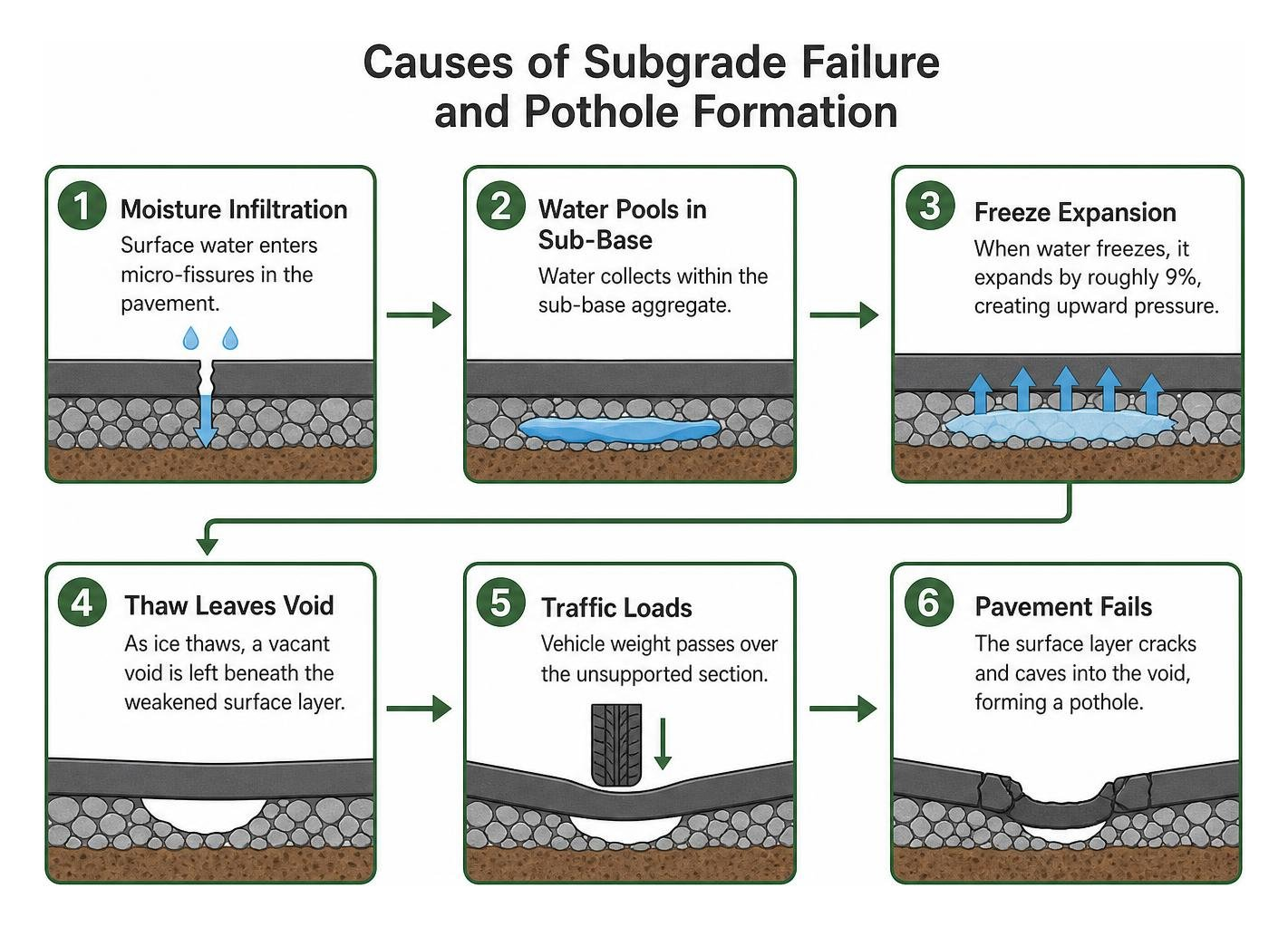
Understanding why a pothole in driveway surfaces forms is the first step toward securing a permanent solution. Moisture infiltration remains the primary catalyst for asphalt and concrete breakdown. When surface water enters micro-fissures in the pavement, it pools within the sub-base aggregate beneath.
In Cook County and DuPage County, extreme seasonal shifts compound this issue. When trapped water freezes, it expands by roughly 9%, creating severe upward pressure against the pavement matrix. As temperatures rise and the ice thaws, a vacant void is left beneath the weakened surface layer. Subsequent vehicle weight passing over these unsupported sections causes the surface layer to flex, crack, and eventually cave into the void.
To learn more about structural patch execution, review The Ultimate Guide to Patching Driveway Holes and Potholes.
Hydrostatic Pressure and Subgrade Erosion
Underground moisture movement creates hydrostatic pressure beneath the driveway surface. As vehicles travel across the pavement, water trapped in the sub-base is forced under pressure through micro-cracks—a destructive mechanism known as sub-base piping. This continuous force washes away fine binder soils and aggregate support. Without a solid, well-compacted sub-base, the surface pavement loses structural integrity and collapses under routine axle loads.
Climate Stress in Cook County and DuPage County
Properties in Elmhurst, Hinsdale, and Arlington Heights experience severe freeze-thaw cycles every winter. Rapid temperature fluctuations cause continuous expansion and contraction within asphalt and concrete matrices. Unsealed cracks allow snow melt and road salt solutions to penetrate deep into the base, accelerating aggregate stripping and destabilizing surrounding sections.
The Professional Method to Fix a Pothole in Driveway Pavement
Achieving a lasting repair requires rigorous industrial methods rather than temporary surface fills. When we perform full-depth restorations, we address both the visible depression and the underlying subgrade failure.
Essential Steps to Prepare a Pothole in Driveway Surfaces
- Mechanical Excavation and Edge Squaring: We saw-cut around the deteriorated area to create clean, vertical 90-degree edges. Vertical edges provide structural shoulders that prevent new material from shoving or creeping under load.
- Debris and Moisture Removal: All loose asphalt fragments, organic matter, and soft subgrade dirt are completely removed down to firm, stable ground using heavy-duty equipment and industrial vacuums.
- Sub-Base Stabilization: We supply high-density dense-graded crushed aggregate stone, compacting it in 3-inch lifts to re-establish a stable base layer.
Comparing Cold Patch vs Hot Mix Asphalt for Lasting Repairs
Selecting the appropriate material dictates the lifespan of the restoration. While cold patch compounds offer a temporary surface cover during emergency freeze-thaw periods, hot mix asphalt or thermal restoration provides permanent structural strength.
| Feature / Criteria | Cold Patch Asphalt | Hot Mix Asphalt / Thermal Restoration |
|---|---|---|
| Intended Application | Temporary emergency repair | Permanent structural restoration |
| Material Flexibility | Stays pliable for short-term fixes | Hardens upon cooling into a durable surface |
| Expected Lifespan | Months to a few years | 7 to 10+ years with proper maintenance |
| Sub-Base Bonding | Mechanical adhesion only | Thermal or hot bitumen binder adhesion |
| Weather Restrictions | Can be applied in colder temperatures | Requires warmer ambient conditions |
For a comprehensive evaluation of patching materials, consult The Ultimate Asphalt Patching Guide for Homeowners.
Compaction Protocol and Required Curing Intervals
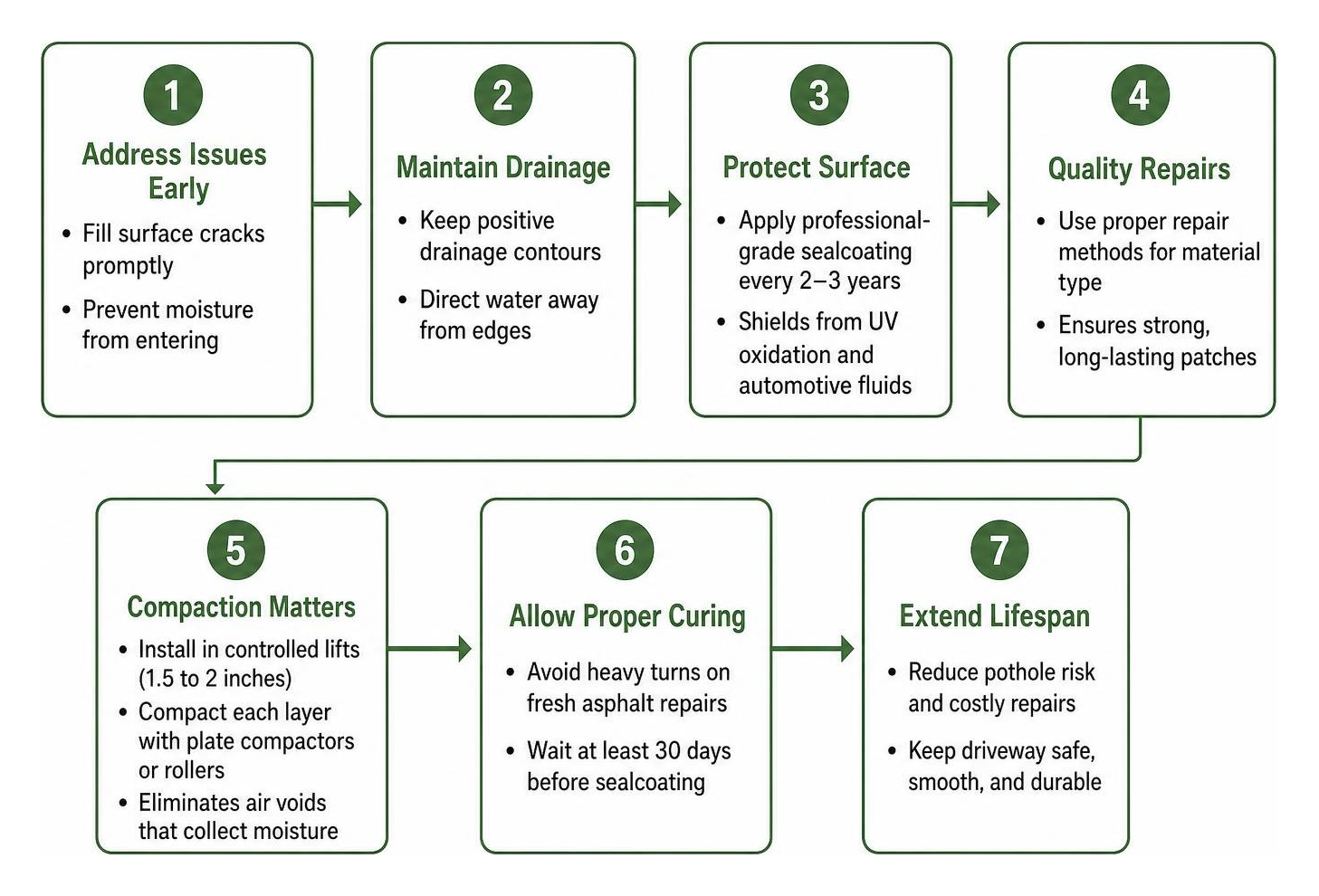
Compaction density is critical for long-term structural integrity. We install repair material in controlled lifts (typically 1.5 to 2 inches) and compact each layer using mechanical vibratory plate compactors or rollers. Proper mechanical compaction eliminates microscopic air voids that could otherwise collect moisture. Vehicles should avoid heavy turns on fresh asphalt repairs during initial curing, and sealcoating applications should wait at least 30 days to allow volatile oils to fully release.
Restoring Asphalt, Concrete, Gravel, and Dirt Driveways
Every driveway material demands a targeted repair method to withstand continuous traffic loads and Midwest weather conditions.
Asphalt Driveway Patching Techniques
For asphalt driveways in Mount Prospect and Norridge, infrared thermal patching provides an optimal seamless repair. Infrared heating units soften the existing surrounding pavement to 300°F, allowing fresh hot mix asphalt to melt directly into the existing edges. This thermal bond eliminates cold joints where water often re-enters. Following compaction, liquid asphalt edge sealer is applied around perimeter seams to lock out surface water.
Gravel and Dirt Driveway Grading and Compaction
Unpaved aggregate driveways require mechanical regrading when low spots develop. We clear loose debris and fill depressions with angular crushed stone, such as crusher run aggregate. The material is crowned toward the center—creating approximately 1 inch of rise for every 3 to 4 feet of width—to encourage positive surface drainage. Heavy mechanical rollers then compact the aggregate into an interlocking surface matrix.
For further strategies on managing aggregate surfaces, see Don’t Let Your Gravel Driveway Become a Moon Crater.
Concrete Slab Void Filling and Raising
Concrete driveways experience surface spalling or slab settlement when underlying soil washes away. For sunken slabs, high-density polyurethane foam injection (slabjacking) lifts the sunken concrete back to proper grade while filling subsurface voids. Small surface pop-outs and spalls are thoroughly excavated, primed, and repaired using polymer-modified structural concrete patch materials.
For additional insight into rigid pavement fixes, refer to Fixing Concrete Potholes Without Losing Your Mind.
Maintenance and Prevention Strategies for Residential and Commercial Driveways

Proactive maintenance programs extend the functional lifespan of both residential driveways and commercial parking lots across Cook County and DuPage County.
Residential Driveway Protection Strategies
- Apply professional-grade fuel-resistant sealcoating every 2 to 3 years to shield bitumen binders from harmful UV oxidation and automotive fluids.
- Fill surface cracks promptly using hot-applied rubberized crack sealants to prevent moisture from entering the sub-base.
- Maintain positive drainage contours to direct rainwater away from structural edges.
- Avoid parking heavy equipment or delivery vehicles along unreinforced pavement edges.
Commercial Parking Lot and Driveway Paving Maintenance
Commercial properties in Winnetka, Lake Forest, and Chicago handle continuous heavy axle loads. We establish custom commercial paving maintenance plans that combine routine surface inspections, commercial crack filling, joint sealing, and scheduled sealcoating to avoid costly surface failures and maintain professional curb appeal.
To explore preventative maintenance schedules, check our Driveway Pothole Repair Guide 2026.
When to Call Professional Asphalt and Brick Paving Contractors
While surface wear can sometimes be managed with routine maintenance, significant pavement distress requires professional assessment and industrial-grade equipment.
Indicators of Severe Sub-Base Failure
If your pavement shows widespread alligator cracking (interlocking cracks resembling reptile skin), deep rutting, or recurring sunken spots, the underlying base layer has likely failed. Simply filling surface depressions over a collapsed foundation guarantees the defect will quickly return.
When base failure occurs, explore structural remedies detailed in Fixing the Foundation of Your Sinking Driveway.
Upgrading to Interlocking Brick Paving for a Permanent Solution
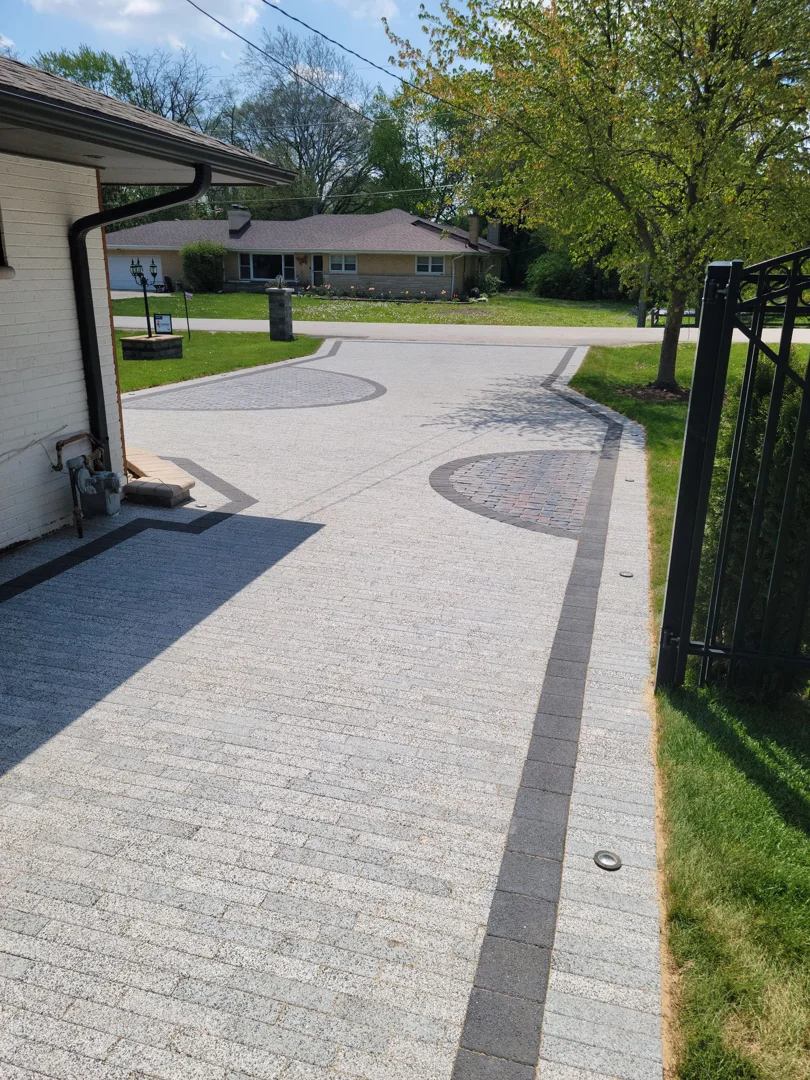
For homeowners seeking an attractive, long-term solution that eliminates recurring asphalt potholes, upgrading to an interlocking brick paver driveway is an ideal option. As a Unilock Authorized Contractor with nearly 20 years of local expertise, Euro Paving designs and installs heavy-duty paver driveways engineered to withstand severe Midwest freeze-thaw cycles.
Interlocking pavers distribute heavy vehicular weight evenly across a engineered crushed stone base, preventing localized settling and surface depressions. Individual pavers flex slightly with ground movements without cracking, and Unilock materials carry a transferable lifetime guarantee. We guide clients through the process using advanced 3D paving design software, allowing you to visualize your new driveway before construction begins.
Frequently Asked Questions About Driveway Potholes
What causes recurring potholes in driveway pavement?
Potholes return when initial repairs address only surface cosmetics while ignoring underlying issues such as trapped moisture, uncompacted base gravel, or subgrade soil erosion.
How long does a professional driveway patch repair last?
A professionally executed hot mix repair or infrared thermal patch typically lasts 7 to 10+ years when paired with proper drainage and regular surface sealcoating.
Can Sealcoating Fix an Active Pothole in Driveway Surfaces?
No. Sealcoating acts as a protective surface barrier against air, sunlight, and moisture. It provides no structural depth or strength and cannot bridge or repair active structural depressions or potholes.
Conclusion
Resolving a pothole in driveway pavement requires correcting both surface damage and underlying base failures. Whether managing residential driveways or commercial parking lots in Elmhurst, Hinsdale, Mount Prospect, Norridge, Arlington Heights, Cook County, or DuPage County, professional structural repairs ensure reliable, long-term performance.
Euro Paving delivers comprehensive hardscaping and driveway solutions across the Chicago suburbs. From commercial asphalt contractor services and concrete sidewalk repair to high-end Unilock brick paver driveway installations, our certified crews provide superior craftsmanship backed by 3D design planning and lifetime material guarantees.
Discover permanent solutions with brick paving driveways and contact Euro Paving today to schedule a consultation with our paving experts!