



Restore the Color, Pattern, and Protection of Your Driveway
Imprinted concrete driveway restoration can renew a faded, stained, cracked, or peeling patterned surface without automatically removing and replacing the whole slab. For structurally sound driveways, professional restoration usually includes deep cleaning, targeted crack and edge repairs, color matching, joint renewal, and a protective sealer.
| If your driveway has… | Professional restoration can… |
|---|---|
| Dull or sun-faded color | Rebuild a richer, more even color finish |
| Peeling, cloudy, or worn sealer | Remove failed coatings and apply new protection |
| Small cracks, chips, or crumbling edges | Repair and blend damaged areas into the pattern |
| Oil marks, algae, and winter grime | Clean and prepare the surface for lasting adhesion |
| Winter salt and freeze-thaw wear | Help limit water penetration and future surface damage |
Chicago winters are especially tough on decorative concrete. Water can enter small openings, expand when it freezes, and gradually widen cracks or cause surface scaling. Road salt and de-icing products can make that damage worse by attacking the color layer and old sealer.
For homeowners and commercial properties across Chicago, Elmhurst, Hinsdale, Mount Prospect, Norridge, Arlington Heights, Cook County, and DuPage County, the key question is whether the slab is still sound. If it is, restoration can be a practical way to improve curb appeal and protect the driveway from another season of traffic and weather.
Euro Paving brings professional paving expertise to driveway and hardscape projects, including brick paving, patio paving, sidewalk repair, concrete work, and commercial paving. Where a damaged concrete driveway is no longer a strong candidate for restoration, a planned upgrade to a Unilock certified brick paving driveway can provide a long-term alternative, supported by 3D paving design and lifetime material guarantees.
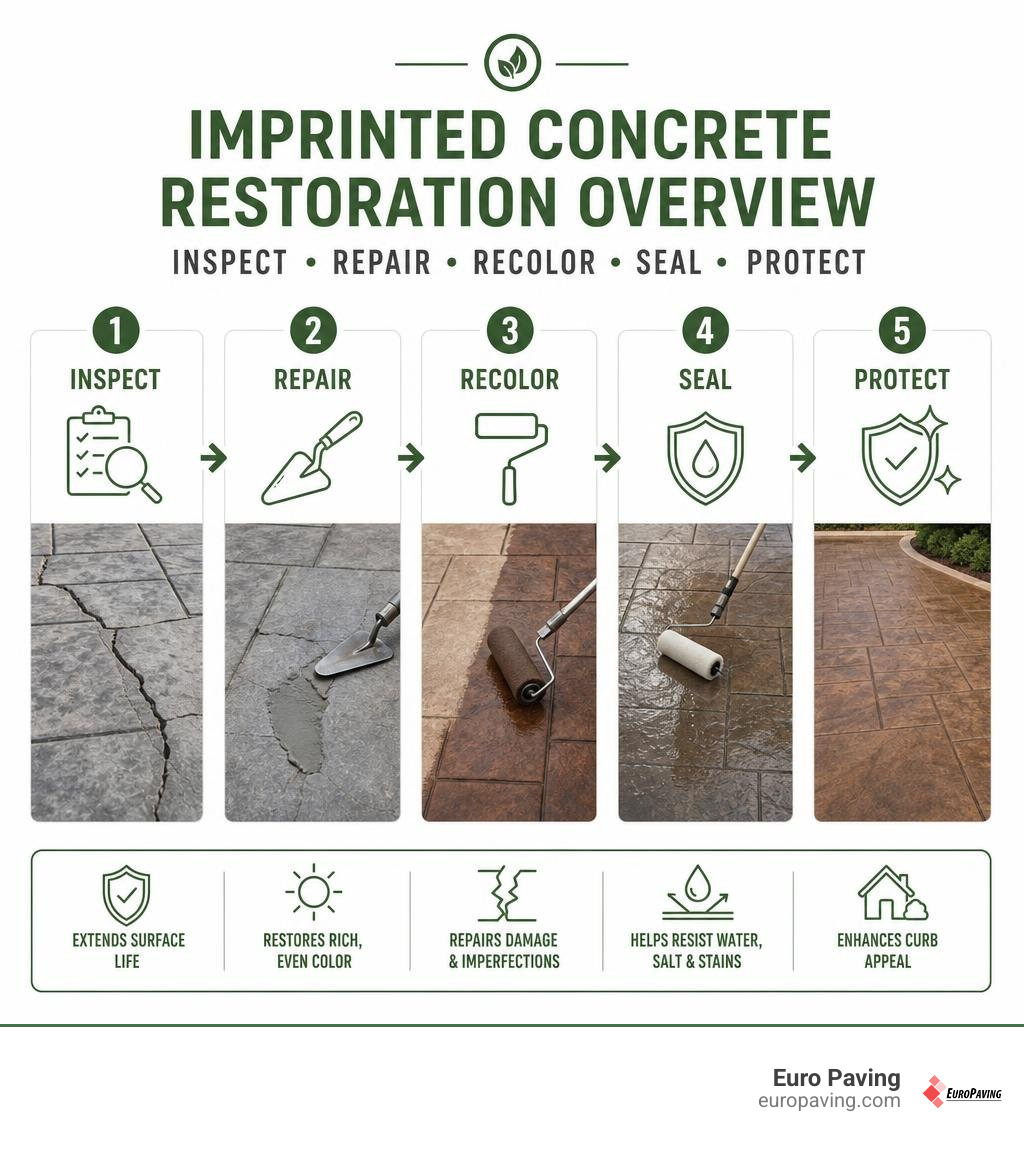
Common imprinted concrete driveway restoration vocab:
- concrete driveway leveling
- repair small cracks in concrete driveway
- repairing concrete driveway potholes
Understanding Damage and Signs for Imprinted Concrete Driveway Restoration
Pattern imprinted concrete—often referred to as stamped concrete—is designed to replicate natural stone, slate, cobblestone, or brick. It achieves its signature aesthetic through pigment color hardeners, accent release powders, and secondary surface stamping. However, nearly 30% of concrete driveways develop some form of cracking within their first five years, and statistics show that up to 80% of concrete performance failures stem from installation flaws or harsh environmental stress.
In Northern Illinois, the combination of severe thermal fluctuations, heavy vehicular loads, and chemical exposure causes surface protective sealers to wear down. When the acrylic top layer wears away, UV rays can degrade underlying concrete color hardeners within three to five years. For commercial parking areas and residential driveways alike, identifying deterioration early allows property owners to engage a certified professional concrete contractor to restore surface protection before structural concrete breakdown occurs.
Common Signs You Need Imprinted Concrete Driveway Restoration
Determining whether an imprinted concrete slab requires restoration involves inspecting both decorative layers and structural joint integrity. The primary signs of failure include:
- Fading Pigments and Discoloration: Exposure to ultraviolet radiation breaks down surface color pigments, leaving stamped patterns looking dull, washed out, or unevenly bleached.
- Surface Whiteness and Moisture Trapping: When solvent-based acrylic sealers are applied improperly or suffer from trapped ground moisture, a white, cloudy film forms underneath the topcoat.
- Peeling or Flaking Sealer: Old sealer coats that lose mechanical adhesion begin to flake off, creating unsightly patches and leaving open concrete pores exposed to weather infiltration.
- Cracking and Crumbling Edges: Small shrinkage cracks can expand significantly if unsealed. Edge spalling along expansion joints weakens the slab edge under vehicle tire weight. For an in-depth look at localized damage evaluation, see our Concrete Driveway Crack Repair in Chicago 2026 Guide.
- Efflorescence and Aggregate Exposure: White mineral deposits migrating to the surface signal water movement through the concrete matrix, which can eventually strip top colors and expose the aggregate pebble layer underneath.
The Impact of Freeze-Thaw Cycles and Winter Salt Damage
The Midwest climate presents unique challenges for decorative hardscaping. In Cook County and DuPage County, local properties undergo between 30 and 50 freeze-thaw cycles every winter season. Water that penetrates unsealed concrete pores expands by approximately 9% upon freezing. This internal expansion creates extreme hydraulic pressure within the concrete matrix, leading to surface scaling, micro-fracturing, and spalling.
Furthermore, application of de-icing chemicals such as sodium chloride rock salt severely damages stamped concrete surfaces. Deicers lower the freezing point of water, increasing the net number of freeze-thaw events within the surface layer while chemically eroding acrylic sealer coats. Calcium chloride and rock salt lift surface hardener pigments and break down expansion joints. Restoring the protective chemical barrier prevents water intrusion, neutralizes salt erosion, and safeguards subsurface soil stability against severe frost heave.
Step-by-Step Process for Restoring Patterned Driveways
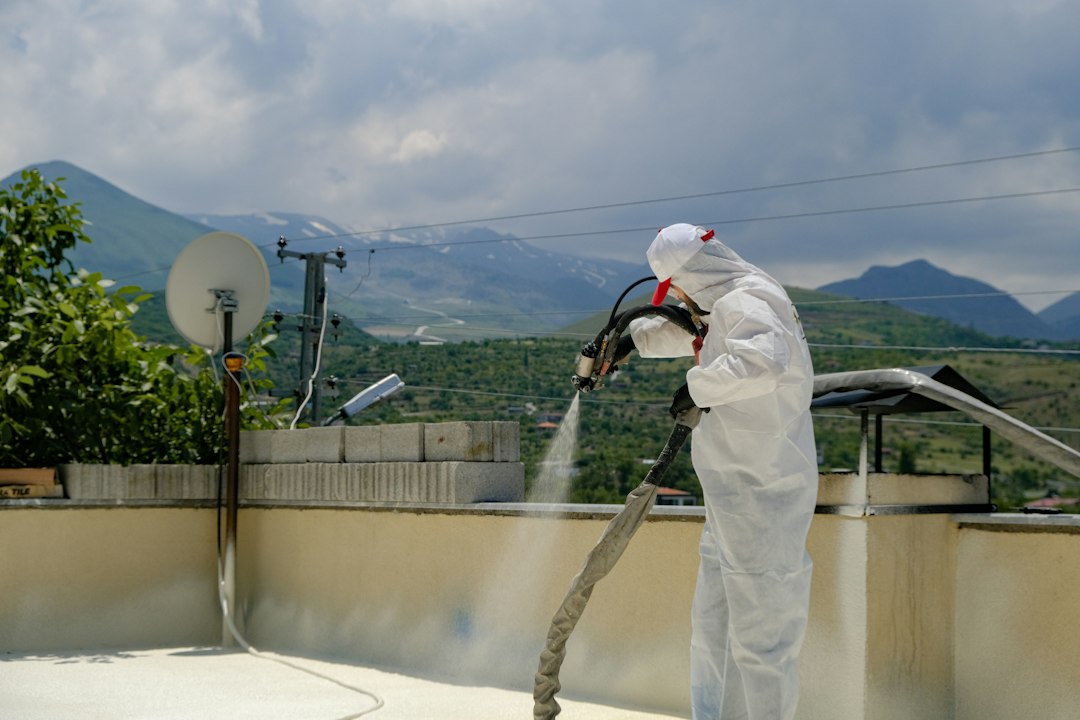
Executing an effective imprinted concrete driveway restoration requires a systematic commercial approach. Skipping essential chemical strip stages or applying sealers over contaminated substrates leads to immediate product failure. To avoid expensive pitfalls, review our guide on Driveway Renovation Avoiding Common Problems.
Before starting restoration work on-site, our crews verify access to a reliable high-pressure water source and steady electrical supply.
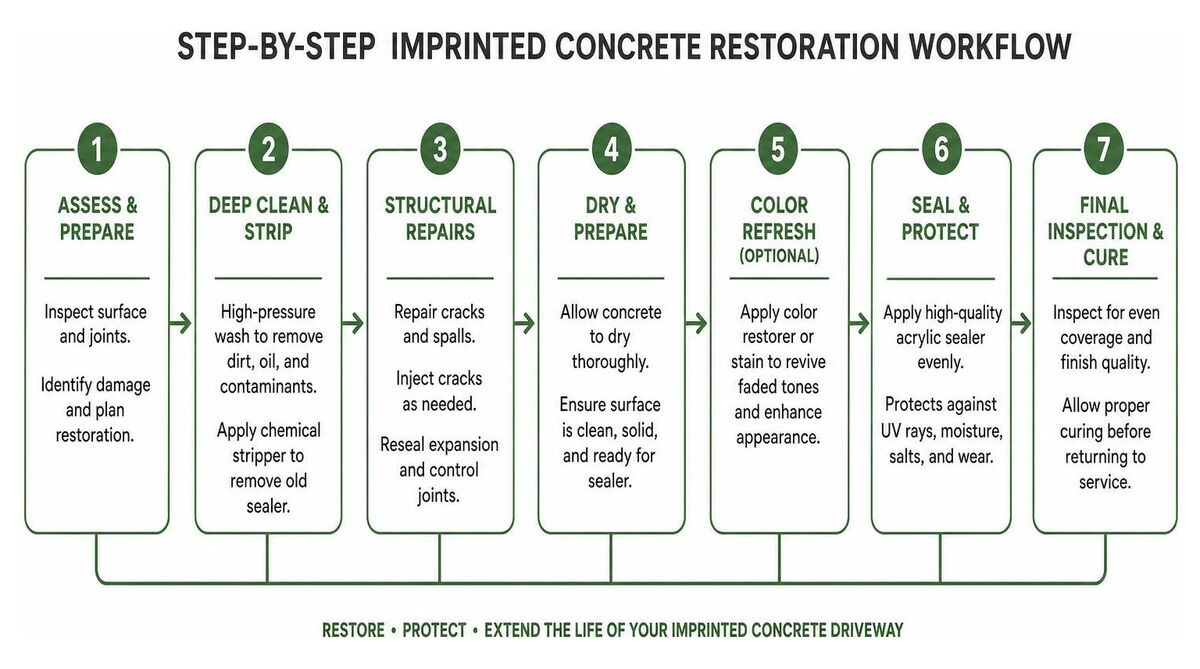
Step 1: Structural Repairs, Crack Injections, and Joint Resealing
The restoration workflow begins with deep surface preparation. High-powered pressure washing cleans out oil stains, moss, lichen, and dirt deposits from deep pattern grooves. When old acrylic sealers have failed or turned white, specialized chemical stripping compounds are applied to break down and lift degraded sealer build-up.
Once the concrete substrate is completely clean and dry, structural repairs commence:
- Crack Injections: Minor cracks and voids are cleaned out using wire mechanical brushes and high-pressure air. We then inject color-matched polymer mortars and specialized crack repair compounds directly into the fractures, packing them tightly to blend seamlessly with surrounding textures. For additional insights on micro-fracture maintenance, refer to The Easy Way to Seal Small Cracks in Your Concrete Driveway.
- Edge Retexturing: Crumbling edges and surface chips are built back up using structural concrete repair compounds tinted to match the base slab shade. Hand-troweled stamping tools are used to recreate matching stamp textures before curing.
- Expansion Joint Restoration: Old, rotted expansion joint fillers are removed. Control joints are cleared of organic material and refilled with high-grade, flexible rubberized silicone. This accommodates natural seasonal expansion and contraction—which averages 0.00001 inches per degree Fahrenheit—preventing future stress fractures.
Step 2: Color Restoration, Tinting, and Pattern Matching
Once structural repairs cure, color intensity must be restored. Because decorative concrete usually combines a light base color with darker secondary antiquing accents, simple surface painting is never acceptable.
- The Wet Test Diagnostic: To determine the correct recoloring protocol, we perform a wet test by spraying clean water onto the dry slab. If the original vibrant colors reappear when wet, the surface only requires a clear protective topcoat. If the concrete remains dull, grey, or patchy, specialized color re-tinting is necessary.
- Color Hardener Re-Tinting and Antiquing: We blend UV-resistant concentrated color pigments and antiquing stains into low-viscosity acrylic carriers. Using airless sprayers or specialized soft-bristle applicators, we apply base tones followed by darker secondary accent stains across border bands and stone pattern joints. This multi-tone technique restores authentic depth, matching natural slate, granite, or brick aesthetics.
Step 3: High-Performance Protective Sealing and Safety Additives
The final phase involves applying commercial-grade sealers to seal in pigments and form an impermeable barrier against fluids and UV radiation. A high-quality sealer can increase concrete color retention by up to 90% and reduce stain absorption by up to 80%.
We apply two full coats of pure solvent-based acrylic or high-solids polyurethane sealers using a professional cross-hatch method: the first coat is brushed or sprayed at a 45-degree angle to penetrate concrete pores, and the second coat is applied at a 90-degree angle once dry to ensure complete coverage. To prevent smooth, sealed concrete from becoming hazardous during wet or icy weather, we blend micronized anti-slip polypropylene additives directly into every batch of sealer.
Long-Term Care, Timelines, and Replacement Alternatives
Understanding curing parameters ensures that newly restored concrete reaches full performance without premature surface scarring.
| Traffic Type | Minimum Curing Requirement | Operational Guidance |
|---|---|---|
| Touch Dry | 1 to 2 Hours | Surface dry to touch under normal ambient temperatures (50°F to 90°F) |
| Foot Traffic | 2 to 4 Hours | Light pedestrian access permitted |
| Light Vehicular Traffic | 24 Hours | Caution advised; avoid sharp tire turning |
| Heavy Vehicular Parking | 48 Hours | Full cure reached; safe for daily passenger vehicles and trucks |
For detailed timing and maintenance breakdowns, consult the Essential Guide To Repair Imprinted Concrete Driveways: Tips For Lasting Results – ConcreteCaptain.com.
Professional Execution vs DIY Risks for Imprinted Concrete Driveway Restoration
While DIY patch kits are sold in home improvement stores, attempting complex imprinted concrete driveway restoration without professional equipment frequently results in permanent cosmetic and structural flaws. Common DIY errors include applying sealer over moist concrete (which causes severe clouding), using incorrect roller materials that leave bubbles, failing to remove old failing sealer, or applying excessive anti-slip powder that ruins surface clarity.
Professional contractors utilize heavy-duty pressure washing systems, specialized chemical stripping agents, industrial airless sprayers, and precise color-matching equipment. Furthermore, experienced installers perform essential sub-base structural evaluations. If a driveway slab suffers from deep settlement, foundation movement, or severe sub-grade failure, surface sealing alone will not fix the problem. Learn more about sub-grade soil compaction issues in our guide on Fixing the Foundation of Your Sinking Driveway.
Restoring vs Complete Replacement and Upgrading
Restoration is a zero-demolition service that reconditions structurally sound driveways at a fraction of full replacement costs. However, when an aging concrete driveway (typically 25 to 30 years old) exhibits widespread structural failure, severe cracking across more than 50% of its surface, or major frost heave settlement, restoration becomes a short-term band-aid.
In these situations, property owners across Elmhurst, Hinsdale, and Arlington Heights often choose to replace deteriorating concrete with a high-end brick paver installation. As an Unilock Authorized Contractor with nearly 20 years of experience, Euro Paving designs and installs custom brick paving driveways, walkways, and patios engineered to endure severe Midwest freeze-thaw cycles. Interlocking brick pavers allow for natural ground movement without cracking, offering lifetime structural durability backed by lifetime material guarantees. Discover whether your property is better suited for restoration or complete replacement by reading Resurface or Replace Your Driveway Today.
Maintenance Practices and Resealing Schedules
To maximize the life of a restored imprinted concrete surface, follow these ongoing maintenance best practices:
- Resealing Intervals: Driveways subject to regular vehicular traffic require a maintenance coat of clear acrylic sealer every 2 to 3 years. Low-traffic patio areas can go up to 5 years between resealing cycles.
- Routine Cleaning: Perform quarterly surface cleaning using a soft-bristle broom and mild detergent to prevent abrasive grit from scratching the protective sealer finish.
- Immediate Spill Removal: Clean vehicle oil, anti-freeze, and grease spills immediately. Prompt spot cleaning reduces stain permanence by up to 90%.
- Winter Care Protocols: Never apply sodium chloride rock salt or chemical deicers to sealed decorative concrete. Instead, use clean coarse sand or kitty litter for winter traction.
Property owners seeking broader maintenance insights can refer to the comprehensive Ultimate Guide To Imprinted Concrete Driveway Restoration: Tips To Revive And Maintain Your Driveway – ConcreteCaptain.com.
Frequently Asked Questions About Driveway Restoration
How long does an imprinted concrete driveway restoration last?
A professionally executed imprinted concrete driveway restoration typically lasts between 2 and 3 years on high-traffic residential driveways before requiring a light maintenance topcoat. infrequently used patio areas and garden walkways can maintain their finish for up to 5 years. Utilizing high-solids, UV-resistant acrylic or polyurethane sealers ensures maximum resistance against color fading, tire marking, and chemical wear.
Will chemical restoration affect my plants or landscaping?
When handled by experienced professional crews, chemical restoration products will not damage surrounding lawns, shrubs, or garden beds. While specialized acidic strippers or solvent agents are required to break down old acrylic coatings, professional contractors use strict chemical isolation protocols. We mask adjacent landscape elements, install protective barrier tarps, and maintain controlled application zones to shield all vegetation during work.
What is the difference between matt, silk, and gloss sealer finishes?
The choice of sealer finish impacts both visual appearance and performance:
- Matt Finish: Provides a flat, non-reflective appearance. Matt sealers are essential when adding concentrated color pigments or re-tinting base concrete, as they ensure uniform pigment integration without streakiness.
- Silk Finish: Delivers a subtle sheen that highlights natural stone textures without creating an artificially reflective surface. It offers an excellent balance of color enhancement and natural aesthetics.
- High-Solids Gloss Finish: Creates a rich, wet-look reflective shine that deepens dark color tones (such as charcoal, slate, or brick red). High-gloss sealers provide maximum surface build, offering exceptional resistance against oil penetration, water absorption, and frost damage.
Conclusion
Restoring an imprinted concrete driveway provides a clear pathway to revitalizing curb appeal, locking in rich pigments, and defending concrete surfaces against winter damage. However, when concrete slabs develop major structural fractures, deep foundation displacement, or extensive surface scaling, investing in ongoing topical repairs is no longer cost-effective.
At Euro Paving, we bring nearly two decades of hardscaping and paving leadership to residential and commercial properties throughout Chicago, Elmhurst, Hinsdale, Mount Prospect, Norridge, Arlington Heights, Cook County, and DuPage County. As a premier Unilock Authorized Contractor, we specialize in complete exterior transformations—ranging from brick paving driveways, commercial parking lots, and sidewalk repairs to custom patio paving, retaining walls, and outdoor fire pit installations.
Our end-to-end service includes advanced 3D paving design planning, allowing you to visualize your prospective driveway or backyard retreat before installation begins. Backed by lifetime-guaranteed Unilock materials and flexible financing through the Unilock DO-IT-NOW Program, our team ensures your property receives award-winning craftsmanship built to last for decades.
Ready to transform your home’s entrance or create a stunning outdoor living space? Contact Euro Paving today to schedule a professional consultation with our hardscaping experts, or visit our dedicated Brick Paving Driveways page to explore custom design options for your property.