



Your Sinking Driveway Is a Structural Problem — Not Just an Eyesore
Sinking driveway repair is one of the most urgent home improvement needs a suburban homeowner can face — and one of the most misunderstood.
A sinking driveway isn’t just unsightly. It’s a sign that the ground beneath your home’s entrance is failing. Left alone, it directs water toward your foundation, creates dangerous trip hazards, and accelerates damage to the surrounding concrete or asphalt.
Here’s a quick summary of what you need to know:
- Cause: Driveways sink when the soil beneath them shifts, erodes, or was never properly compacted to begin with
- Warning signs: Uneven slabs, pooling water near the garage, visible gaps, or a hollow sound underfoot
- Repair options: Professional base rebuilding, interlocking paver resetting, asphalt section replacement, or full driveway replacement
- Best outcome: Address the root cause — the soil — not just the surface
- When to act: As soon as you notice sinking; early repair is far less expensive than full replacement
For Chicago-area homeowners, the problem is even more urgent. Illinois freeze-thaw cycles — which can repeat 30 to 50 times in a single winter — turn minor settlement into serious structural failure fast.
The good news? A sinking driveway is fixable. And in many cases, it’s an opportunity to upgrade to a more durable, beautiful surface that won’t fail again.
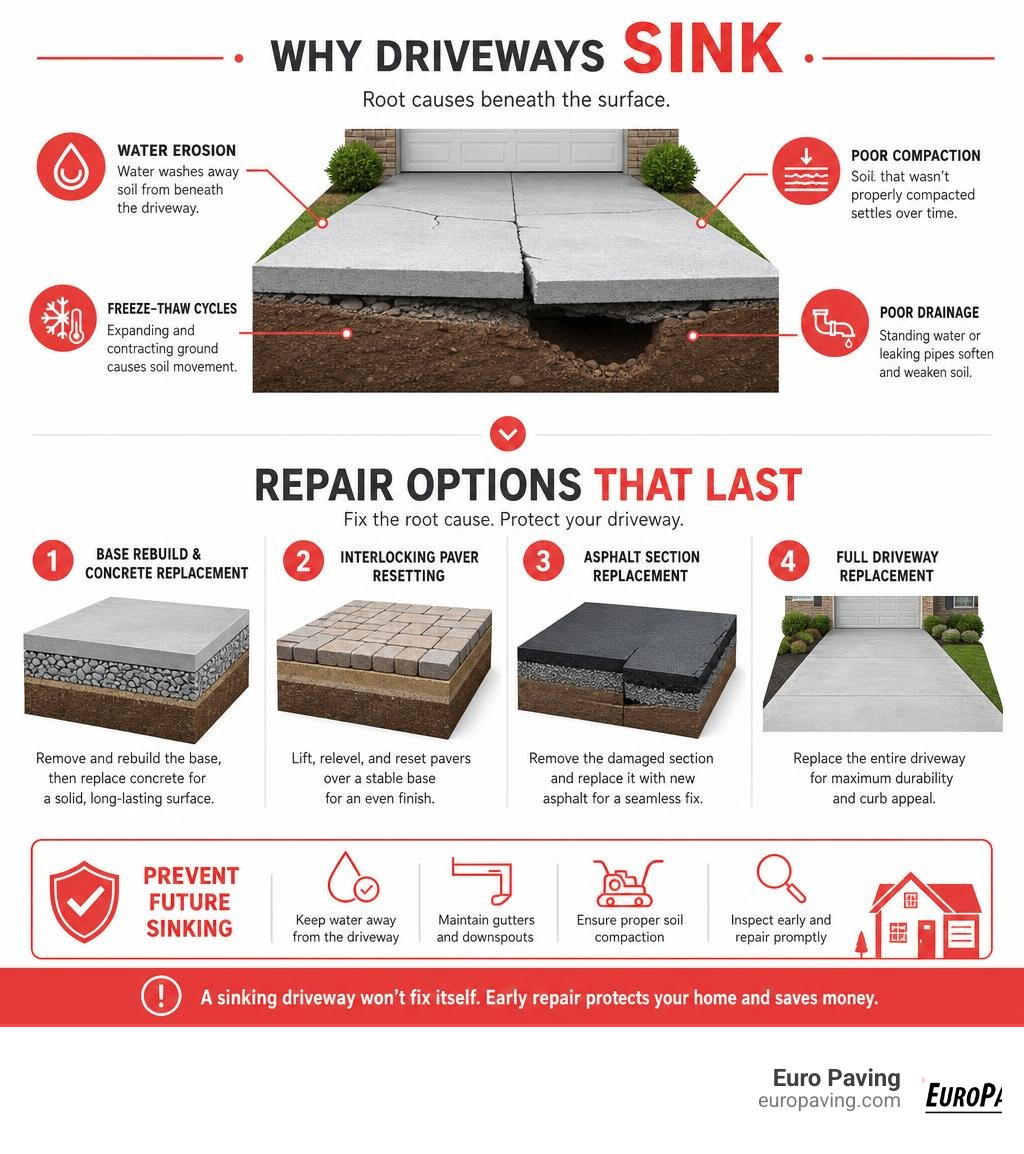
Common sinking driveway repair vocab:
What Causes a Driveway to Sink?
When we look at a sagging or sloping driveway, it is tempting to blame the surface material itself. However, the concrete, asphalt, or brick is merely a mirror reflecting the structural instability hidden beneath it. Driveways do not sink because they are heavy; they sink because the ground supporting them has given way. Understanding these underground dynamics is the first step toward a permanent cure.
1. Poor Sub-Base Compaction
Before any paving material is laid, the underlying soil and gravel base must be mechanically compacted. In many new-construction homes across Chicago suburbs like Barrington or Glenview, developers are often in a rush. If the soil excavated during foundation digging is loosely backfilled around the garage apron without proper compaction, it will naturally settle over the next few years. As the soil particles tightly pack together under gravity and vehicle weight, a void forms beneath the driveway. Eventually, the heavy pavement collapses into this void.
2. Soil Erosion and Water Runoff
Water is the ultimate architect of structural failure. When downspouts dump water directly next to your driveway, or when a nearby drainage ditch has leaking joints, water sweeps beneath the pavement. This rushing water washes away the fine sand and aggregate particles that make up your driveway’s sub-base. Once these “fines” are gone, the structural support vanishes. This is a common issue with under-driveway drainage pipes, as detailed in The Culvert Crisis: Why Your Driveway is Sinking (and How to Save It) – Camrock Foundations. To prevent this, we always emphasize proper grading; you can read more about safeguarding your property in our guide on how to Don’t Let Your Driveway Go Down the Drain.
3. High-Clay Soil Behavior
In northeastern Illinois, Cook County and DuPage County are notorious for heavy clay soils. Clay is an “expansive” soil. It acts like a sponge, swelling significantly when saturated with water and shrinking dramatically during dry summer spells. This constant movement creates empty pockets beneath the driveway, leaving the rigid surface above with nothing to rest on.
4. Heavy Vehicle Loads
Driveways are engineered for standard passenger vehicles. If you regularly park heavy motorhomes, commercial trucks, or delivery vehicles on your driveway, the localized pressure accelerates settlement, especially if the base was already compromised. Overloaded sections will crack and sink, creating localized depressions that are difficult to fix with simple surface patches. Planning your driveway’s load capacity is a crucial step in Driveway Renovation Avoiding Common Problems.
Identifying Sinking Driveway Repair Needs Early
Recognizing the early warning signs of settlement can save you thousands of dollars in major reconstruction costs. Many homeowners ignore minor dips until they turn into severe vehicle-scraping drops.
Here are the primary indicators that your driveway is actively sinking:
- The Garage Apron Gap: The most common location for sinking is the transition zone where your driveway meets the rigid garage floor slab. If you notice a step-down or gap opening up—often starting at an inch and growing to 4 or 5 inches—your apron is settling.
- Standing Water and Pooling: If puddles consistently form in the middle of your driveway or right in front of your garage doors after a light rain, the pavement has lost its slope.
- Spiderweb or Alligator Cracking: As the pavement loses base support, it bends under the weight of vehicles. This stress produces dense patterns of cracks that mimic alligator skin or spiderwebs.
- Hollow Sounds: Walking or driving over certain sections of your driveway shouldn’t sound different. If you notice a hollow, echoing thump, it indicates a void has formed directly beneath the surface.
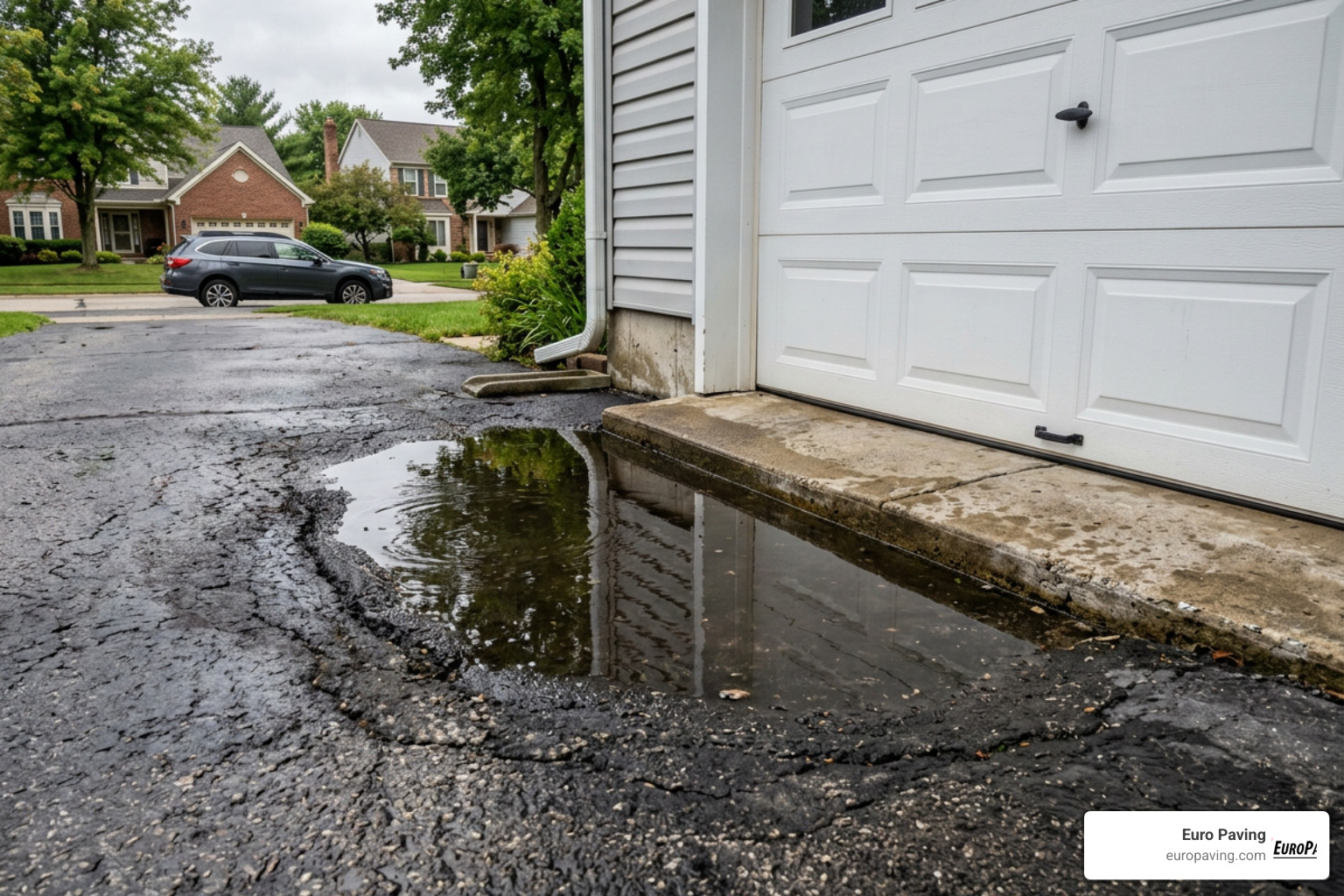
The Impact of Midwest Freeze-Thaw Cycles
Our local climate in Northern Illinois—from Naperville up to Lake Forest—presents a brutal environment for rigid pavements. We experience highly volatile temperature swings where the thermometer bounces above and below freezing dozens of times between November and April.
When water penetrates through surface cracks or pools along a sunken driveway edge, it seeps deep into the sub-base. As the temperature drops, this trapped water freezes and expands by approximately 9% in volume. This expansion exerts immense upward pressure, a phenomenon known as frost heave.
When the ice thaws, the ground collapses back down, but the soil is now looser and weaker than before. This relentless cycle repeats 30 to 50 times per season in Chicagoland. For rigid, continuous surfaces like poured concrete or asphalt, this movement causes immediate cracking, spalling, and deep sinking.
This climate reality is why many homeowners in our area are transitioning away from rigid slabs. Flexible pavement systems—specifically high-end interlocking brick pavers—are designed to handle this movement. Because they are individual units bound by specialized joint sand, they flex and distribute the stress of frost heave without cracking, preserving the structural integrity of your home’s entrance for decades.
Professional Sinking Driveway Repair & Restoration Methods
When addressing a sinking driveway, temporary quick-fixes like pouring a thin layer of concrete over the dip or applying cold-patch asphalt are bound to fail. They simply add more weight to an already unstable base, accelerating the sinking process. Professional sinking driveway repair requires a systematic approach to correct the underlying structural failure.
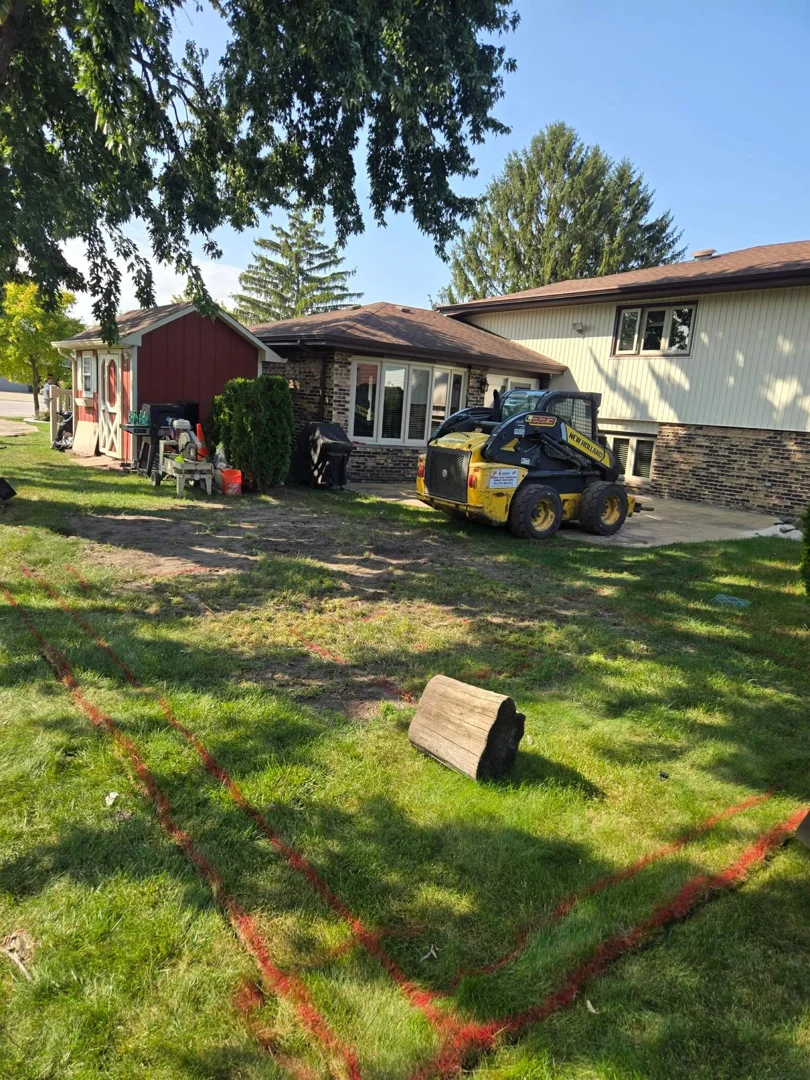
The Anatomy of a Professional Base Restoration
To fix a sunken driveway permanently, a professional hardscaping team must address the foundation. This process involves:
- Excavation of the Settled Area: Removing the damaged surface material to expose the compromised sub-grade.
- Soil Stabilization: Assessing the native clay soil and treating it if necessary to prevent future shifting.
- Geotextile Fabric Installation: Laying a heavy-duty, woven geotextile fabric. This acts as a barrier that prevents the gravel base from sinking into the soft clay subgrade while allowing water to drain.
- Grading and Compaction: Adding layers of crushed aggregate, compacting each layer with industrial vibratory plate compactors to achieve maximum density.
- Drainage Correction: Ensuring the entire base is graded to slope away from the home’s foundation at a minimum 2% drop.
For concrete driveways, some homeowners consider lifting services like mudjacking or polyurethane foam injection, which can raise settled slabs by pumping material through drilled holes. While these methods are fast, they are only temporary if the surrounding drainage issues are not solved. For a deep look at localized concrete repairs, see Sinking Concrete Driveway Repair in McHenry & Lake County, IL | RCC Masonry & Concrete or explore regional concrete lifting techniques at Barrington IL Concrete Leveling & Lifting | Raise-Rite.
The Advantage of Interlocking Brick Pavers for Sinking Driveways
For homeowners seeking a permanent, premium solution to sinking driveways, interlocking brick pavers are the premier choice. Unlike rigid concrete or asphalt, which must be completely demolished and repoured when they crack or sink, a brick paver system is entirely modular.
1. Easy Re-Leveling and Resetting
If a section of a brick paver driveway settles over time due to extreme soil movement or a tree root, the repair is incredibly simple. A professional contractor does not need to bring in heavy demolition equipment. Instead, we carefully unzip the affected pavers, correct and re-compact the underlying gravel base, and lay the exact same pavers back in place. The repair is completely invisible, seamless, and costs a fraction of concrete replacement.
2. Superior Flexibility and Strength
Interlocking pavers create a flexible pavement system. The joints between the bricks are filled with polymeric sand, which allows the driveway to bend and distribute heavy loads without cracking. During harsh Illinois winters, the paver system naturally rises and falls with frost heaves, returning to its original state in the spring without structural damage.
3. Unilock Lifetime Material Guarantees
As a Unilock Authorized Contractor, we utilize premium concrete pavers engineered with proprietary technologies like EnduraColor for lasting beauty and EasyClean stain resistance. Best of all, Unilock products come with a transferable lifetime material guarantee. When installed over a professionally engineered base, a paver driveway is a one-time investment that elevates your home’s curb appeal permanently.
If you are tired of dealing with recurring cracks and sinking concrete slabs, you can Schedule a consultation for brick paving driveways with our design experts today to plan a beautiful, lifetime entrance.
When to Choose Professional Repair vs. Full Driveway Replacement
Deciding whether to repair your sinking driveway or replace it entirely depends on three main factors: the structural integrity of the base, the age of the surface, and your long-term aesthetic goals.
If the sinking is localized—such as a 3-foot section near your garage door or a small depression over an old utility line—and the rest of the driveway is in excellent condition, a targeted base restoration is highly cost-effective. However, if your driveway is over 15 to 20 years old, covered in widespread “alligator” cracks, or has multiple sunken sections, the base has failed completely. Patching or lifting at this stage is simply throwing money away.
In these cases, a full replacement is the only logical choice. You can learn more about the complete process of removing old asphalt and laying a fresh, durable surface in our guide on Asphalt Driveway Paving.
| Assessment Factor | Choose Professional Repair / Resetting | Choose Full Driveway Replacement |
|---|---|---|
| Severity of Sinking | Localized to a single area (e.g., garage apron) | Widespread settlement across multiple zones |
| Surface Condition | Minor surface cracks, structurally sound slabs/pavers | Deep, intersecting cracks, crumbling edges, potholes |
| Underlying Base Status | Mostly stable; localized washouts or minor compaction issues | Total base failure, severe erosion, or deep clay shifting |
| Driveway Age | Under 10-15 years old | Over 20 years old |
| Aesthetic Goal | Keep existing look with seamless restoration | Modernize curb appeal with premium brick pavers |
Cost, Longevity, and Prevention of Driveway Settlement
Investing in professional sinking driveway repair is an investment in your home’s equity and safety. While quick fixes may seem appealing, they lack the longevity required to withstand Chicago’s demanding climate.
Understanding the True Costs of Driveway Restoration
The cost of professional driveway repair varies depending on the scale of the damage, the accessibility of the site, and the materials chosen:
- Professional Base Rebuilding and Resetting: For a brick paver driveway, lifting, re-compacting the base, and resetting the pavers typically ranges from $1,500 to $3,500 depending on the size of the area. This represents a massive savings compared to full demolition.
- Full Concrete Replacement: Demolishing and pouring a new concrete driveway in the Chicago area typically costs $8 to $12 per square foot for standard broom finish, and up to $18 per square foot for high-end stamped patterns.
- Drainage Correction: Installing French drains, catch basins, or rebuilding a sunken drywell typically adds $500 to $2,500 to a project, but it is the only way to guarantee your new surface won’t sink again. For details on how to diagnose and repair these integrated systems, refer to How To Fix a Sinking Driveway Drainage System – This Old House.
When you choose a high-quality base restoration, the repair can easily last 15 to 25 years. In contrast, simple surface patches or concrete overlays often fail within a single winter season.
Preventing Future Driveway Sinking
The secret to a permanent driveway is controlling water and ensuring a rock-solid foundation. Here are the steps our team takes—and that you should maintain—to prevent future settlement issues:
1. Proper Gutter and Downspout Redirection
Never allow roof downspouts to empty directly onto or immediately next to your driveway. The volume of water coming off a suburban Chicago roof is immense and will quickly wash away the sub-base. Extend downspouts at least 5 to 10 feet away from the pavement, or route them into underground solid PVC drainage pipes.
2. Maintain Professional Grading
The ground surrounding your driveway must slope away from the pavement. If your lawn or landscaping beds drain toward the driveway, water will pool along the edges, softening the sub-base soil. Keep lawn edges trimmed and ensure soil levels are kept slightly below the driveway edge to allow sheet flow of rainwater.
3. Ensure Adequate Sub-Base Thickness
For our local clay soils, a standard 4-inch gravel base is rarely enough. A professional installation should feature a minimum of 6 to 8 inches of densely graded, crushed stone base for residential driveways, thoroughly compacted in 2-inch lifts. This thick, stable platform distributes vehicle weight and resists frost movement.
4. Address Cracks Immediately
If you have an asphalt or concrete driveway, water entering surface cracks is the catalyst for base erosion. Seal cracks as soon as they appear to keep water out of the sub-base. For step-by-step guidance, explore our expert advice on How to Repair Driveway Cracks.
Frequently Asked Questions About Sinking Driveway Repair
How much does professional sinking driveway repair cost?
The cost depends entirely on the repair method and the size of the settled area. For localized base rebuilding and resetting of brick pavers, homeowners typically pay between $1,500 and $3,500. If you are dealing with concrete, targeted slab lifting can range from $500 to $1,500 per section, while full driveway replacement typically starts at $8 to $12 per square foot. Incorporating crucial drainage corrections like downspout burial or catch basin installation will add $500 to $2,000 but ensures the longevity of the repair.
Why do concrete and asphalt driveways sink more than brick pavers?
Concrete and asphalt are rigid, continuous pavement systems. Because they cannot flex, any minor shifting of the soil beneath them creates stress. Once a void forms, the heavy slab cracks under vehicle weight and sinks.
In contrast, interlocking brick pavers are a flexible system. The individual pavers can micro-adjust to ground movement and distribute heavy loads evenly. If extreme soil movement does cause a dip, the pavers can be individually lifted, the base re-compacted, and the same pavers reinstalled seamlessly. This makes brick pavers highly resilient against the shifting clay soils of northeastern Illinois. For a deeper look at professional concrete repair challenges, see Concrete Driveway Repair & Leveling Services.
Can a sunken asphalt driveway be leveled without full replacement?
Yes, if the asphalt’s overall foundation is still in good condition, a sunken section can be repaired without tearing out the entire driveway. One common professional method is an infrared seamless repair, which heats the existing asphalt to a workable state, adds fresh hot-mix asphalt, and compacts it to match the surrounding grade.
Another option for minor low spots is a professional asphalt overlay (resurfacing), where a new layer of asphalt is applied over the existing surface. However, if the sinking is caused by a shifting, uncompacted base, these surface treatments are temporary. The base must be dug out, re-graded, and rebuilt to prevent the depression from returning. To explore more about diagnostic steps and professional asphalt repair, read How to Fix a Sinking Driveway: Best Repair Methods.
Conclusion
A sinking driveway is a structural challenge that demands a professional, lasting solution. While temporary patches or lifting foams might offer a quick fix, they do not address the root causes of settlement: poor soil compaction, water erosion, and our relentless Midwest freeze-thaw cycles.
At Euro Paving, we believe your driveway should be as durable as it is beautiful. As a premier hardscaping specialist and Unilock Authorized Contractor serving Chicago and its premier suburbs—including Elmhurst, Hinsdale, Mount Prospect, Norridge, and Arlington Heights—we specialize in transforming failing driveways into engineered masterpieces. Our team designs and installs custom brick paver driveways, patios, and outdoor living spaces that are built to withstand the test of time, backed by lifetime material guarantees.
Don’t let a sinking driveway compromise your home’s safety, value, and curb appeal. Schedule a consultation for brick paving driveways with Euro Paving today, and let our experts build a foundation you can rely on for a lifetime.