



Your Asphalt Driveway Is Telling You Something — Are You Listening?
Asphalt driveway resurfacing is one of the smartest investments a homeowner can make to restore a worn driveway without the cost of full replacement.
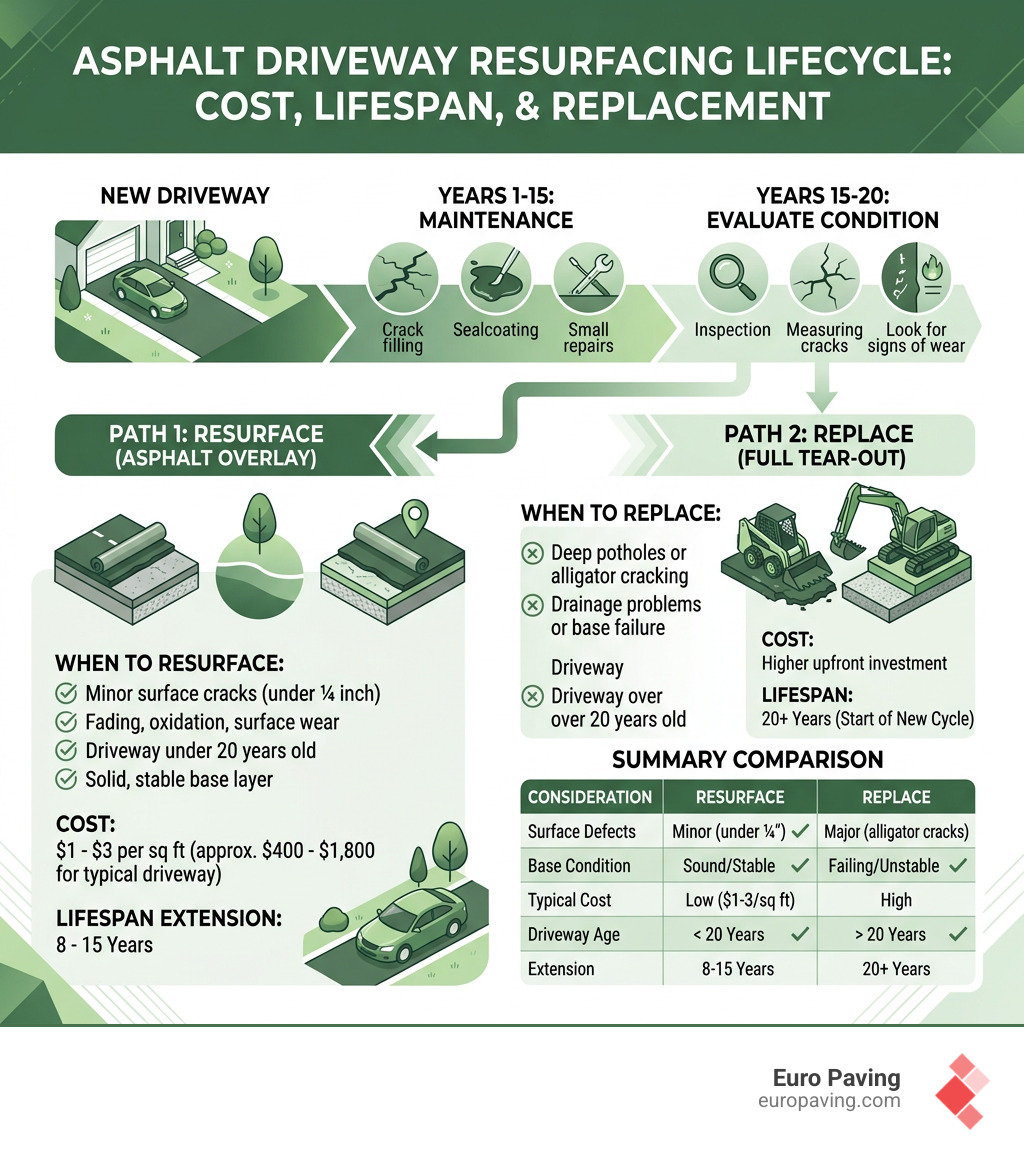
Quick answer: Resurfacing means applying a fresh 1.5″ to 2″ layer of asphalt over your existing driveway. It costs $1 to $3 per square foot (roughly $400 to $1,800 for a typical driveway), extends your driveway’s life by 8 to 15 years, and saves up to 50% compared to full replacement — as long as the base layer is still structurally sound.
Here’s when resurfacing makes sense at a glance:
| Situation | Resurface | Replace |
|---|---|---|
| Minor surface cracks (under ¼ inch) | Yes | No |
| Fading, oxidation, surface wear | Yes | No |
| Driveway under 20 years old | Yes | No |
| Solid, stable base layer | Yes | No |
| Deep potholes or alligator cracking | No | Yes |
| Drainage problems or base failure | No | Yes |
| Driveway over 20 years old | No | Yes |
Your driveway is one of the first things people notice about your home. A cracked, faded surface doesn’t just look bad — it can lower your property value and create real safety hazards. The good news? In many cases, you don’t need to tear everything out and start over.
But here’s what most homeowners miss: resurfacing only works when it’s done right. Poor prep, wrong materials, or ignoring drainage issues can mean your “fresh” driveway fails in just a few years. That’s why hiring an experienced professional contractor — rather than attempting a DIY fix — makes all the difference.
At Euro Paving, we serve homeowners across Chicago’s suburbs, including Elmhurst, Norridge, and Arlington Heights, delivering professional resurfacing results built to last through tough Midwest freeze-thaw cycles.
Understanding Asphalt Driveway Resurfacing
When we talk about asphalt driveway resurfacing, we are referring to a process often called an “asphalt overlay.” Think of it like putting a high-quality new roof over old shingles—it provides a brand-new wearing surface without the massive labor of a total tear-down.
At its core, asphalt is a mixture of aggregates (stone, gravel, and sand) bound together by a sticky, black petroleum material called bitumen. Over time, the sun’s UV rays and the harsh Chicago winters cause this bitumen to dry out and oxidize, leading to that brittle, gray appearance.
A study by the National Asphalt Pavement Association found that resurfacing is vital because it restores the structural integrity of the pavement before the damage reaches the foundation. By removing the top layer (milling) and applying a fresh coat, we can effectively reset the clock on your driveway. However, this only works if the “bones” of your driveway are still good. If you have deep structural failures, you may need a more comprehensive asphalt-contractor to evaluate whether a simple overlay is enough.
The Benefits of Asphalt Driveway Resurfacing
Why choose resurfacing over a complete reconstruction? The most obvious answer is cost-effectiveness. Resurfacing generally saves homeowners up to 50% of the cost compared to full-depth reconstruction. It’s the middle ground between a simple sealcoat (which is just a “paint job” for protection) and a total replacement.
Beyond the wallet, there are several key benefits:
- Safety: Smooth surfaces eliminate trip hazards and prevent damage to your vehicle’s tires and suspension.
- Aesthetic Value: There is nothing like the look of a jet-black, smooth driveway to boost curb appeal. In fact, well-maintained driveways can boost property value by up to 5%.
- Lifespan Extension: While a standard asphalt driveway might last 20-30 years, regular resurfacing every 15 years can push that lifespan to its maximum potential.
- Enhanced Protection: A new layer prevents water from seeping into the sub-base, which is the primary cause of potholes during the freeze-thaw cycles we see in places like Downers Grove and Barrington.
While asphalt is a fantastic, flexible material, some homeowners eventually look for even more durability and “wow factor.” If you are tired of the maintenance cycle of asphalt, you might consider the 8-benefits-of-having-brick-driveway-instead-of-asphalt-driveway for a truly permanent and high-end solution.
When to Choose Resurfacing vs. Full Replacement
Making the right choice between an overlay and a total replacement depends entirely on what lies beneath the surface. If your driveway’s foundation—the gravel and soil base—is shifting or sinking, a new layer of asphalt will simply crack in the same spots within a year. We call this “reflective cracking.”
| Feature | Resurfacing (Overlay) | Full Replacement |
|---|---|---|
| Primary Goal | Restore surface and aesthetics | Fix foundation and drainage |
| Layer Thickness | 1.5 to 2 inches added | Entire 4-8 inch structure |
| Lifespan | 8 to 15 years | 20 to 30 years |
| Installation Time | 1-2 days | 3-5 days |
| Best For | Surface cracks, fading, minor pits | Foundation failure, deep ruts |
If you notice “alligator cracks”—those interconnected cracks that look like reptile skin—it usually signals that the base has failed. In these cases, resurfacing is like putting a band-aid on a broken bone. To ensure you don’t waste money, it’s critical to understand driveway-renovation-avoiding-common-problems before signing a contract.
Signs Your Asphalt Driveway Resurfacing is Necessary
How do you know it’s time to call us? Look for these “cries for help” from your pavement:
- Oxidation: Your driveway has turned from black to a light, brittle gray.
- Surface Raveling: You notice loose gravel and “sand” washing away every time it rains.
- Minor Cracking: Hairline cracks or cracks under a quarter-inch wide are perfect candidates for a fresh overlay.
- Potholes: Small pits (1-2 inches deep) can be patched and then covered during the resurfacing process.
If you are seeing these signs, don’t wait. Water is the enemy of asphalt. Learning how-to-repair-driveway-cracks can help in the short term, but once the cracks become widespread, asphalt driveway resurfacing is the only way to save the structure.
The Professional Asphalt Driveway Resurfacing Process
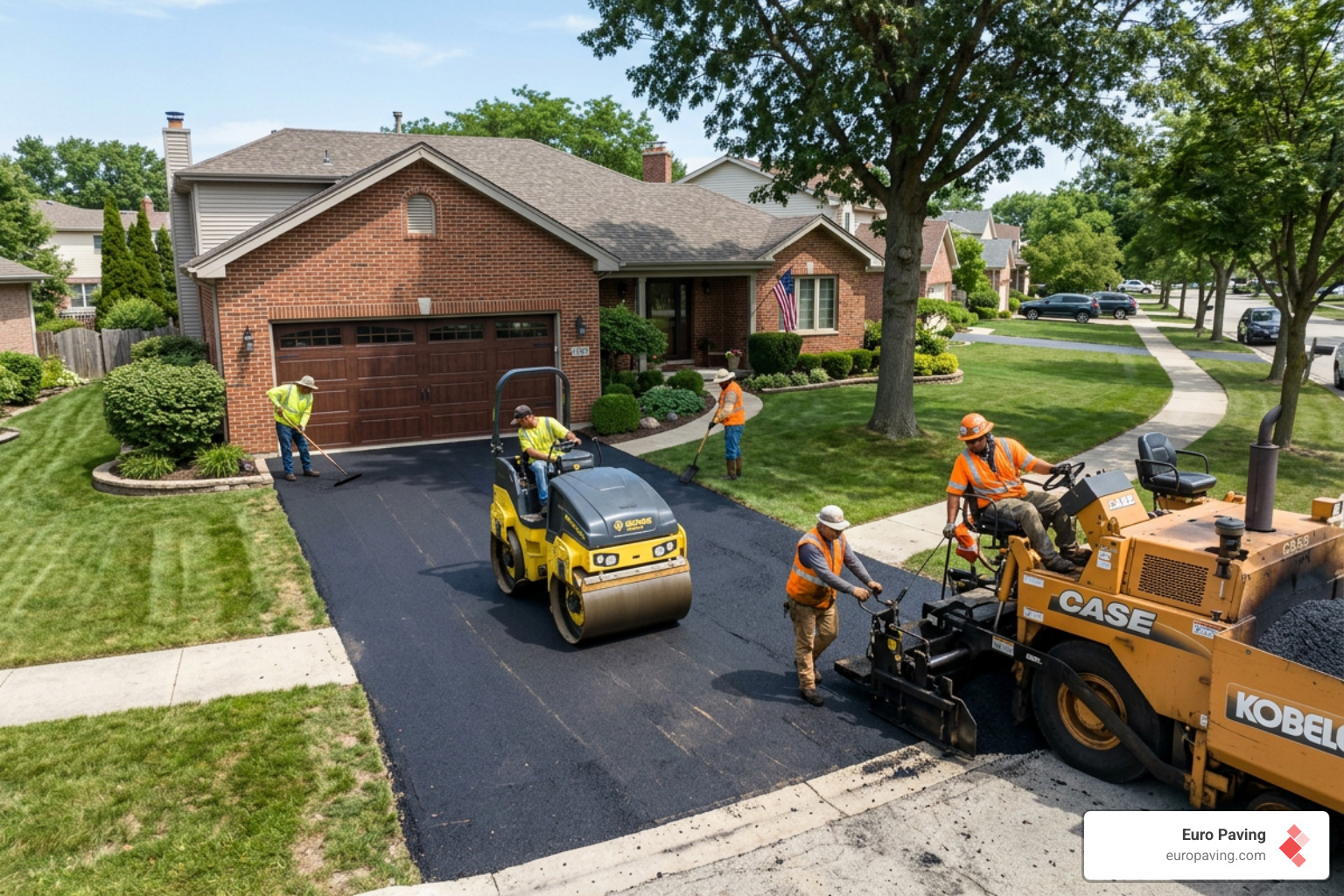
When we arrive at your home in Skokie or Arlington Heights, we follow a rigorous professional process. This isn’t a project you can do with a bucket and a squeegee from a big-box store.
The professional steps include:
- Assessment and Cleaning: We power wash the surface and remove all debris, weeds, and oil spots. New asphalt won’t stick to dirt.
- Milling: For the best results, we often mill (grind down) the top layer of the old asphalt. This ensures the new layer doesn’t sit too high against your garage floor or sidewalk.
- Crack and Pothole Repair: We fill existing voids with hot-mix patch material and tamp them down until they are flush.
- Tack Coat Application: This is the “glue.” We spray a liquid asphalt emulsion that ensures the new layer bonds permanently to the old one.
- Laying the Hot Mix: We use a paving machine to spread a fresh 1.5″ to 2″ layer of hot-mix asphalt at temperatures between 275°F and 300°F.
- Compaction: A multi-ton vibratory roller smooths the surface and compresses the asphalt to the correct density.
- Curing: While you can walk on it almost immediately, we recommend keeping cars off for at least 3 to 5 days.
As experts in hardscaping, we often coordinate these projects with other upgrades. If your project involves more than just the driveway, you might need a concrete-contractor to handle curbs or apron transitions.
Managing Drainage and Utilities During Asphalt Driveway Resurfacing
One of the most overlooked aspects of asphalt driveway resurfacing is the change in elevation. Because we are adding nearly two inches of material, the water flow on your property will change.
If you have a drain or catch basin at the end of your driveway, it must be raised to match the new height. Simply “feathering” the asphalt down to the old drain often creates a “bowl” where water sits, leading to ice patches in the winter and asphalt deterioration in the summer.
We also take great care with county utilities. In many Chicago suburbs, water shut-off valves or sewer manholes might sit within your driveway. These must be adjusted by a professional to ensure they remain accessible but flush with the new surface. Proper grading is the difference between a dry garage and a flooded one. If you’re concerned about long-term drainage, you might find that is-a-brick-driveway-cheaper-than-concrete discussions often highlight how permeable pavers can solve water issues more effectively than solid asphalt.
Frequently Asked Questions about Asphalt Resurfacing
How long does a resurfaced driveway last?
A professionally resurfaced driveway typically lasts 8 to 15 years. According to reports in Asphalt Magazine, the actual lifespan depends heavily on maintenance. If you sealcoat the surface every 2-3 years and fill small cracks as they appear, you can push that lifespan toward the 15-year mark. In the harsh Illinois climate, road salt and snow plows can take a toll, so proactive care is essential.
Is resurfacing a DIY project?
In a word: No. While you can buy “driveway resurfacer” in a bucket at a hardware store, that is essentially just a thick sealcoat. True asphalt driveway resurfacing requires heavy machinery, including milling machines and multi-ton rollers, and hot-mix asphalt that must be applied while it’s searing hot. DIY attempts often result in uneven surfaces, poor drainage, and a layer that peels off (delaminates) within a single season. Save yourself the headache and the liability—hire a pro.
What is the average cost of resurfacing?
For a standard driveway in the Chicago area, you can expect to pay between $1 and $3 per square foot. For a typical 2-car driveway, this usually lands between $1,200 and $3,000 depending on the amount of prep work required. Factors that can increase the price include:
- Significant milling requirements.
- Raising drains or utility covers.
- Deep pothole repairs.
- Regional material costs (which fluctuate with oil prices).
Conclusion
Your driveway is more than just a place to park your car; it’s the welcome mat to your home. Whether you live in Arlington Heights, Norridge, or Hinsdale, keeping your pavement in top shape is essential for your property’s value and safety.
At Euro Paving, we don’t just “slap on a coat of tar.” We are a Unilock Authorized Contractor with years of experience in the hardscaping and paving industry. We specialize in transforming outdoor spaces—from functional asphalt driveways to custom brick patios and outdoor kitchens. Our team uses 3D paving design to help you visualize the final result before we even break ground.
We stand behind our work with lifetime material guarantees and a commitment to the highest quality standards in the Chicago area. Don’t let a crumbling driveway detract from your home’s beauty.
Transform your driveway with expert paving services today. Contact us for a professional assessment and let us help you decide whether to resurface or replace for a result that lasts a lifetime.