



Understanding the Root Causes of a Pitted Concrete Driveway
A pitted concrete driveway rarely happens by accident. Moisture penetration, temperature swings, and chemical exposure work together to degrade the top layer of concrete. Concrete acts like a sponge, drawing surface moisture into micro-pores. When winter temperatures hit Cook County and DuPage County, that trapped water freezes and expands by roughly 9%, creating heavy hydraulic pressure inside the slab.
Over repeated freeze-thaw cycles, this internal pressure breaks the walls of the small pores, causing tiny fragments of cement paste to flake away. De-icing chemicals like sodium chloride and calcium chloride speed up this destruction. They lower the freezing point of water, increasing the frequency of liquid-to-solid phase changes inside the surface matrix.
Installation defects also contribute significantly to premature surface failure:
- Excess water in the initial mix: Adding too much water during pouring makes the wet mix easier to work with, but it dilutes the cement paste and creates porous concrete.
- Premature finishing: Troweling wet concrete before bleedwater completely evaporates traps moisture and air directly beneath the top finish, creating a weak surface layer (laitance).
- Inadequate curing: Skipping proper moist curing for at least 7 days leaves the surface paste under-hydrated, weak, and highly prone to surface scaling.
Air Voids, Popouts, and Pinholes
Distinguishing between various types of surface defects helps identify the underlying cause. Pinholes (or bugholes) are small, 1/32 to 1/8-inch voids created when trapped air bubbles fail to escape before the concrete hardens.
Aggregate popouts are larger, cone-shaped craters ranging from 1 to 3 inches in diameter. They happen when porous chert or soft gravel aggregates near the surface absorb water, freeze, and pop out of the slab, leaving small holes behind. Surface scaling appears as thin layers flaking off across wider sections of the driveway. Understanding these mechanics is essential for choosing effective repair strategies rather than short-term fixes.
Environmental Stressors in Chicagoland
Driveways across Chicago and surrounding suburbs face severe seasonal stress. The region experiences tens of freeze-thaw cycles every winter. As snow falls and melts, water sits on driveways with inadequate pitch, seeping into the unsealed concrete pores.
Chemical de-icers aggravate these conditions. Rock salt (sodium chloride) causes severe chemical scaling on unsealed concrete. Calcium chloride, while effective at lower temperatures, increases moisture retention inside the slab. In high-humidity spring thaws and harsh freezing winters, unsealed concrete driveways face constant surface erosion.
Diagnosing Concrete Surface Damage: Cosmetic Pitting vs. Structural Spalling
Before choosing between localized repair or a full driveway overhaul, we perform precise diagnostic steps to measure the true extent of slab damage.
| Characteristic | Cosmetic Pitting | Structural Spalling & Failure |
|---|---|---|
| Defect Depth | 1/16 in. to 1/4 in. deep | Greater than 1/2 in. deep with exposed aggregate |
| Slab Soundness | Solid, metallic ringing when tapped | Hollow, dull thud indicating internal voids |
| Cracking Pattern | Isolated surface scaling; no deep structural cracks | Alligator cracking, deep fractures, or shifted edges |
| Subgrade State | Fully supported, stable sub-base | Settled subgrade, soil washouts, or uneven movement |
Identifying Surface Delamination
Surface delamination happens when the thin top layer of cement paste detaches from the underlying aggregate matrix. To find hidden pockets of delaminated concrete, we use the classic hammer sound test.
Tapping a steel hammer across the concrete in a grid pattern tells us everything about the interior matrix:
- A sharp, high-pitched metallic ringing sound indicates a dense, solid slab structure.
- A dull, hollow “thud” reveals subsurface voiding, delamination, or trapped air where the top layer has separated from the base.
If large areas of your driveway produce hollow sounds, applying a simple surface patch will fail because the material beneath it is structurally unsound. For additional diagnostic guidance on surface cracks, consult our concrete driveway crack repair in chicago 2026 guide.
Subgrade Erosion and Base Failures
Surface pitting often masks deeper subgrade issues. Soil washouts, inadequate gravel base compaction, or tree root expansion can hollow out the earth underneath a concrete slab.
When heavy vehicles drive over these hollow sections, the unsupported concrete flexes, cracks, and flakes off at an accelerated rate. If your driveway exhibits sunken sections alongside severe pitting, surface overlays alone will not restore structural integrity.
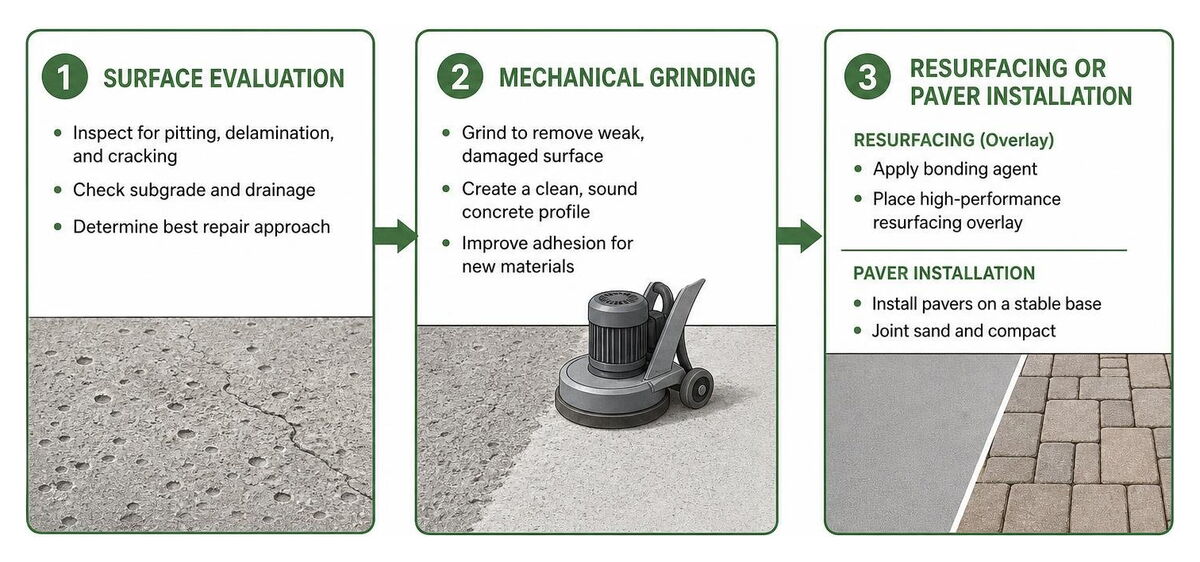
3 Proven Methods to Restore and Repair Damaged Driveways
When addressing a pitted concrete driveway, choosing the right restoration method depends on the depth and scope of the surface failure.
High-Performance Polymer Patching for Minor Pits
For isolated pits and shallow surface defects (less than 1/4 inch deep), targeted polymer patching provides a clean, localized fix:
- Surface Cleaning: We remove loose sand, oil stains, and dirt using industrial power washing combined with stiff-bristle scrubbing.
- Mechanical Etching: We chisel pit edges slightly outward so the hole base is wider than the top, giving the repair mortar a strong mechanical tooth to bite into.
- Bond Coat Application: We apply high-performance liquid bonding adhesive to ensure the new repair mortar permanently adheres to the cured concrete.
- Polymer Patching: We pack high-strength, polymer-modified epoxy or cementitious patch mix tightly into the pit using a margin trowel, smoothing it flush with the surrounding concrete.
Evaluating Severe Pitted Concrete Driveway Damage
When surface pitting covers a widespread area, localized patching looks blotty and uneven. In these cases, professional concrete resurfacing is required:
- We grind the top 1/8 inch of damaged concrete away using a diamond-cup wheel or planetary surface grinder to strip away weak paste and open the concrete pores.
- We clean the exposed slab with high-pressure water (minimum 3,500 PSI) to remove all dust, laitance, and micro-debris.
- We mix a self-leveling, polymer-modified cementitious resurfacer and spread it evenly across the damp slab using a rubber squeegee at a 1/8 to 1/4 inch thickness.
- Before the overlay sets, we pull a soft-bristle broom across the surface to create an attractive, slip-resistant finish.
While resurfacing yields a fresh visual layer, thin overlays exposed to severe Chicagoland freeze-thaw cycles typically have a service life of 5 to 15 years before maintenance is required again. Explore whether to resurface or replace your driveway today.
Interlocking Brick Paver Replacement for Permanent Results
For homeowners looking to eliminate concrete scaling, pitting, and surface cracking forever, replacing a failing concrete slab with an interlocking brick paver driveway delivers unmatched performance and elegance.
Unlike poured concrete, which forms a rigid slab vulnerable to thermal expansion cracking and chemical spalling, interlocking paver systems feature flexible joints. These joints allow individual pavers to absorb ground movement, freeze-thaw shifts, and heavy wheel loads without cracking or pitting.
As a certified Unilock Authorized Contractor, Euro Paving installs high-density brick paver systems that offer:
- High compressive strengths (often exceeding 8,000 PSI, compared to standard 3,500 PSI poured concrete).
- Complete resistance to winter salt spalling, scaling, and freeze-thaw surface pitting.
- Lifetime material guarantees backed by Unilock.
- High architectural curb appeal with custom borders, contrasting inlay patterns, and integrated lighting options.
Residential and Commercial Driveway Restoration Solutions
Long-Term Prevention for Your Pitted Concrete Driveway
If you choose to maintain an existing concrete driveway, protecting the surface requires strict routine care:
- Apply Penetrating Sealers: Use deep-penetrating silane-siloxane sealers every 2 to 3 years. Unlike topical acrylic coatings that trap moisture beneath the surface and peel, penetrating sealers react chemically with silica inside the concrete pores to form a hydrophobic moisture barrier.
- Manage Snow Safely: Avoid applying chemical de-icers like rock salt (sodium chloride) or ammonium sulfate. Use coarse sand, coarse gravel, or kitty litter to provide winter traction without triggering surface scaling.
- Prompt Water Drainage: Keep edge joints sealed and ensure downspouts divert water away from the driveway to prevent pool formation.
For further reading on maintaining concrete integrity, review municipal design standards in the Permeable Pavement Design Guide.
Commercial Paving and Heavy-Duty Applications
Commercial parking lots, retail walkways, and industrial access aprons face intense vehicular stress. Heavy truck axle loads combined with constant snow-plow scraping quickly destroy compromised concrete surfaces.
Euro Paving delivers commercial-grade paving and hardscaping solutions throughout Cook County and DuPage County. From commercial parking lot overlays to durable heavy-duty paver aprons, we engineer base structures capable of handling extreme daily traffic loads without rutting, cracking, or surface scaling.
Frequently Asked Questions About Concrete Driveway Pitting
Can pitted concrete driveways be permanently fixed without replacing the entire slab?
Minor to moderate surface pitting can be temporarily corrected using polymer-modified concrete resurfacing or specialized patching mortars. However, if the pitting is driven by poor original mix quality, structural subgrade settling, or deep freeze-thaw damage, thin surface overlays will eventually fail. Replacing the driveway with an interlocking brick paver system is the only permanent solution that completely eliminates scaling and pitting risks.
What is the difference between concrete pitting, spalling, and aggregate popouts?
Pitting refers to small, shallow surface holes (usually under 1/4 inch deep) caused by trapped air bubbles, poor finishing, or light surface wear. Spalling (or scaling) involves larger, deeper flaking where significant sheets of cement paste strip away to expose coarse aggregate beneath. Aggregate popouts are distinct cone-shaped holes created when individual porous stones absorb water, freeze, and shatter out of the surface layer.
Why do Chicagoland driveways suffer from severe winter surface pitting?
The Midwest experiences rapid winter temperature swings that cause dozens of freeze-thaw cycles every season. When water enters unsealed concrete pores and freezes, it expands by roughly 9%, generating intense internal pressure. Coupled with aggressive chemical de-icing salts used across Chicago, Elmhurst, Hinsdale, and Arlington Heights, unsealed concrete surfaces suffer accelerated scaling and breakdown.
Upgrading Your Driveway with Euro Paving
While surface patching or polymer resurfacing offers a temporary shield against winter weather, continuous cycles of freezing, thawing, and salt exposure mean standard concrete repairs require ongoing maintenance. If your driveway is showing severe scaling, deep cracking, or recurring pitting, upgrading to a custom brick paver installation provides a permanent, elegant solution.
At Euro Paving, we bring nearly 20 years of specialized hardscaping experience to homeowners and commercial property owners across Chicago, Arlington Heights, Norridge, Skokie, Downers Grove, Lake Forest, Northbrook, Highland Park, Winnetka, Hinsdale, Mount Prospect, and Lombard.
When you choose Euro Paving, you get:
- Unilock Authorized Contractor Expertise: We use premium, high-density Unilock pavers backed by lifetime material guarantees that will not pit, scale, or crack under harsh winter weather.
- Custom 3D Paving Design: We help you visualize your new driveway before construction starts, letting you pick color combinations, border motifs, and pattern layouts with confidence.
- Comprehensive Base Engineering: We excavate to deep, solid subgrade levels and lay open-graded aggregate bases to ensure structural stability and reliable water drainage.
- Flexible Financing Solutions: We offer convenient financing options through the Unilock DO-IT-NOW Program, making it easy to bring your outdoor living vision to life on a comfortable budget.
Transform your curb appeal with a durable, maintenance-free driveway designed to stand up to the toughest winters. Explore our custom brick paving driveways or read our complete driveway concrete paving in chicago 2026 guide for expert design ideas.
Contact Euro Paving today to schedule your consultation and get a project estimate from our expert hardscaping team!