



Comprehensive Breakdown of Driveway Removal and Replacement Costs
When you receive a quote for driveway removal and replacement, the single biggest mistake is treating the line-item number as just a price for new paving materials. A durable driveway rebuild is effectively two full construction projects: structural demolition with material extraction, followed by ground engineering and new surface installation.
The table below breaks down realistic expectations across primary driveway materials for local homeowners in Chicago, Norridge, Skokie, and surrounding Cook and DuPage Counties:
| Driveway Type | Demo & Haul-Off Cost | Material & Installation | Average Total Range (600–800 sq ft) | Usable Lifespan |
|---|---|---|---|---|
| Hot-Mix Asphalt | $1.50 – $7.00 / sq ft | $3.00 – $25.00 / sq ft | $9,000 – $22,000 | 15 – 30 Years |
| Poured Concrete | $2.00 – $14.00 / sq ft | $6.00 – $28.00+ / sq ft | $12,000 – $28,000 | 30 – 40 Years |
| Interlocking Brick Pavers | $2.00 – $9.00 / sq ft | $10.00 – $30.00+ / sq ft | $14,000 – $29,000+ | 30 – 40+ Years |
Demolition expenses depend heavily on the thickness and structural reinforcement of the old surface. Tearing out standard 2-inch asphalt is fast, but breaking up a 6-inch reinforced concrete slab packed with rebar requires heavy hydraulic machinery. Dump haul-off fees and municipal recycling gate rates add $75 to $300+ per truckload.
Sub-base excavation and site grading fees account for another $2.50 to $10.00 per square foot. Skipping proper base grading guarantees that any new surface will fail prematurely.
Concrete vs. Asphalt Tear-Out and Material Options
Tearing out concrete is fundamentally different from removing blacktop. Unreinforced concrete slabs cost roughly $2 to $9 per square foot to demolish and haul away. However, if your driveway was poured with steel rebar grids or heavy wire mesh, prices quickly climb to $4 to $14+ per square foot due to the additional labor hours required to cut, extract, and separate steel from concrete rubble.
Hot-mix asphalt is thinner (typically 2 to 3 inches) and lacks embedded steel, making it 20% to 30% cheaper to extract. Asphalt is also 100% recyclable, often lowering local disposal costs.
When selecting replacement materials, balance upfront cost against long-term durability. While plain poured concrete and asphalt are common, high-performance interlocking brick pavers provide superior freeze-thaw resilience and eliminate random surface cracking.
Hidden Subterranean Expenses and Site Conditions
What lies hidden beneath your existing driveway often dictates the final contingency budget. In Chicagoland, expansive clay soil is the primary enemy of hardscaping. Clay absorbs water, swells during autumn rains, and expands when frozen, causing massive upward pressure.
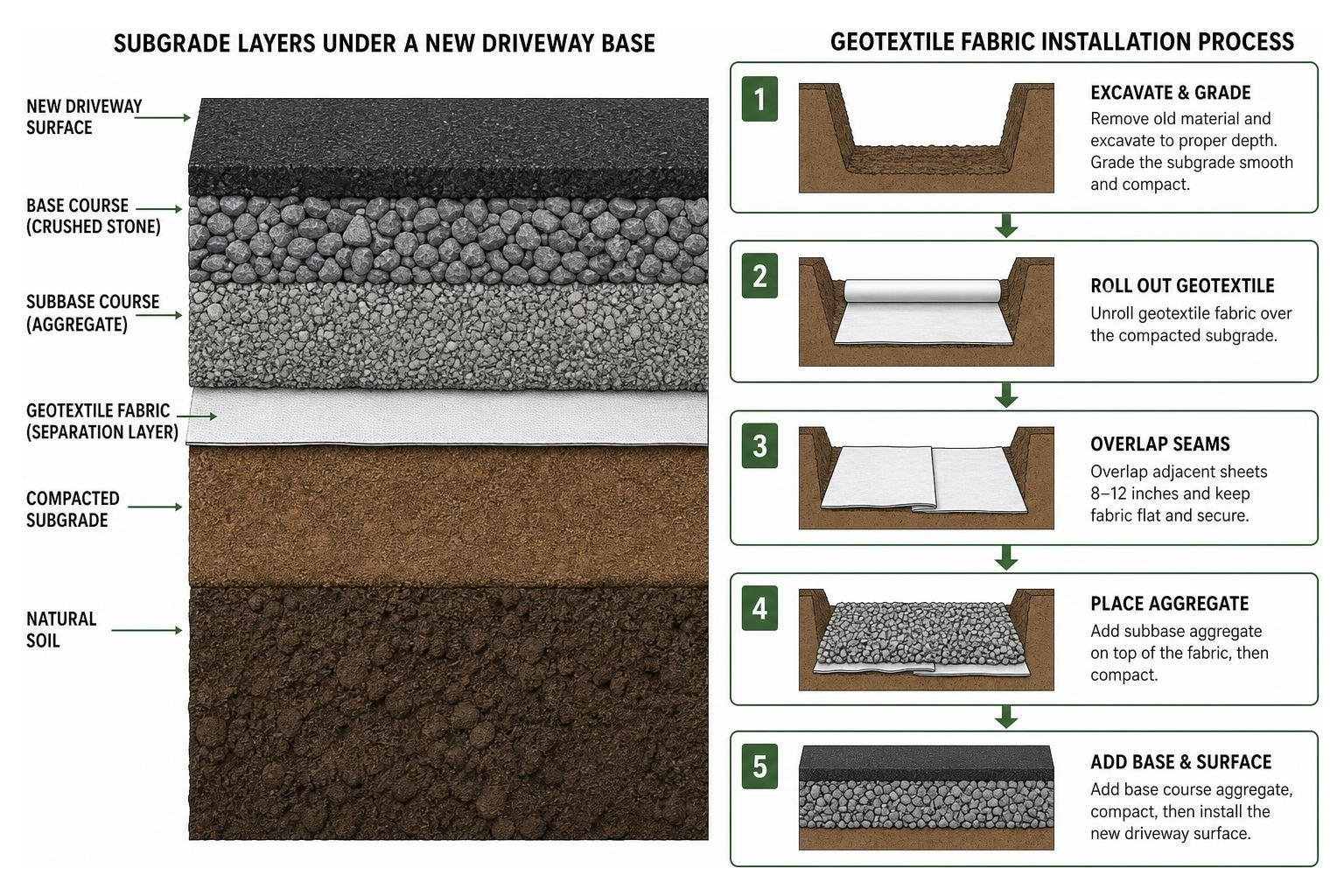
During excavation, we frequently uncover hidden subterranean surprises:
- Historical Paving Layers: Old asphalt poured directly over pre-existing concrete slabs or buried gravel beds, doubling demolition haul-off volume.
- Unstable Soil “Pumping”: Mud bubbling up through saturated subgrade under heavy machinery weight, requiring deep base excavation.
- Root Intrusion & Poor Drainage: Hidden tree roots or collapsed clay pipe drains requiring mechanical excavation and grading.
To stabilize soft clay soil, we install heavy-duty geotextile fabric between the native soil and the crushed aggregate base, preventing stone migration and settling. Learn how to address these sub-base challenges in our guide on Fixing the Foundation of Your Sinking Driveway.
Essential Indicators: When Repairing Is No Longer Viable
Not every surface flaw demands full excavation. Minor surface hairline cracks or localized wear can often be managed temporarily. However, spending money on cosmetic patches over structural subgrade failure is burning cash.
Full driveway removal and replacement becomes mandatory when you encounter:
- Widespread Alligator Cracking: Interlocking web-like cracks across large areas signal that the underlying base stone has failed under traffic loads.
- Frost Heaving and Sunken Sections: Extreme seasonal thermal movement that creates dangerous trip hazards and uneven transitions.
- Severe Surface Spalling and Crumbling: Flaking concrete or unravelling asphalt aggregate caused by salt corrosion and freeze-thaw cycles.
- Standing Water and Drainage Pooling: Depressions that direct rainwater back toward your home foundation or garage entry.
Evaluating whether to restore or replace your surface? Check out our article on whether to Resurface or Replace Your Driveway Today.
Resurfacing Limitations vs Full Structural Replacement
Driveway resurfacing or applying an asphalt overlay sounds attractive because it avoids demolition expenses. However, overlays are purely surface cosmetics.
If the foundational base beneath the driveway has settled, shifted, or eroded, applying a new 1-inch to 2-inch top layer results in reflective cracking. Within 12 to 24 months, the old cracks beneath push right back through the new layer.
Furthermore, adding surface layers raises the driveway elevation. This creates awkward transitions along garage floors, entry walkways, and public sidewalks. Complete structural replacement resets the base to proper depth and ensures pitch-perfect water drainage. Avoid costly mistakes by reading Driveway Renovation: Avoiding Common Problems.
The Professional Execution Strategy: Step-by-Step
Replacing a driveway correctly requires systematic execution and heavy machinery designed for precision grading.
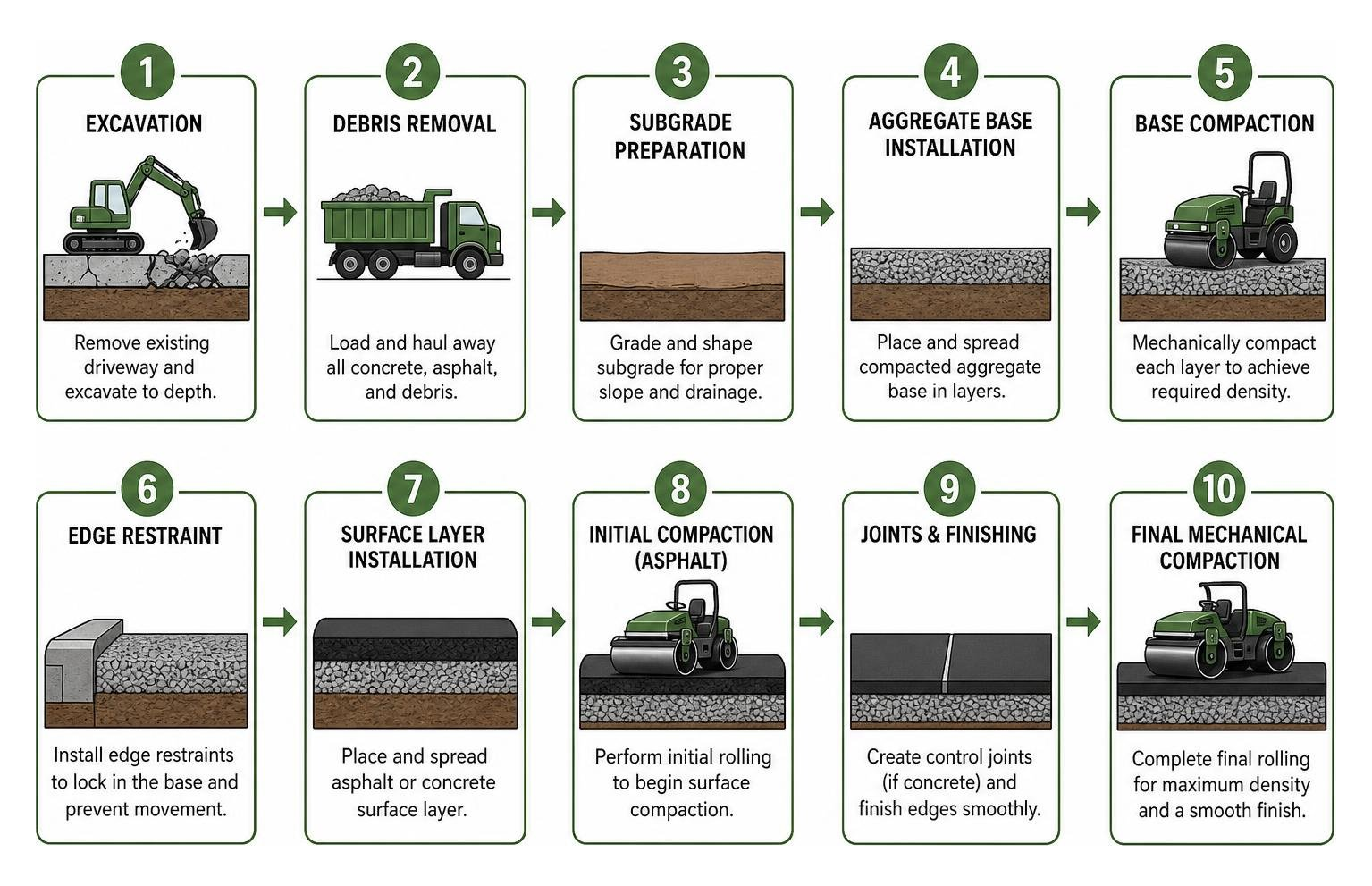
Before demolition begins, perimeter edges connecting to garage aprons, public sidewalks, or city curbs must be deep saw-cut using diamond blade saws. Saw-cutting prevents accidental cracking or structural damage to adjoining concrete structures when heavy machinery starts ripping up the main slab.
After breaking up the old surface, heavy excavators and skid steers haul the debris away. We then rebuild the foundation using compacted aggregate base stone (such as CA-6 or Item 4 crushed stone), creating a stable subgrade capable of supporting full vehicle weight. Refer to the Village of Norridge Street Paving Guidelines for municipal standards on public right-of-way connections.
Essential Steps in the Driveway Removal and Replacement Process
A standard professional tear-out and rebuild follows a strict sequence:
- Utility Line Locates (JULIE / 811): Marking underground gas, electric, water, and fiber lines before excavation tools hit the ground.
- Saw-Cutting & Edge Isolation: Cutting clean perimeter lines along garage doors, walkways, and street borders.
- Hydraulic Breaker Demolition: Mechanically breaking up 4-to-6-inch concrete or aged asphalt slabs into manageable haul-away debris.
- Sub-Base Excavation & Fabric Laydown: Digging out unstable clay soil and laying down woven geotextile stabilization fabric.
- Crushed Stone Base Installation: Spreading 6 to 10 inches of dense graded aggregate stone in controlled lifts.
- Laser Slope Grading & Mechanical Compaction: Setting precise pitch (minimum 1/8-inch drop per foot) away from home foundations using vibrating plate compactors and heavy rollers.
- Paving Surface Installation: Laying fresh asphalt, pouring air-entrained concrete with rebar, or hand-setting high-strength Unilock interlocking pavers.
Municipal oversight is critical during this process. For details on local codes in Northbrook, review the Village of Northbrook Driveway Permit Requirements.
Factors Influencing Driveway Removal and Replacement Timelines
Most residential tear-out and rebuilding projects take between 1 and 3 days of active field work, though total timeline dependencies include:
- Active Demolition Phase: Standard 2-car driveways take 1 day to demolish, haul off, and excavate.
- Municipal Base Inspection Schedule: Many Chicago suburban villages mandate an official inspector sign-off on the compacted aggregate base before any new surface material can be placed.
- Site Access Restrictions: Narrow side drives, steep hillsides, or proximity to retaining walls slow down equipment maneuvering.
- Weather Windows: Asphalt paving requires warm, dry weather, while concrete requires protection from freezing temperatures during its initial curing period.
Hiring Professional Paving Contractors and Vetting Bids
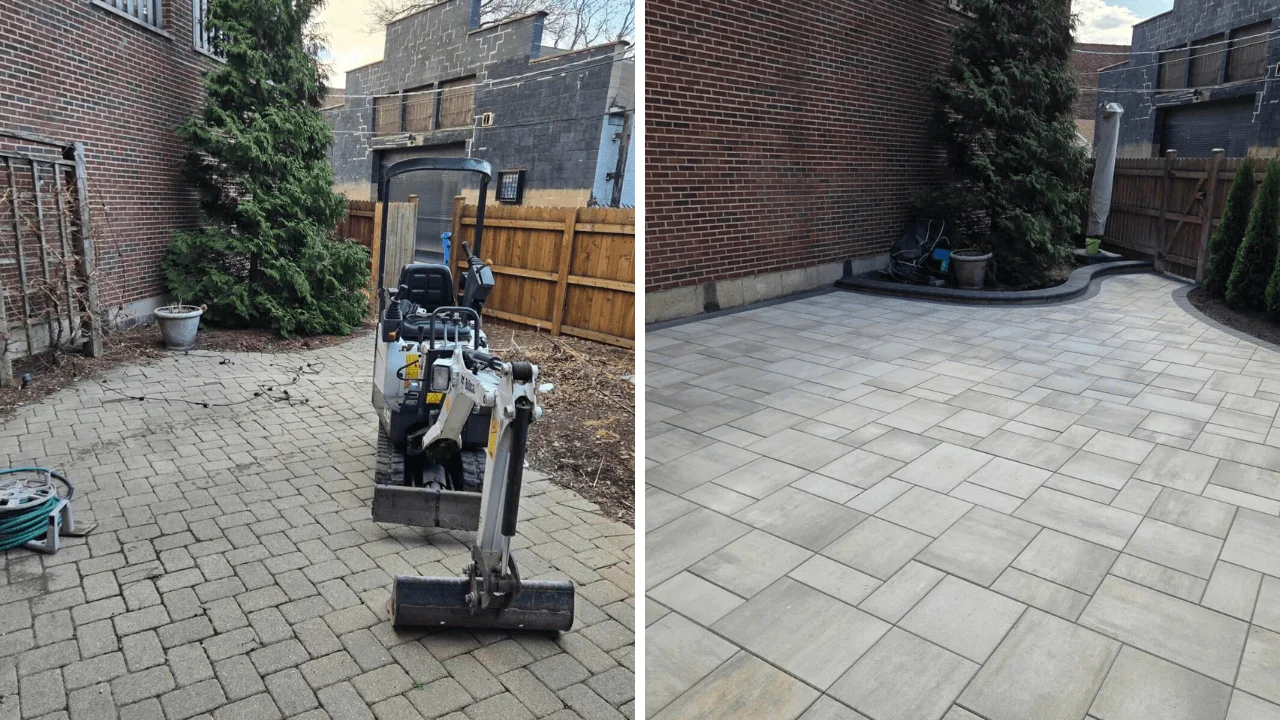
Driveway removal and replacement is not a project to award to the lowest lump-sum bidder. Bids that seem unusually cheap often skip crucial steps—such as omitting soil geotextile fabric, laying insufficient aggregate base stone, or lacking adequate property damage insurance.
When reviewing contractor proposals, demand itemized estimates separating demolition, haul-off fees, aggregate base tonnage, and surface paving materials. Confirm that the contractor owns heavy machinery, employs experienced crews, and maintains proper licensing and bonding. For comprehensive guidance on contractor selection, read Contractor Quest: Hiring the Right Team for Your Driveway.
Key Vetting Questions and Red Flags
Before signing a contract or handing over a deposit, ask these critical questions:
- Do you handle municipal right-of-way and driveway apron permits? Red flag: Asking the homeowner to pull structural construction permits.
- Are utility locates (811) included in the bid scope? Red flag: Excavating without official utility site markings.
- Will the job require subcontractors, or do you employ in-house crews? Red flag: Unclear contractor accountability.
- What compaction equipment is used on the aggregate base? Red flag: Hand-tamping or skipping mechanical roller compaction.
- What material and structural warranties do you offer? Red flag: Verbal guarantees lacking written terms.
Review our full range of professional services on our Driveway Paving page.
Frequently Asked Questions About Driveway Tear-Outs
Do I need a municipal permit for full driveway replacement in Cook or DuPage County?
Yes. Virtually all Chicagoland municipalities—including Arlington Heights, Downers Grove, Mount Prospect, Skokie, and Glenview—require a building permit for complete driveway removal and replacement. Permits ensure that your project meets local slope grading rules, water runoff guidelines, and public right-of-way regulations near sidewalks and street aprons. Permit fees typically range between $100 and $400 depending on your municipality.
Can I pave over my old driveway to avoid removal costs?
Paving over an existing driveway (an asphalt overlay or recapping) is only viable if the underlying structural base is perfectly sound and free of deep cracks or settling. If your driveway has alligator cracking, sunken sections, or clay sub-base failure, paving over it is a temporary band-aid. The underlying defects will quickly show through the new surface. Full removal is required for long-term performance.
How long after installation can heavy vehicles drive on the new surface?
Curing and traffic wait times vary depending on the chosen replacement material:
- Hot-Mix Asphalt: Usable for passenger cars within 3 to 5 days, though full curing takes up to 12 months. Avoid parking heavy trucks or turning wheels sharply while stationary during hot summer days.
- Poured Concrete: Requires a minimum curing period of 7 days before passenger vehicles can drive on it, and 28 days for full structural PSI strength.
- Interlocking Brick Pavers: Ready for immediate vehicle traffic as soon as the final joint sand is swept and mechanically compacted into the paver joints!
Transform Your Property with High-Performance Hardscaping
A worn, cracking driveway lowers your home’s curb appeal and creates constant maintenance headaches. Upgrading to a custom interlocking brick paver driveway delivers unmatched aesthetic elegance, eliminates crack risks, and increases your home’s long-term value.
At Euro Paving, we bring nearly two decades of hardscaping expertise to homeowners across Chicago and surrounding suburbs like Hinsdale, Highland Park, Barrington, and Winnetka. As an Unilock Authorized Contractor in Illinois, we install lifetime-guaranteed brick paver driveways engineered to withstand severe Midwest freeze-thaw cycles without cracking.
Our end-to-end approach includes advanced 3D paving design previews, full site demolition, precision sub-base grading, and seamless installation. We also offer flexible financing through the Unilock DO-IT-NOW Program so you can build your dream driveway on your terms.
Ready to elevate your home’s entrance? Explore our custom design options on our Driveway Paving page or contact the team at Euro Paving today to schedule your consultation!