



Driveway Repair vs. Replacement: Identifying Structural Failure
Every homeowner faces the inevitable decision of whether to apply a temporary fix or invest in a full structural upgrade. Understanding the root cause of surface breakdown is essential. While minor cosmetic flaws can be patched, deep structural defects require total reconstruction. To weigh your immediate options, explore our guide on how to Resurface or Replace Your Driveway Today.
When an asphalt or concrete surface develops widespread interconnecting cracks—often called “alligator cracking”—the damage extends far below what the eye can see. This pattern indicates that the underlying aggregate base has lost its load-bearing capacity. Continuing to apply patch material over base failure is a losing battle. Water seeps into those fissures, expands during Chicago freeze-thaw cycles, and rapidly destabilizes the subgrade beneath.
Drainage failure is another definitive sign that full replacement is necessary. If water consistently pools near your garage apron or structural foundation, the driveway was improperly graded or the soil beneath has settled. Left uncorrected, standing water undermines surrounding concrete slabs and risks basement flooding during severe summer storms.
Surface Patching vs. Full Replacement
Surface flaking and spalling occur when the top layer of concrete chips away, frequently triggered by de-icing salts and winter moisture expansion. While surface patching may temporarily hide localized spalling, it does not restore structural integrity.
Sunken slabs create dangerous trip hazards and can scrape vehicle undercarriages. As tree roots expand or subgrade soil erodes, entire sections of pavement shift out of alignment. Slab jacking or leveling compounds rarely offer a long-term solution when expansive clay subsoils continue to move.
Environmental Impacts on Driveway Lifespan
Chicago winters present a harsh environment for residential hardscaping. Cook County and DuPage County feature dense clay subsoils that retain moisture and expand dramatically when frozen. This frost heave exerts massive pressure on rigid, poured surfaces.
When spring arrives and ice melts, saturated subsoil loses stability, leading to void spaces beneath heavy slabs. Rigid poured concrete and unreinforced asphalt crack under the weight of parked vehicles over these soft spots. Interlocking paver systems, by contrast, feature engineered joints that flex with natural ground movement without fracturing.
Comparing Options for Your Driveway Replacement Near Me
Selecting the right surfacing material is the most critical decision in your driveway replacement project. While asphalt offers a lower upfront cost and poured concrete is a familiar choice, high-performance interlocking pavers represent the gold standard for curb appeal, climate durability, and long-term value.
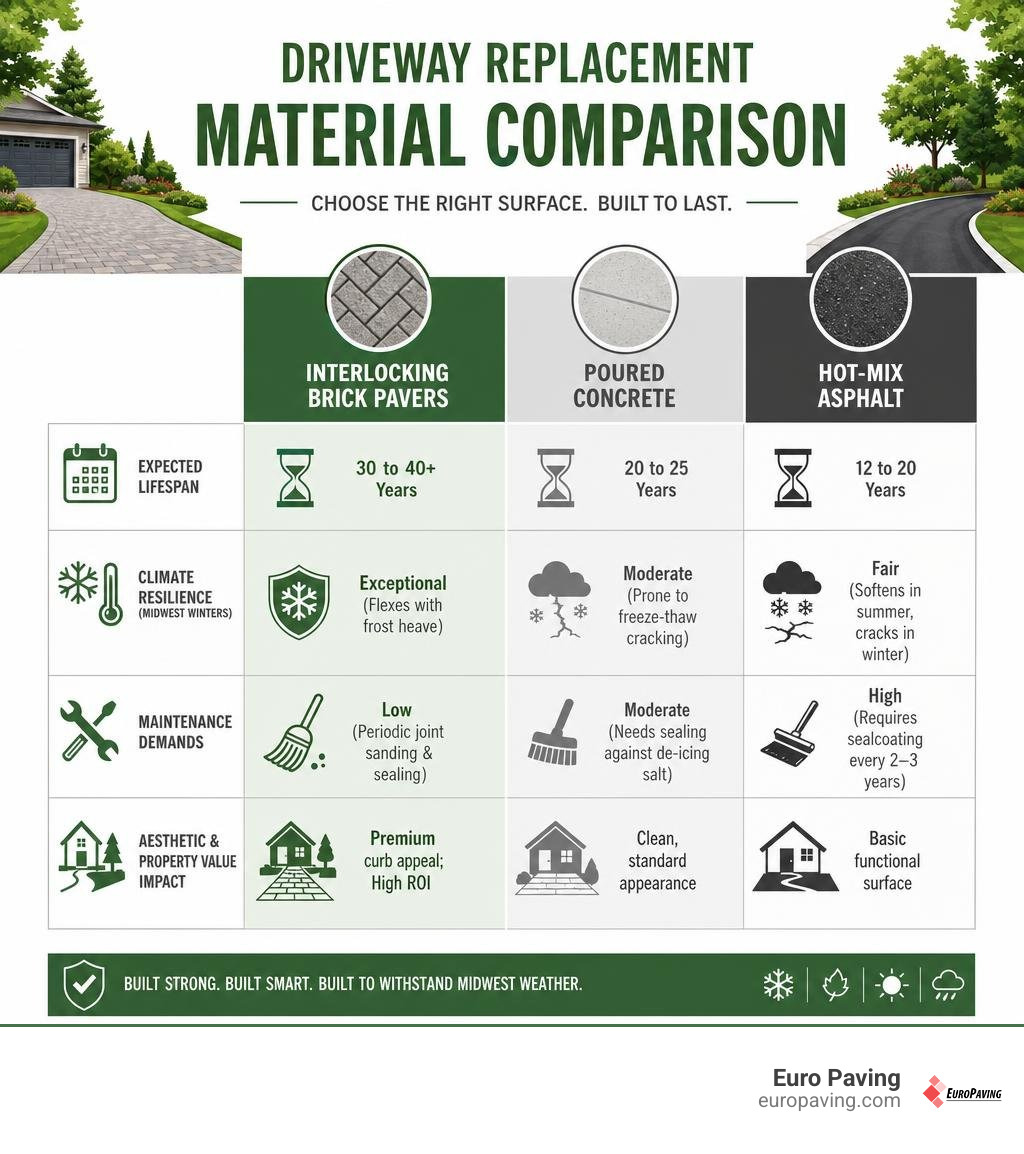
| Material Option | Expected Lifespan | Climate Resilience (Midwest Winters) | Maintenance Demands | Aesthetic & Property Value Impact |
|---|---|---|---|---|
| Interlocking Brick Pavers | 30 to 40+ Years | Exceptional (Flexes with frost heave) | Low (Periodic joint sanding & sealing) | Premium curb appeal; High ROI |
| Poured Concrete | 20 to 25 Years | Moderate (Prone to freeze-thaw cracking) | Moderate (Needs sealing against de-icing salt) | Clean, standard appearance |
| Hot-Mix Asphalt | 12 to 20 Years | Fair (Softens in summer, cracks in winter) | High (Requires sealcoating every 2–3 years) | Basic functional surface |
| Permeable Pavers | 30 to 40+ Years | Superior (Eliminates surface runoff) | Low (Occasional vacuuming of joints) | Eco-friendly premium aesthetic |
Paver Driveway Material Comparison
Traditional asphalt driveways require routine sealcoating every few years to slow down oxidation, yet they remain vulnerable to fuel spills, rutting, and edge unraveling. Poured concrete provides a cleaner finish but cannot withstand severe freeze-thaw stresses without eventually cracking across control joints.
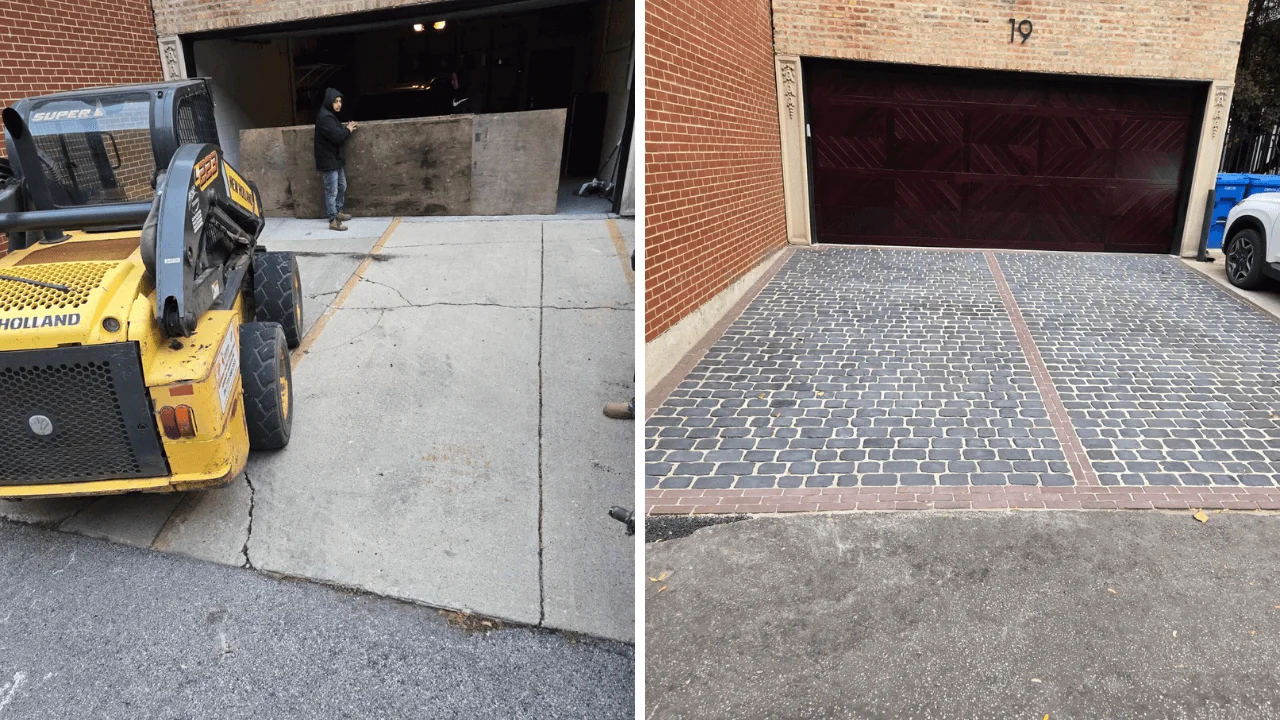
Interlocking concrete pavers outperform poured surfaces because individual units act as a flexible system. Instead of fighting thermal expansion and frost heave, pavers absorb micro-movements across jointing sand. If a sub-surface utility line ever requires repair, paver units can be lifted and reinstalled seamlessly—eliminating unsightly patches.
Choosing the Best Material for Driveway Replacement Near Me
At Euro Paving, we specialize in high-strength Unilock pavers engineered specifically for vehicle traffic and Midwest weather conditions. Featuring compressive strength ratings up to four times higher than standard poured concrete, Unilock products resist de-icing salts, oil stains, and UV fading.
Permeable paver installations offer an advanced, eco-friendly alternative for properties facing local stormwater management restrictions in municipalities like Hinsdale, Skokie, or Lake Forest. Permeable pavers feature wider joint voids filled with crushed aggregate, allowing heavy rainfall to drain directly into an underground stone reservoir. This eliminates standing puddles, reduces ice buildup in winter, and protects local storm sewer systems.
Step-by-Step Professional Replacement Process and Costs
A long-lasting driveway depends on meticulous sub-base preparation. Simply laying surfacing materials over unprepared soil leads to premature failure. To learn more about how we structure complete hardscaping projects, read our comprehensive guide to Finding the Best Driveway Paving Near Me: A Comprehensive Guide.
Property Preparation and Installation Stages
The replacement process begins with complete demolition and haul-away of existing asphalt or concrete. We excavate the site to a depth tailored to local soil conditions—typically 8 to 12 inches for residential vehicular applications.
- Subgrade Preparation & Geotextile Membrane: Soil is leveled and compacted. A heavy-duty woven geotextile fabric is laid to prevent native clay from mixing into the clean stone base.
- Dense Aggregate Base Installation: Crushed aggregate is applied in 2- to 3-inch lifts and compacted using high-impact mechanical equipment to establish a stable foundation.
- Slope and Drainage Pitch: The base is precisely graded with a minimum pitch of 1/8 inch per foot away from your home’s foundation and garage apron.
- Edge Restraints: Heavy-duty industrial edge restraints are staked into the base to securely lock pavers in place and prevent lateral shifting over time.
- Bedding Layer & Precision Installation: A 1-inch uniform layer of washed screed sand or fine aggregate is prepared, and pavers are laid in high-strength interlocking patterns such as herringbone.
- Joint Sanding & Compaction: Polymeric joint sand is swept across the surface and vibrated into joint voids using a padded plate compactor, creating a unified, weed-resistant barrier.
What to Expect During Driveway Replacement Near Me
Most residential paver driveway replacements are completed within 3 to 5 days, depending on square footage and site complexity.
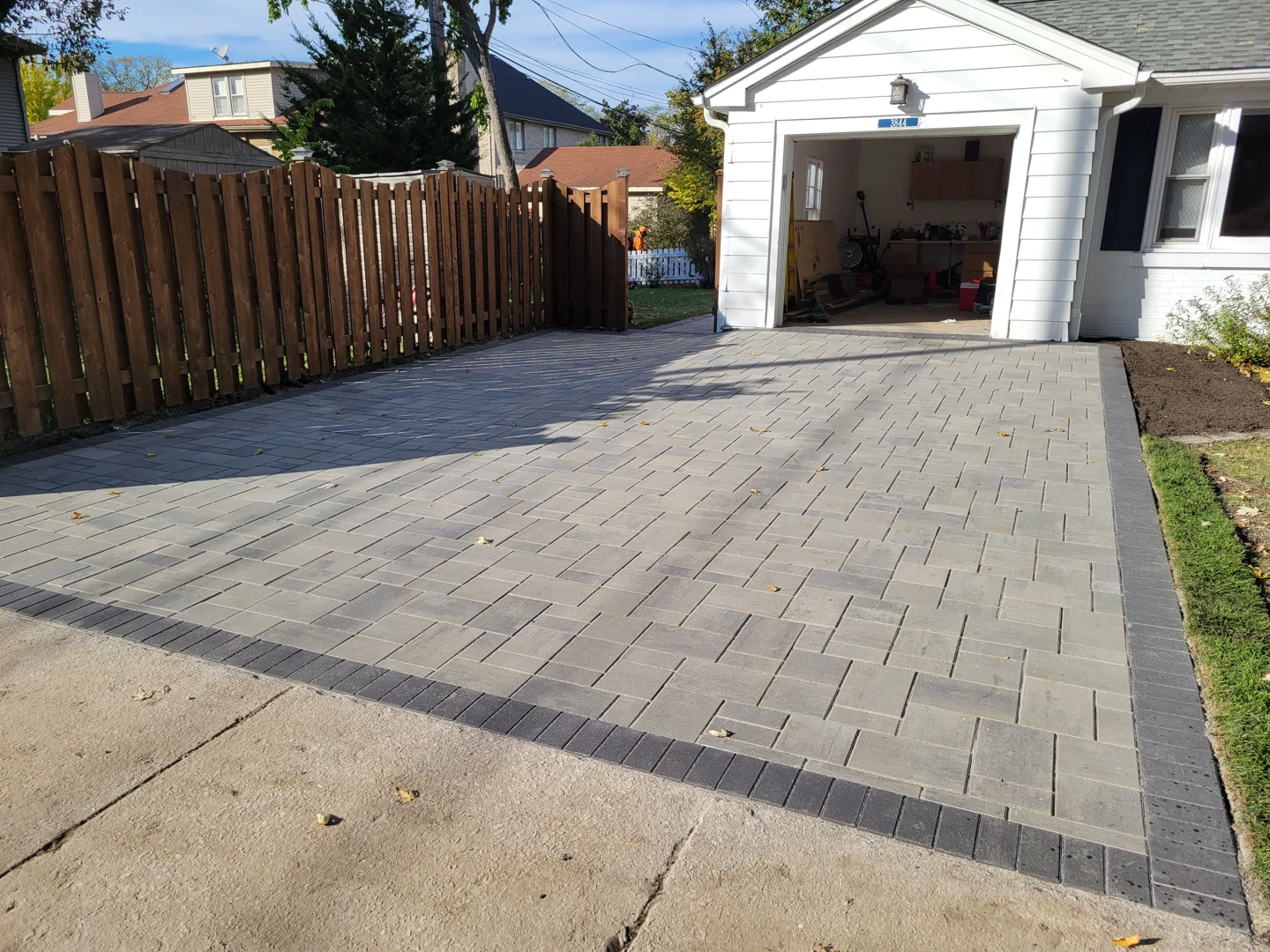
During demolition and base compaction, heavy machinery like skid steers and rollers will be active on site. Prior to work commencing, local utility locating services (such as JULIE in Illinois) must mark underground water, gas, and electrical lines. After joint sand compaction is complete, homeowners can immediately walk across a paver driveway. Vehicles can typically be parked on the surface as soon as the final compaction step is wrapped up.
Selecting a Qualified Contractor and Municipal Permitting
Replacing a residential driveway requires technical expertise in excavation, soil mechanics, and structural drainage. For advice on evaluating potential installation teams, check out our guide on Contractor Quest: Hiring the Right Team for Your Driveway.
When evaluating local contractors, verify that they carry comprehensive general liability and workers’ compensation insurance. As an authorized contractor, Euro Paving maintains strict quality controls, offering lifetime material guarantees on Unilock products along with robust structural installation warranties.
Essential Questions for Prospective Paving Contractors
Before signing a driveway contract, ask these critical questions to safeguard your investment:
- Are you an Authorized Contractor for the material manufacturer? (Ensures crews are certified in proper base assembly and edge restraint procedures.)
- What base depth and subgrade preparation do you specify for local clay soils? (Vehicular driveways require a deep, fully compacted aggregate sub-base.)
- Do you handle all municipal permitting and inspection scheduling? (Contractors should manage permits with local building departments in Cook and DuPage Counties.)
- Will you install geotextile stabilization fabric between clay soil and crushed base stone? (Crucial for preventing long-term driveway settlement.)
- What structural warranty do you provide on installation workmanship?
Permitting rules vary across Chicago suburbs. Municipalities like Arlington Heights, Downers Grove, Mount Prospect, and Highland Park enforce strict rules regarding property line setbacks, stormwater management, and street apron construction. Working with a fully licensed and bonded contractor ensures your project fully complies with all local building codes.
Long-Term Maintenance and Care
Interlocking paver driveways require remarkably little maintenance to retain their premium aesthetic.
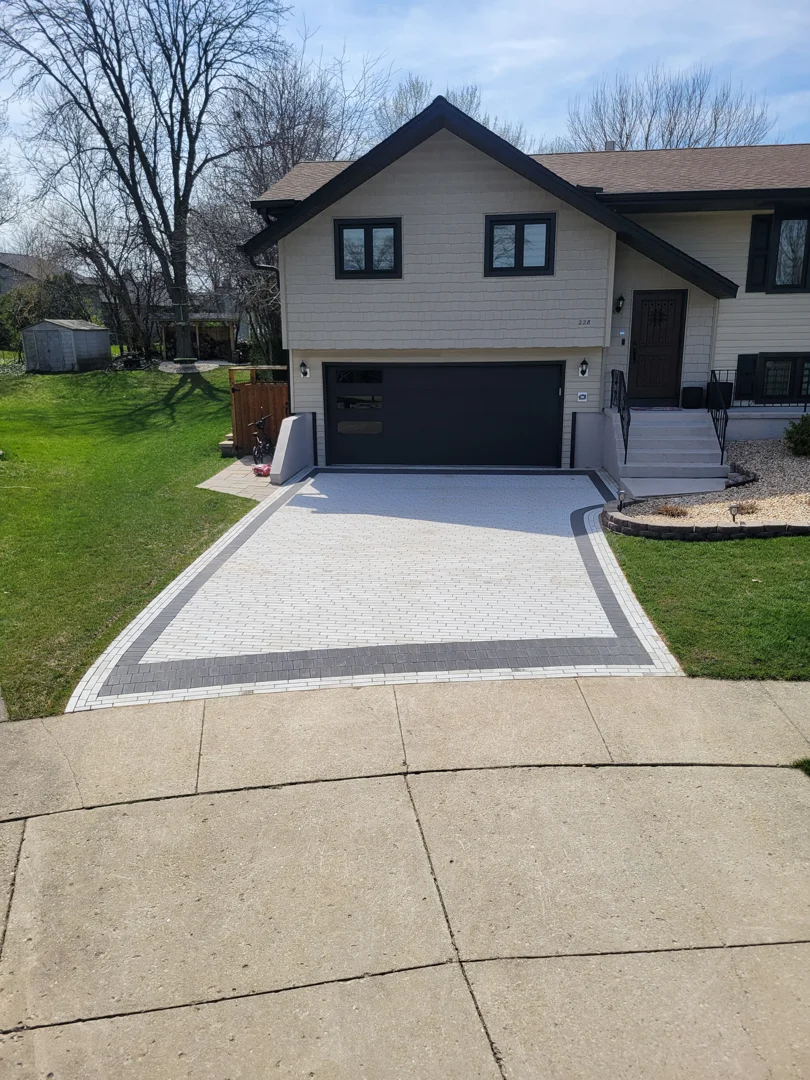
Applying a breathable, penetrating paver sealer every 3 to 5 years enhances color vibrancy, shields surfaces against oil drips, and makes winter snow clearing smoother. When removing snow, plastic blades or rubber edge guards on plows protect paver surfaces. Avoid using magnesium-based de-icers during the first winter season; instead, clean sand provides safe, non-corrosive traction across frozen driveways.
Frequently Asked Questions About Driveway Replacement
For additional insights into suburban paving projects, explore our resource on Driveway Paving Near Me: Your Chicago Guide.
How do I know if my driveway needs complete replacement instead of repair?
Complete replacement is required when you observe widespread cracking, severe foundation settling, standing water near your home, or significant spalling across large areas. If your driveway is over 20 years old and showing base failure, patching is only a short-term band-aid. Full replacement addresses root causes, restoring proper drainage and structural support.
How long does a driveway replacement take and when can I drive on it?
A standard paver driveway replacement takes 3 to 5 days from initial demolition to final compaction. Unlike poured concrete—which requires 7 full days of cure time before supporting vehicle weight—an interlocking paver driveway can be driven on immediately after installation and joint sanding are finished.
Do I need a municipal permit for driveway replacement in Chicago suburbs?
Yes, most municipalities across Cook and DuPage Counties require a building permit for driveway replacements, especially if you plan to modify the driveway width, alter public street aprons, or change site grade elevation. Euro Paving handles all permit filings, site plan submissions, and municipal inspection scheduling on behalf of our clients.
Conclusion
Searching for driveway replacement near me is the first step toward transforming your home’s exterior performance and curb appeal. Patching can temporarily mask minor flaws, but investing in a complete replacement using Unilock interlocking pavers delivers structural performance built to withstand Chicago’s toughest winters.
With nearly 20 years of experience serving suburban communities like Elmhurst, Hinsdale, Arlington Heights, Skokie, and Lake Forest, Euro Paving combines expert craftsmanship with advanced 3D design planning. From initial layout visualization to final site cleanup, our certified crews build custom driveways engineered for a lifetime of heavy use.
Ready to upgrade your driveway with premium materials backed by structural guarantees? Explore our complete Driveway Paving Services or visit our main guide to Upgrade Your Home’s Curb Appeal with Euro Paving to schedule your design consultation today!