



Understanding Concrete Driveway Resurfacing vs. Full Replacement
When evaluating options to upgrade a worn entrance, understanding the mechanics of a concrete overlay versus total removal is critical. Choosing between a targeted surface restoration and a structural rebuild comes down to the condition of the underlying slab.
What Is Concrete Driveway Overlay and Restoration?
A polymer-modified concrete overlay is a specialized blend of portland cement, graded aggregates, and synthetic polymer resins. Unlike traditional concrete pours requiring several inches of depth, polymer overlays form a monolithic chemical bond with existing concrete at application depths as thin as 1/16 inch up to 1/2 inch (with 1/4 inch being standard for residential driveways).
This process relies on an existing, structurally sound concrete base. The polymer additives provide superior flexural strength, adhesion, and moisture resistance compared to standard concrete mixes, allowing the new layer to adhere without flaking. If you are debating whether to resurface or replace your driveway today, evaluating your sub-base integrity is the first step.
Signs Your Home Needs Concrete Driveway Resurfacing
Resurfacing is an ideal solution when damage is isolated to the top layer of the slab. Common indicators include:
- Surface Scaling and Flaking: Often caused by harsh deicing chemicals breaking down the upper concrete paste.
- Hairline and Spider Cracks: Non-structural surface crazing that has not compromised the full depth of the slab.
- Pitting and Pop-Outs: Small craters caused by moisture freezing inside porous aggregate particles during Chicago winters.
- Cosmetic Discoloration: Faded, stained, or aged concrete that detracts from your home’s curb appeal.
For minor cracking issues, detailed concrete driveway crack repair in chicago 2026 guide techniques can prepare the surface for a smooth topcoat.
When Complete Concrete Replacement Is Mandatory
Resurfacing cannot fix structural failure. Applying a thin polymer layer over a failing foundation will lead to premature cracking and peeling. Complete concrete replacement or conversion to heavy-duty brick paving is required if your driveway exhibits:
- Deep Structural Breaks: Cracks wider than 1/4 inch or vertical displacement where one side of the slab has shifted higher than the other.
- Severe Slab Settlement or Heaving: Deep sub-base erosion or frost heaving that creates severe slope issues.
- Compromised Gravel Base: Hollow sounds when tapping the concrete, indicating large voids underneath the slab.
- Widespread Drainage Failure: Persistent standing water that pools toward your home foundation due to poor grading.
In cases involving deep structural settling, address issues like fixing the foundation of your sinking driveway before planning any surface work.
Comparing Driveway Restoration Options: Benefits, Lifespan, and Costs
Selecting the right driveway material requires evaluating upfront investment, long-term maintenance, and performance in northern Illinois weather.
| Criteria | Concrete Resurfacing | Full Concrete Replacement | Premium Unilock Brick Pavers |
|---|---|---|---|
| Primary Benefit | Restores surface finish rapidly | Brand-new structural foundation | Maximum curb appeal, zero cracking |
| Typical Lifespan | 10 to 15 years | 25 to 30 years | 30 to 50+ years (Lifetime Warranty) |
| Project Timeline | 1 to 2 days | 3 to 5 days | 3 to 5 days |
| Midwest Winter Durability | Moderate (requires sealing) | Moderate (susceptible to salt) | Exceptional (flexible joints prevent cracking) |
| Maintenance Level | Reseal every 2–3 years | Reseal every 2–3 years | Low (occasional joint sand sweep) |
Cost Factors for Concrete Driveway Resurfacing
The overall investment for a resurfacing project depends on several technical variables:
- Surface Preparation Requirements: Extensive diamond grinding, shot-blasting, or heavy chemical degreasing increases labor time prior to application.
- Crack and Spall Repairs: Filling deep pitting or stabilizing dynamic cracks with high-performance epoxy mortars adds to material costs.
- Square Footage and Layout: Larger multi-car driveways yield economies of scale per square foot compared to small apron repairs.
- Custom Decorative Finishes: Incorporating integral color stains, stamped masonry textures, or borders requires specialized installation expertise.
To learn more about tailored installation plans, read our driveway solutions for your chicago home 2026 guide. Technical specifications like those found in the MAPEI Concrete Renew Technical Specs detail how polymer ratios affect performance in freeze-thaw environments.
Longevity and Durability in Midwest Winters
A professionally installed polymer-modified overlay delivers 10 to 15 years of service. In contrast, alternative surfaces have distinct lifespans: resin-bound systems last 10–20 years, tarmac lasts 12–15 years (or up to 20 with high-grade sealants), and tar and chip driveways last up to 10 years.
In communities like Elmhurst and Hinsdale, temperature swings cause water inside concrete pores to expand by nearly 9% when freezing. Polymer-modified overlays provide improved flexural strength and lower permeability, helping them resist winter cracking better than standard concrete mixes.
Professional Overlay Materials and Decorative Design Finishes
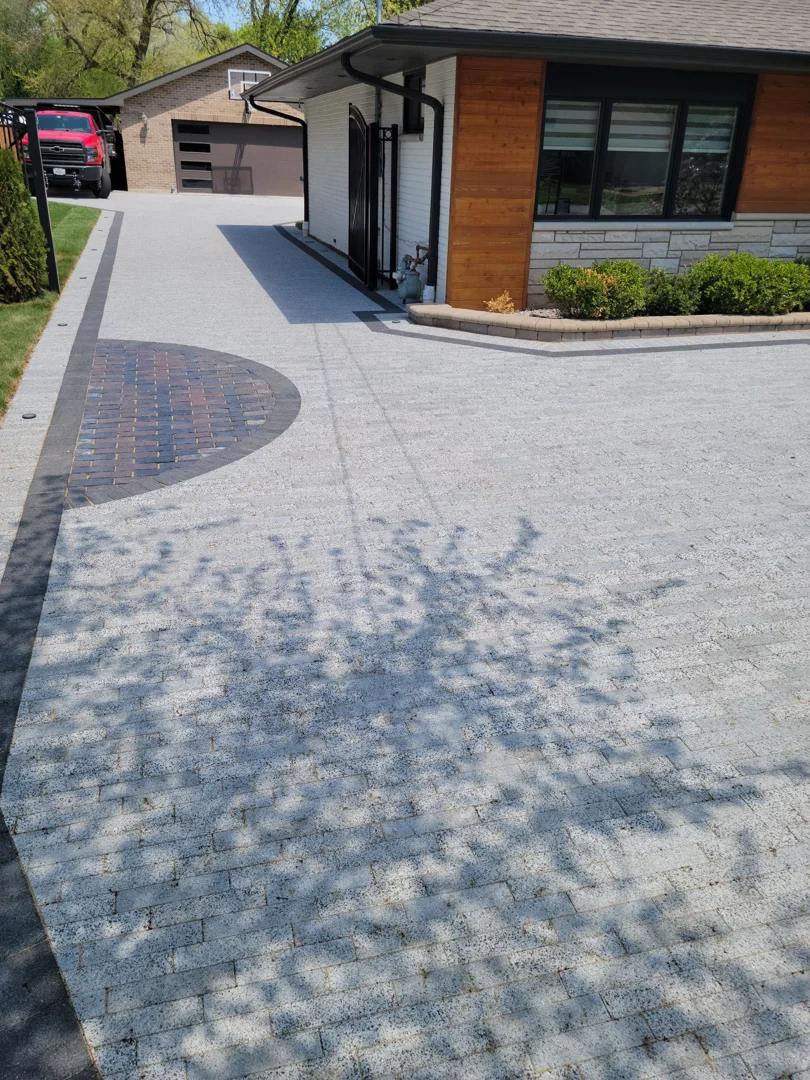
Modern concrete restoration materials do more than cover imperfections—they allow property owners to customize colors, textures, and architectural styles.
Manufacturers formulate products like those in the QUIKRETE Concrete Resurfacer Technical Data with high-early-strength cements and polymer cross-linkers. These achieving compressive strengths exceeding 4,000 to 6,000 PSI after full 28-day curing.
Popular decorative finishes for residential properties in Mount Prospect and Arlington Heights include:
- Broom Finish Textures: A fine-textured, anti-slip surface created by drawing a specialized concrete broom across wet mix, providing reliable vehicle traction.
- Stamped Masonry Patterns: Thin-stamped overlays applied at 1/4 to 3/8 inch thickness, imprinted with rubber stamps to mimic flagstone, slate, or ashlar cut stone.
- Integral Color Stains: UV-stable pigments mixed directly into the polymer matrix or applied topically to add depth and warmth to gray concrete.
Residential vs. Commercial Driveway Restoration Needs
Residential driveways primarily handle passenger vehicles and light pickup trucks, where aesthetic detail is top priority. Commercial sites in Norridge require heavy-duty performance. Commercial parking areas, loading aprons, and multi-family driveways demand specialized, vehicle-rated polymer overlays mixed with additives like latex modifiers to withstand high wheel loads and rolling abrasion.
As a full-service concrete contractor, we evaluate load calculations and surface traffic profiles before recommending an overlay system.
The Step-by-Step Professional Concrete Overlay Process
Proper installation requires rigorous surface prep and strict execution. Skipping mechanical surface preparation is the leading cause of overlay delamination.
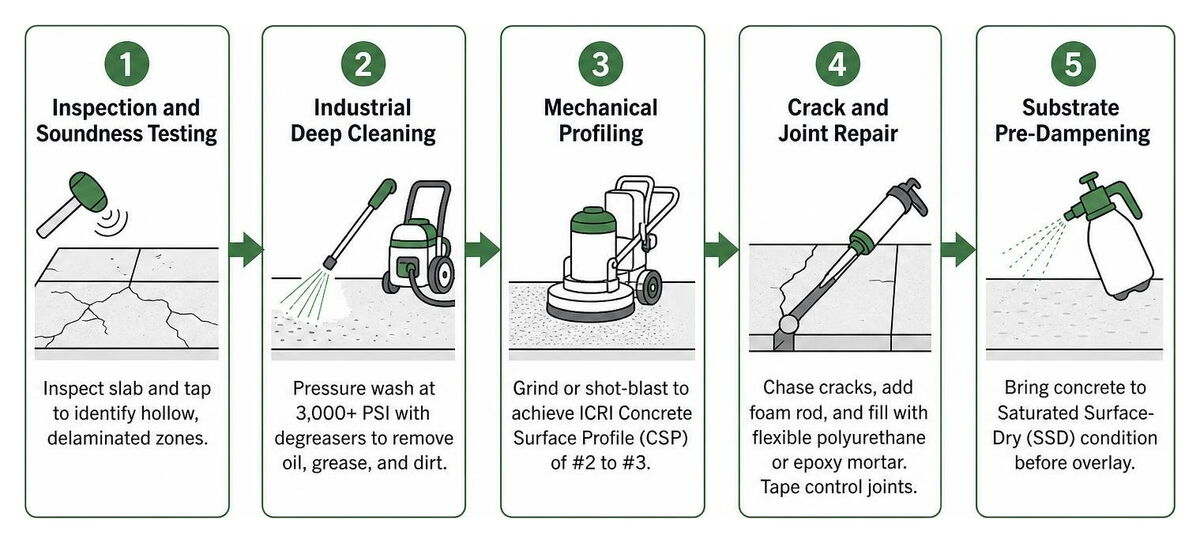
- Inspection and Soundness Testing: We inspect the entire slab, tapping the surface to identify hollow, delaminated zones that require full excavation.
- Industrial Deep Cleaning: The driveway is pressure washed using industrial equipment rated at 3,000 PSI or higher, combined with commercial degreasers to remove oil, grease, and dirt.
- Mechanical Profiling: We grind or shot-blast the surface to reach an ICRI Concrete Surface Profile (CSP) of #2 to #3, creating an open-pore texture for physical bonding.
- Crack and Joint Repair: Cracks are chased with a diamond blade, backed with foam rod, and filled with flexible polyurethane or epoxy repair mortar. Control joints are taped off to prevent bridging.
- Substrate Pre-Dampening: The concrete is brought to a Saturated Surface-Dry (SSD) condition to prevent the dry slab from drawing moisture out of the new overlay mix.
- Scrub Coat and Overlay Spreading: A thin scrub coat is worked into the concrete pores using squeegees. A polymer resurfacer is poured and spread uniformly across the driveway.
- Texturing and Finishing: Within a 20-to-30-minute working window, crews apply a broom, trowel, or stamped finish before the material sets.
- Curing and Sealing: After 24 hours of curing, a breathable, penetrating concrete sealer is applied to shield against water intrusion, UV rays, and road salts.
For further application details, consult The Concrete Resurfacer Application Guide.
How to Choose a Qualified Driveway Contractor in Chicago
Choosing the right partner ensures your investment yields long-lasting results. When searching for driveway paving near me, look for key credentials:
- Mechanical Preparation Capabilities: Ensure the contractor utilizes industrial diamond grinders rather than relying on quick acid washing.
- Winter Warranty Protection: Verify that the company offers clear warranty terms covering bond strength and resistance to scaling.
- Proven Midwest Experience: Request a portfolio of completed local projects subjected to past Chicago freeze-thaw seasons.
- Comprehensive Hardscaping Expertise: Select a team capable of assessing whether resurfacing or a complete upgrade to interlocking pavers offers the best long-term return on investment.
Frequently Asked Questions about Concrete Driveways
How long does a resurfaced driveway take to cure before driving?
Foot traffic is typically safe after 24 hours. Vehicle parking and driving require waiting 48 to 72 hours, depending on ambient temperatures and humidity levels.
Can resurfacing fix deep cracks or sunken concrete slabs?
No. Resurfacing will not repair active structural movement or sunken slabs. Wide cracks must be structurally stabilized, and sunken sections raised via mudjacking or polyurethane foam injection before applying an overlay; otherwise, cracks will transfer right up through the new coat.
How do I maintain a resurfaced driveway during Chicago winters?
Reapply a quality concrete sealer every 2 to 3 years to block water absorption. Avoid harsh chemical deicing salts (sodium chloride) during the first winter—use sand or kitty litter for traction instead. Also, fit snowplow blades with protective rubber edges to prevent surface scraping.
Transform Your Driveway with Euro Paving
While concrete driveway resurfacing offers an effective way to restore aging concrete, homeowners seeking a permanent, high-end upgrade often choose interlocking brick pavers. Brick paver systems eliminate cracking, resist severe freeze-thaw cycles, and dramatically enhance your property’s overall curb appeal.
At Euro Paving, we bring nearly 20 years of expertise as an Unilock Authorized Contractor, delivering premium hardscaping solutions across Chicago and surrounding suburbs—including Elmhurst, Hinsdale, Mount Prospect, Norridge, Arlington Heights, Cook County, and DuPage County.
From initial 3D paving design and planning to precision installation backed by lifetime Unilock material guarantees, our expert team ensures your project is built to last. Explore our custom brick paving driveways solutions or schedule a consultation with our paving specialists today to create a stunning entrance for your home.