



A Small Hole in Your Concrete Driveway Is a Bigger Problem Than It Looks
A hole in a concrete driveway is rarely just a cosmetic issue — left alone, it almost always gets worse, threatening the structural integrity of your entire property entrance.
Here is how professional contractors evaluate and address the issue:
- Surface Assessment: Identifying whether the pitting is cosmetic scaling or a symptom of deep sub-base failure.
- Sub-Base Stabilization: Addressing the underlying soil erosion and gravel compaction before applying any surface materials.
- High-Strength Restoration: Utilizing commercial-grade polymer-modified concrete and bonding agents for a permanent, structural repair.
- Long-Term Prevention: Upgrading to highly durable, flexible paving systems like Unilock interlocking brick pavers to eliminate cracking entirely.
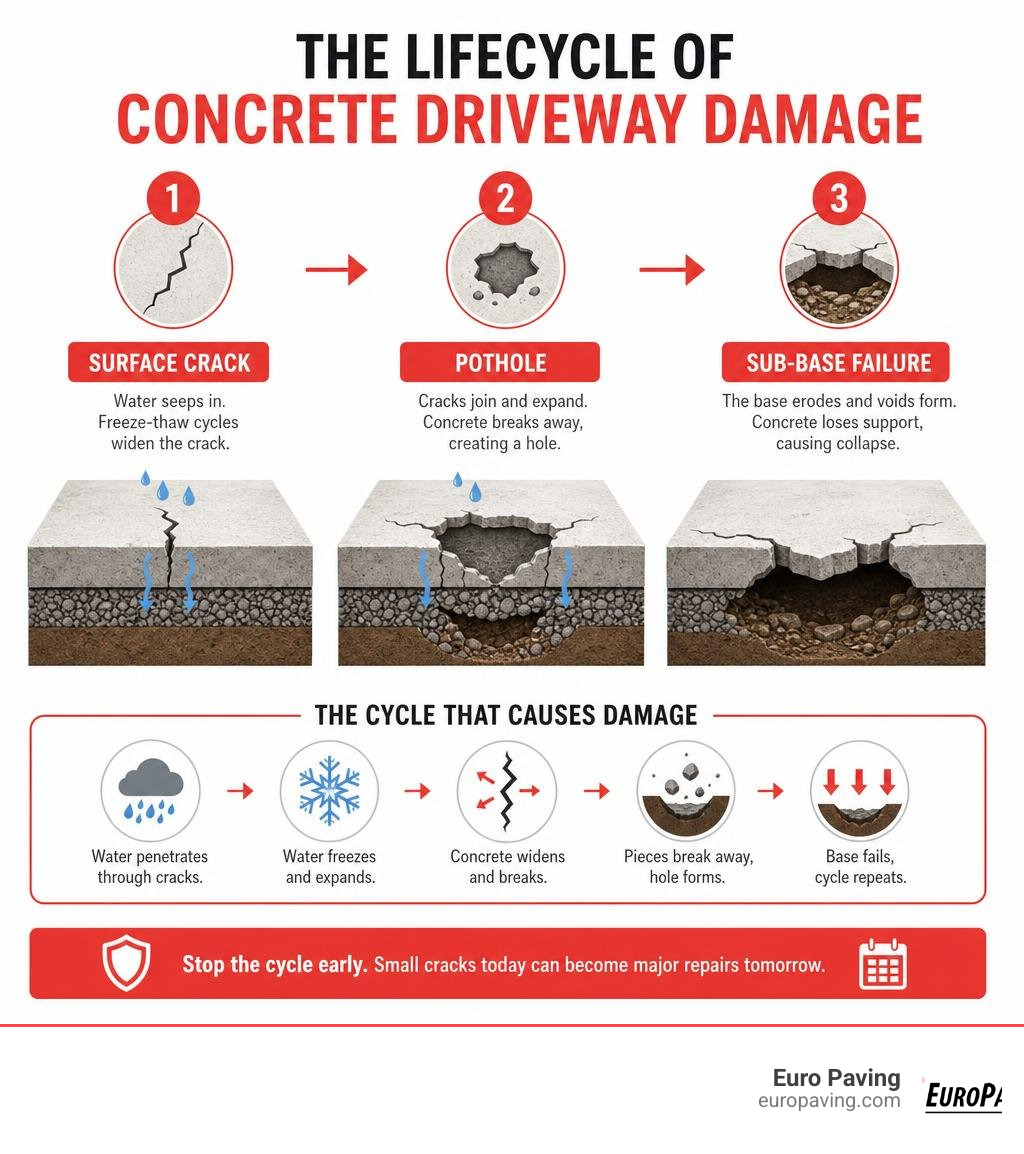
Nearly 30% of concrete surfaces show signs of distress within the first few years. Water seeps into small cracks, freezes, expands, and breaks the concrete apart — cycle after cycle. Chicago-area winters are especially brutal, with 30–50 freeze-thaw cycles per season putting constant stress on rigid, unprotected concrete surfaces.
While temporary patches exist, achieving a permanent, high-durability finish requires professional-grade materials and expert execution. Understanding the root cause of the damage is the first step toward protecting your property investment.
Simple hole in concrete driveway glossary:
What Causes a Hole in Concrete Driveway Surfaces?
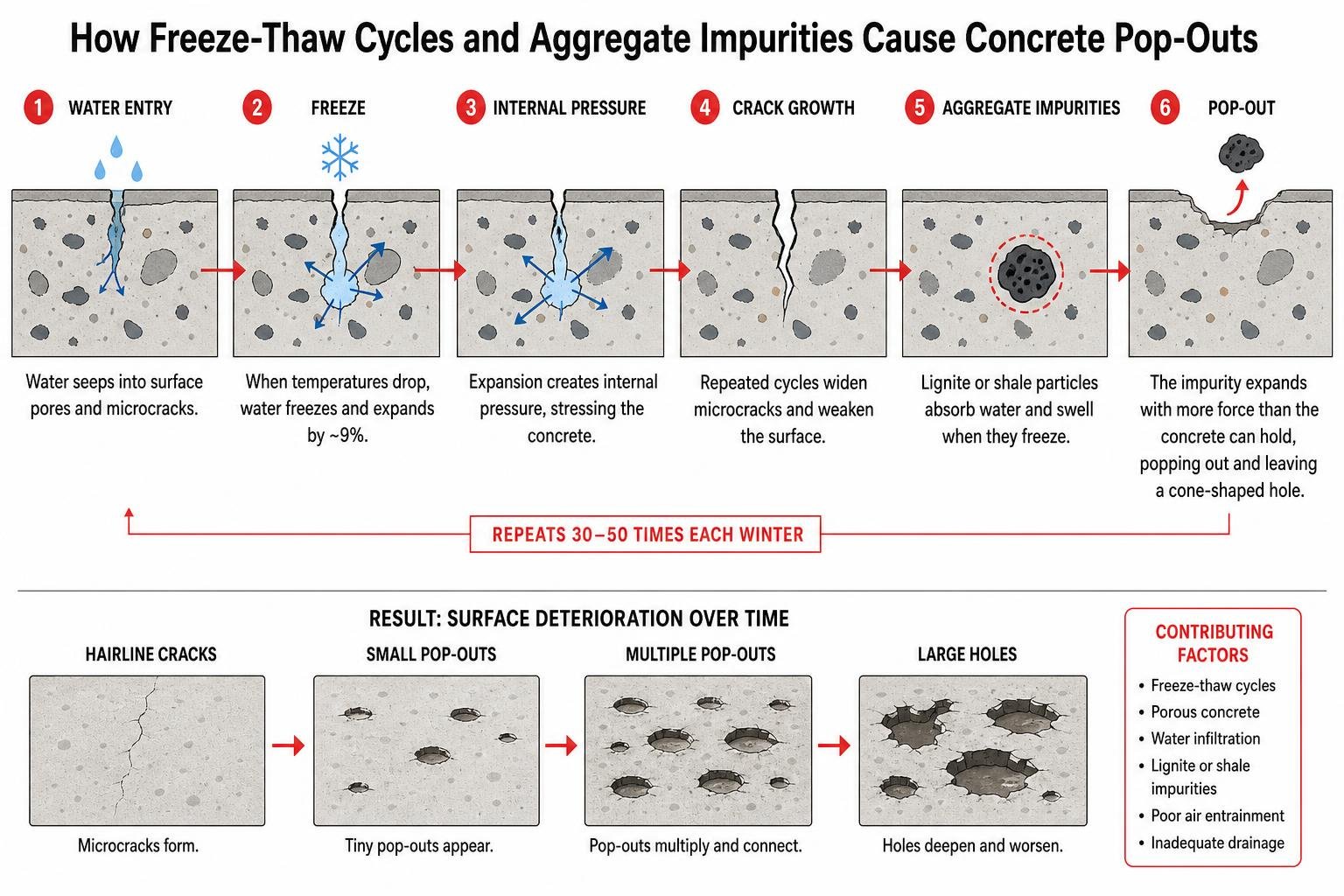
To fix a hole in a concrete driveway permanently, we must first play detective. Concrete looks like solid stone, but it is actually a porous, rigid sponge. When water penetrates these pores and freezes, it expands by roughly 9%. This expansion exerts immense internal pressure on the concrete.
In Northern Illinois—including areas we serve like Norridge, Skokie, and Glenview—the freeze-thaw cycle repeats 30 to 50 times every single winter. This constant expanding and contracting rapidly turns microscopic fissures into gaping craters.
Another major culprit is the soil beneath the slab. Clay-rich Illinois soil retains water, leading to dramatic frost heaves during winter and shrinkage during dry summer months. This shifting leaves voids under the concrete, causing the unsupported slab to crack and collapse under the weight of family vehicles.
Additionally, many pop-outs are caused by impurities in the concrete aggregate itself. If you want to dive deeper into the material science of why these pop-outs occur, you can learn more about lignite and shale pop-outs. Lignite and shale particles are lightweight, highly absorbent carbons that sometimes end up in the sand mix. When they absorb water and freeze near the surface, they expand with force greater than the concrete’s tensile strength, popping out to leave a cone-shaped crater.
Identifying a Tiny Hole in Concrete Driveway Slabs
Not all holes are created equal. If your driveway looks like it has been peppered with miniature craters, you are likely dealing with one of three surface defects:
- Pinholes (Bugholes): These tiny voids (typically 1/32 to 1/8 inch across) are cosmetic imperfections. They occur during the original pour if air bubbles or bleed water are trapped just beneath the surface because the finishing crew troweled the concrete too early.
- Pop-outs: These are distinct, cone-shaped craters ranging from 1 to 3 inches in size. They leave a clean, circular void where a piece of aggregate (often shale or lignite) once sat before moisture forced it to break free.
- Scaling and Spalling: This looks like thin, dusty sheets or flakes peeling off the surface, exposing the rough aggregate underneath. It is usually caused by poor concrete mix design, premature finishing, or heavy exposure to harsh deicing salts during winters in the Chicago area.
Ignoring these tiny pockmarks is an open invitation for rapid deterioration. To keep your driveway from scaling further, check out our guide on preventing driveway crumbling.
Diagnosing a Deep Hole in Concrete Driveway Sections
When a hole in a concrete driveway exceeds 1 inch in depth or spans several inches in width, it crosses the line from cosmetic annoyance to structural hazard. Deep holes and potholes are highly vulnerable to heavy rains, snow accumulation, and vehicle traffic.
If you notice a deep hole, you must assess whether the sub-base has been compromised. The sub-base is the compacted gravel and sand foundation that supports the heavy concrete slab. Signs of sub-base failure include:
- A hollow sound when you tap the concrete around the hole with a hammer.
- Sunken or uneven sections of concrete sloping toward the hole.
- Cracks that reappear in the exact same spot shortly after being patched.
Often, soil erosion at the edges of the driveway washes away this crucial foundation. If you are struggling with deeper craters, you can find advanced troubleshooting tips in our guide on fixing concrete potholes.
Professional Restoration and Structural Repair of Concrete Driveway Holes
If the surrounding concrete is structurally sound and the sub-base is stable, professional patching and resurfacing can restore your driveway’s smooth surface. However, simply throwing standard retail concrete into a dry hole guarantees a failed repair within a few weeks.
To achieve a structural bond that withstands heavy vehicle traffic and brutal Chicago winters, professional contractors follow a rigorous preparation and installation process.
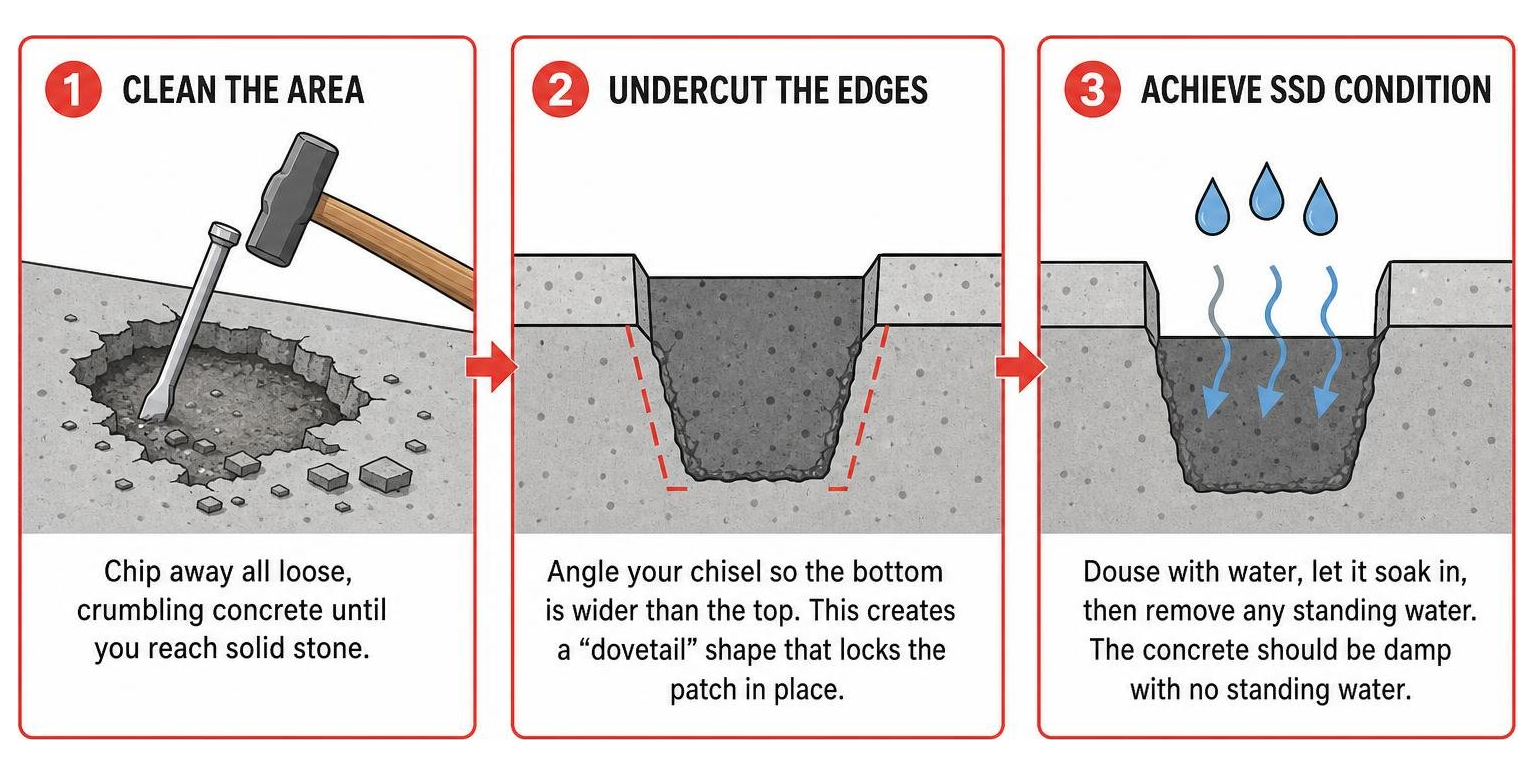
- Mechanical Excavation: Technicians use industrial chisels and saws to cut away all loose, crumbling concrete until they reach solid, sound aggregate.
- Undercutting the Edges: Instead of feathering the edges, professionals angle the cuts to make the bottom of the hole wider than the top. This creates a mechanical “dovetail” lock that prevents the patch from popping out.
- Saturated Surface Dry (SSD) Conditioning: Dry concrete is highly absorbent. If new patching compound is placed directly into a dry hole, the old concrete sucks the moisture out of the mix, starving it of the water needed for proper hydration. This causes shrinkage, cracking, and premature failure. Professionals douse the area and blow out standing water to ensure the concrete is damp but free of puddles.
For a comprehensive breakdown of the preparation tools and curing times, refer to this step-by-step concrete repair guide.
Commercial-Grade Solutions for Deep Potholes and Structural Voids
For deep holes and structural voids, standard retail vinyl patchers are insufficient. Professional contractors utilize high-strength, polymer-modified concrete mixes engineered for maximum compressive strength and minimal shrinkage.
- Bonding Agents: Industrial-grade acrylic or epoxy bonding adhesives are applied directly to the prepared cavity walls to chemically fuse the old and new concrete.
- Aggregate Reinforcement: For deep voids, clean #8 pea gravel is integrated into the high-strength mix to add structural integrity and prevent thermal cracking.
- Moist Curing: Professional installations are kept under controlled moisture conditions or sealed with curing compounds for 3 to 7 days, allowing the concrete to complete its hydration process and reach its full load-bearing capacity.
To avoid common pitfalls during larger driveway overhauls, check out our guide on avoiding common renovation problems.
Why Simple Patching Often Fails Without Professional Sealing
Many property owners find themselves patching the exact same hole in concrete driveway sections year after year. Why? Because patching only fills the void—it does not stop the water penetration that caused the damage in the first place.
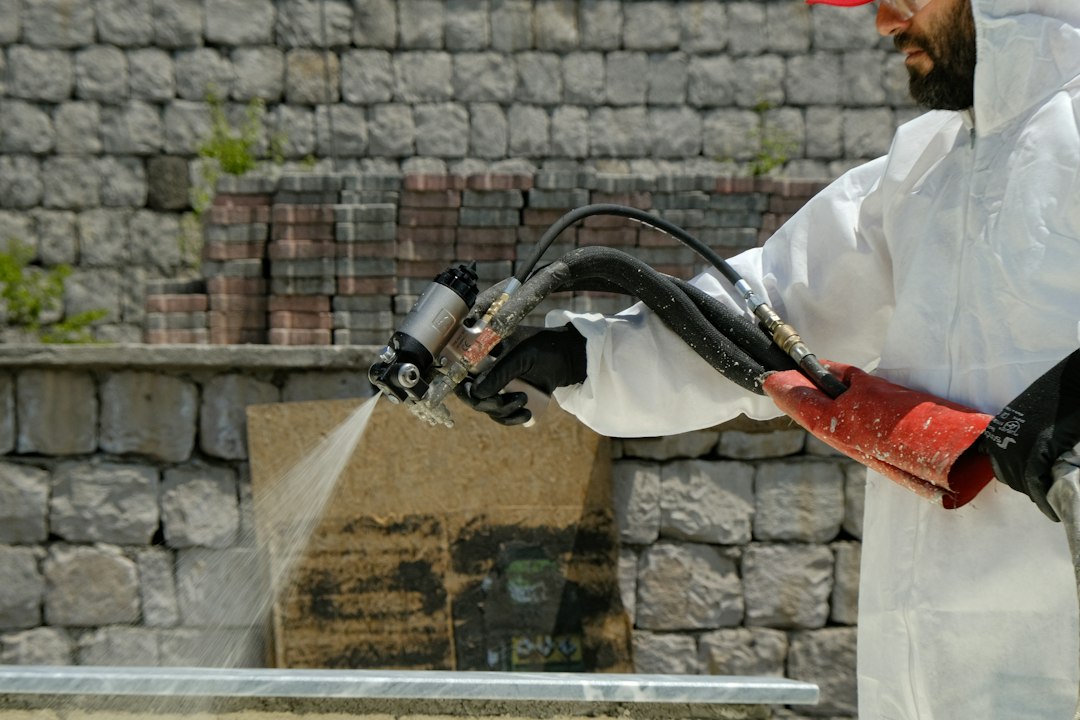
When you patch concrete, you create a cold joint—a seam where the new concrete meets the old. Water easily penetrates this seam. When winter hits, that trapped water freezes, expands, and pops the patch right back out.
Furthermore, filling a hole with standard concrete often results in a glaring color mismatch, leaving your driveway looking like it has a bad case of chickenpox.
To prevent this, professional contractors apply a high-quality penetrating sealer (such as a silane-siloxane formula) over the entire driveway once the patch has cured for 28 days. Penetrating sealers chemically react with the concrete to form a hydrophobic barrier inside the pores, keeping water and road salts out while allowing vapor to escape. Sealing your driveway can extend its lifespan by up to 50%!
| Feature | Temporary DIY Patching | Professional Sealing & Restoration |
|---|---|---|
| Water Resistance | Low (water penetrates the cold joint) | High (hydrophobic barrier repels moisture) |
| Lifespan | 1 to 2 seasons | 5 to 10+ years |
| Aesthetics | Visible color patches (“chickenpox” effect) | Uniform, clean, and blended appearance |
| Freeze-Thaw Protection | None | Excellent (stops water expansion damage) |
When to Choose Professional Restoration Over DIY Repair
While patching a small hole in concrete driveway slabs might seem like a quick fix, there are times when temporary repairs are simply a band-aid on a major structural wound.
You should step away from temporary fixes and call in professional paving contractors if you notice:
- Deep Structural Cracks: Cracks wider than 1/2 inch that run completely through the slab.
- Sunken or Heaving Slabs: Sections of your driveway that have dropped or risen by an inch or more, creating dangerous trip hazards and vehicle damage risks.
- Widespread Spalling: Surface scaling that covers more than 20% of your driveway.
- Poor Drainage: Standing water that remains on your driveway or commercial parking lot for more than 30 minutes after a heavy rain.
In these cases, the underlying foundation is compromised. Simply throwing patching compound over the surface will not stop the slab from continuing to sink or crack.
At Europa Paving, we specialize in transforming failing, cracked concrete driveways into stunning, durable hardscapes. Serving the Chicago Area—including Cook and DuPage Counties, Hinsdale, Mount Prospect, and Arlington Heights—we understand how local soils and brutal winters impact your property. If your driveway is suffering from poor grading or drainage issues, read our guide on preventing drainage issues to protect your home’s foundation.
Frequently Asked Questions About Concrete Driveway Holes
Why do small holes keep appearing in my concrete driveway?
Small, recurring holes are typically caused by aggregate pop-outs (lignite or shale expanding when wet and frozen) or surface scaling from harsh winter deicers. In the Chicago area, road salt carried home on your car’s tires melts snow, which then sinks into the concrete pores and refreezes, popping off the top layer of concrete. Upgrading to high-durability brick paving completely eliminates this issue.
Can I use regular concrete mix to patch a shallow hole?
No. Standard concrete mix contains large gravel aggregates that require a thickness of at least 2 inches to settle and bond properly. If you try to use it for a shallow hole (under 1 inch), the mix will quickly crumble and break apart. Professional contractors use specialized polymer-modified compounds or recommend a complete driveway replacement for long-term durability.
How long should I wait to drive on a repaired concrete driveway?
For small, shallow patches using professional vinyl compounds, keep foot traffic off for 24 hours and vehicles off for 48 hours. For deep structural repairs using high-strength concrete, keep vehicles off the driveway for a minimum of 3 to 7 days to allow the patch to gain structural strength.
Conclusion
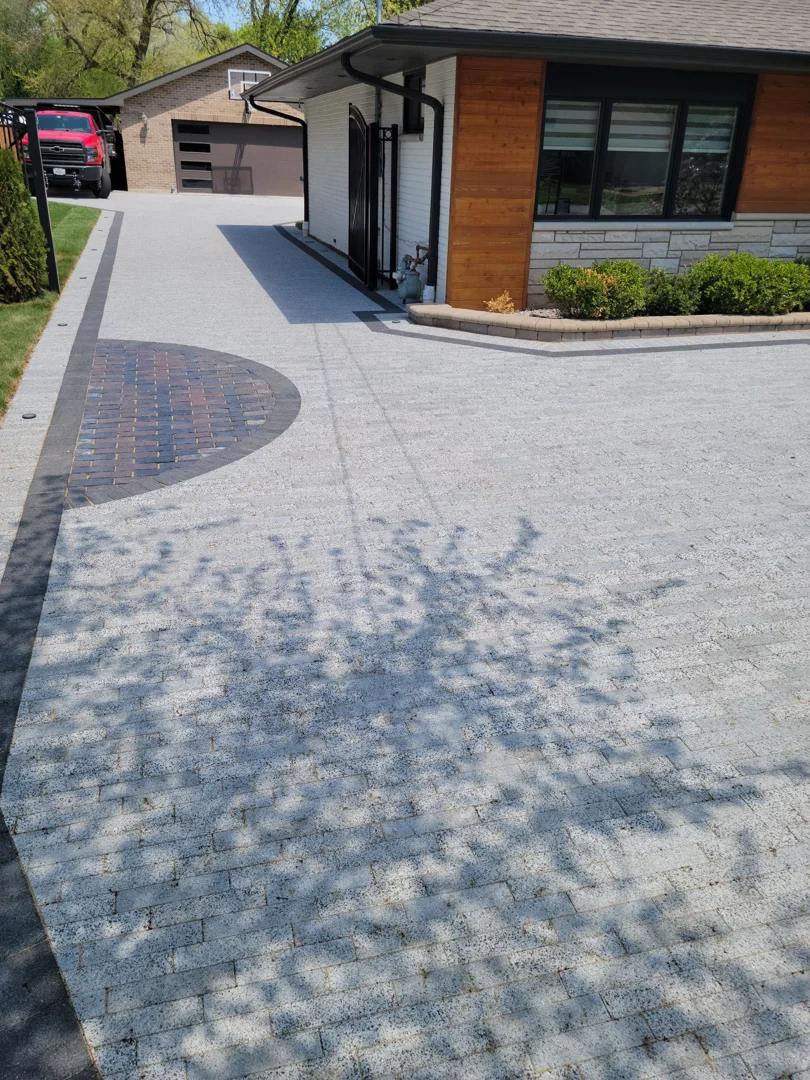
A hole in a concrete driveway is more than just an eyesore—it is a ticking clock. What starts as a tiny surface pop-out this summer can easily turn into a tire-popping pothole after the next brutal Illinois winter. While small repairs can be managed with a little elbow grease and the right patching compounds, extensive damage requires a permanent, high-end solution.
If you are tired of dealing with cracking, scaling, and sinking concrete, it might be time to elevate your home’s curb appeal with a premium, long-lasting alternative.
At Europa Paving, we specialize in custom brick patios, outdoor kitchens, and stunning brick paving driveways. We serve homeowners across the Chicago suburbs—including Elmhurst, Hinsdale, Mount Prospect, Norridge, and Arlington Heights. Unlike rigid concrete, our interlocking brick pavers are flexible, allowing them to naturally adjust to winter frost heaves without cracking. Plus, they add unmatched elegance and value to your property.
Ready to say goodbye to ugly concrete patches forever? Transform your driveway with Euro Paving’s professional brick paving services and let us help you design a beautiful, family-friendly outdoor space that lasts a lifetime.