



Your Driveway Is Sending You a Warning — Are You Listening?
A cracked driveway fix is something most Chicago-area homeowners need sooner than they expect — especially after another brutal Cook County winter.
Here’s a quick overview of how to fix driveway cracks:
- Clean the crack — Remove debris, weeds, and loose material with a wire brush or pressure washer
- Choose your filler — Self-leveling sealant for narrow cracks; patching compound for wider ones
- Use backer rod — For cracks deeper than 1/2 inch, insert foam backer rod first
- Fill and smooth — Apply filler, smooth level with the surface, let cure
- Seal the driveway — Apply sealcoat after repairs to protect against water and UV damage
For lasting results, professional repair is strongly recommended — especially for cracks showing structural damage.
Small cracks are easy to ignore. But in the Chicago suburbs, they rarely stay small.
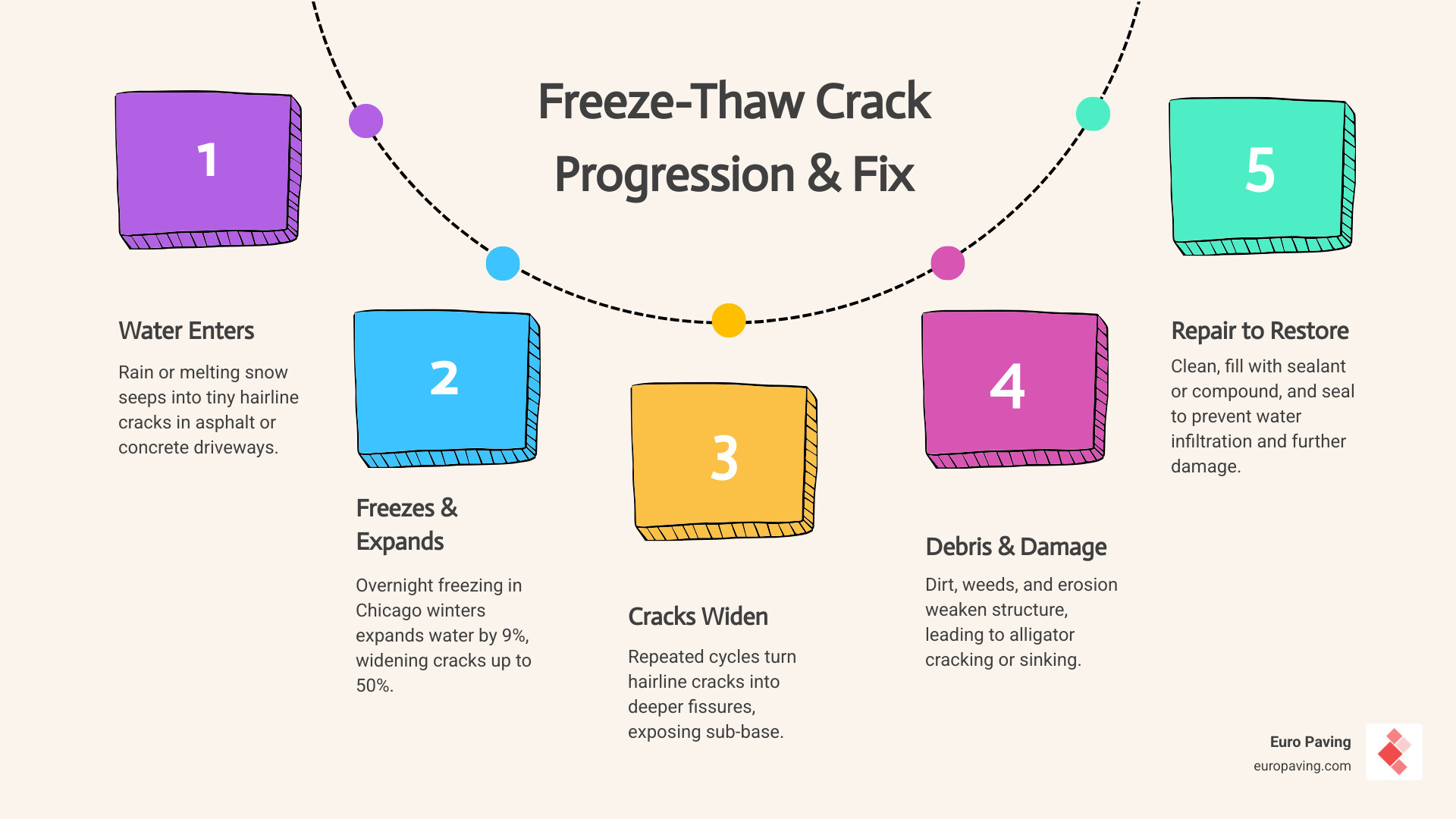
Every spring, freeze-thaw cycles do their damage. Water seeps into a hairline crack, freezes overnight, expands, and forces that crack wider. By the time you notice it, what started as a surface blemish may already signal something deeper — an unstable sub-base, drainage problems, or structural failure.
And it’s not just a functional issue. A cracked, deteriorating driveway is the first thing guests — and potential buyers — see when they pull up to your home.
The good news: caught early, most driveway cracks are fixable. The key is knowing what type of crack you’re dealing with, using the right materials, and not skipping preparation.
Cracked driveway fix terms to learn:
Identifying the Root Cause of Your Cracked Driveway Fix
Before we can implement a lasting cracked driveway fix, we must understand why the pavement failed in the first place. In the Chicago area—from Arlington Heights to Downers Grove—our driveways face a unique set of environmental stressors.
Freeze-Thaw Cycles and Soil Erosion
The primary culprit in our region is the relentless freeze-thaw cycle. In April 2026, we are seeing the aftermath of a typical Illinois winter. When water enters a crack and freezes, it expands with immense force. This cycle happens dozens of times per season, effectively “jackhammering” your driveway from the inside out. Furthermore, poor drainage can lead to soil erosion beneath the slab, leaving the concrete or asphalt unsupported.
Tree Roots and Heavy Vehicles
Nature and utility also play their parts. Large trees near driveways in suburbs like Lake Forest or Barrington often have root systems that exert upward pressure, causing “heaving.” Additionally, while driveways are built for passenger cars, frequent deliveries from heavy freight trucks can exceed the load capacity of a standard residential driveway, leading to stress fractures. Identifying these triggers is the first step in 5 Signs You Need To Call A Paving Expert.
Surface Crazing vs. Structural Damage
Not all cracks are created equal. It is vital to distinguish between cosmetic issues and foundational threats.
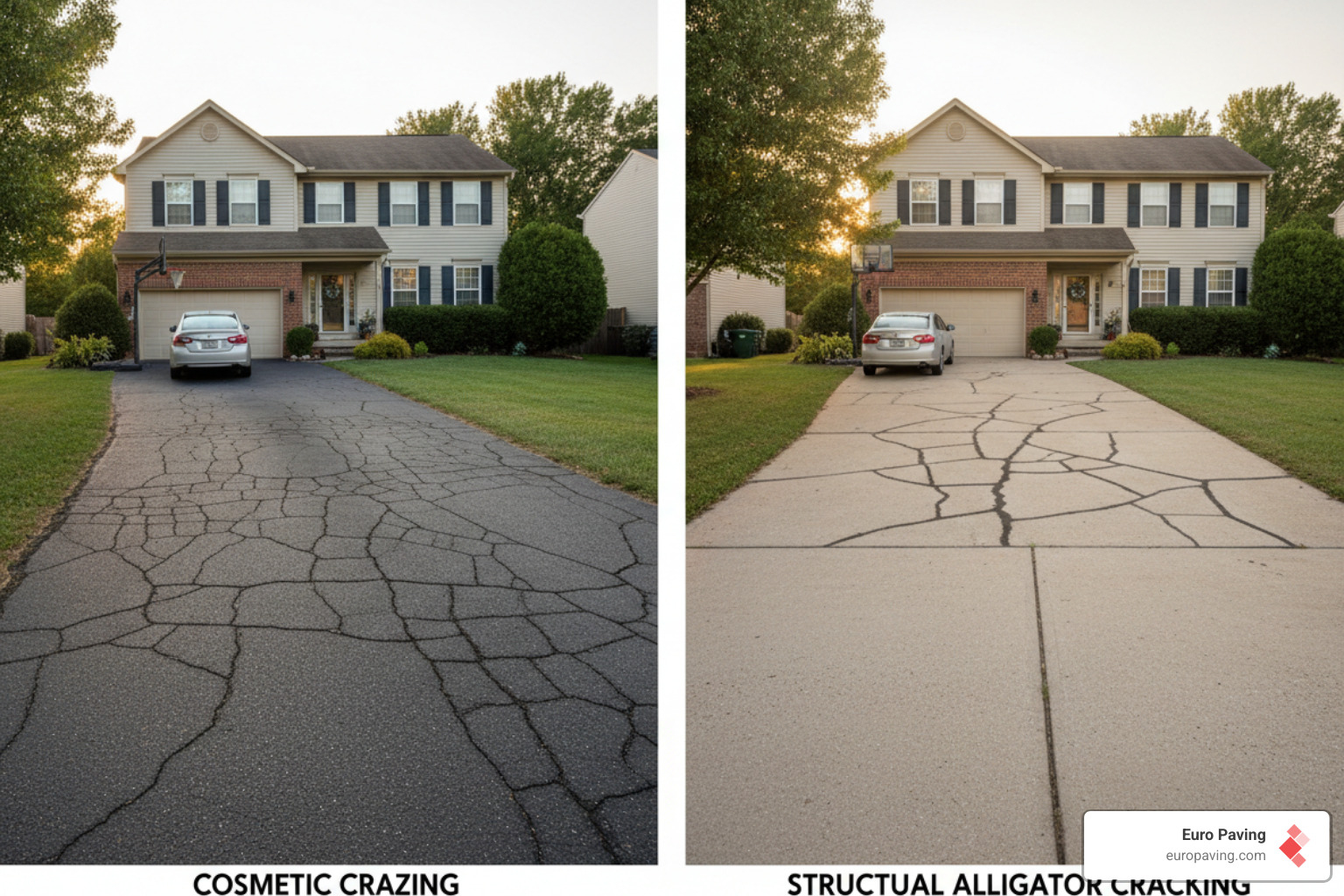
- Hairline Cracks: Usually under 1/4 inch wide. These are often surface-level but require sealing to prevent water ingress.
- Alligator Cracking: A network of interconnected cracks resembling scales. This is a sign of sub-base failure and usually requires more than a simple filler.
- Sinking Slabs: When one side of a crack is higher than the other, it indicates significant soil movement or a “void” beneath the surface.
Environmental Impact on Chicago Driveways
Our local climate requires expansion joints to handle temperature fluctuations. In the heat of an Illinois summer, concrete expands; in winter, it contracts. If these joints are clogged with debris or were never properly installed, the driveway has nowhere to move but “up,” resulting in cracks. According to How to Fix Driveway Cracks on Asphalt and Concrete, ignoring these environmental factors is why many amateur repairs fail.
Professional Standards for Asphalt and Concrete Preparation
At Euro Paving, we’ve seen that 70% of DIY driveway repairs fail within a single year. Why? Because the homeowner skipped the most grueling part: preparation. You cannot simply pour filler into a dirty crack and expect it to stick.
Pressure Washing and Debris Removal
The crack must be clinically clean. We utilize high-pressure cleaning equipment to blast out mold, mildew, and deeply embedded dirt. For stubborn vegetation, we use wire brushes and specialized hooks to ensure no organic material remains. Any roots or weeds left behind will eventually grow through your new patch, rendering the cracked driveway fix useless. For a deeper look at the prep process, see How To Repair Driveway Cracks.
Selecting the Right Cracked Driveway Fix Materials
Choosing the wrong material is a recipe for a mess.
- Self-Leveling Sealants: These are runny and designed for horizontal cracks. They flow into the crevices and create a flat, smooth finish.
- Non-Sag Fillers: These are thicker and used for sloped driveways or vertical surfaces where you don’t want the material to run out of the crack.
- Rubberized Asphalt: For our asphalt clients in Norridge and Skokie, we use hot-poured rubberized sealants that remain flexible. This flexibility is key because it allows the repair to “breathe” during Chicago’s temperature swings.
- Backer Rods: For cracks deeper than 1/2 inch, we insert a foam backer rod. This provides a “floor” for the sealant, ensuring you don’t use an entire gallon of filler on one deep void.
Tools for High-Durability Repairs
While a standard caulk gun works for minor touch-ups, professional-grade results often require diamond saws to “route” the crack. Routing involves widening the crack slightly to create a clean, uniform channel that holds the sealant more effectively. As noted in How to Repair Cracks in a Concrete Driveway, creating this reservoir is the secret to a repair that lasts five years instead of five months.
The Step-by-Step Process for Lasting Results
When we perform a cracked driveway fix, we follow a rigorous protocol to ensure the repair integrates perfectly with the existing surface.
Routing and Bonding
- Routing: We use a diamond blade to widen the crack into a “U” or “V” shape. This removes jagged edges that are prone to further breaking.
- Bonding Adhesives: For concrete, we may apply a bonding agent to ensure the new patching compound adheres to the old, dry concrete.
- Compaction: For asphalt “cold patches” or larger holes, compaction is king. We use heavy tampers or vibratory plates to ensure the material is packed tight, eliminating air pockets where water could hide. This is especially important when you repair crumbling edge asphalt driveway.
Executing a Permanent Cracked Driveway Fix
Timing is everything. Most repair mortars and sealants require a “weather window” where the temperature remains above 50°F for at least 24 to 48 hours. If it rains too soon, the material will wash away or fail to bond.
We also utilize a technique called sand broadcasting. While the sealant is still tacky, we lightly sprinkle fine sand over the top. This does two things: it camouflages the repair to match the texture of the surrounding pavement, and it provides traction so the repair isn’t slippery when wet. This proactive approach is part of our maintenance tips.
Sealing and Resurfacing for Uniformity
Once the cracks are filled, the driveway often looks like a “road map” of dark lines. To restore curb appeal, we recommend a full sealcoating for asphalt or a resurfacer for concrete. This provides:
- UV Protection: Prevents the sun from drying out and “graying” your asphalt.
- Waterproofing: Acts as a membrane to keep water out of the pores.
- Uniform Appearance: Gives the entire driveway a fresh, “like-new” finish.
When to Repair vs. Replace Your Driveway
As a homeowner, you have to weigh the cost of a cracked driveway fix against the long-term ROI of a full replacement.
| Feature | Repair/Patching | Full Replacement |
|---|---|---|
| Cost | $500 – $1,200 (pro) | $5,000 – $12,000+ |
| Lifespan | 1 – 5 years | 25 – 40 years |
| Aesthetics | Visible seams | Flawless finish |
| Structural | Masks issues | Fixes sub-base |
The 25% Rule
A good rule of thumb: if more than 25% of your driveway surface is cracked, sunken, or showing “alligator” patterns, repairs are merely a temporary Band-Aid. At that point, the cost of constant patching will soon exceed the cost of a new installation. If your driveway is over 30 years old (asphalt) or 40 years old (concrete), the material has likely reached the end of its service life. For more on this decision, read about driveway renovation problems.
Long-Term Benefits of Brick Paver Upgrades
If you are facing a full replacement, many of our clients in Hinsdale and Winnetka are moving away from traditional slabs in favor of brick pavers.
- No Cracking: Unlike concrete, a brick paver system is flexible. The individual bricks move with the ground during freeze-thaw cycles, meaning they won’t crack.
- Easy Repair: If a single brick is stained or damaged, you replace just that brick—not the whole driveway.
- Increased Value: High-quality hardscaping significantly boosts home resale value.
Discover the 8 benefits of brick driveways to see why they are the ultimate solution for Chicago’s climate.
Frequently Asked Questions about Driveway Cracks
How long should I wait to drive on a repaired crack?
Curing times vary by product. While some rapid-setting mortars allow foot traffic in 4 hours, we generally recommend waiting 24 to 48 hours before driving a vehicle over the repaired area. The weight of a 4,000-pound SUV can easily displace material that isn’t fully hardened.
Is sealing necessary after a crack repair?
Absolutely. Think of the crack repair as the “surgery” and the sealant as the “bandage.” Sealing the entire surface ensures that new water cannot find its way into smaller pores that haven’t cracked yet. We recommend a professional inspection every two years to maintain this protective barrier.
Why do DIY driveway repairs often fail?
Stats show that 70% of DIY repairs fail within 12 months. The most common reasons include:
- Improper Cleaning: Leaving dust or moisture in the crack.
- Wrong Materials: Using rigid concrete in a joint that needs to expand.
- Lack of Routing: Failing to create a proper reservoir for the sealant to “grip.”
Conclusion
A cracked driveway fix is about more than just filling a hole; it’s about protecting your home’s foundation and preserving your property value. In the Chicago area, the elements are working against your pavement every day. Whether you need a professional-grade repair for your existing asphalt or you’re ready to upgrade to a stunning, crack-proof brick paver driveway, Euro Paving is here to help.
We specialize in transforming tired, cracked surfaces into beautiful, functional hardscapes throughout Arlington Heights, Skokie, Hinsdale, and the surrounding suburbs. Our expertise in Unilock materials and custom 3D design ensures your new driveway will be the envy of the neighborhood for decades to come.
Don’t let cracks kill your curb appeal. Schedule a professional consultation with Euro Paving for your next driveway project today and let us build you a space that lasts.