



When Your Driveway Starts Sinking, It’s Time to Act
Concrete driveway leveling is the process of lifting and stabilizing sunken concrete slabs — without tearing out and replacing your entire driveway.
Here’s a quick look at how it works and what to expect:
| Question | Quick Answer |
|---|---|
| What is it? | Lifting settled concrete slabs back to their original position by filling voids underneath |
| Main methods | Polyurethane foam injection, mudjacking, or full replacement |
| Typical cost | $800–$4,000 vs. $5,000–$15,000+ for full replacement |
| How long does it take? | A few hours; driveway usable within 15 minutes to 2 hours |
| How long does it last? | 20 to 50+ years with proper maintenance |
| When to replace instead | Severely cracked, crumbling, or structurally compromised slabs |
That slow dip at the end of your driveway. The slab near the garage that now sits two inches lower than it used to. The crack you’ve been stepping over for a year.
These aren’t just cosmetic problems. A sunken driveway creates real trip hazards, channels water toward your foundation, and quietly chips away at your home’s curb appeal — and its value.
The good news? In most cases, you don’t need to tear the whole thing out. A professional leveling service can restore your driveway in a single afternoon, at a fraction of replacement cost.
Concrete driveway leveling definitions:
Why Concrete Driveways Sink: Understanding the Root Causes
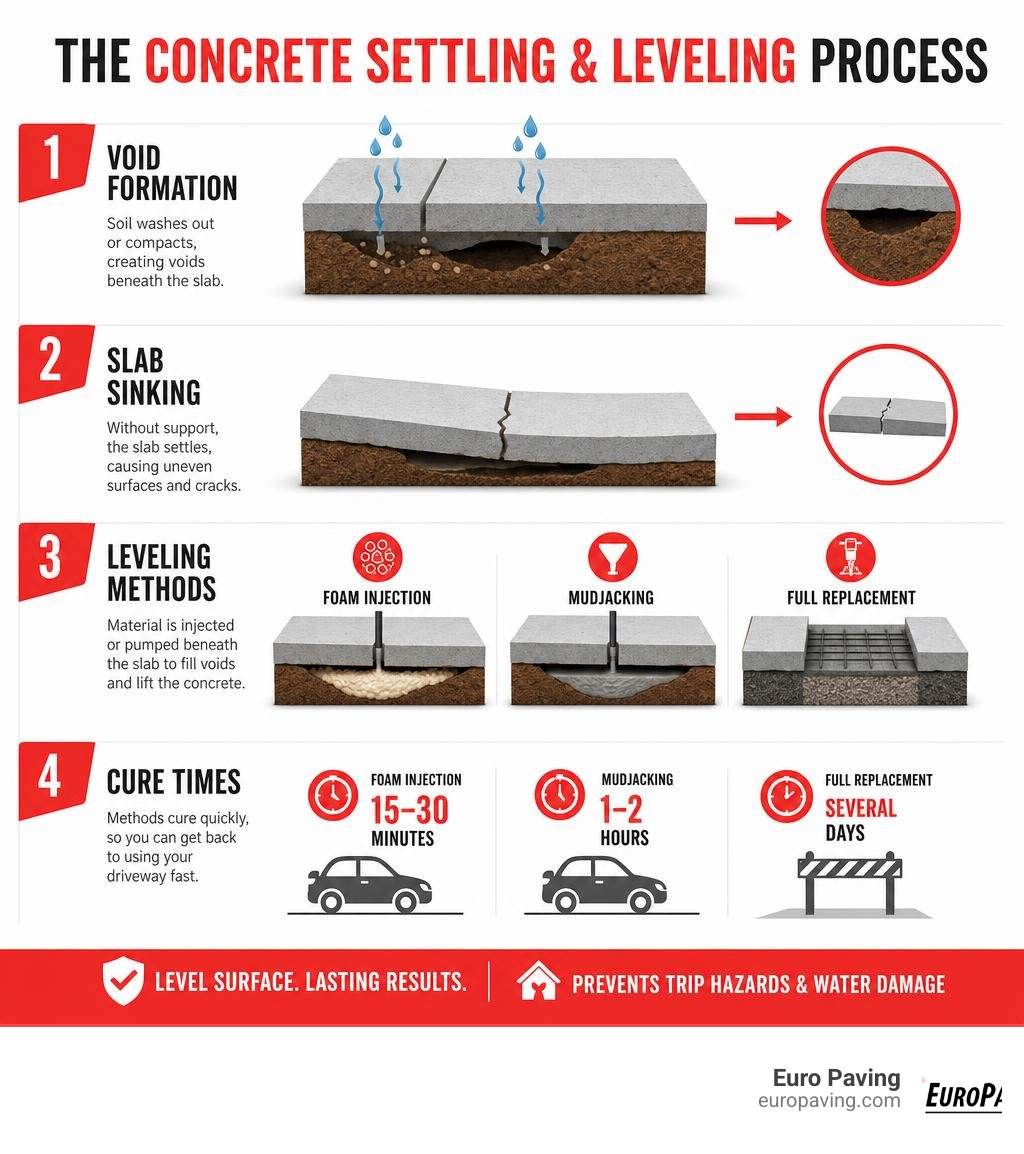
To understand how to fix a sinking driveway, we first have to look at what is happening beneath the surface. Concrete is incredibly heavy, strong, and rigid. However, its structural integrity is entirely dependent on the soil beneath it. When that soil shifts, shrinks, or washes away, the concrete loses its support and sinks under its own weight.
In the Chicago area—from Norridge and Skokie down to Downers Grove and Hinsdale—our driveways face a unique combination of geological and climatic challenges.
1. Soil Erosion and Washout
Heavy Midwestern rains and melting winter snow can easily wash away the soil beneath your driveway. If your property has poor drainage, water will find the path of least resistance, often flowing directly under your concrete slabs. This carrying away of fine soil particles creates large subterranean pockets or “voids.” Without support, the heavy slab eventually cracks and drops into the void. This is why it is so important to manage water runoff; for more on this, read our guide on how to Don’t Let Your Driveway Go Down the Drain.
2. Poor Original Soil Compaction
During home construction, soil is excavated and moved around. If the base material beneath your driveway was not thoroughly compacted before the concrete was poured, the weight of the slab—combined with the heavy vehicles parked on it—will naturally compress the loose soil over time. This leads to uneven settling, often within the first few years of installation.
3. Expansive Clay Soils
Much of Cook County and DuPage County features soil with a high clay content. Clay acts like a sponge: it swells significantly when wet and shrinks drastically during dry summer spells. This constant swelling and shrinking cycle creates movement beneath the slab, destabilizing the base and leaving voids when the clay contracts.
4. The Brutal Chicago Freeze-Thaw Cycle
Our local climate is notoriously tough on hardscaping. During winter, moisture beneath the concrete freezes and expands, lifting the slabs (a phenomenon known as frost heave). When spring arrives and the ground thaws, the soil softens and settles unevenly, leaving the slab unsupported in key areas. Over several seasons, this cycle virtually guarantees uneven concrete if the joints are not properly sealed.
5. Heavy Vehicle Loads
While standard concrete driveways are engineered to support passenger cars, they are not always prepared for the concentrated weight of large RVs, delivery trucks, or heavy construction equipment. When these heavy loads park on a section of concrete with a minor void underneath, it forces the slab downward, accelerating the sinking process.
Professional Methods for Concrete Driveway Leveling
When it comes to restoring an uneven driveway, you generally have three professional avenues to choose from: polyurethane foam injection, traditional mudjacking, or full concrete replacement.
Selecting the right method depends on your budget, how quickly you need to use your driveway, and the overall structural condition of the concrete.
| Feature / Method | Polyurethane Foam Injection | Traditional Mudjacking | Full Slab Replacement |
|---|---|---|---|
| Material Used | Lightweight expanding polymer | Heavy sand-cement-soil slurry | Brand new reinforced concrete |
| Drill Hole Size | Small (3/8″ to 5/8″ — about penny-sized) | Large (1″ to 2″ — soda-can-sized) | N/A (Full demolition) |
| Weight Added to Soil | Extremely light (~4 lbs per cubic foot) | Very heavy (~120 lbs per cubic foot) | Heavy new slab and sub-base |
| Cure & Traffic Time | Ready in 15 minutes to 2 hours | 24 to 48 hours | 3 to 7 days (up to 30 for heavy loads) |
| Erosion Resistance | Waterproof; will never wash away | Can erode or wash out over time | Dependent on new soil base |
| Relative Cost | Moderate ($1,200 – $4,000) | Lower ($800 – $3,000) | High ($5,000 – $15,000+) |
Understanding these options helps homeowners make informed decisions about maintaining their property’s value and safety.
Polyurethane Foam Concrete Driveway Leveling
Often referred to as slab lifting or foam jacking, polyurethane foam injection is the modern standard for concrete driveway leveling.
The process is elegant in its simplicity and highly effective. Technicians drill tiny, penny-sized holes (typically 3/8 to 5/8 of an inch) into the sunken concrete slab. A specialized injection gun is then used to pump a two-part liquid polyurethane polymer beneath the concrete.
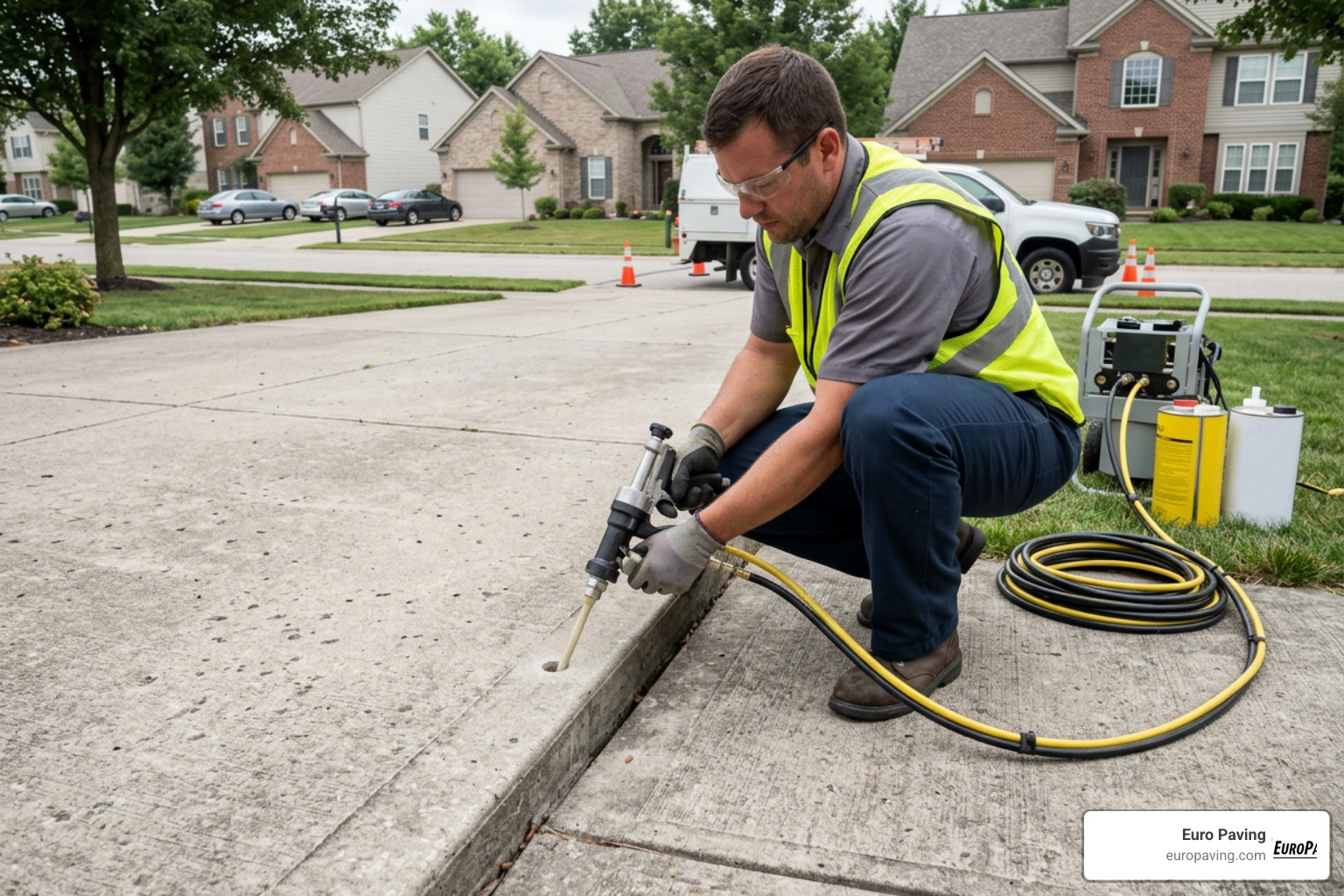
As the two liquids combine, a chemical reaction occurs, causing the material to expand rapidly into a dense, rigid foam. This expansion fills every microscopic void, compacts the loose underlying soil, and exerts a powerful upward force that lifts the concrete slab back into perfect alignment.
The Benefits of Polyurethane Foam:
- Remarkably Lightweight: Polyurethane foam weighs only about 4 pounds per cubic foot. Compare this to the 120 pounds per cubic foot of traditional mudjacking slurry. Because it is so light, it does not add unnecessary weight to already weak, unstable subsoils.
- Eco-Friendly Formulations: Modern polyurethane foams used in residential leveling are highly advanced, often utilizing 39% to 49% recycled materials, making them a responsible choice for environmentally conscious homeowners.
- Waterproof and Permanent: Unlike soil-based mixtures, cured polyurethane is completely waterproof. It will never wash away, erode, or degrade when exposed to underground water pooling or heavy rainfall.
- Rapid Cure Time: The foam cures and reaches full load-bearing capacity within minutes. You can drive your car over the repaired driveway within an hour of the technicians completing the job.
Traditional Mudjacking vs. Modern Concrete Driveway Leveling
Mudjacking is a decades-old technique that remains popular due to its lower upfront cost. Instead of synthetic foam, mudjacking utilizes a thick, heavy slurry composed of topsoil, sand, clay, and a small amount of Portland cement.
To perform mudjacking, contractors must drill much larger holes—usually 1 to 2 inches in diameter—to accommodate the thick slurry. A hydraulic pump then forces this heavy mixture under the slab under high pressure, filling the void and raising the concrete.
While mudjacking is highly effective at lifting heavy slabs, it has several notable drawbacks when compared to modern foam leveling:
- The Weight Issue: Adding a material that weighs 120 lbs. per cubic foot on top of already failing, poorly compacted soil can actually trigger secondary settlement. The sheer weight of the mudjacking slurry can cause the subsoil to compress further, causing the driveway to sink again a few years down the road.
- Erosion Risk: Because the slurry is primarily organic soil and sand, it remains susceptible to water erosion. If water continues to seep beneath your driveway, it can slowly wash the mudjacking material away, bringing you right back to square one.
- Aesthetics: The large drill holes required for mudjacking are much harder to conceal, often leaving highly visible, circular patches across your driveway.
When to Choose Leveling vs. Full Driveway Replacement
While concrete driveway leveling is an exceptional, cost-saving solution, it is not a magic wand for every damaged driveway. Knowing when to lift and when to completely replace your driveway can save you thousands of dollars in premature repairs.
When Leveling is the Perfect Solution
Leveling is highly recommended if your concrete slabs are structurally intact but have simply settled, tilted, or sunk. If you have clean, single cracks running across a slab, or if an entire section has dropped creating a dangerous lip at your garage entrance, leveling will solve your problem beautifully. It restores the structural support beneath the slab, eliminating the trip hazard and correcting the slope for proper water drainage.
For more details on making this exact decision, take a look at our detailed guide: Resurface or Replace Your Driveway Today.
When Full Replacement is Necessary
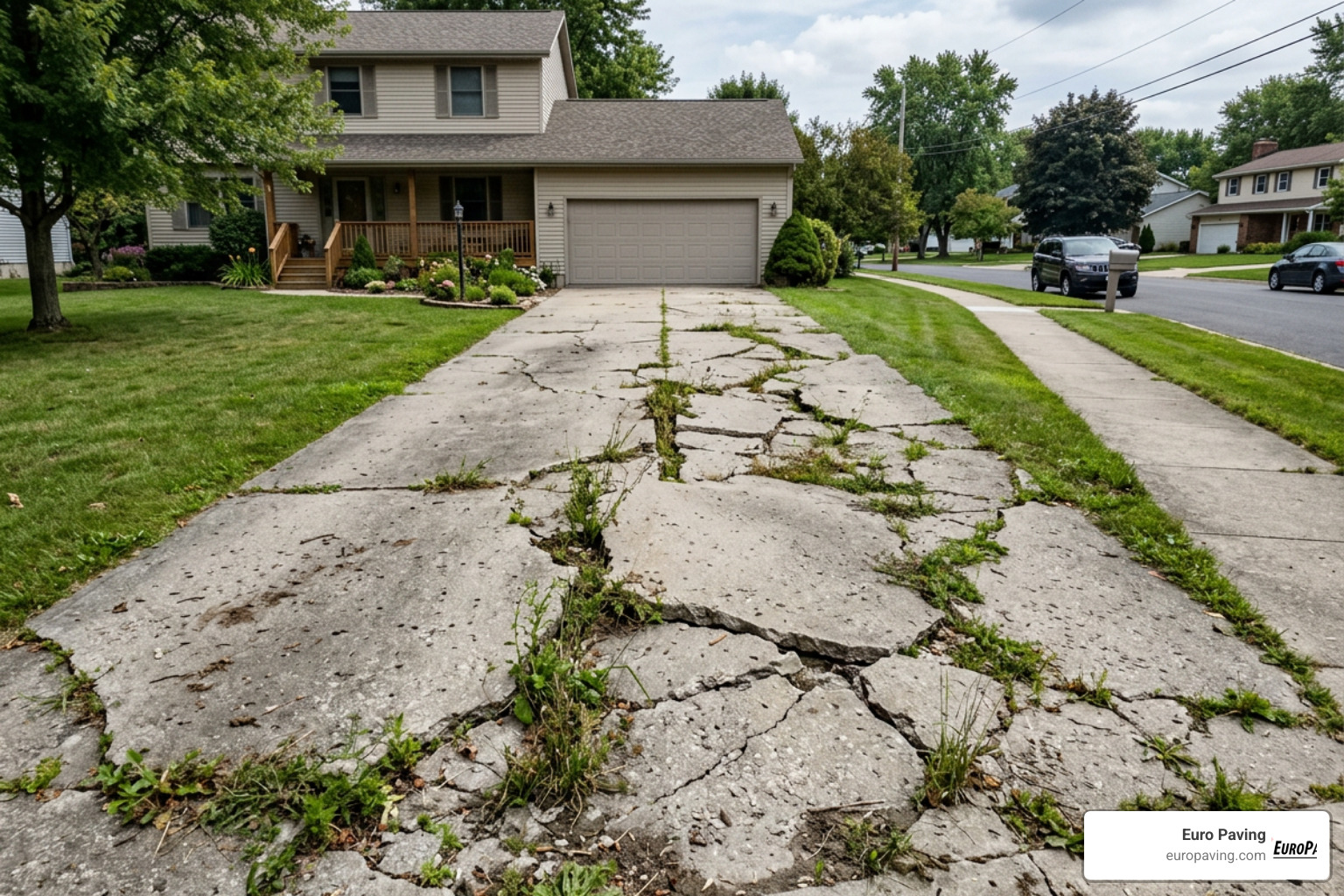
Unfortunately, if the concrete itself has failed structurally, leveling will not work. You should opt for a full replacement if you notice:
- Spiderweb or Mosaic Cracking: If a slab is shattered into multiple small pieces (often called “alligator cracking”), there is no cohesive structure left to lift. Injecting foam will simply cause the individual pieces to move independently, resulting in an uneven, messy surface.
- Crumbling, Scaling, or Spalling: If the surface of your concrete is actively flaking off, crumbling at the edges, or showing exposed rebar, the concrete has reached the end of its lifespan. To understand how to handle these issues before they get out of hand, read our advice on How to Fix Your Crumbling Driveway Edges Before They Disappear.
- Severe Deep Settling with Structural Damage: If a slab has sunk more than 4 to 5 inches and is structurally bound to a failing home foundation or retaining wall, simple leveling may not be safe or sufficient without extensive engineering work.
If you are located in the northern or western suburbs, consulting with a professional hardscaping and paving specialist can help you evaluate these structural thresholds and determine the best path forward for your property.
Post-Repair Maintenance: Protecting Your Investment
Once your driveway has been professionally leveled, your job isn’t quite finished. To ensure that your newly leveled concrete remains stable for the next 20 to 50 years, you must take active steps to prevent the underlying soil from shifting or washing away again.
1. Seal All Cracks and Joints Immediately
The single most important step you can take is to seal every open crack and control joint on your driveway. This prevents water from seeping down to the subgrade soil. Use a high-quality, self-leveling polyurethane sealant designed specifically for concrete. For step-by-step instructions, see our comprehensive guide on How to Repair Driveway Cracks.
2. Extend and Redirect Downspouts
Make sure your home’s gutter downspouts do not discharge water directly next to or onto your driveway. Roof runoff should be directed at least 5 to 10 feet away from any concrete surfaces into a proper drainage area or rain garden.
3. Maintain the Surrounding Soil Grade
Ensure that the soil and landscaping along the edges of your driveway are graded properly. The soil should slope gently away from the concrete so that rainwater naturally drains away rather than pooling along the edge of the slab. If the soil along the edge of your driveway is eroded, pack it with fresh topsoil or clay to support the sides of the concrete. For more helpful ideas, check out Don’t Let Your Driveway Crumble with These Maintenance Tips.
4. Keep Heavy Vehicles Off the Edges
Avoid parking heavy vehicles, such as commercial trucks or large motorhomes, directly on the joints or edges of your driveway slabs. Distributing vehicle weight toward the center of mature, well-supported slabs minimizes stress on the subgrade.
Frequently Asked Questions About Driveway Restoration
How long does the leveling process take and when can I drive on it?
Most residential concrete leveling projects are completed remarkably quickly. A standard two-car driveway with moderate settling can typically be leveled, patched, and cleaned up in 1 to 3 hours.
Unlike brand-new concrete, which requires 3 to 7 days to cure before you can park a vehicle on it, polyurethane foam leveling offers nearly instant gratification. The foam expands and reaches 90% of its ultimate structural strength within 15 minutes. In most cases, you can walk and drive on your leveled driveway within 15 minutes to 2 hours after the technicians finish the injection process.
Will the injection holes and patches be highly visible?
One of the greatest advantages of modern polyurethane foam leveling is how minimally invasive it is. Because the injection equipment is highly compact, the drilled holes are only 3/8 to 5/8 of an inch in diameter—roughly the size of a penny.
Once the lifting is complete, these small holes are thoroughly cleaned and patched with a custom-blended concrete grout. Initially, these circular patches may look slightly lighter or darker than your weathered concrete. However, as they are exposed to traffic, sunlight, and weather, they naturally blend into the surrounding surface, becoming barely noticeable within a few months.
How long will a professionally leveled driveway last?
When performed correctly using high-density polyurethane foam, concrete leveling can easily last 20 to 50+ years—essentially matching the remaining lifespan of the concrete slab itself.
Because polyurethane is entirely waterproof and chemically inert, it will not rot, break down, or wash away under the influence of moisture or soil chemicals. The longevity of the repair is almost entirely dependent on how well you maintain your driveway’s drainage and joints. If you keep the cracks sealed and prevent active water erosion, the foam base will remain rock-solid indefinitely.
Conclusion
A sunken concrete driveway is an eyesore and a safety hazard, but it doesn’t have to mean a massive financial headache or days of messy demolition. By opting for modern concrete driveway leveling, you can restore your home’s curb appeal, eliminate dangerous trip hazards, and protect your property’s value in a single afternoon—all while saving up to 70% compared to the cost of a full concrete replacement.
However, if your driveway is showing signs of severe structural failure, or if you are ready to upgrade your home’s exterior with a beautiful, long-lasting hardscape, it may be time to consider an elegant alternative.
At Europa Paving, we specialize in transforming ordinary driveways and backyards into stunning, family-friendly outdoor living spaces. Serving Chicago and premier suburbs like Elmhurst, Hinsdale, Mount Prospect, Norridge, and Arlington Heights, we combine expert craftsmanship with premium materials to design custom brick patios, outdoor kitchens, fire pits, and gorgeous brick paver driveways that stand the test of time.
Ready to say goodbye to ugly, sinking concrete and elevate your home’s exterior? Transform your driveway with premium brick paving solutions and schedule your professional consultation with the team at Euro Paving today!