



Why a Permeable Pavers Sidewalk Is the Smarter Choice for Your Property
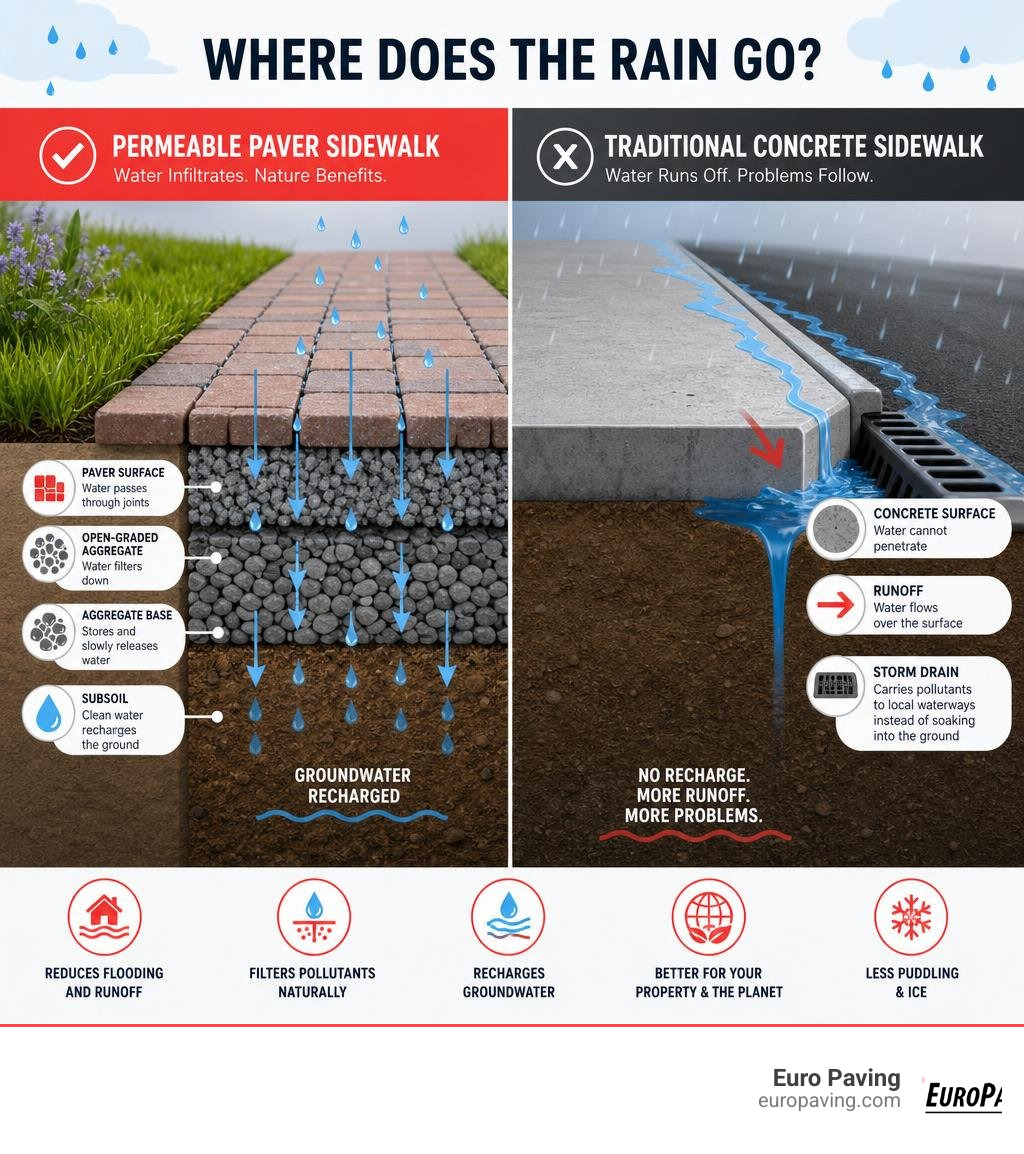
A permeable pavers sidewalk does something traditional concrete and asphalt simply cannot: it lets rainwater pass through the surface and soak naturally into the ground below, instead of rushing into storm drains.
Quick answer: Permeable paver sidewalks are specially designed interlocking pavers with wider joints filled with open-graded aggregate. They allow stormwater to infiltrate the ground rather than running off, reducing flooding, filtering pollutants, and helping homeowners meet local stormwater regulations — while looking great doing it.
Here’s what makes them stand out at a glance:
- Stormwater control – Can reduce runoff by up to 90% compared to impervious surfaces
- Flood prevention – Reduces peak discharge into local sewer systems during storms
- Less ice and puddling – Water drains through instead of pooling and freezing
- Environmental benefits – Recharges groundwater, filters pollutants, reduces the urban heat island effect
- Financial upside – Longer lifespan than asphalt, potential rebates up to $6,000, and lower stormwater utility fees
- Aesthetic flexibility – Available in many colors, shapes, and finishes to complement any home
Most suburban homeowners think of sidewalks as purely functional — pour the concrete and move on. But as cities like Chicago tighten stormwater regulations and municipalities offer real financial incentives for reducing impervious surfaces, permeable pavers are becoming a genuinely smart investment.
They’ve been used in large-scale commercial projects for decades. Now, more and more residential property owners are choosing them for sidewalks, driveways, and patios — because the benefits go well beyond just managing water.
This guide covers everything you need to know: how permeable sidewalks work, what installation actually requires, how to maintain them through Chicago winters, and how to take advantage of available rebates and incentives.
Basic permeable pavers sidewalk glossary:
What is a Permeable Pavers Sidewalk?
To understand what a permeable pavers sidewalk is, it helps to look at how we have built traditional walkways for the last century. Conventional sidewalks are constructed from poured concrete or dense asphalt. These materials form a completely solid, non-porous barrier. When rain falls or snow melts, the water has nowhere to go but sideways, carrying dirt, motor oil, and debris directly into municipal storm sewers.
A permeable paver sidewalk takes a completely different approach. It is a highly engineered, self-draining system composed of individual interlocking concrete or composite units. Instead of fitting tightly together with fine sand, these pavers are separated by wider joints filled with clean, coarse aggregate.
This design allows rainwater to seep rapidly around the individual units, filtering down into a graduated stone base reservoir beneath. From there, the water slowly and naturally infiltrates the native subsoil, replenishing local aquifers rather than overwhelming municipal infrastructure.
For homeowners looking to choose The Best Paving Stones for a Sidewalk that Lasts, opting for high-quality Permeable Interlocking Concrete Pavers (PICPs) is a premier choice. This system is widely recognized as a sustainable design standard, featured heavily in public infrastructure guidelines like the Permeable Interlocking Concrete Paver (PICP) | NYC Street Design Manual. By using these specialized materials, we can build walks, driveways, and patios that harmonize with the natural water cycle.
How Permeable Interlocking Concrete Pavers (PICPs) Work
At first glance, a PICP might look like a standard concrete paver. However, the secret to its high-performance drainage lies in its structural design and the layers underneath.
- Specialized Spacer Bars: Permeable pavers are manufactured with wider, integrated spacer tabs. When installed, these tabs automatically create consistent, wide joint gaps (typically ranging from 1/4 inch to 3/8 inch).
- Open-Graded Aggregate Joint Fill: Instead of standard polymeric sand—which locks out water—we fill the joints with small, washed angular stone chips (such as ASTM No. 8 or No. 9 stone). This aggregate leaves plenty of open void space for water to pass through freely.
- High Void Percentage: The entire system relies on a graduated sub-base of clean, open-graded stone (free of sand or “fines”). This base provides structural support for pedestrian and light vehicular loads while maintaining a high void space (often 30% to 40% empty space) to temporarily store incoming stormwater before it drains into the soil.
By utilizing advanced materials like Permeable Pavers for Driveways, Patios, and Walkways – Unilock, we can deliver surfaces that combine luxurious aesthetic finishes with maximum water infiltration rates.
Permeable vs. Traditional Impervious Sidewalk Materials
When deciding on a new sidewalk for your residential or commercial property in the Chicago area, comparing materials side-by-side helps clarify the long-term value.
| Feature | Permeable Pavers (PICP) | Traditional Poured Concrete | Conventional Asphalt |
|---|---|---|---|
| Water Infiltration | High (Up to 90%+ runoff reduction) | Zero (100% runoff) | Zero (100% runoff) |
| Average Lifespan | 30 to 50+ Years | 15 to 25 Years (Prone to cracking) | 10 to 15 Years (Requires sealing) |
| Freeze-Thaw Durability | Excellent (Flexible joints prevent cracking) | Poor (Rigid slabs crack from frost heave) | Moderate (Potholes and rutting) |
| Aesthetics & Design | Premium, customizable colors & patterns | Basic, uniform gray | Plain black or weathered gray |
| Winter Safety | High (Melts ice quickly, no standing water) | Low (Prone to pooling water and black ice) | Low (Puddles freeze easily) |
| Long-Term Value | High (Increases property value, no replacement) | Moderate (Requires patching or replacement) | Low (Frequent maintenance needed) |
Environmental and Municipal Benefits of Permeable Sidewalks
Installing a permeable walkway does more than just protect your lawn from pooling water. It has measurable, positive impacts on our local environment and municipal infrastructure.
First, permeable pavements are highly effective at mitigating the urban heat island effect. Traditional concrete and asphalt absorb and store immense amounts of solar radiation, radiating heat back into the surrounding air. Because permeable paver systems contain open-graded stone bases that allow air to circulate and moisture to evaporate, they maintain cooler surface temperatures. Lighter-colored pavers further reduce heat absorption, keeping your walkways comfortable during hot Midwestern summers.
Second, these systems facilitate groundwater recharge. In natural environments, rain slowly filters through the soil, cleaning itself and replenishing the water table. Urbanization blocks this process. By installing permeable sidewalks, we restore this natural cycle, filtering out suspended solids and heavy metals before the water ever reaches the subsoil.
Third, by eliminating surface runoff, permeable surfaces significantly reduce soil erosion. Water that would otherwise cascade off a hard concrete edge and wash away adjacent topsoil is absorbed instantly. This protects your landscaping, prevents muddy patches, and supports the root health of nearby grass and plantings. For a deeper look at how quality masonry elevates your property, check out 11 Benefits of Adding a Brick Sidewalk to Your Home.
Managing Stormwater Runoff and Preventing Flooding
For communities throughout Cook and DuPage Counties, stormwater management is a critical priority. Heavy seasonal rains can quickly overwhelm combined sewer systems, leading to flooded basements, street pooling, and untreated overflow discharge.
Permeable paver sidewalks act as localized storage reservoirs. During a massive storm event, they can reduce stormwater runoff by up to 90%. By capturing water right where it falls, they lower peak sewer discharge rates, taking pressure off municipal infrastructure.
The real-world reliability of this technology is well-documented. For instance, in a highly publicized municipal roadway and pedestrian retrofit project, engineers utilized permeable interlocking concrete pavers to solve severe regional flooding and water pollution issues. As detailed by Stormwater Solutions, post-installation testing showed extraordinary surface infiltration rates of over 600 inches per hour. Even after two years of heavy environmental exposure and winter conditions, the systems maintained infiltration rates well above 100 inches per hour, easily handling intense downpours without a single puddle.
Financial Incentives and Tax Rebates for a Permeable Pavers Sidewalk
Many homeowners are surprised to learn that choosing a sustainable sidewalk can actually put money back in their pockets. Because municipalities are eager to reduce the burden on their stormwater systems, many offer direct financial incentives:
- Stormwater Fee Discounts: Many towns in the Chicago area charge property owners a stormwater utility fee based on the amount of impervious surface area on their lot. Replacing a traditional concrete sidewalk or driveway with a permeable paver system can dramatically lower or completely eliminate these recurring fees.
- Municipal Rebate Programs: Depending on your specific ward or municipality, generous rebate programs exist to encourage green infrastructure. Some local programs offer rebates of up to $15 per square foot for replacing impervious surfaces with permeable pavers, with maximum property incentives reaching up to $6,000.
- Increased Property Value: A professionally installed, premium paver walk instantly boosts curb appeal and overall home value. Buyers in 2026 place a high premium on eco-friendly, low-maintenance hardscaping.
To explore how residential green infrastructure programs can support your project, check out resources like the guide on Permeable Pavers and Surfaces, which highlights how local governments encourage and subsidize these installations.
Technical Specifications and Installation Requirements
Installing a permeable pavers sidewalk is not a standard DIY project. Because the entire system relies on structural engineering to manage water load, it requires precision excavation, specific stone gradations, and certified professional installation to ensure it stands the test of time.
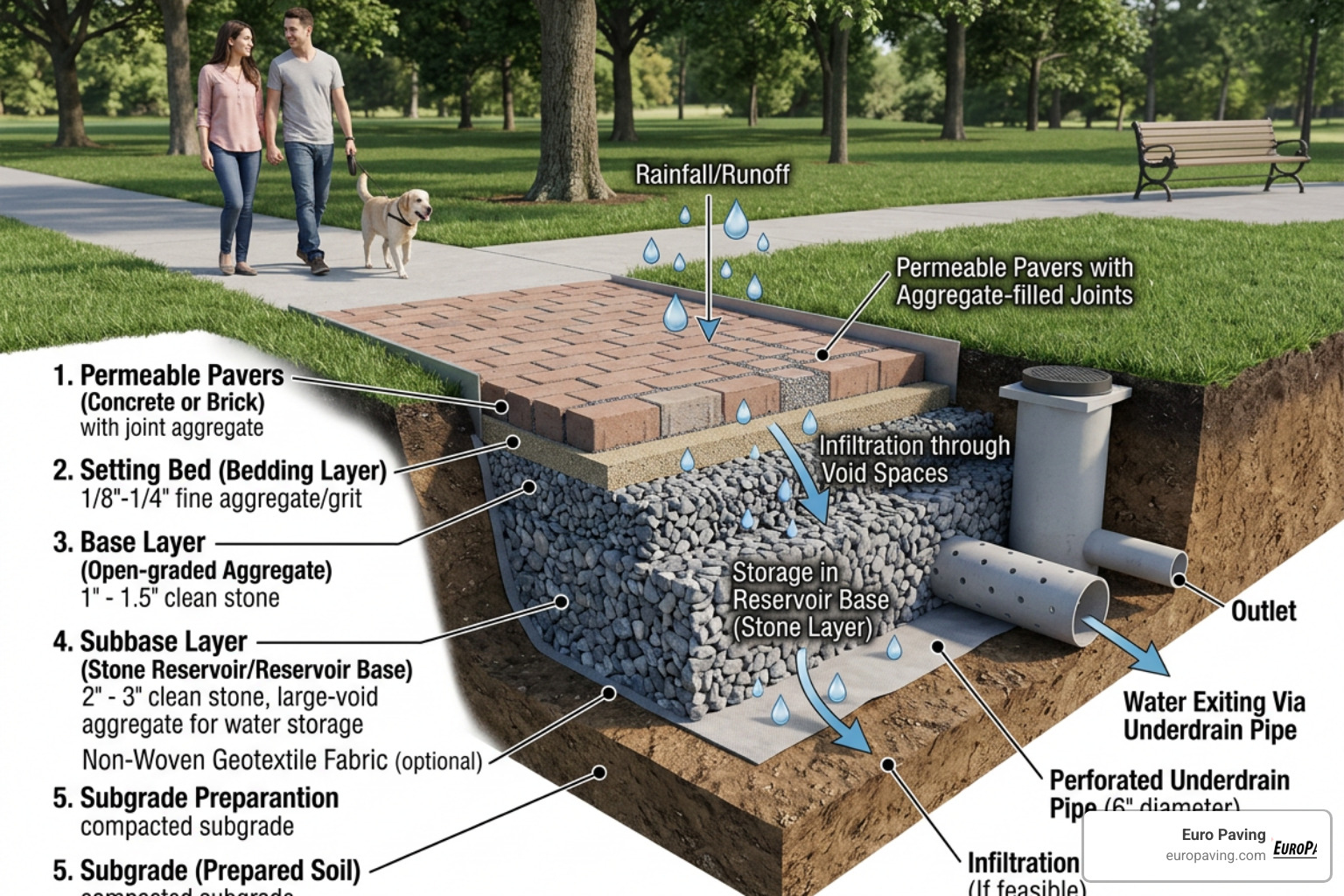
The process begins with careful site evaluation. In many parts of the Chicago area—from Norridge to Downers Grove—the native subsoil is rich in dense clay. Clay soils drain water much slower than sandy soils. To compensate for this, our professional installation teams design a deeper aggregate reservoir base. This provides extra storage capacity, allowing water to sit safely in the stone layer without backing up while it slowly percolates into the clay subgrade.
To understand the complete sequence of physical steps required to prepare and lay a durable walkway, read our comprehensive Step-by-Step Guide to Laying a Stone Paver Sidewalk.
Designing a Permeable Pavers Sidewalk for ADA Compliance
Public and residential sidewalks alike must prioritize accessibility and safety. When we design permeable walkways, we strictly adhere to Americans with Disabilities Act (ADA) guidelines to ensure a smooth, stable surface for everyone, including those using wheelchairs, strollers, or walking aids.
Key design criteria include:
- Strict Joint Width Limits: To prevent wheels or heels from catching, the joint gaps between pavers must not exceed 1/4 inch (or 13mm) in nominal width.
- Lippage Control: The height difference (lippage) between adjacent pavers must be kept under 1/8 inch. Our crews use precise mechanical compaction and high-strength bedding aggregates to achieve a perfectly flat plane.
- Surface Tolerance: The completed surface must be incredibly level, with a maximum deviation of only 3/8 inch over a 10-foot straightedge.
- Slip Resistance: We select premium concrete units with textured, slip-resistant finishes that provide excellent traction in both wet and dry conditions.
For detailed municipal engineering standards on these parameters, refer to the official Sidewalk Permeable Pavers Specifications.
Material Standards and Aggregate Gradations
A permeable sidewalk is only as good as the stone layers beneath it. We use clean, double-washed angular gravel with no sand or fine particles, conforming to strict ASTM standards:
- The Sub-Base Reservoir Layer (ASTM No. 57 Stone): This layer consists of larger, 1-inch to 1.5-inch angular stones. It provides the main structural foundation and offers the open void space needed to temporarily hold water.
- The Bedding & Joint Layer (ASTM No. 8 or No. 9 Stone): A 2-inch bedding layer of smaller, 1/4-inch to 3/8-inch clean stone chips is laid directly on top of the base. This provides a smooth, flat surface to set the pavers and is also swept into the joints to lock the units in place while keeping them fully permeable.
- Geotextile Fabric: We install a high-performance, non-woven geotextile fabric between the native soil subgrade and the stone base. This prevents the soil from migrating upward and clogging the stone reservoir, ensuring the system drains perfectly for decades.
Long-Term Maintenance and Winter Performance
One of the most common myths about permeable paving is that it requires constant, grueling maintenance. In reality, keeping a permeable sidewalk in peak condition is remarkably straightforward.
For residential properties, basic preventative maintenance consists of occasionally sweeping or blowing off loose leaves, grass clippings, and organic debris. This prevents organic matter from breaking down and settling into the joints.
For commercial properties or high-traffic walkways, a quarterly sweeping or vacuuming is recommended. Using a standard commercial vacuum sweeper once or twice a year easily removes any accumulated sediment from the joint aggregate, fully restoring the system’s original infiltration rates. If some of the joint stone chips are drawn out during deep cleaning, simply sweep a small amount of fresh ASTM No. 8 stone back into the joints.
To see how permeable systems compare to other commercial and residential sidewalk options, read our detailed guide on Don’t Get Stepped On: Commercial and Residential Sidewalk Paving Solutions.
Winter Performance and De-Icing Salt Reduction
Chicago winters are legendary, and ice management is always a top priority. Permeable paver sidewalks perform exceptionally well in freezing temperatures:
- Rapid Snow Melt: Because the stone base layers beneath the pavers contain air voids, they act as a natural insulator. This sub-surface airflow keeps the pavement slightly warmer, causing snow to melt faster than on solid concrete.
- Zero Standing Water: When snow melts on a traditional sidewalk, it pools on the surface. When temperatures drop overnight, this water freezes into dangerous sheets of black ice. On a permeable sidewalk, melting snow drains instantly through the joints, keeping the surface dry and ice-free.
- Up to 70% Less Salt Required: Because water drains away before it can refreeze, you will find you need significantly less de-icing salt to keep your walkway safe. This saves money and protects your adjacent lawns and plantings from salt damage.
- Shoveling & Plowing: Permeable sidewalks can be shoveled or snow-blown just like traditional concrete. We recommend using shovels or snow-blower augers with protective plastic or rubber edges to avoid scratching the premium paver finish.
Protecting Urban Trees and Root Systems
Traditional concrete sidewalks and mature trees are notorious enemies. As tree roots grow, they seek out air and moisture just beneath the solid concrete slab. This upward pressure inevitably cracks, tilts, and heaves the concrete, creating dangerous tripping hazards and damaging the tree’s root system.
Permeable paver sidewalks solve this conflict entirely. Because the open-graded stone base allows both oxygen and water to circulate freely throughout the entire subgrade, tree roots are encouraged to grow downward into the deeper soil layers rather than spreading laterally directly beneath the surface.
For high-sensitivity areas containing historic or protected trees, we can incorporate advanced systems like Flexi-Pave Porous Flexible Paving Spec v7.72. This highly specialized, porous flexible pavement combines clean angular aggregate with recycled rubber and high-performance binders. It provides an incredibly durable, ADA-compliant pedestrian surface that can flex to accommodate future root growth without cracking, while offering an astounding water infiltration rate of over 2,500 gallons per square foot per hour. When installing walkways within critical root zones, we recommend having a full-time ISA Certified Arborist oversee the excavation to ensure the tree’s health is fully protected.
Frequently Asked Questions About Permeable Sidewalks
How long do permeable paver sidewalks last compared to concrete?
A professionally installed permeable paver sidewalk has a significantly longer lifespan than traditional poured concrete. While concrete sidewalks typically begin to crack, scale, and settle within 15 to 20 years—especially under the stress of Chicago’s severe freeze-thaw cycles—high-quality interlocking concrete pavers are rated to last 30 to 50+ years.
Because the system consists of individual interlocking units set on a flexible stone base, the entire sidewalk can expand and contract naturally during seasonal temperature swings without cracking. If an individual paver ever becomes stained or physically damaged, it can be easily extracted and replaced in minutes without having to tear up and repour an entire section of your walkway.
Do permeable pavers get clogged easily?
No. While fine dust, windblown silt, and organic debris will slowly enter the joints over time, a properly constructed PICP system is highly resilient. The initial infiltration rates of a newly installed permeable sidewalk are incredibly high—often exceeding several hundred inches per hour.
Even if the joints become partially restricted by sediment over several years of neglect, the system will still easily drain typical heavy Midwestern rainstorms. To prevent severe clogging, simply keep the sidewalk clear of thick piles of wet leaves or loose soil, and perform a quick sweep or vacuum wash every couple of seasons to keep the joints clear.
Can permeable pavers handle heavy pedestrian and light vehicle traffic?
Absolutely. Permeable interlocking concrete pavers are engineered for exceptional structural strength. The individual concrete units are manufactured under extreme pressure and have a compressive strength exceeding 8,000 PSI—nearly double that of standard poured concrete.
When installed over a properly compacted, multi-layered ASTM No. 57 and No. 2 stone foundation, a permeable sidewalk can easily support heavy pedestrian crowds, municipal maintenance equipment, and even light service vehicles (such as utility trucks or emergency vehicles) without any structural shifting, rutting, or cracking.
Conclusion
Upgrading to a permeable pavers sidewalk is one of the smartest, most forward-thinking investments you can make for your property. It provides an elegant, high-end aesthetic that instantly elevates your home’s curb appeal while serving as a powerful, eco-friendly system that manages stormwater, prevents localized flooding, and stands up beautifully to harsh winters.
At Europa Paving, we specialize in transforming ordinary outdoor areas into beautiful, functional, and sustainable spaces. As hardscaping experts serving the entire Chicago area—including Elmhurst, Hinsdale, Norridge, Cook County, and DuPage County—we have the deep engineering expertise, Unilock certifications, and precision equipment required to design and install flawless permeable paver systems.
Ready to take your property to the next level with a gorgeous, long-lasting walkway? Contact Euro Paving today to discuss your next project, or explore our professional sidewalk paving services to schedule your custom design consultation!