



Why Getting the Paving Slope for Drainage Right Makes or Breaks Your Outdoor Space
Paving slope for drainage is the intentional angle built into any paved surface — patio, driveway, or walkway — so water flows away instead of pooling. Here’s the quick answer:
| Surface Type | Recommended Slope | Drop per Foot |
|---|---|---|
| Patio | 2% (min 1%) | 1/4 inch |
| Walkway | 1.5–5% | 1/8–5/8 inch |
| Driveway | 2% minimum | 1/4 inch |
| Maximum (driveway) | 15% | – |
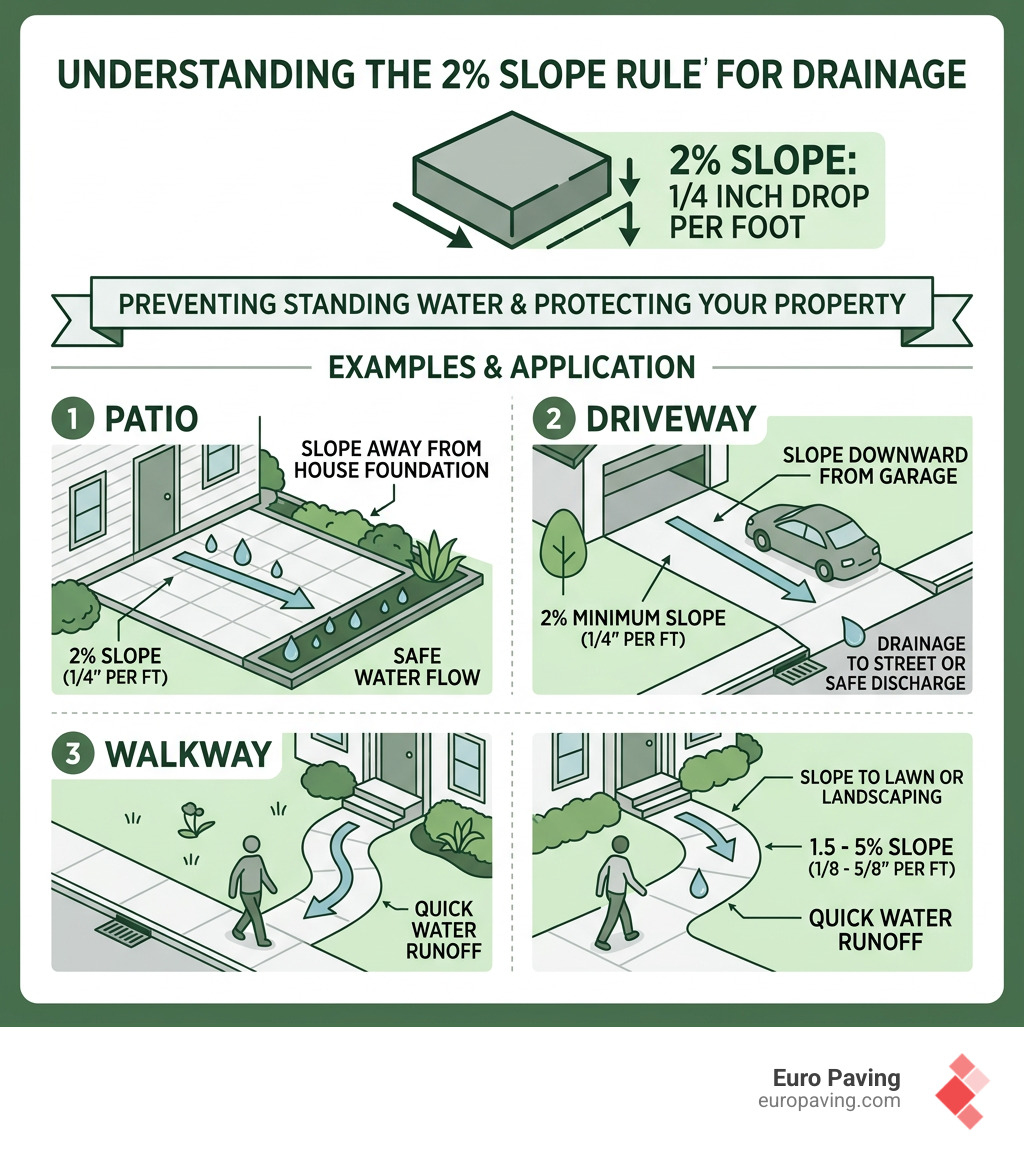
The single most important rule: never install any paved surface perfectly flat. A minimum 2% slope — that’s a 1/4-inch drop for every foot of length — is the industry standard across patios, driveways, and walkways.
Here’s the problem most homeowners don’t see coming.
You invest in a beautiful brick patio. The pavers look stunning. Then spring arrives and a puddle sits in the corner every time it rains. Or worse, water creeps toward your foundation. That’s not a paving problem — it’s a grading problem, and it starts before the first paver is ever laid.
Water doesn’t care how nice your patio looks. It follows gravity, and if you haven’t told it where to go, it will find its own path — often somewhere you don’t want it.
In the Chicago area, this matters even more. Freeze-thaw cycles mean trapped water expands, contracts, and slowly destroys even well-built surfaces from the inside out.
The good news? Proper slope is entirely predictable and plannable. When a professional grades your project correctly from the start, water flows where it should — away from your home and into safe discharge points — and your outdoor space stays beautiful and functional for decades.
The Fundamentals of Paving Slope for Drainage
When we talk about the fundamentals of a successful hardscape project in Chicago, Skokie, or Barrington, we aren’t just talking about the color of the bricks. We are talking about physics. A paving slope for drainage is the “quiet hero” of your driveway or patio. Without it, gravity becomes your enemy.
The industry standard of a 2% slope (a 1/4-inch drop per linear foot) ensures that surface water gains enough velocity to overcome surface tension and minor imperfections in the material. If a surface is too flat, water “beads” and stays put. In our local climate, that standing water is a ticking time bomb.
Water expands by roughly 10% when it freezes. If that water is trapped in your paver joints or sitting on a concrete slab, the resulting “freeze-thaw” pressure leads to spalling, cracking, and heaving. Proper grading ensures that by the time the temperature drops, the water is already long gone.
Minimum and Maximum Slope Requirements
While 2% is the “sweet spot,” different projects have different boundaries:
- Minimum (1%): In very dry conditions or for specific high-density materials like porcelain, you might see a 1% slope (1/8-inch per foot), but this leaves very little room for error.
- Walkways (Up to 5%): According to ADA compliance standards and general safety, a walkway can slope up to 5% (5 inches of drop over 100 inches of run) before it requires handrails or steps.
- Driveways (Up to 15%): While the drainage minimum remains 2%, the maximum functional slope for a vehicle is typically 15%. Anything steeper and you’ll find cars sliding during a Chicago winter.
To keep your surface performing well through the ice and snow, check out our guide on Winter Paver Maintenance.
Consequences of Improper Grading
If the grade is ignored, the house always loses. Improperly sloped patios can cause water to pool against the foundation, creating hydrostatic pressure. This pressure eventually forces water through tiny cracks in your foundation, leading to basement leaks and mold.
On the surface, poor drainage leads to “alligator cracking” (a series of interconnected cracks resembling reptile skin) in asphalt and severe erosion of the joint sand in brick applications. If you’re already seeing these signs on your property, you may need to learn How to Repair Driveway Cracks before the subgrade fails entirely.
Calculating the Perfect Pitch: Rise, Run, and Ratios
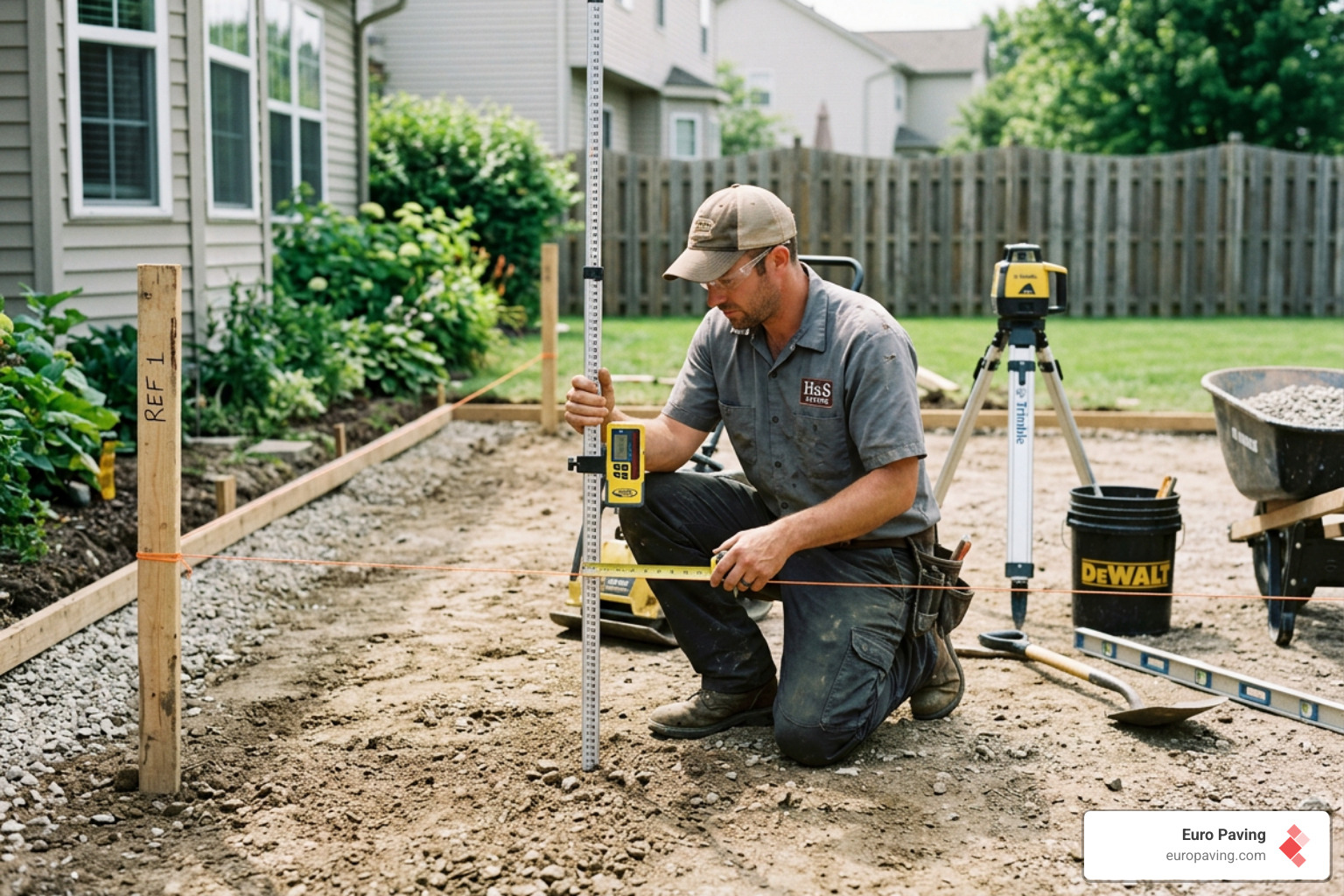
Calculating the paving slope for drainage doesn’t require a degree in advanced mathematics, but it does require precision. We use the “Rise over Run” formula to ensure the math checks out before we ever move a shovel of dirt.
The Formula: (Vertical Rise / Horizontal Run) x 100 = Slope Percentage.
For example, if you have a patio that extends 10 feet (120 inches) from your house, and you want a 2% slope:
- 120 inches (Run) x 0.02 (2%) = 2.4 inches (Rise/Drop).
- You would set your outer edge exactly 2.4 inches lower than the edge meeting the house.
Step-by-Step Calculation for Paving Slope for Drainage
- Set your High Point: This is usually the threshold of a door or the siding of the house.
- Drive Stakes: Place a stake at the start and another at the end of the run.
- Run a String Line: Tie a string between the stakes. Use a line level to make the string perfectly horizontal.
- Measure the Drop: On the outer stake, measure down from the level string the distance you calculated (e.g., 2.4 inches) and mark it.
- Adjust the Grade: This mark is your new surface height.
For a deeper dive into the installation process, see our article on How to Build a Brick Paving Patio in 9 Steps.
Adjusting for Large Scale Projects
On larger projects, like a long driveway in Lake Forest or a commercial parking lot in Arlington Heights, we look at total fall. This involves calculating the longitudinal slope (the length of the drive) and the transverse fall (the width).
Often, we use a “crossfall” where the center of the pavement is higher than the edges (a crown), or we slope the entire surface to one side. For these big jobs, we highly recommend following professional standards for How to Lay a Brick Driveway.
Engineering Surface Drainage: Crossfall, Crowns, and Swales
A flat slope in one direction isn’t always the best solution. Depending on the “lay of the land,” we might employ different engineering profiles:
- The Crown: Common in driveways, the center is the highest point, and water sheds to both the left and right. This is highly effective for wide surfaces.
- Crossfall: The entire surface tilts to one side. This is ideal for walkways running parallel to a building.
- Swales: These are shallow, paved or landscaped “valleys” designed to collect water from two different slopes and direct it toward a drain.
Integrating Secondary Drainage Features
Sometimes, the paving slope for drainage needs a little help. If your yard has a natural “bowl” shape or the soil is heavy clay (common in Downers Grove and Northbrook), we integrate:
- Trench Drains: Long, narrow grates placed at the end of a slope or in front of a garage door.
- French Drains: Buried perforated pipes surrounded by gravel that catch subsurface water.
- Catch Basins: Grated boxes that collect surface water and send it into the municipal storm sewer.
Directing Water Flow Safely
It’s not enough to just move water off the pavers; you have to move it to a safe “discharge point.” We ensure water never drains onto a neighbor’s property—which can lead to legal liability—and stays at least 10 feet away from your home’s foundation. In many Chicago suburbs, municipal codes dictate exactly how and where you can connect to storm sewers.
Professional Tools and Techniques for Verifying Grade
At Euro Paving, we don’t guess—we measure. While a DIYer might use a string line, we utilize professional-grade tools to ensure a 1/4-inch drop is exactly that across the entire surface.
- Laser Levels: These provide a 360-degree level reference point across the entire job site, allowing us to check elevations within 1/16th of an inch.
- Digital Inclinometers: These tools give us an instant digital readout of the slope percentage when placed on a screed rail.
- Subgrade Compaction: The slope must be built into the “subgrade” (the dirt) and the “base” (the gravel), not just the pavers. We compact gravel in 3-inch “lifts” to reach 95% proctor density, ensuring the slope doesn’t sink or change over time.
Verifying the Paving Slope for Drainage During Installation
We perform “flow tests” before the project is finalized. By simulating a heavy rain with a hose, we can verify that there are no “birdbaths” (small depressions where water sits).
| Soil Type | Required Base Thickness | Drainage Characteristics |
|---|---|---|
| Sandy | 4–6 inches | Excellent; natural infiltration |
| Silty | 6–8 inches | Moderate; requires careful grading |
| Clay (Chicago Standard) | 8–12 inches | Poor; requires thick base and positive slope |
Material-Specific Considerations and Permeable Solutions
The material you choose affects how water behaves.
- Porcelain: Very smooth and non-absorbent. It sheds water quickly but can be slippery if the slope isn’t perfect.
- Natural Stone: Sandstone has great traction but can be porous.
- Permeable Pavers: These are a game-changer for Chicago homeowners. Unlike traditional pavers, permeable systems have wider joints filled with small stones.
Permeable Paving and Infiltration
Permeable systems allow water to flow through the surface into a deep stone reservoir (often called a “trass bed”) below. This reduces the need for a steep surface slope because the water doesn’t have to “run off”—it just “soaks in.” This is an excellent way to manage stormwater and recharge groundwater without needing complex pipe systems.
Correcting Existing Slope Issues
If you have an existing patio that is sinking or sloping toward your house, you have options:
- Slabjacking: Pumping a specialized foam or concrete “slurry” under a sinking slab to lift it back to the correct grade.
- Overlays: Adding a new layer of material on top, though this is rarely a permanent fix for drainage.
- Full Reconstruction: Often, the only way to truly fix a 30-year-old grading mistake is to remove the old material, re-grade the subsoil, and start fresh.
Frequently Asked Questions about Paving Slope for Drainage
What is the ideal paving slope for drainage on a patio?
The ideal paving slope for drainage for a patio is 2%, which translates to a 1/4-inch drop for every foot of distance away from the house. This is steep enough to move water effectively but shallow enough that you won’t feel like your patio furniture is sliding away.
Can you correct the paving slope for drainage on an existing surface?
Yes, though the method depends on the material. Concrete slabs can sometimes be “mudjacked” or lifted with foam. For brick pavers, we can often pull up the affected area, add more base material to correct the grade, and re-lay the bricks. However, if the entire base has failed, a full replacement is usually the most cost-effective long-term solution.
How does soil type affect drainage requirements?
In the Chicago area, we deal with a lot of heavy clay. Clay holds onto water and expands when wet, which can shift your pavers. Because clay drains poorly, you need a thicker gravel base (8-12 inches) to act as a “buffer” and a very consistent 2% slope to ensure water gets off the surface as fast as possible.
Conclusion
A beautiful outdoor space is only as good as the engineering beneath it. Whether you are dreaming of a custom brick patio in Elmhurst, a family-friendly fire pit in Hinsdale, or a grand driveway in Mount Prospect, the paving slope for drainage is the foundation of your investment.
At Euro Paving, we combine our years of experience in the Chicago area with advanced 3D design and precision grading to transform backyards into relaxing, worry-free retreats. Don’t let a “flat” patio become a flooded basement.
Schedule a professional consultation for your sidewalk or patio project today, and let us help you get the grade right the first time.