



Why Choosing the Right Inexpensive Walkway Pavers Can Save You Thousands
Finding inexpensive walkway pavers for a large project doesn’t mean settling for low quality — but it does mean knowing which materials deliver the best long-term value for your money.
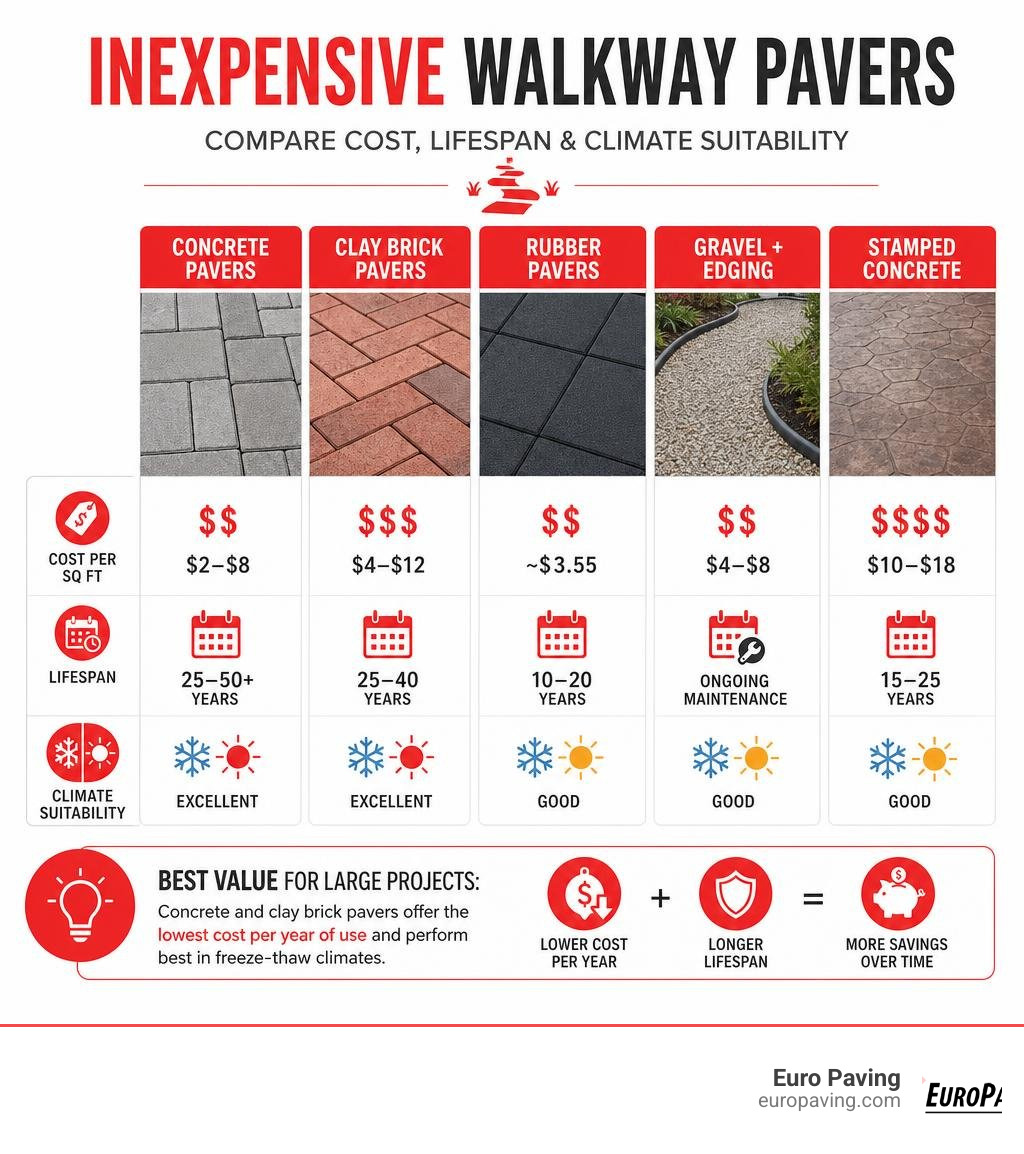
The most cost-effective walkway paver options, ranked by price and value:
| Paver Type | Material Cost (per sq ft) | Lifespan | Best For |
|---|---|---|---|
| Concrete pavers | $2–$8 | 25–50+ years | Large walkways, driveways |
| Clay brick pavers | $4–$12 | 25–40 years | Classic curb appeal |
| Rubber pavers | ~$3.55 | 10–20 years | Low-traffic garden paths |
| Gravel + edging | $4–$8 | Ongoing maintenance | Casual garden paths |
| Stamped concrete | $10–$18 | 15–25 years | Decorative surfaces |
For large projects in the Chicago area, concrete and clay brick interlocking pavers consistently offer the lowest cost per year of use — especially when professionally installed over a proper base.
Here’s the reality most homeowners miss: the paver material itself is rarely the biggest cost driver. Base preparation, drainage, and installation quality determine whether your walkway lasts 5 years or 50. A cheap paver installed correctly will outperform an expensive one laid on a poor foundation — every time.
This is especially true in Cook and DuPage Counties, where freeze-thaw cycles put enormous stress on any hardscape surface every winter.
Inexpensive walkway pavers terminology:
Selecting Inexpensive Walkway Pavers with High Long-Term Value
When evaluating inexpensive walkway pavers for large-scale residential or commercial projects, the upfront purchase price is only one part of the financial equation. True affordability is measured by how much the walkway costs over its entire lifespan.
For high-end, commercial-ready paving services, three primary materials dominate the market: standard concrete pavers, classic clay brick, and interlocking paver systems. Selecting the right option ensures your front yard or backyard transition looks stunning without requiring frequent, expensive repairs.
To explore how budget-conscious choices can still yield a premium look, you can read about Chic and Cheap Walkway Designs for Your Front Yard.
Additionally, manufacturers like Belgard offer a wide array of options designed to emulate natural stone while maintaining structural uniformity. To see how these products fit into a larger hardscape plan, view the Concrete Patio Pavers + Slabs – Belgard collection.
Comparing Concrete and Clay Brick as Cost-Effective Walkway Pavers
For homeowners in the Chicago area, choosing between concrete and clay brick is the first major decision. Both materials are highly durable, but they perform differently under environmental stress and have distinct cost profiles:
- Concrete Pavers ($2–$8 per sq ft): These are the most budget-friendly pre-formed hardscape units available. Manufactured by mixing cement, aggregates, and pigments, they offer incredible design flexibility. Modern concrete pavers are engineered to withstand heavy foot traffic and vehicular loads, making them ideal for both expansive walkways and integrated driveways.
- Clay Brick Pavers ($4–$12 per sq ft): Made from natural clay fired in a kiln, brick pavers offer a timeless, classic aesthetic. Their color is completely natural and will not fade over decades of UV exposure. While slightly more expensive upfront than basic concrete options, clay bricks are incredibly durable and add substantial curb appeal to historical or traditional homes.
In terms of weather resistance, high-quality concrete and clay pavers both excel when installed with proper jointing sand. However, concrete pavers often have a slight edge in modern architectural designs due to the vast array of interlocking shapes and uniform dimensions that make installation highly efficient.
Why Molded and Poured Concrete Fails Compared to Pre-Formed Walkway Pavers
It is common for property owners to consider poured concrete or DIY molded concrete (using plastic molds and wet concrete mix) as a way to cut costs. While a poured concrete slab might seem cheaper initially, it frequently fails in northern climates.
Poured concrete is a rigid, monolithic slab. When the ground underneath shifts due to moisture or temperature changes, the solid concrete has no choice but to crack. Once a poured sidewalk cracks, repairing it seamlessly is nearly impossible, often requiring a complete tear-out and repour.
Conversely, pre-formed interlocking paving stones function as a flexible pavement system. Because they are individual units fitted tightly together over a compacted gravel and sand base, they can flex slightly with ground movement without cracking. If an individual paver ever becomes stained or damaged, it can be easily uninstalled and replaced with a new one in minutes—saving you thousands of dollars in long-term maintenance.
Designing Cost-Effective Walkways for Chicago’s Freeze-Thaw Climate
Designing a walkway in the Chicago metropolitan area—including suburbs like Arlington Heights, Skokie, Barrington, Downers Grove, Lake Forest, and Northbrook—requires a deep understanding of local soil and climate conditions.
Our harsh winters feature rapid temperature swings that cause the ground to freeze, expand, thaw, and contract. This constant movement, known as the freeze-thaw cycle, is the ultimate test of any hardscape installation. To ensure your investment doesn’t heave or sink, you must select materials rated specifically for these conditions, such as those featured in The Best Paving Stones for a Sidewalk That Lasts.
Furthermore, choosing premium products from trusted suppliers like Unilock ensures your pavers possess the structural density required to resist water absorption, which is the primary cause of winter cracking. You can learn more about these specialized local options by viewing Patio Pavers & Paving Stones Chicago I – Unilock.

Ground Conditions and Base Preparation in Northern Illinois
The secret to a flat, long-lasting paver walkway lies entirely beneath the surface. Northern Illinois is notorious for its heavy clay soil, which retains water and expands significantly when frozen.
To counteract this, a professional installation must include:
- Excavation: Digging down 6 to 8 inches to remove unstable topsoil and clay.
- Geotextile Fabric: Laying a commercial-grade geotextile fabric to prevent the clay soil from mixing with the clean gravel base.
- Compacted Gravel Base: Installing 4 to 6 inches of crushed gravel (such as CA-6), compacted in layers using a heavy-duty plate compactor. This base provides a stable platform and allows water to drain away from the pavers.
- Sand Bedting Layer: Spreading a 1-inch layer of washed concrete sand, perfectly leveled, to cradle the pavers.
Whether you are building a walkway in Elmhurst, Hinsdale, or Mount Prospect, skipping any of these steps to save a few dollars upfront will inevitably result in a wavy, uneven path within two seasons. Proper drainage and base preparation are non-negotiable for a professional-grade installation.
How to Estimate Materials and Costs for Large-Scale Walkway Projects
Accurately estimating the volume of materials and overall costs is crucial when planning a large-scale hardscape project. Underestimating can halt construction, while overestimating leads to wasted budget.
To determine the number of pavers required, use this simple formula:
$$text{Total Square Footage} = text{Length of Walkway (ft)} times text{Width of Walkway (ft)}$$
Always add a 5% to 10% waste factor to account for cuts, curves, and future replacements. For example, if you are planning a 100-foot-long walkway that is 4 feet wide:
$$100 text{ ft} times 4 text{ ft} = 400 text{ sq ft}$$ $$400 text{ sq ft} times 1.10 = 440 text{ sq ft of pavers needed}$$
When purchasing pavers by the pallet, keep in mind that coverage varies by manufacturer. For instance, a pallet of Nantucket Pavers Yorkstone (24 in. x 24 in.) covers 88 square feet, meaning you would need exactly 5 pallets for a 440-square-foot project.
To see how larger format units can streamline your layout and minimize joint lines, check out Get Your Path Straight with These Top-Rated Large Walkway Pavers.
At Europa Paving, we take the guesswork out of the estimation process by utilizing state-of-the-art 3D design planning. This allows you to visualize the entire layout, color schemes, and integration with existing elements before a single spade touches the dirt, ensuring absolute precision in material ordering.
Why Professional Installation Outperforms DIY for Large Walkway Projects
While the idea of laying inexpensive walkway pavers yourself might seem like a great way to save money, large-scale projects quickly become overwhelming for DIYers. Hardscaping is incredibly labor-intensive, requiring heavy machinery, precise leveling tools, and a deep understanding of civil engineering principles.
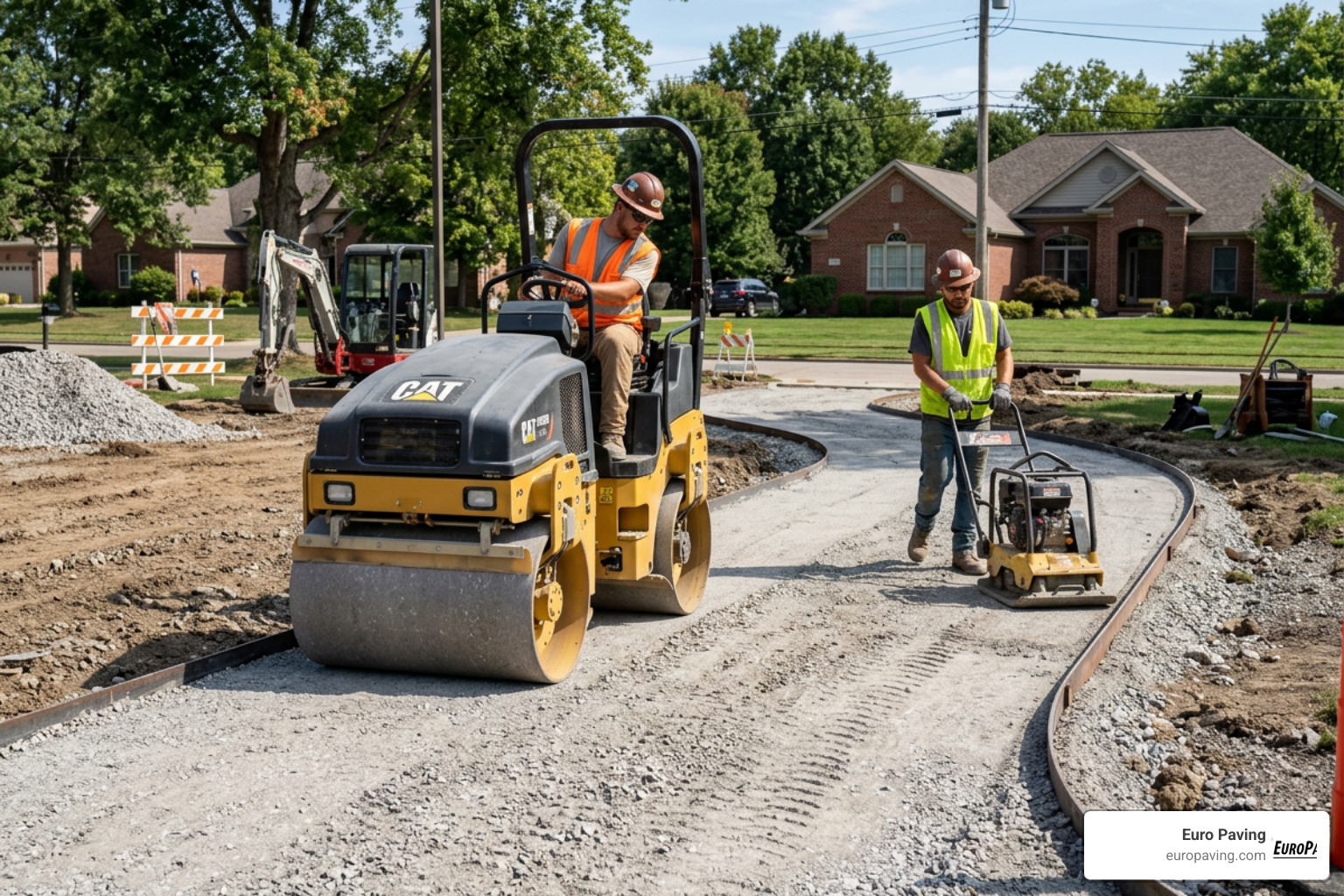
Here is why hiring an experienced contractor is the smartest financial decision for large projects:
- Excavation and Soil Removal: For a 400-square-foot walkway, you will need to excavate and dispose of roughly 10 tons of soil and clay, then haul in 12 tons of gravel and sand. Professionals use skid steers and dump trucks to complete this in hours, whereas doing it by hand with a wheelbarrow can take weeks.
- Compaction Depth: Hand tamping is insufficient for Chicago’s clay soils. Professionals use commercial plate compactors that deliver thousands of pounds of force, ensuring the gravel base will never settle or shift.
- Perfect Grading: Walkways must be sloped slightly (typically a 1% to 2% grade) away from home foundations to prevent water pooling. Professional crews use laser levels to guarantee perfect drainage.
To find reputable local experts who understand these technical demands, refer to Finding the Best Sidewalk Paving Contractors in Your Area. If you want to understand the exact physical steps involved in a standard build, you can read our Step-by-Step Guide to Laying a Stone Paver Sidewalk.
Frequently Asked Questions About Walkway Pavers
How long do concrete and brick walkway pavers last?
When properly installed over a professional-grade compacted aggregate base, concrete pavers typically last between 25 and 50 years. Clay brick pavers are even more resilient, often lasting 40 to 100 years. Their long lifespan is due to their flexible joint system, which prevents cracking during freeze-thaw cycles.
What is the most cost-effective paver pattern for large walkways?
The running bond pattern (where rectangular pavers are laid in parallel rows with staggered joints) is the most cost-effective pattern. It requires very little cutting, which minimizes material waste (usually under 5%). Complex patterns like the herringbone look beautiful but require extensive cutting along the borders, increasing labor costs and material waste up to 10% or 15%.
Why is professional base preparation critical for Chicago walkways?
Chicago’s soils are rich in clay, which expands dramatically when wet and frozen. Without a professional gravel base (typically 4 to 6 inches deep) and a geotextile barrier, the freezing ground will push individual pavers upward, causing severe heaving, tripping hazards, and pooling water.
Conclusion
Investing in a large-scale walkway doesn’t have to break the bank, but true savings come from selecting durable materials and ensuring an flawless installation. By choosing high-quality, inexpensive walkway pavers like interlocking concrete or classic clay brick, you secure a beautiful, low-maintenance asset that enhances your property’s value for decades.
At Europa Paving, we specialize in transforming backyards and front yards into relaxing, family-friendly spaces. As a premier hardscaping specialist serving Chicago and suburbs like Arlington Heights, Skokie, Barrington, Downers Grove, Lake Forest, and Northbrook, we bring your vision to life with precision 3D design and expert craftsmanship. We are proud to be a Unilock authorized contractor, allowing us to offer industry-leading lifetime material guarantees on your paving stones.
Ready to elevate your home’s curb appeal with a professional, worry-free installation? Explore our professional sidewalk paving services and schedule your design consultation with our team today!