



Why Getting Your Patio Slope Right Matters Before You Lay a Single Paver
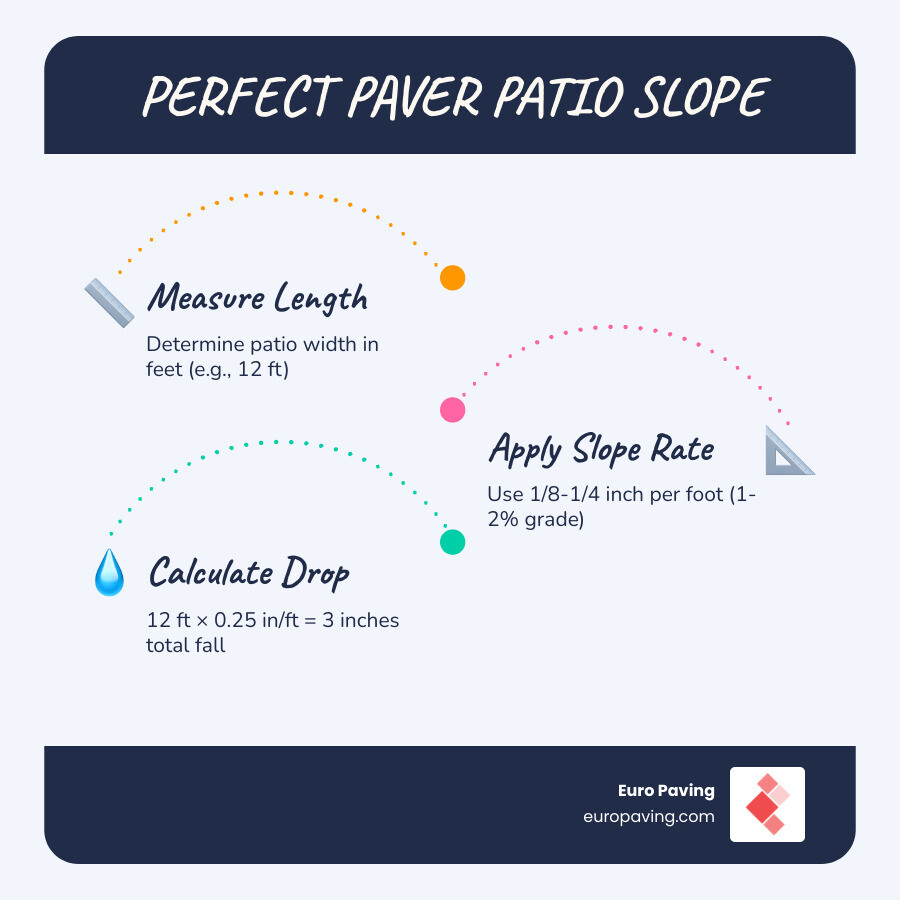
A paver patio slope calculator is a tool that determines the correct drainage angle for your outdoor surface — so water flows away from your home instead of pooling on your new patio.
Quick Answer: How to Calculate Paver Patio Slope
| Method | Formula | Example (12 ft patio) |
|---|---|---|
| Inch per foot | Length × slope rate | 12 ft × 0.25 in = 3 in total drop |
| Percentage | (Rise ÷ Run) × 100 | (3 in ÷ 144 in) × 100 = 2% |
| Gradient ratio | Run ÷ Rise | 1:48 (approximately 1:60 standard) |
The standard rule: your patio needs a minimum drop of 1/8 inch per foot (1% grade) and a maximum of 1/4 inch per foot (2% grade), always sloping away from your home’s foundation.
You’ve spent months imagining the perfect backyard — brick pavers, a fire pit, summer evenings with the family. But here’s what most homeowners don’t realize until it’s too late: a beautiful patio that drains poorly is a problem patio.
Standing water doesn’t just look bad. It accelerates paver deterioration, promotes mold and algae growth, and — especially here in the Chicago suburbs — creates serious freeze-thaw damage every winter.
The slope calculation seems simple on the surface. But the right grade depends on your patio’s size, the paver material, your soil conditions, and how your yard already drains. Get it wrong in either direction — too flat or too steep — and you’re looking at costly repairs within a few years.
This guide walks you through every variable, formula, and professional technique used to calculate and verify patio slope before a single stone is placed.
Paver patio slope calculator basics:
Why a Paver Patio Slope Calculator is Essential for Drainage
When we design a custom hardscape in Arlington Heights or Skokie, our first priority isn’t the color of the brick—it’s the physics of the water. A paver patio slope calculator serves as the mathematical foundation for your entire project. Without it, you are essentially guessing where thousands of pounds of water will go during a heavy Midwestern downpour.
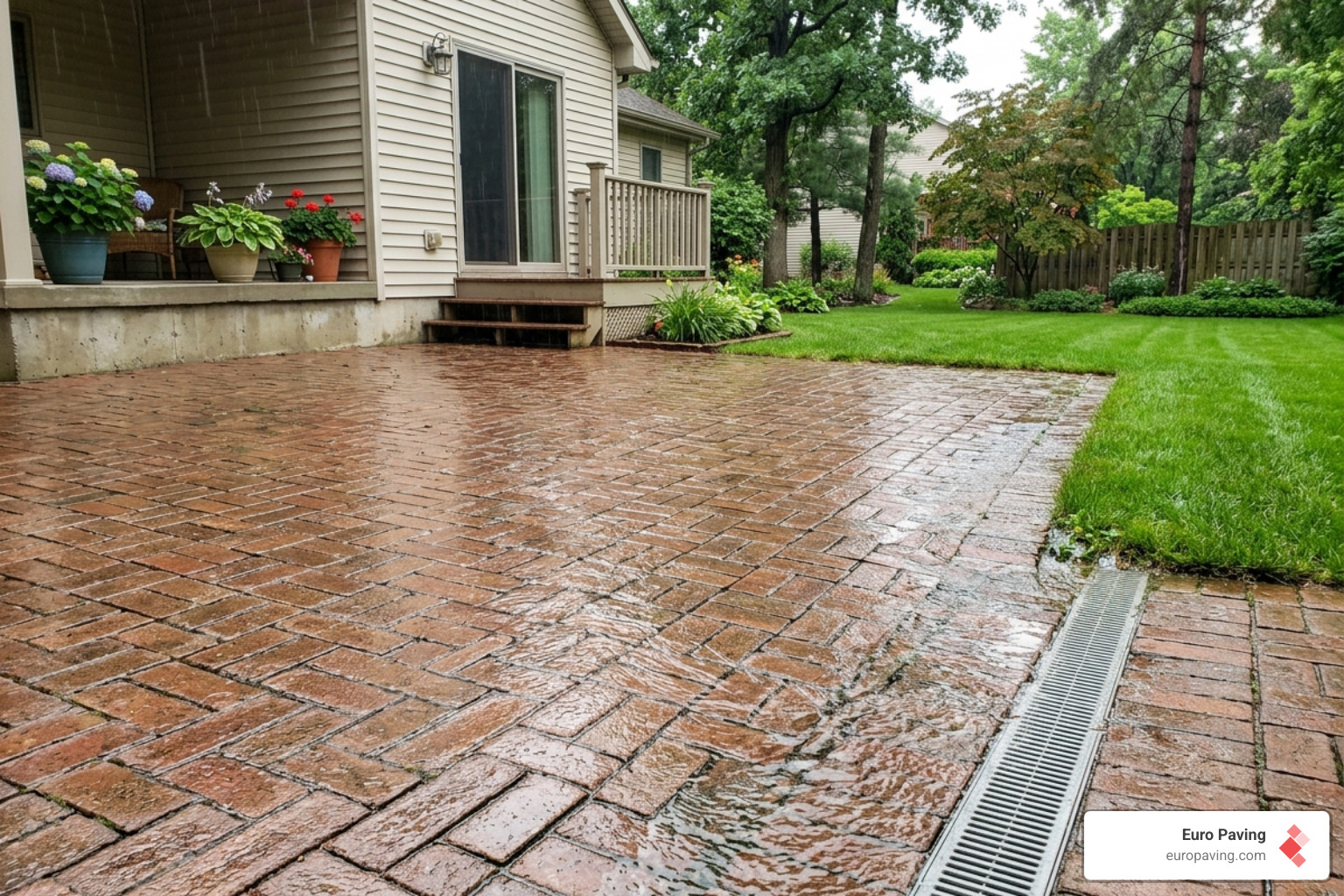
Using a Paver Patio Slope Calculator Online allows you to input two critical variables: the horizontal distance (the “run”) and the elevation difference (the “rise”). By calculating the “rise over run,” we determine the total fall needed to move water effectively.
Why is this so critical? Hydrostatic pressure is a silent killer for hardscapes. If water saturates the bedding sand and gravel base because of poor slope, the base loses its structural integrity. In the worst-case scenarios, water can even migrate toward your home, leading to basement leaks or foundation damage. By establishing a consistent pitch, we ensure that gravity does the heavy lifting, protecting both your investment and your home’s structural health.
Using a Paver Patio Slope Calculator for Irregular Shapes
Not every patio is a perfect rectangle. In fact, many of our favorite projects involve curved alcoves, circular fire pit areas, and winding walkways. These irregular shapes add complexity to drainage planning. You cannot simply calculate one slope for the entire area; you often need multiple drainage points.
When dealing with complex curves, we divide the area into smaller segments. For each segment, we use the calculator to ensure the “longest run” of that section still maintains the required 2% grade. This precision prevents “birdbaths”—those annoying puddles that form in the middle of a beautiful design. Understanding What to Know Before Your Paving Stone Installation includes recognizing that shape complexity requires more frequent measurement checks to maintain calculation accuracy across the entire surface.
Standard Formulas and Gradient Requirements for 2026
As of April 2026, the industry standards for residential paving remain clear, though precision tools have made achieving them easier for professionals. The “Golden Rule” is a 2% grade, which translates to a 1-inch drop for every 4 feet of horizontal distance.
| Slope Percentage | Inch per Foot Drop | Ratio (Gradient) | Typical Use Case |
|---|---|---|---|
| 1.0% | 1/8 inch | 1:100 | Smooth pavers, high-sun areas |
| 1.25% | ~5/32 inch | 1:80 | Minimum for driveways/walkways |
| 1.67% | ~3/16 inch | 1:60 | Standard patio “sweet spot” |
| 2.0% | 1/4 inch | 1:48 | Textured pavers, shady areas |
The Interlocking Concrete Pavement Institute (ICPI) guidelines suggest a maximum slope of 1/4 inch per foot for pedestrian areas. If you go steeper, the patio starts to feel like a ramp, and your patio furniture might begin to wobble. If you go shallower than 1/8 inch per foot, surface tension may keep water from moving, especially on textured “old world” style bricks.
Verifying Results with a Paver Patio Slope Calculator
A common mistake we see in DIY attempts is a failure in unit conversion. If you measure your run in feet but your rise in inches, your decimal precision will be off, leading to a patio that is either too flat or dangerously steep. A paver patio slope calculator automates these conversions, ensuring that your 20-foot run correctly requires a 5-inch total vertical drop.
Once the math is done, site-specific adjustments are often necessary. For instance, if your patio is located in a heavily shaded area of a Northbrook backyard, we might lean toward the 2% maximum to ensure the surface dries quickly and resists moss growth. Professional grade assessment involves looking at these environmental factors alongside the raw numbers.
Technical Factors Influencing Your Slope Calculation
In the Chicago area, we face unique challenges that make slope calculation more than just a “set it and forget it” task. Our climate and soil play massive roles in how a patio performs over time.
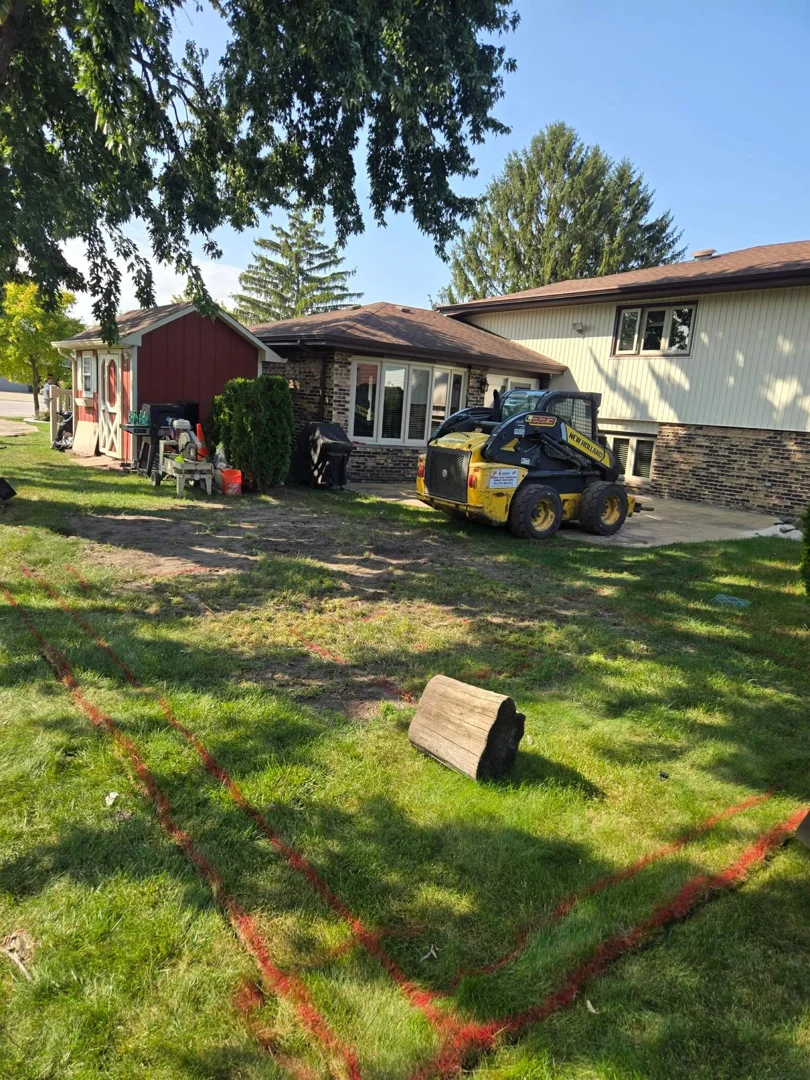
- Chicago Freeze-Thaw Cycles: We live in a region where the ground heaves. If water remains trapped in the base because of a 0% slope, it will freeze and expand, popping your pavers out of alignment.
- Soil Permeability: Clay-heavy soils (common in Lombard and Glenview) don’t absorb water quickly. This means the surface slope must be perfect because the ground underneath won’t “help” with the drainage.
- Rainfall Intensity: Our spring storms can be intense. The slope must be sufficient to handle high-velocity runoff without washing out the polymeric sand in your joints.
- Material Porosity: Smooth, non-porous pavers shed water instantly. Heavily textured or tumbled bricks have “nooks and crannies” that can trap water, often requiring a slightly steeper pitch to overcome surface friction.
According to our Going Downhill: The Essential Guide to Paving Slopes, negative grade correction is one of the most frequent tasks we perform. This involves building up the area near the foundation with compacted structural fill to ensure the “starting point” of the patio is high enough to allow for a downward slope away from the house.
Professional Tools and Techniques for Verifying Grade
Calculating the slope is the first step; implementing it in the dirt is the second. Professionals use a variety of tools to ensure the theoretical 2% grade becomes a reality.
- Laser Levels and Rotary Transits: For large patios in Lake Forest or Barrington, we use rotary lasers. These tools project a level beam across the entire site, allowing us to measure the “drop” at any point with millimeter precision.
- String Lines and Stakes: The tried-and-true method. We set stakes at the high and low points, pull a string tight, and use a line level. By measuring down from the level string to the ground, we can verify the fall.
- Builder’s Square: Essential for ensuring the slope is moving perpendicular to the foundation.
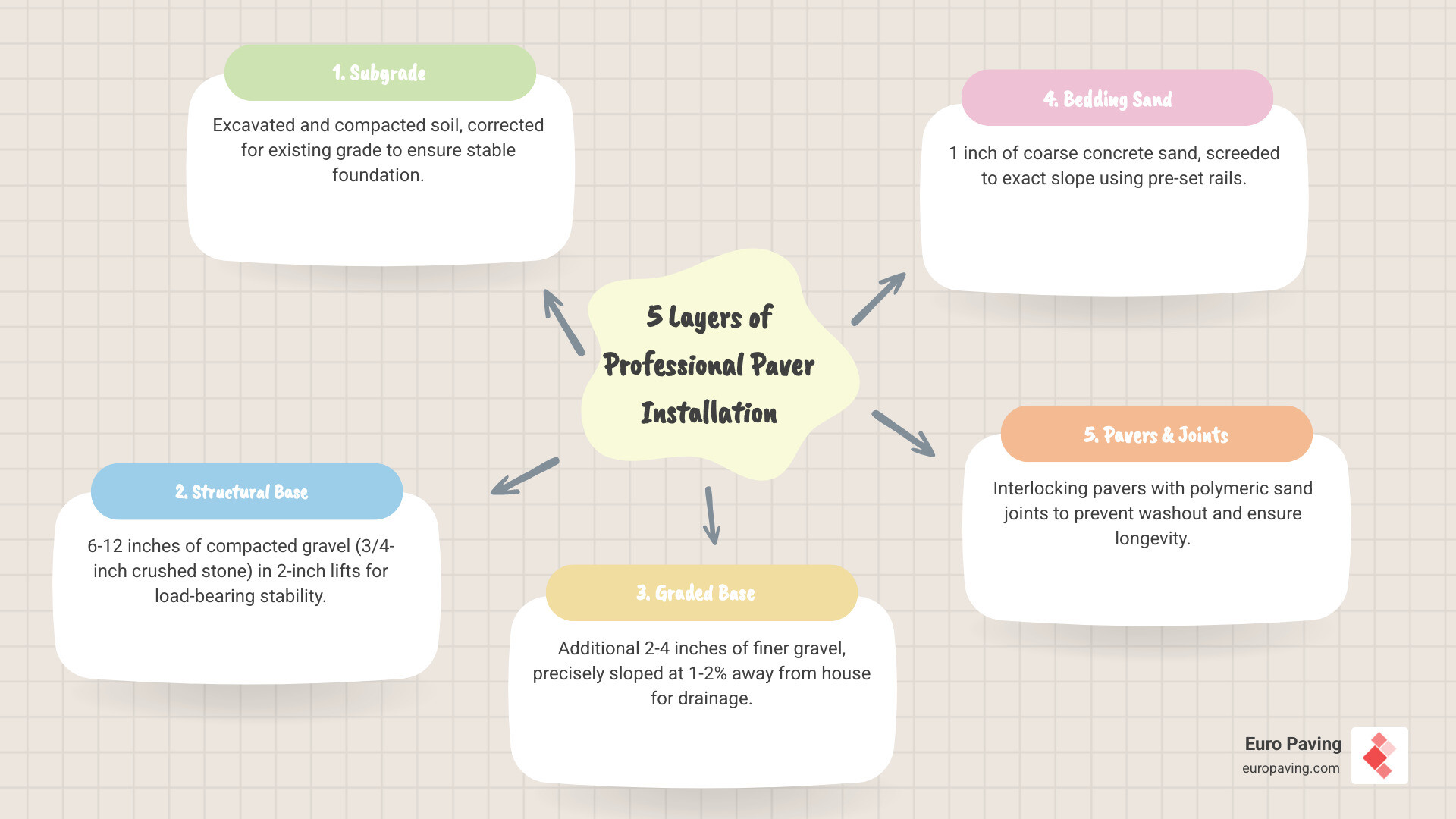
- Screeding Techniques: When we lay the bedding sand, we use pre-set “screed rails” that are already set to the desired slope. This ensures the pavers sit on a perfectly pitched plane.
Using a Slope and Gradient Calculator – IBRAN can help you double-check these manual measurements. If your string line shows a 4-inch drop over 16 feet, the calculator will confirm you’ve hit that perfect 1:48 ratio.
Integrating the Paver Patio Slope Calculator into Project Planning
At Euro Paving, we use 3D design technology to visualize the slope before we even break ground. This allows us to perform a “material takeoff” that accounts for the extra gravel and base material needed to build up a slope on a flat yard.
A patio’s long-term durability is directly tied to the stability of the base. If you have to build up one side of a patio by 6 inches to achieve the correct slope, that extra base material must be compacted in 2-inch “lifts” using a heavy vibratory plate compactor. Simply dumping 6 inches of gravel will lead to settling and a “wavy” patio within a year.
Frequently Asked Questions about Patio Sloping
What is the minimum slope required for a paver patio?
The absolute minimum is 1/8 inch per foot (1% slope). This is generally only recommended for very smooth surface pavers in areas with high sun exposure. Any less than this, and water velocity won’t be high enough to overcome the surface tension of the water droplets, leading to standing puddles.
How does the slope change for permeable vs. impermeable pavers?
Permeable pavers are designed to allow water to infiltrate through the joints into a specialized open-graded stone base. Because they manage so much water subsurface, they can sometimes be installed with a shallower surface slope. However, for standard impermeable pavers (like traditional clay or concrete), the surface slope is the only way water leaves the area, making the 2% grade non-negotiable.
Why must a patio slope away from the house foundation?
This is the most important rule in hardscaping. If a patio slopes toward the house, you are effectively funnelling hundreds of gallons of roof and surface runoff directly into your foundation. This leads to water intrusion, basement flooding, and structural damage. We always aim for at least a 1-inch drop for every 4 feet of run to keep your home bone-dry.
Conclusion
Building a luxury paver patio is an investment in your home’s value and your family’s lifestyle. Whether you are in Hinsdale, Mount Prospect, or Arlington Heights, the key to a patio that lasts 30 years instead of three is the engineering beneath the surface.
By using a paver patio slope calculator and following professional grading standards, you ensure that your backyard remains a relaxing oasis rather than a swampy headache. At Euro Paving, we specialize in these technical details. From 3D design planning to precision excavation and Unilock-certified installation, we transform Chicago-area backyards into family-friendly spaces with fire pits, outdoor kitchens, and perfectly graded drainage.
Ready to start your project with the experts? From Sidewalk Paving Services to expansive backyard retreats, we are here to help. Contact Euro Paving today for a consultation and let us handle the math, the dirt, and the design to create your perfect outdoor space.