



Your Driveway Is the First Thing People See — Make It Count
Brick paving a driveway is one of the most impactful upgrades a homeowner can make to boost curb appeal and long-term property value.
Here’s a quick overview of the professional process:
- Excavate to 12 inches deep
- Compact a gravel sub-base (8 inches)
- Add a 1-inch sharp sand bedding layer
- Lay pavers in your chosen pattern (herringbone is strongest)
- Fill joints with polymeric sand
- Seal the surface for protection
A well-installed brick driveway lasts 25 to 50 years — far longer than asphalt (12–15 years) or poured concrete (20–25 years). And unlike those materials, individual pavers can be replaced without tearing up the whole surface.
But getting it right takes more than just laying bricks on sand. The foundation work — excavation depth, sub-base compaction, drainage slope — is what separates a driveway that lasts decades from one that sinks, shifts, or cracks after the first Chicago winter.
This guide walks you through the full professional process, from material selection and site prep to pattern choices, sealing, and long-term maintenance.
Brick paving a driveway vocab to learn:
Advantages of Brick Over Asphalt and Concrete
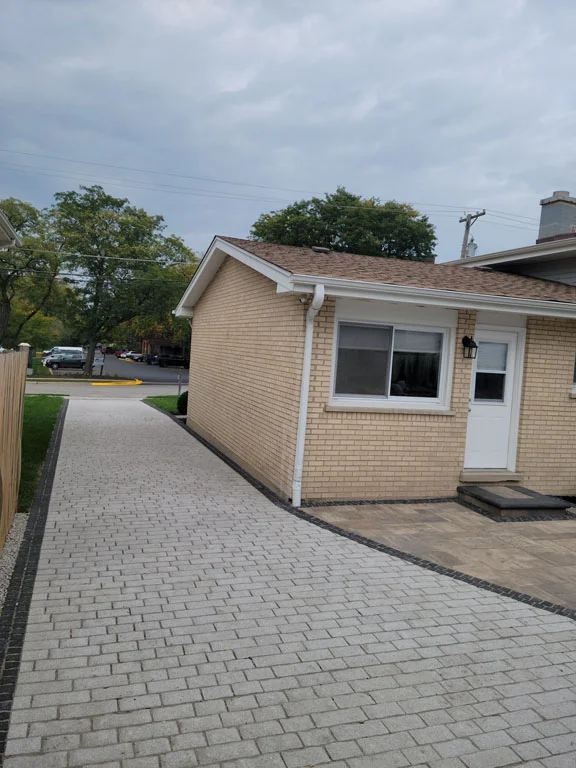
When we talk to homeowners in Arlington Heights or Skokie about their driveways, the conversation usually starts with a choice between asphalt, poured concrete, or pavers. While asphalt is often the “budget” choice, it lacks the longevity and character that a custom-designed home deserves.
There are 8 benefits of having a brick driveway instead of asphalt driveway, ranging from immediate aesthetic impact to long-term structural integrity. Asphalt is prone to cracking, requires frequent resealing, and absorbs immense heat during our humid Illinois summers. Poured concrete, while sturdier, is notorious for “heaving” during the freeze-thaw cycles common in the Chicago area. Once a concrete slab cracks, the only real fix is a costly demolition and replacement.
Brick paving a driveway offers a “flexible” pavement system. Because the driveway is composed of individual units, the surface can move slightly with the ground’s natural expansion and contraction without cracking. If a single brick is stained by oil or chipped by a heavy delivery truck, we can simply pop that one unit out and replace it. You can’t do that with a monolithic slab of concrete.
Many people ask, is a brick driveway cheaper than concrete? The short answer is no—the initial investment for pavers is higher. However, when you factor in the 25- to 50-year lifespan and the significantly lower repair costs, the return on investment (ROI) for brick is far superior.
Superior Strength and Lifespan
At Euro Paving, we utilize premium materials like Unilock Elegance™ pavers, which are engineered to be up to four times the strength of traditional poured concrete. This is vital for driveways that need to support heavy SUVs and frequent traffic. While an asphalt driveway might begin to fail after 12 years, a professionally installed brick system remains a permanent feature of your landscape for generations.
Material Selection: Clay vs. Concrete Pavers
Choosing the right material is the first step in our 3D design planning process. We generally categorize driveway units into two main types: clay brick and concrete pavers.
| Feature | Clay Brick Pavers | Concrete Pavers |
|---|---|---|
| Composition | Natural kiln-fired clay | Portland cement & aggregate |
| Color Longevity | Never fades (natural earth tones) | Can fade slightly over decades |
| Strength | Very high (compressive) | Extremely high (engineered) |
| Shapes | Mostly rectangular | Infinite variety (circles, fans, etc.) |
| Cost | Typically $10–$20 per sq. ft. | Typically $8–$15 per sq. ft. |
For a deeper dive, check out the ultimate guide to buying driveway paver bricks. Clay bricks offer a timeless, “Old World” look that never goes out of style. Because the color is consistent throughout the entire brick, it will look the same in fifty years as it does today. Concrete pavers, on the other hand, offer more versatility in texture and shape—mimicking natural stone, granite, or even weathered planks.
Permeable Paver Options for Stormwater Management
In many Chicago suburbs like Northbrook and Lake Forest, local municipalities have strict codes regarding “impermeable” surfaces to prevent flooding. Permeable brick pavers are an excellent eco-friendly solution. These systems use larger joints filled with small stones rather than sand, allowing rainwater to seep directly into the ground rather than running off into the street. This reduces the load on local storm sewers and can even qualify you for certain municipal incentives.
The Professional Process of Brick Paving a Driveway
If you are researching how to lay a brick driveway, you will find that the “magic” happens underground. A driveway is only as good as the soil it sits on. We follow a rigorous multi-step process to ensure your investment doesn’t sink or shift.
The first step is always a thorough site assessment. We mark all underground utilities and calculate the necessary pitch. In our region, a 1% to 2% slope away from the home’s foundation is mandatory to prevent basement flooding and ice patches in the winter. For broader background on pavement design standards and drainage performance, homeowners can also review resources from the Interlocking Concrete Pavement Institute.
According to the professional standards for high-traffic pavement, the excavation must be deep enough to accommodate the structural layers required for vehicle loads.
Structural Requirements for Brick Paving a Driveway
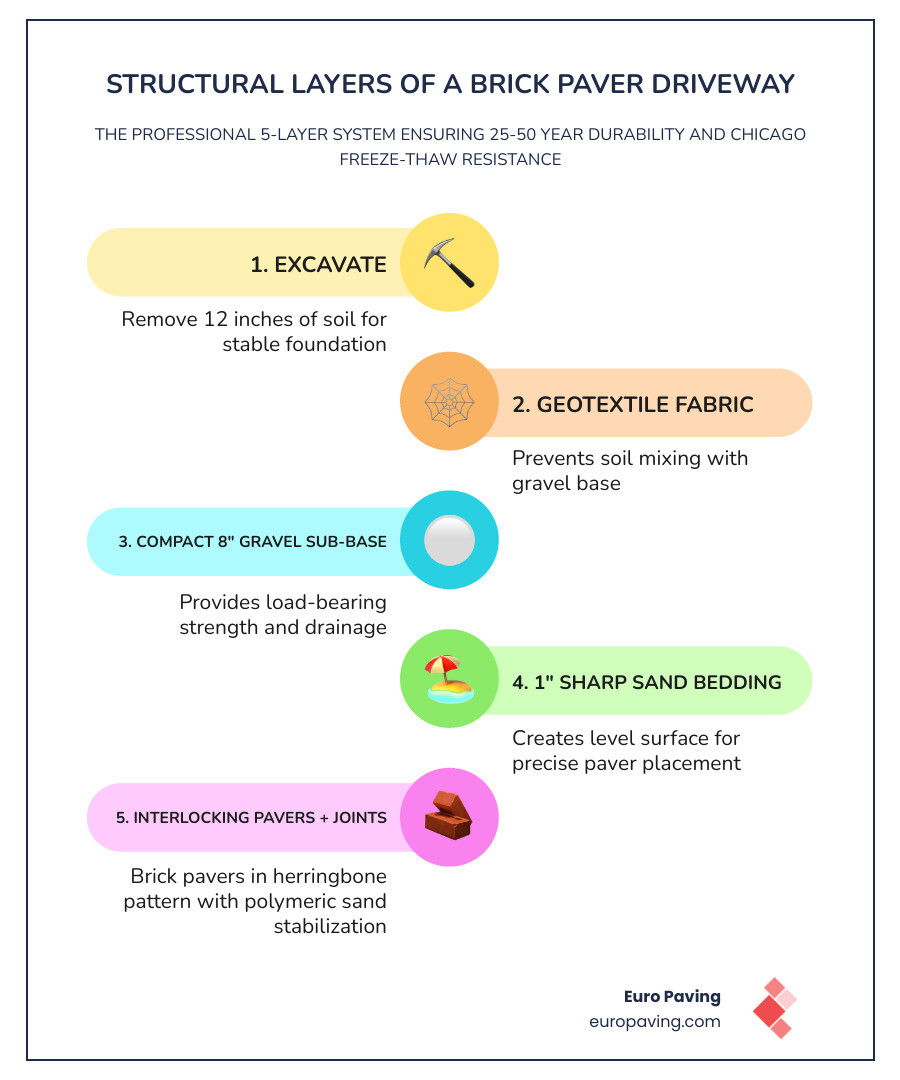
For a standard residential driveway in the Chicago area, we recommend the following structural “sandwich”:
- Subgrade Preparation: We excavate to a depth of approximately 12 inches. The raw soil is then compacted using a heavy-duty vibrating plate compactor to remove air pockets.
- Geotextile Fabric: We lay a professional-grade stabilization fabric. This prevents the heavy gravel base from sinking into the soft clay soil over time.
- Sub-base (8 inches): We install 8 inches of crushed stone (often CA6 or 3/4-inch minus crushed limestone). This is applied in 2-inch “lifts,” with each layer being compacted individually to ensure maximum density.
- Bedding Layer (1 inch): A 1-inch layer of sharp, coarse sand is screeded perfectly level. This acts as the “cushion” that the pavers sit in.
- Edge Restraints: We install heavy-duty plastic or metal edging secured with long steel spikes. This “frames” the driveway, preventing the bricks from spreading outward under the weight of a car.
Proper sub-base preparation is the most critical factor in preventing shifting and sinking over time.
Choosing the Best Pattern for Brick Paving a Driveway
While aesthetics matter, the pattern you choose for brick paving a driveway also impacts its strength.
- Herringbone (45 or 90 degree): This is the “gold standard” for driveways. The interlocking nature of the herringbone pattern provides the best resistance to the “shove” of vehicle tires, especially when cars are turning or braking.
- Running Bond: A classic look that mimics a brick wall. It’s elegant but requires a very strong edge restraint to prevent shifting.
- Basketweave: Best for historic homes, though often used for borders rather than the main field of a driveway.
Maintenance and Longevity of Paver Systems
One of the biggest myths is that brick driveways are high maintenance. In reality, they are incredibly resilient. Everything you need to know about brick paver driveways suggests that a simple annual cleaning is often all that’s required.
The key to a weed-free driveway is polymeric sand. Unlike the play sand used in DIY projects, polymeric sand contains special additives that harden when misted with water. This creates a “mortar-like” joint that resists weeds, prevents ants from nesting, and stays in place during heavy rain or power washing.
Professional Sealing and Repairs
While clay bricks don’t need to be sealed to maintain their color, we often recommend a siloxane-based, breathable sealer for both clay and concrete pavers. Sealing protects the surface from salt damage (crucial for Chicago winters), oil stains, and UV fading.
If you do experience a spill or a “dip” in the driveway due to a water line repair underneath, the fix is simple. We lift the affected pavers, add a bit more base or sand, and re-lay the original bricks. It’s a seamless repair that is impossible with asphalt or concrete.
Frequently Asked Questions about Brick Driveways
Can brick pavers be installed over existing concrete?
Yes, this is known as a “paver overlay.” However, it should only be done if the existing concrete is structurally sound and has no major cracks or settling issues. We typically use a thin sand-set method or specialized thin pavers for these projects. Drainage is the biggest concern here, as adding 2-3 inches of height can affect door sills and garage entries.
How much does a professional brick driveway installation cost?
In the Chicago market, you can expect to pay between $10 and $20 per square foot for a professional installation. This includes the excavation, base materials, pavers, and labor. While natural stone or cobblestone can push that price toward $50 per square foot, standard brick and concrete pavers offer the best balance of luxury and value. For a custom quote in areas like Downers Grove or Northbrook, it’s best to have a Euro Paving professional measure your specific layout.
How often should a brick driveway be sealed?
We recommend resealing every 3 to 5 years. If you notice that water is no longer “beading” on the surface or if the color looks a bit dull, it’s time for a fresh coat. We offer various finishes, from “natural matte” to a “wet look” gloss, depending on your home’s style.
Conclusion
At Euro Paving, we believe your driveway should be more than just a place to park your car—it should be a “red carpet” that welcomes you home. Whether you are in Arlington Heights, Skokie, or Norridge, our team brings decades of expertise to every project.
We specialize in transforming ordinary exteriors into extraordinary landscapes using 3D design planning and premium materials like Unilock. From the initial excavation to the final sweep of polymeric sand, we stand by our craftsmanship with lifetime material guarantees.
Ready to elevate your home? More info about brick paving driveways is just a click away. Contact Euro Paving today to schedule a consultation with our hardscaping experts and see how we can transform your property.