



Why Brick Driveway Edging Is the Finishing Touch Your Home’s Curb Appeal Needs
Brick driveway edging is the structured border installed along the sides of a driveway to define its edge, contain the surface material, and create a polished, finished look.
Here’s a quick overview of what you need to know:
| Topic | Key Facts |
|---|---|
| Best materials | Clay brick, concrete pavers, natural stone, reconstituted granite |
| Common styles | Soldier course, sailor course, herringbone border, linear modern |
| Foundation depth | 9-11 inches total (4-6″ base + 1″ sand + brick height) |
| Restraints needed | Aluminum, steel, or rigid PVC anchored with spikes |
| Joint filler | Polymeric sand – hardens, resists weeds, prevents erosion |
| Supports vehicles? | Yes, with compacted sub-base and interlocking system |
Your driveway is one of the first things people notice about your home. A clean, defined edge separates a professional hardscape from a neglected one. But beyond looks, edging does real structural work – it keeps your driveway surface from spreading, stops erosion at the margins, and protects your investment through Chicago’s brutal freeze-thaw cycles.
Done right, brick edging isn’t just decorative. It’s an engineered system.
Whether you’re finishing a new asphalt or concrete driveway, or upgrading an existing one, the right edging solution makes a measurable difference in both appearance and longevity.
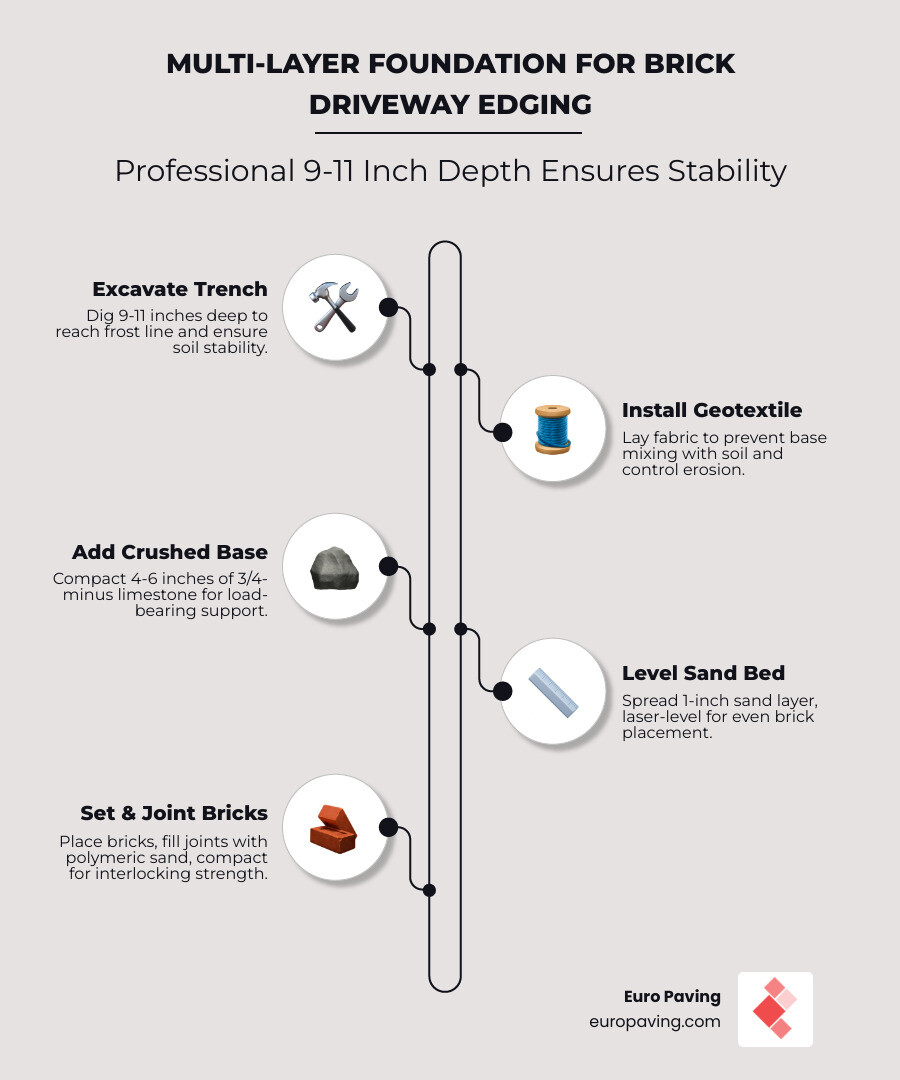
The Functional Benefits of Brick Driveway Edging
When we talk to homeowners in Arlington Heights or Northbrook, the conversation often starts with aesthetics. Everyone wants that “estate” look. However, the true value of brick driveway edging lies beneath the surface. Without a proper border, even the most expensive asphalt or poured concrete driveway is vulnerable to the elements and the weight of daily traffic.
Lateral Stability and Structural Support
One of the primary reasons we recommend a robust brick border is to provide lateral stability. Driveways, especially those made of asphalt or gravel, have a tendency to “creep” or spread outward over time under the weight of vehicles. By installing a reinforced brick edge, we create a permanent shoulder that holds the driveway material in place. This prevents the edges from thinning out and cracking, which is a common precursor to total driveway failure. If you’ve noticed your driveway margins looking ragged, you should learn How to Fix Your Crumbling Driveway Edges Before They Disappear to save the rest of the surface.
Erosion Control and Moisture Management
In the Chicago area, we deal with significant rainfall and snowmelt. Without a defined edge, water can wash away the soil supporting the sides of your driveway, leading to “undermining.” This creates air pockets beneath the surface that eventually cause the driveway to collapse or sink. A professional brick edge acts as a gutter system of sorts, directing water flow away from the structural base of the driveway and into the lawn or drainage system. To further protect your investment, consider the 7 Benefits of Sealcoating Your Brick Driveway once the installation is complete.
Weed Suppression and Defined Boundaries
There is nothing more frustrating than grass and weeds creeping into your driveway. Brick driveway edging creates a physical barrier that stops root systems from encroaching on your pavement. When we install a deep-set border with polymeric sand joints, we effectively eliminate the “no-man’s land” where weeds typically thrive. This makes mowing and edging your lawn much easier, as you have a hard, level surface to guide your equipment against.
Selecting Premium Materials for Brick Driveway Edging
The durability of your edging depends entirely on the quality of the materials used. In our years of experience serving communities like Skokie and Barrington, we have found that not all bricks are created equal—especially when they need to withstand vehicle weight and road salt.
Unilock Pavers: The Gold Standard
We frequently utilize Unilock materials because they are engineered specifically for the harsh Illinois climate. Unlike standard clay bricks that might flake or “spall” after a few winters, Unilock pavers are manufactured with high-density concrete and color-fast pigments. They offer the traditional look of brick with the structural integrity of modern engineering.
Clay vs. Concrete
While we often use the term “brick,” there is a distinction between traditional clay and modern concrete pavers.
- Clay Bricks: These offer a timeless, rich color that never fades because the color is baked into the material. They are excellent for historic homes in Lake Forest or Highland Park.
- Concrete Pavers: These provide superior dimensional consistency, making them easier to lock together tightly. They come in a wider variety of textures, including options that mimic natural stone or weathered granite.
To better understand the differences, you can explore our guide on What is Brick Paving? to see which material fits your home’s architecture.
Natural Stone and Reconstituted Granite
For a truly high-end finish, some homeowners opt for natural stone accents or reconstituted granite. These materials offer an organic look that complements lush landscaping. Reconstituted granite, in particular, provides the rugged durability of stone with the uniform installation benefits of a manufactured product. These materials are exceptionally weather-resistant and can handle the heavy load of SUVs and delivery trucks without shifting.
Custom Design Patterns for Brick Driveway Edging
The pattern you choose for your brick driveway edging can dramatically change the visual “weight” of your home’s entrance. We work with our clients to select patterns that either blend seamlessly with the driveway or provide a bold, contrasting frame.
- Soldier Course: This is the most popular choice. Bricks are laid standing upright (on their short ends) or lengthwise, perpendicular to the driveway. It creates a strong, thick border that looks like a row of soldiers standing guard.
- Sailor Course: In this pattern, bricks are laid flat and end-to-end, parallel to the driveway. This creates a thinner, more subtle border that is perfect for narrower driveways.
- Herringbone Borders: For a more intricate look, a herringbone pattern can be used within a wider border. This is highly effective at “locking” the bricks together, as the interlocking angles distribute weight more evenly.
- Linear Modern: For contemporary homes in areas like Chicago’s North Side or modern builds in Hinsdale, we often use long, plank-style pavers to create a sleek, minimalist edge.
For more inspiration on how to layout your project, check out our Tips for Designing a Driveway with Brick Pavers.
Choosing the Right Restraints for Brick Driveway Edging
A common mistake in DIY projects is forgetting the “invisible” part of the edging: the restraints. Without a physical barrier on the lawn side of the bricks, the entire border will eventually “drift” into the grass, causing the joints to open up and weeds to take over.
We use professional-grade systems to ensure your edging stays exactly where we put it:
- Aluminum BrickBlock: This is a permanent, reversible edging system. It is much more durable than plastic and won’t rust like steel. It is flexible enough to handle the elegant curves we often design for driveways in Downers Grove.
- Rigid PVC: High-quality PVC restraints are excellent for straight runs. They are cost-effective and provide a solid wall for the bricks to butt against.
- Steel Landscape Edging: For a very thin, nearly invisible profile, steel is an option. However, it must be high-gauge and properly coated to prevent corrosion from winter salt.
- Concrete Haunching: In some heavy-duty applications, we “haunch” the back of the bricks with a concrete shoulder. This is a traditional masonry technique often used when installing cobblestone driveway edging to provide maximum resistance against vehicle tires.
The Professional Installation Process for Lasting Stability
Installing brick driveway edging that lasts for decades requires more than just digging a shallow hole and dropping in some bricks. At Europa Paving, we follow a rigorous engineering process to ensure your border remains level and true, even through the shifting soils of Cook and DuPage Counties.
Step 1: Sub-Grade Preparation and Excavation
The foundation is everything. We start by excavating a trench that is significantly wider than the bricks themselves. This allows us to install a base that extends beyond the brick, providing a “shelf” that prevents the edge from tipping. We call the utility companies first to mark any lines, and then we dig down to stable sub-soil. If you are interested in the full scope of a driveway project, you can read our detailed guide on How to Lay a Brick Driveway.
Step 2: Geotextile Fabric and Base Layer
We lay down a high-quality geotextile fabric at the bottom of the trench. This fabric acts as a separator, preventing the expensive gravel base from sinking into the soft clay soil common in the Chicago area.
Next, we add 3/4-minus crushed limestone. This material is essential because it contains a mix of stone sizes that lock together when compacted. We don’t just dump it in; we add it in 2-inch “lifts,” compacting each layer with a heavy-duty vibrating plate compactor.
Step 3: Laser Leveling and Drainage Grading
Precision is what separates a professional job from a DIY attempt. We use laser levels to ensure the edging follows the exact slope of your driveway. Proper grading is vital—the edging must be flush with the driveway surface to avoid trip hazards and tire damage, but it must also be sloped slightly away from your home’s foundation to manage water runoff.
Precision Engineering for Brick Driveway Edging
Once the base is set, the actual “laying” of the bricks begins. This is where the artistry meets the engineering.
Trenching Depth and the “Rule of 10”
For a standard 4-inch tall brick, we typically dig a trench 9 to 11 inches deep. This allows for:
- 6 inches of compacted limestone base.
- 1 inch of leveled bedding sand.
- The height of the brick itself.
By ensuring the base is deep enough, we protect the edging from “frost heave”—the process where moisture in the soil freezes and pushes the bricks upward. Following established Brick Paving Standards and Patterns ensures that the final result is as durable as it is beautiful.
Mechanical Compaction and Sand Bedding
We use a 1-inch bed of coarse sand to provide a final leveling layer for the bricks. Once the bricks are set in the desired pattern (such as a soldier course), we run the compactor over the top of the bricks. This “seats” the bricks into the sand and forces the sand up into the joints, creating an initial lock.
Polymeric Sand Activation
The final step is the most important for long-term maintenance. We sweep polymeric sand into the joints. Unlike regular sand, polymeric sand contains special additives that turn into a flexible “glue” when activated with water. Once we mist the surface, the sand hardens, locking the bricks in place and creating a surface that is nearly impenetrable to weeds and ants.
Maintaining Your Driveway Investment in the Chicago Climate
Living in areas like Hillside, Winnetka, or Mount Prospect means your driveway will face extreme temperature swings. Maintenance is the key to ensuring your brick driveway edging looks as good in year ten as it did on day one.
Managing Freeze-Thaw Cycles
The constant freezing and thawing of the ground can cause minor shifts in any hardscape. Because we use a flexible base system (sand and gravel rather than rigid concrete), our brick edging can “breathe” with the ground. However, you should inspect your edges every spring. If you notice any minor shifts, it’s best to address them early. Learn How to Repair Driveway Cracks to keep the entire system integrated.
Power Washing and Joint Sand Replenishment
Over time, even polymeric sand can wear down due to heavy pressure washing or extreme weather. Every few years, we recommend a professional cleaning and a “top-off” of the joint sand. This keeps the interlocking system tight and prevents water from getting under the pavers.
Professional Inspections in Cook and DuPage County
We recommend having a professional look at your driveway and edging every 3-5 years. We can check for signs of undermining, check the integrity of the restraints, and suggest re-sealing if the pavers are starting to look dull. Our local expertise in the Chicago suburbs allows us to spot problems that out-of-state contractors might miss.
Frequently Asked Questions about Driveway Edging
Can brick edging support the weight of a vehicle?
Yes, absolutely—provided it is installed correctly. When we use an interlocking system on a 6-inch compacted stone base, the weight of a vehicle is distributed across the entire foundation, not just a single brick. This prevents sinking and shifting. For driveways that see heavy delivery truck traffic, we can further reinforce the edge with concrete haunching.
How deep should the foundation for brick edging be?
In the Chicago area, we aim for a total trench depth of 9-11 inches. This accommodates the 6 inches of stone base required to get below the most active “heave” zone of the soil and provides enough room for the sand bed and the paver itself. In areas with particularly soft “muck” soil, we may go even deeper.
Is polymeric sand necessary for driveway borders?
While you can use regular sand, we don’t recommend it for driveways. Polymeric sand is essential because it resists being washed away by the high-velocity water runoff common on driveways. It also provides a much stronger “lock” between the bricks, which is necessary to resist the lateral force of a turning vehicle tire.
Conclusion
At Europa Paving, we believe that your home deserves a grand entrance. Brick driveway edging is more than just a border; it’s a statement of quality and a commitment to protecting your home’s value. From our initial 3D design modeling—where you can see your project before we even break ground—to our expert installation using premium Unilock materials, we handle every detail with precision.
As a Unilock authorized contractor, we offer lifetime material guarantees, giving you peace of mind that your investment is protected. Whether you are in Chicago, Elmhurst, Hinsdale, or any of the surrounding suburbs, our team is ready to transform your driveway into a polished, professional hardscape.
Contact Euro Paving for your next brick paving driveway project today and let us help you create a look that lasts a lifetime.