



Why Getting Your Paver Calculator Square Feet Right Saves Time and Money
Paver calculator square feet is the core formula every homeowner needs before ordering a single stone for their patio, walkway, or outdoor kitchen area.
Here’s the quick answer to estimate your paver needs:
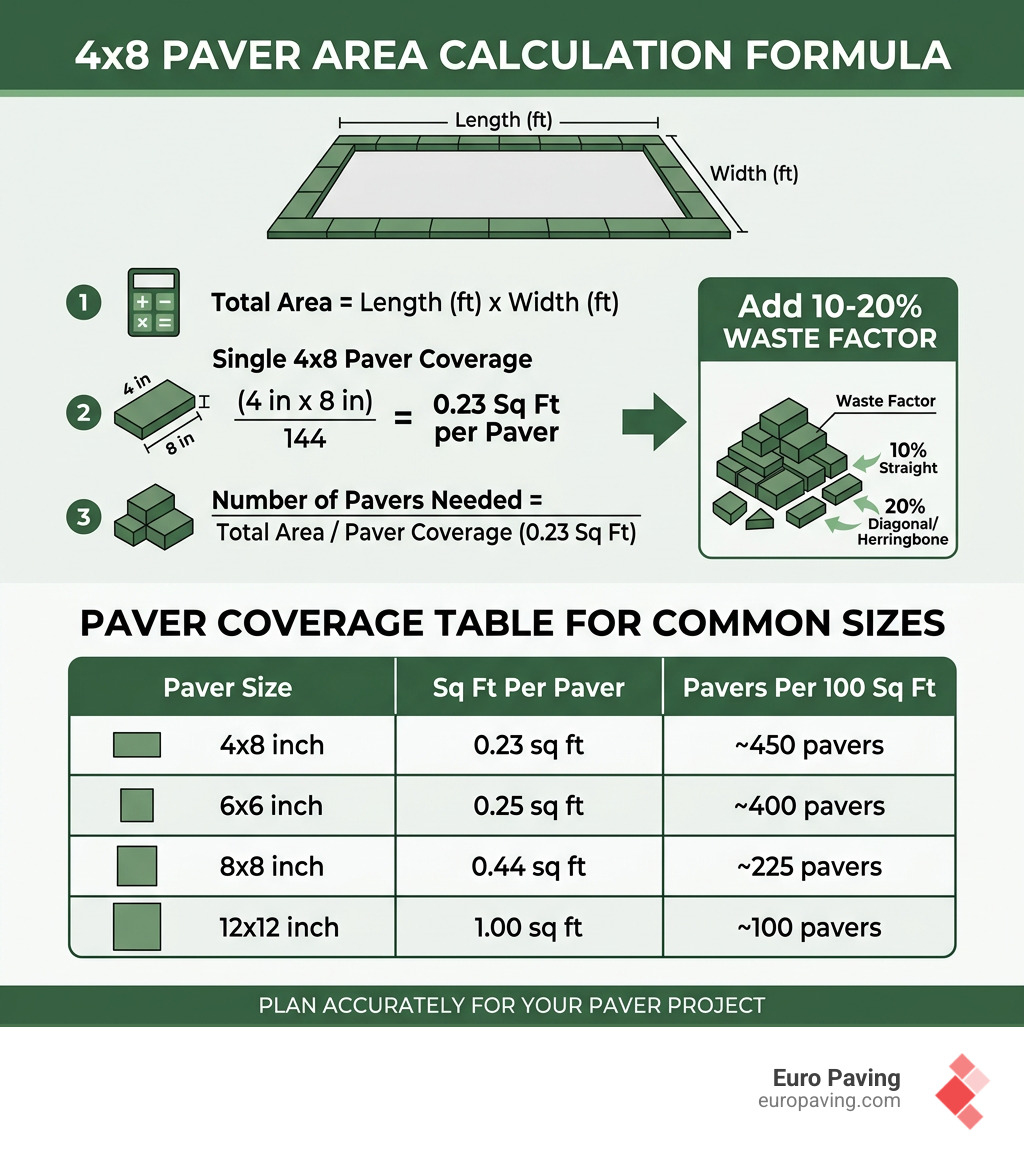
- Measure your area – Multiply length (ft) x width (ft) to get total square footage
- Calculate paver coverage – Multiply paver length (in) x width (in), then divide by 144 to get square feet per paver
- Divide total area by paver coverage – Round up to the nearest whole number
- Add waste factor – Add 10% for straight patterns, 20% for diagonal patterns like herringbone
For 4×8 inch pavers specifically:
| Paver Size | Sq Ft Per Paver | Pavers Per 100 Sq Ft |
|---|---|---|
| 4×8 inch | 0.23 sq ft | ~450 pavers |
| 6×6 inch | 0.25 sq ft | ~400 pavers |
| 8×8 inch | 0.44 sq ft | ~225 pavers |
| 12×12 inch | 1.00 sq ft | ~100 pavers |
Getting these numbers wrong is a costly mistake. Order too few pavers and you risk a mismatched dye lot when you reorder. Order too many and you’ve wasted budget that could have gone toward a fire pit or outdoor kitchen upgrade.
For a 600 square foot patio using 4×8 pavers, that means ordering roughly 2,609 pavers – before adding your waste factor. For a busy suburban homeowner planning a backyard transformation in the Chicago area, accurate planning upfront is what separates a smooth project from a stressful one.
The sections below walk through every calculation you need – from base gravel volumes to polymeric sand coverage – so you can plan with confidence before talking to a professional.
Mastering the Paver Calculator Square Feet Formula
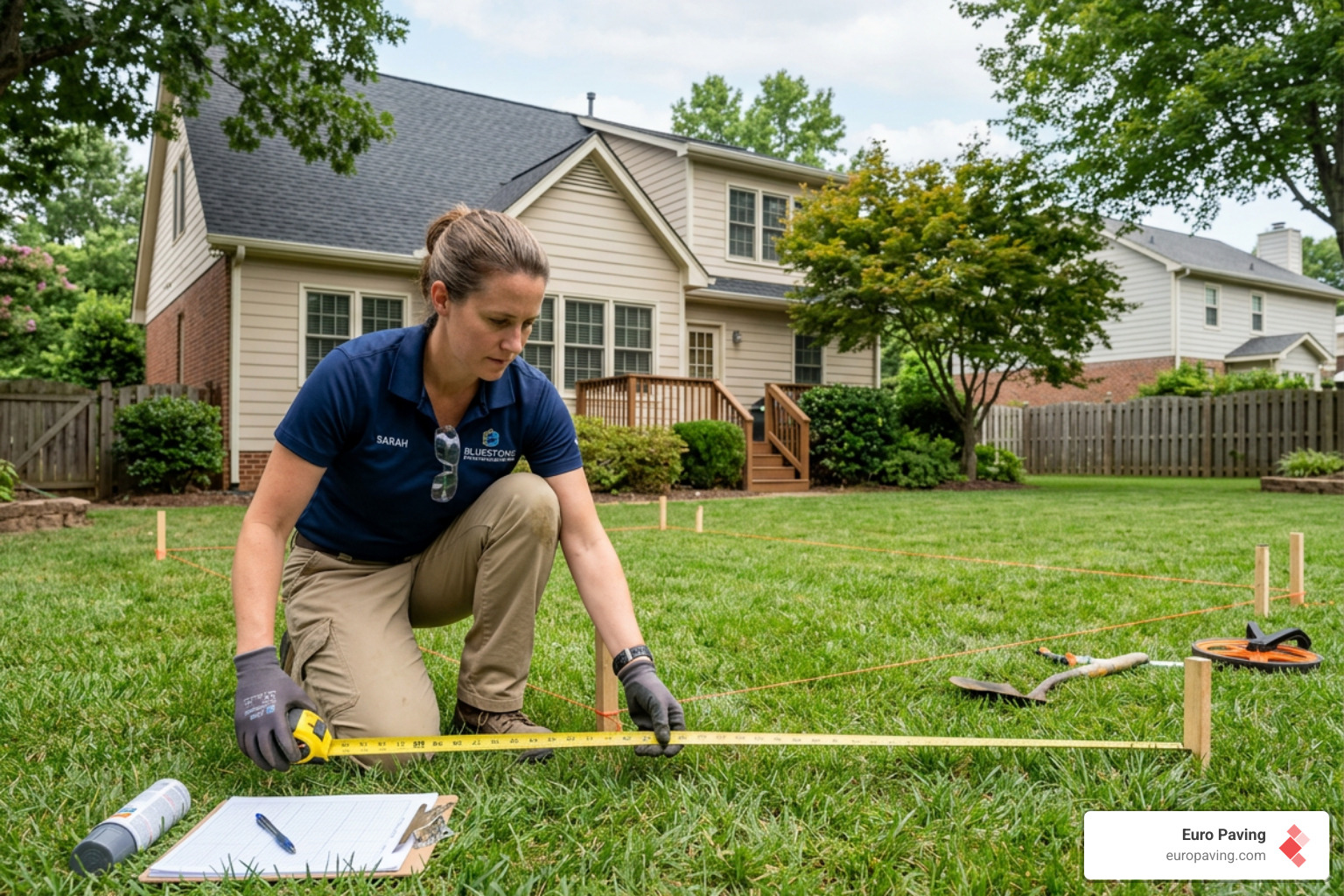
When we begin a project in suburbs like Arlington Heights or Hinsdale, the very first step is obtaining an airtight measurement of the space. Whether you are using a digital Paver Calculator and Price Estimator or a notebook and tape measure, the goal is to determine the exact “net” area.
Precision is vital because even a small error cascades. For instance, mismeasuring a 20×30 foot patio as 19×29 feet creates a 51-square-foot deficit. That is over 220 missing 4×8 pavers! To ensure your foundation is solid, we always recommend reviewing More info about brick paving standards to understand how professional layouts are structured.
Converting 4×8 Dimensions for a Paver Calculator Square Feet Result
To find out how many pavers fit into your space, we first have to speak the same language: square feet. Most pavers are sold by the square foot, but their dimensions are measured in inches.
The math is straightforward:
- Multiply the length by the width in inches (4″ x 8″ = 32 square inches).
- Divide that number by 144 (the number of square inches in one square foot).
- 32 / 144 = 0.222… (rounded to 0.23) square feet per paver.
| Paver Size | Calculation (Inches) | Sq Ft Coverage | Pavers per 100 Sq Ft |
|---|---|---|---|
| 4×8 Standard | 32 / 144 | 0.23 | 450 |
| 6×6 Square | 36 / 144 | 0.25 | 400 |
| 6×9 Rectangle | 54 / 144 | 0.38 | 267 |
| 12×12 Large | 144 / 144 | 1.00 | 100 |
Calculating Total Area for a Paver Calculator Square Feet Estimate
If your backyard is a perfect rectangle, just multiply length times width. However, most beautiful designs in the Chicago Area involve more complexity. We often break irregular yards into “sub-areas.” If you have an L-shaped patio, treat it as two rectangles, calculate the square footage for each, and add them together.
For those looking to create expansive entertaining zones, you can find More info about patio paving services to see how different zones (like a dining area and a fire pit zone) are calculated and integrated.
Pattern Complexity and Waste Factor Adjustments
The pattern you choose changes more than just the look of your home; it changes how much material we need to order. A complex pattern requires more cuts, and more cuts mean more waste. Tools like the Paver Calculator – The Home Depot provide a baseline, but they often default to a standard 10% waste factor. At Euro Paving, we adjust this based on the specific aesthetic you desire. You can explore More info about paving materials to see which stones work best for high-waste vs. low-waste patterns.
Straight vs. Diagonal Pattern Waste
- Running Bond or Stack Bond (Straight): These are the most efficient. We recommend a 10% waste factor. This covers the occasional broken paver and the simple cuts at the end of each row.
- Herringbone or Diagonal Patterns: Because every single paver meeting the edge restraint must be cut at a 45-degree angle, the waste increases significantly. We recommend a 20% waste factor for these installations.
Always remember to keep a few “attic stock” pavers. If a utility pipe ever needs repair under your patio in five years, you’ll want pavers from the same dye lot to patch the hole.
Calculating for Irregular Shapes and Curves
Curves add elegance but require a math upgrade. For a circular patio, use the formula: π (3.14) x radius². If you have a 10-foot wide circle (5-foot radius), the area is 3.14 x 25 = 78.5 square feet.
Because curves require a high volume of small, wedge-shaped cuts, we typically bump the waste factor to 20-25% for the perimeter. For walkways that wind through a garden, check out More info about sidewalk paving to see how we calculate for fluid, natural lines.
Calculating Base Materials: Gravel, Sand, and Polymeric Requirements
A patio is only as good as what is underneath it. If you skip the math on your base materials, your beautiful 4×8 pavers will be shifting and sinking within two Chicago winters. We pride ourselves on heavy-duty base preparation, especially for More info about driveway paving, where vehicle weight is a factor.
Estimating Aggregate Volume per Square Foot
For a standard residential patio, we use a 4 to 6-inch base of compacted crushed stone (CA-6 or “3/4-minus” gravel).
- Formula for Gravel: (Square Footage x Depth in Feet) / 27 = Cubic Yards.
- Example: A 100 sq ft patio with a 6-inch (0.5 ft) base: (100 x 0.5) / 27 = 1.85 Cubic Yards of gravel.
On top of the gravel, we add exactly 1 inch of bedding sand. Do not go deeper than 1 inch with sand, as it can become unstable.
Polymeric Sand Coverage and Joint Stability
Polymeric sand is the “glue” that keeps weeds out and pavers in place. It is activated by water and hardens to lock the joints.
- A standard 50lb bag typically covers 25 to 50 square feet, depending on the depth of your pavers and the width of the joints.
- For 4×8 pavers, which have more joints per square foot than large 24×24 slabs, you will likely be on the lower end of that coverage (closer to 25-30 sq ft per bag).
Professional Project Costing in the Chicago Area
When budgeting for a paver calculator square feet estimate, you have to account for more than just the stones. In the Chicago market, professional installation typically ranges from $15 to $25 per square foot, depending on the materials and complexity. For a deeper dive into the numbers, read More info about brick paving costs.
Regional Installation Variables
Costs vary slightly across the North and West suburbs. Whether we are working in Barrington, Highland Park, or Downers Grove, we have to account for local soil conditions. In some areas like Norridge or Skokie, the clay content in the soil is higher, which may require a slightly deeper gravel base or the use of geotextile fabric to prevent the stone from sinking into the mud.
Total Investment Breakdown
A professional quote from us includes:
- Excavation: Removing old soil and grass.
- Base Preparation: Delivering, leveling, and compacting gravel in “lifts.”
- Unilock Materials: We often use high-end materials that come with lifetime structural guarantees.
- Professional Labor: Ensuring the pitch is exactly 1-2% (1/8″ per foot) away from your home to prevent flooding.
Frequently Asked Questions about Paver Calculations
How many 4×8 pavers are in a pallet?
A standard pallet typically holds between 78 and 160 square feet of pavers. The wide range exists because different manufacturers stack their pallets to different heights based on the weight limit of their delivery trucks. When we coordinate logistics for a project in Mount Prospect or Glenview, we always check the specific pallet count for that “batch” to ensure we don’t block your entire driveway with extra pallets.
How do you calculate pavers for a multi-size random pattern?
If you aren’t using just 4x8s but a “three-piece” system (like a small, medium, and large square/rectangle mix), you calculate by the module. The manufacturer will tell you the square footage of one “pattern repeat.” You simply divide your total square footage by the module size. For example, if one pattern repeat is 12 square feet, and you have a 120-square-foot patio, you need 10 modules.
What is the standard base depth for a residential driveway?
Driveways require significantly more strength than patios. We recommend 8 to 12 inches of compacted gravel. We also utilize geotextile fabric between the soil and the gravel to provide “soil stabilization,” ensuring that heavy SUVs don’t create ruts in your beautiful new entrance.
Conclusion
Accurately using a paver calculator square feet formula is the first step toward the backyard of your dreams. At Euro Paving, we take that data and transform it into custom brick patios, functional outdoor kitchens, and family-friendly fire pit areas. By combining 3D paving design with expert knowledge of the Chicago climate, we ensure your investment lasts for decades.
Ready to stop crunching numbers and start enjoying your yard? Schedule a consultation for your brick paving driveway project with our team today. Whether you are in Hinsdale, Arlington Heights, or anywhere in the Chicago IL area, we are ready to help you build a space your family will love.