



Why Damaged Driveways and Patios Cost You More Than You Think
Driveway and patio repair is one of the smartest investments a homeowner can make — and one of the most commonly delayed.
Here’s a quick answer to what you need to know:
| Common Problem | Best First Step |
|---|---|
| Hairline or surface cracks | Professional crack sealing |
| Sinking or uneven slabs | Concrete leveling (slabjacking or foam injection) |
| Shifting or loose pavers | Paver resetting with polymeric sand |
| Widespread crumbling or deep fractures | Full section or slab replacement |
| Surface staining or scaling | Resurfacing and sealing |
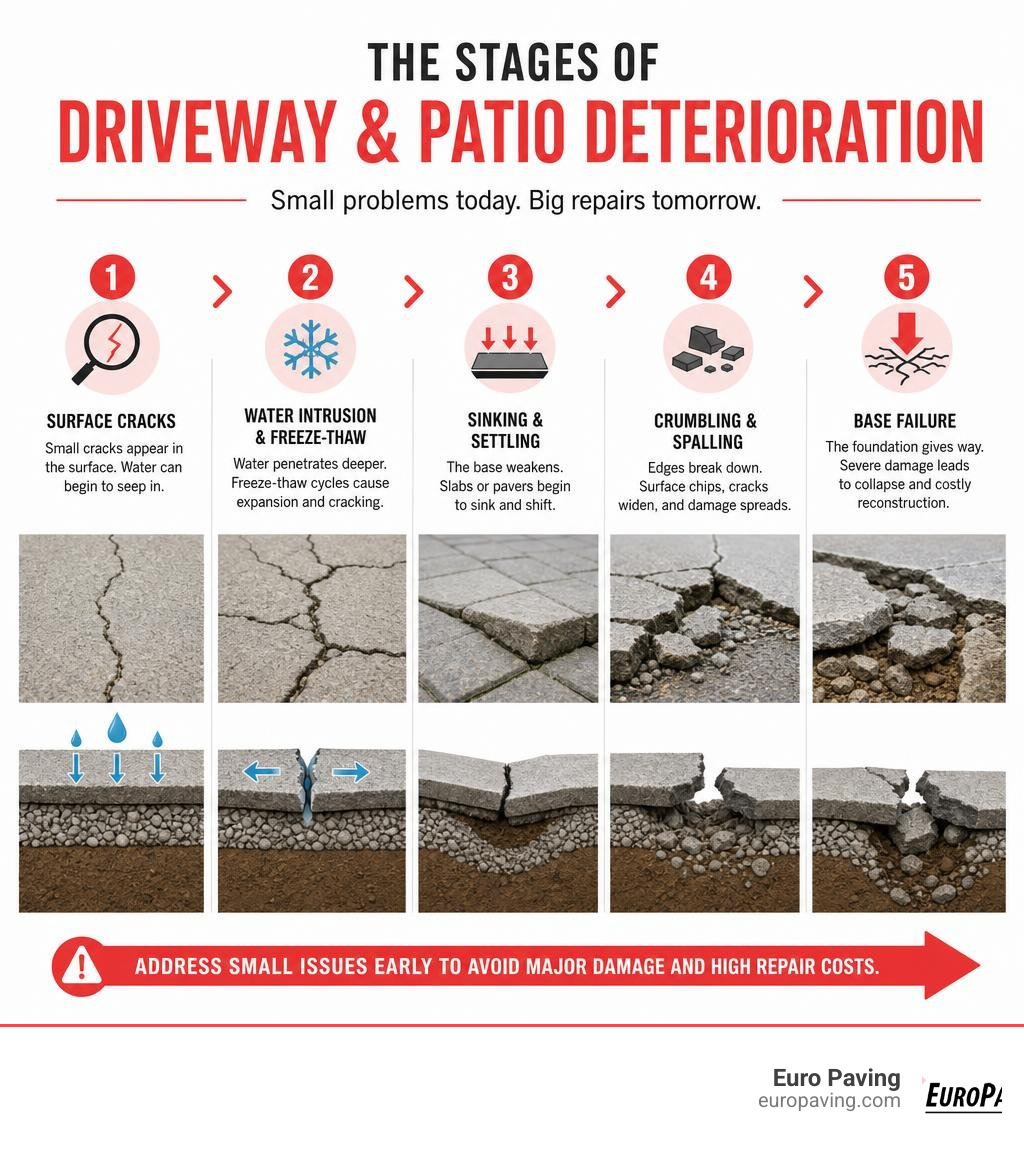
Your driveway and patio take a beating every single day — from vehicle weight, foot traffic, Chicago’s brutal freeze-thaw winters, and expansive clay soil underneath. Small cracks don’t stay small. Water gets in, freezes, expands, and turns a $300 repair into a $6,000 replacement.
Cracked or uneven driveways are consistently among the top reasons homebuyers reduce their offers or walk away from a property entirely. And yet most surface damage is completely repairable — at roughly 10–20% of the cost of full replacement.
Whether you’re dealing with a sunken patio slab, shifting brick pavers, or a driveway that’s starting to look its age, understanding your options is the first step toward a solution that actually lasts.
Euro Paving serves homeowners across Chicago’s Cook and DuPage Counties — bringing professional-grade repair, restoration, and paving expertise to driveways, patios, walkways, and beyond.
Quick driveway and patio repair terms:
Understanding Driveway and Patio Repair: Common Damage and Causes

To execute a lasting driveway and patio repair, we must first understand the enemy. Paved surfaces do not fail without reason. Whether you have a poured concrete driveway in Skokie or a custom brick paver patio in Downers Grove, damage typically manifests in a few highly predictable ways.
First, let’s talk about concrete cracks. Not all cracks are created equal. Hairline cracks are often just a sign of minor shrinkage as concrete cures, but wider structural cracks indicate shifting beneath the surface. If left unaddressed, these openings allow water to penetrate the subbase. Learning how to repair driveway cracks early is the single most effective way to prevent total structural failure.
Sinking slabs are another common headache. When the soil beneath a concrete slab washes away or compacts unevenly, the heavy concrete overhead loses its support and sinks. This creates dangerous trip hazards and causes water to pool exactly where you don’t want it. As we like to say, don’t let your driveway go down the drain by ignoring minor pooling or early signs of sinking.
Separation occurs when adjacent concrete slabs or brick borders begin to pull apart. This is often driven by lateral soil movement or invasive tree roots. Finally, discoloration and surface scaling (where the top layer of concrete chips or flakes away) ruin your home’s aesthetic appeal. cracks kill your curb appeal and can strip thousands of dollars off your home’s market value in an instant.
Climate and Soil Challenges in Chicago Suburbs
The Chicago area presents a perfect storm of environmental challenges for hardscaped surfaces. Our local climate is defined by brutal freeze-thaw cycles. When water gets trapped beneath or inside concrete and brick joints, it freezes and expands. Because water expands by about 9% when it turns to ice, it exerts immense pressure on the surrounding material, widening minor cracks into gaping chasms. Over 70% of concrete driveway failures in freeze-thaw climates are directly caused by water infiltration and poor base preparation.
Beneath the surface, we must contend with heavy clay soil. Unlike sandy soils that drain quickly, clay-rich soil retains water like a sponge. During wet spring months, clay swells significantly, pushing upward on your driveway and patio. In dry summer months, the clay shrinks and contracts, leaving empty voids beneath your paved surfaces. This constant rising and falling destabilizes the base.
To combat this, professional hardscapers rely on robust base construction. For example, our brick paving & driveways in Chicago are built over a deeply excavated, highly compacted aggregate base designed specifically to flex with seasonal soil expansion and prevent erosion.
Structural Issues in Driveway and Patio Repair
While weather and soil do their worst, human error during initial installation often seals a driveway’s fate. Poor compaction of the subgrade or aggregate base is the leading cause of early sinking. If the soil wasn’t packed down with heavy-duty commercial compactors before the concrete was poured or pavers were laid, the weight of vehicles will quickly cause uneven settling.
Tree roots are another aggressive disruptor. As local oaks and maples grow, their powerful roots push upward with enough force to crack and lift heavy concrete slabs. Water infiltration from poorly designed downspouts or improper slope grading washes away the supporting soil, leading to catastrophic base failure.
When addressing these issues in areas like Arlington Heights, hiring a team that understands local soil conditions is paramount. Utilizing expert paving services ensures that root barriers, proper slope grading, and robust base compaction are integrated into the repair process to prevent future structural issues.
Repair vs. Replacement: Making the Right Decision
Deciding whether to opt for targeted driveway and patio repair or invest in a full replacement is a major decision for any homeowner. The table below outlines the key indicators that point toward each path:
| Repair Indicators | Replacement Indicators |
|---|---|
| Cracks narrower than 1/4 inch | Deep structural cracks running through the entire slab thickness |
| Localized sinking of a single slab or section | Widespread shifting and multiple sunken areas across the entire surface |
| Minor surface scaling or cosmetic staining | Severe crumbling, hollow-sounding concrete, or major base failure |
| Shifting or uneven brick pavers (re-leveling is highly effective) | Concrete or pavers that have exceeded their natural 25-to-30-year lifespan |
| Cost is highly economical (typically 10-20% of replacement) | Multiple past repairs have failed, indicating deep subgrade issues |
To make an informed choice, you must weigh the structural integrity of the entire installation. If you are unsure which path to take, read our guide on whether to resurface or replace your driveway today. A professional inspection is always the safest way to evaluate the age of the concrete and the true extent of subsurface damage.
When to Choose Driveway and Patio Repair
Repairing your existing surface is almost always the smartest, most budget-friendly choice when the damage is localized or cosmetic. If your driveway has minor surface cracks, light spalling, or localized sinking, professional repairs can restore both function and beauty while saving you thousands of dollars. On average, homeowners who choose to repair rather than replace damaged concrete save between $3,000 and $8,500 per project.
For asphalt surfaces, targeted restoration is highly effective. Utilizing specialized asphalt repair & resurfacing methods allows you to patch localized potholes and seal cracks without the massive disruption and expense of a complete tear-out.
When Full Replacement is Necessary
Unfortunately, some driveways and patios are past the point of saving. If your concrete has deep, intersecting structural cracks, or if the surface has begun to crumble and turn to gravel, the base beneath has likely failed completely. Attempting to patch or resurface over a failed base is a waste of money; the cracks will simply reflect up through the new material within a single winter.
When planning a complete overhaul, it is vital to work with experienced professionals who follow strict structural guidelines to prevent a repeat failure. Reviewing our advice on driveway renovation avoiding common problems can help you understand the importance of proper excavation, thick aggregate bases, and heavy-duty reinforcement like rebar or wire mesh. For those requiring a fresh start, utilizing standard driveway replacement guidelines ensures your new installation is engineered to withstand heavy loads and harsh weather for decades to come.
Professional Methods for Restoring Paved Surfaces

When it comes to executing a high-quality driveway and patio repair, modern hardscaping technology offers several highly effective, minimally invasive restoration methods. Gone are the days when a sunken slab automatically meant bringing in jackhammers and dump trucks.
One of the most popular methods for raising sunken concrete slabs is polyurethane foam injection (often called polyjacking). This process involves drilling penny-sized holes through the sunken concrete and injecting a high-density, eco-friendly foam beneath the slab. As the foam expands, it fills voids, compacts the loose soil underneath, and gently lifts the concrete back to its original level.
Another traditional method is mudjacking (or slabjacking), which uses a slurry mixture of water, soil, sand, and cement pumped under pressure to raise the slab. For homes in Norridge, securing professional paving solutions ensures the correct method is chosen based on your specific soil and load requirements.
For worn but structurally sound surfaces, concrete resurfacing is an outstanding option. This involves applying a thin, polymer-modified concrete overlay across the entire surface to cover stains, minor cracks, and scaling, followed by a professional broom, trowel, or stamped finish. Similarly, worn asphalt driveways can be restored using professional asphalt repair resurfacing techniques, giving you a brand-new, jet-black finish at a fraction of the cost of replacement.
Concrete Leveling and Crack Sealing
Slabjacking and polyurethane foam injection are incredibly efficient because they address the root cause of the problem: the empty voids beneath the concrete. Once the slabs are perfectly leveled, professional crack sealing must be performed to lock out water.
Unlike cheap DIY silicone caulks that peel away after a single season, commercial-grade joint sealants are highly flexible and bond deeply to the concrete walls. This allows them to stretch and contract as temperatures change without breaking the seal.
This level of professional driveway repair is essential for long-term water prevention. For comprehensive projects, integrating professional resurfacing methods or hiring a specialized team for concrete driveway repair in Chicago, IL ensures that all joints and cracks are completely sealed against the elements.
Brick Paver and Patio Restoration
One of the greatest advantages of brick paver patios is their modular nature. Unlike solid concrete slabs, which cannot easily be repaired piecemeal, individual brick pavers can be carefully extracted, the base repaired beneath them, and the original bricks reset seamlessly.
Our professional brick paver restoration process involves:
- Removing the affected pavers in the sunken or shifting area.
- Checking and rebuilding the aggregate gravel base, compacting it thoroughly.
- Adding a fresh, level bedding sand layer.
- Reinstalling the original pavers in their exact pattern.
- Sweeping high-performance polymeric sand into the joints.
- Compacting the entire surface to lock the pavers in place, and then misting with water to activate the polymers.
Using polymeric joint sand is critical because it hardens to resist weed growth, prevent joint sand washout, and stop shifting. You can learn more about how we prevent weed growth between paving stones to keep your patio looking immaculate.
If you live in Skokie or surrounding suburbs, partnering with local experts ensures your brick paver driveway or patio is restored using materials specifically engineered to withstand our local climate.
Investment, Lifespan, and Choosing a Reputable Contractor
Investing in professional driveway and patio repair is highly cost-effective, but you must understand what affects the longevity of your investment. To maximize your return, protective maintenance is key. For example, there are 7 benefits of sealcoating your brick driveway, including preventing water penetration, resisting oil stains, and blocking UV rays that fade rich paver colors.
For homeowners in South Barrington, securing professional paving services ensures that both repairs and protective sealcoats are applied using premium, commercial-grade materials suited for large-scale suburban driveways.
Lifespan and Durability of Restored Surfaces
How long do professional repairs last? When performed correctly by licensed experts who address the underlying base issues, concrete leveling and paver restorations can easily last 5 to 10 years—and often much longer.
However, the durability of any repair is heavily influenced by environmental exposure and routine maintenance. To make sure your hardscaping stands the test of time, follow our driveway maintenance tips.
Proper sealing frequency is also a major factor. Poured concrete and brick pavers should be sealed every 3 to 5 years. Properly sealed concrete driveways can last 20 to 30 years with routine maintenance, compared to just 10 to 15 years without sealing.
Selecting the Right Contractor and Financing Options
Choosing the right hardscaping team is the difference between a repair that lasts a decade and one that washes away in the next spring rain. Always look for contractors who are fully licensed, bonded, and insured. Ask to see a detailed project portfolio of past work in your immediate area and inquire about written structural warranties.
For residents in Downers Grove, working with a certified team that offers comprehensive paving services gives you peace of mind that your project will meet all local municipal building codes. Furthermore, reputable contractors often provide flexible financing plans, allowing you to address critical structural repairs immediately rather than waiting for minor cracks to turn into expensive structural failures.
Frequently Asked Questions About Driveway and Patio Repair
How long do professional concrete repairs typically last?
With professional installation and proper maintenance, concrete repairs like crack sealing, polyjacking, and resurfacing typically last between 5 and 10 years. Their ultimate durability depends on addressing the root cause of the damage (such as drainage issues or tree roots) and applying a high-quality protective sealer.
For specific local guidelines on property standards and structural maintenance, you can consult resources like the Driveway/Patio | Northbrook, IL municipal guide, which outlines local compliance and drainage requirements.
What are the key differences in services offered by local repair companies?
Not all concrete and paving contractors offer the same scope of services. Some companies specialize strictly in concrete leveling (mudjacking or foam injection) and do not handle aesthetic resurfacing or decorative brickwork.
At Euro Paving, we take a comprehensive approach. We don’t just patch the surface; we analyze the underlying subgrade, correct drainage issues, and specialize in high-end brick paver restoration, custom hardscaping, and structural concrete repairs. This ensures your outdoor space is both structurally sound and visually stunning.
How does local weather affect the timing of driveway and patio repair?
Outdoor repair work is highly dependent on temperature. Concrete overlays, crack sealants, and polymeric sand require dry conditions and consistent temperatures (typically above 45°F to 50°F) to cure properly. Attempting these repairs during freezing weather or heavy rain will cause the materials to fail prematurely.
To protect your investments during the off-season, proper winter preparation is essential. Read our guide on winter paver maintenance to learn how to keep your paved surfaces safe from snow, ice, and harsh deicing salts.
Conclusion
Your driveway and patio are major components of your home’s value, safety, and curb appeal. Delaying necessary driveway and patio repair only allows water and shifting soil to cause deeper, more expensive damage. By choosing targeted, professional restoration methods, you can save thousands of dollars while extending the life of your paved surfaces for years to come.
At Euro Paving, we proudly serve homeowners across Chicago’s Cook and DuPage Counties—including Hinsdale, Mount Prospect, Skokie, Arlington Heights, and Downers Grove. We specialize in transforming worn, cracked, or uneven backyards into stunning, relaxing outdoor living spaces complete with custom brick patios, outdoor kitchens, and family-friendly fire pits.
Ready to restore your home’s curb appeal and protect your hardscaping investment? Transform your outdoor space with Euro Paving by contacting our team of certified paving experts today for a professional consultation!