



What an Asphalt Paver Machine Costs — and Whether to Buy or Rent
An asphalt paver machine is one of the most important pieces of equipment in road and pavement construction. Whether you’re a contractor evaluating your next equipment purchase or a property manager planning a large commercial paving project in the Chicago suburbs, knowing your options upfront saves time and money.
Here’s a quick overview of asphalt paver machine options by scale:
| Paver Type | Typical Horsepower | Paving Width | Best For |
|---|---|---|---|
| Compact / Small | 49–125 hp | Up to 15 ft | Parking lots, driveways, small sites |
| Mid-Sized | 148–173 hp | Up to 20 ft | Highways, commercial lots |
| Large / High-Production | 210–249 hp | Up to 33 ft | Interstates, airports, runways |
Key options at a glance:
- Buy new — Large track pavers like the Cat AP1055 (249 hp, up to 33 ft paving width) start at a significant capital investment but offer the highest throughput at up to 1,602 tons/hour
- Buy mid-sized — Models like the LeeBoy 8520C (125 hp, up to 15 ft) or Cat AP500 (148 hp) suit most commercial and suburban paving jobs
- Rent — Ideal for one-off projects; Cat, BOMAG, and LeeBoy all offer rental programs through dealers
- Finance — Manufacturers and dealers offer zero-down and rebuild financing options
This guide breaks down the top asphalt paver machine models, their specs, what they cost to own or rent, and how to choose the right one for your project.
Asphalt paver machine word roundup:
Core Components and Operation of Modern Pavers
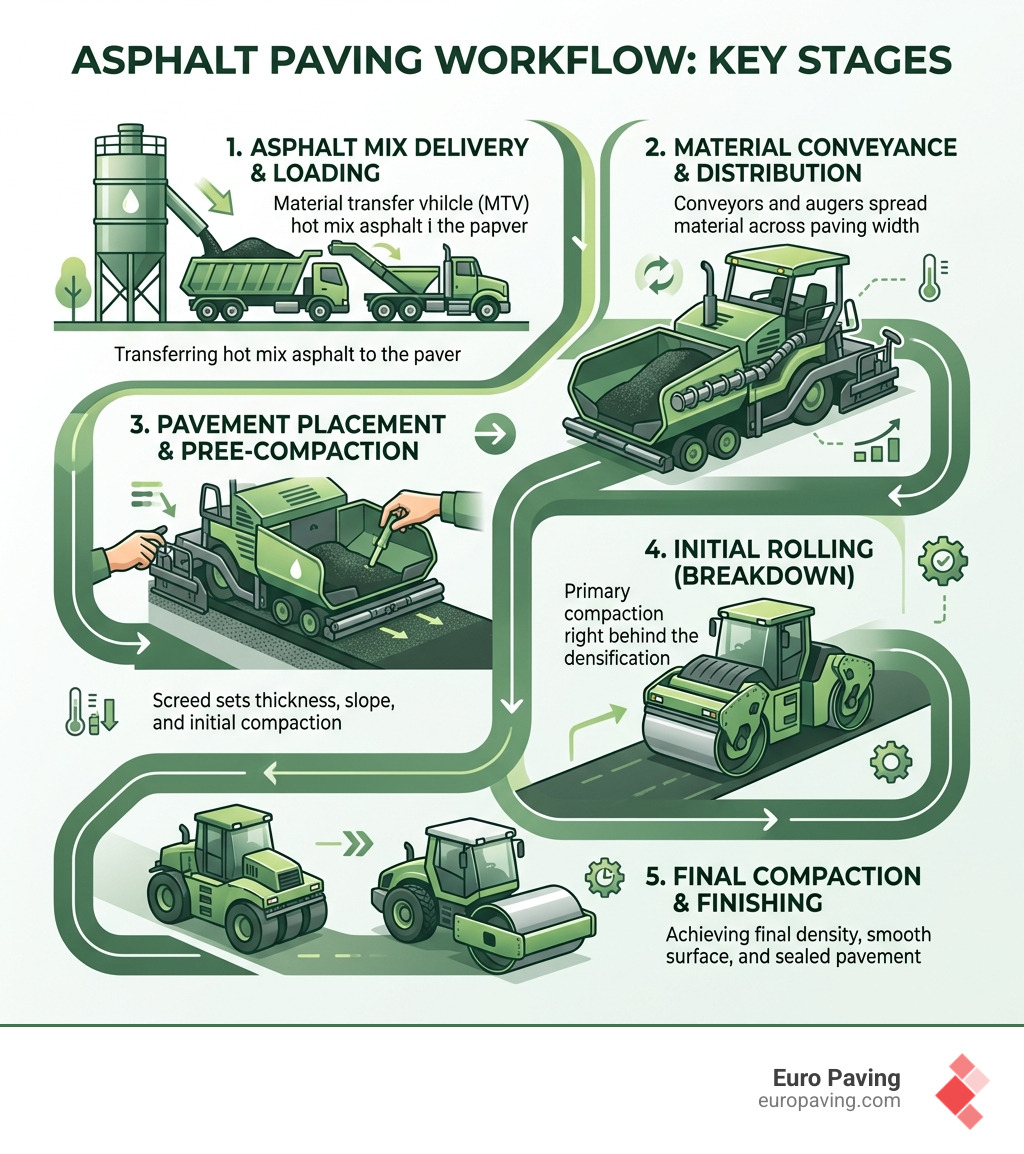
To understand why an asphalt paver machine is such a marvel of engineering, we have to look under the hood—or rather, inside the hopper. Its primary function is to receive hot mix asphalt (HMA), spread it evenly across a surface, and provide initial compaction. While we often focus on the beautiful final result of a smooth driveway in Barrington or a parking lot in Skokie, the machine’s internal “digestive system” does all the heavy lifting.
The process begins at the hopper, a large bin at the front where dump trucks or material transfer units (MTUs) deposit the hot asphalt. From there, heavy-duty conveyors pull the material toward the rear of the machine. Once it reaches the back, an auger system—essentially a giant screw—distributes the mix outward to the desired paving width.
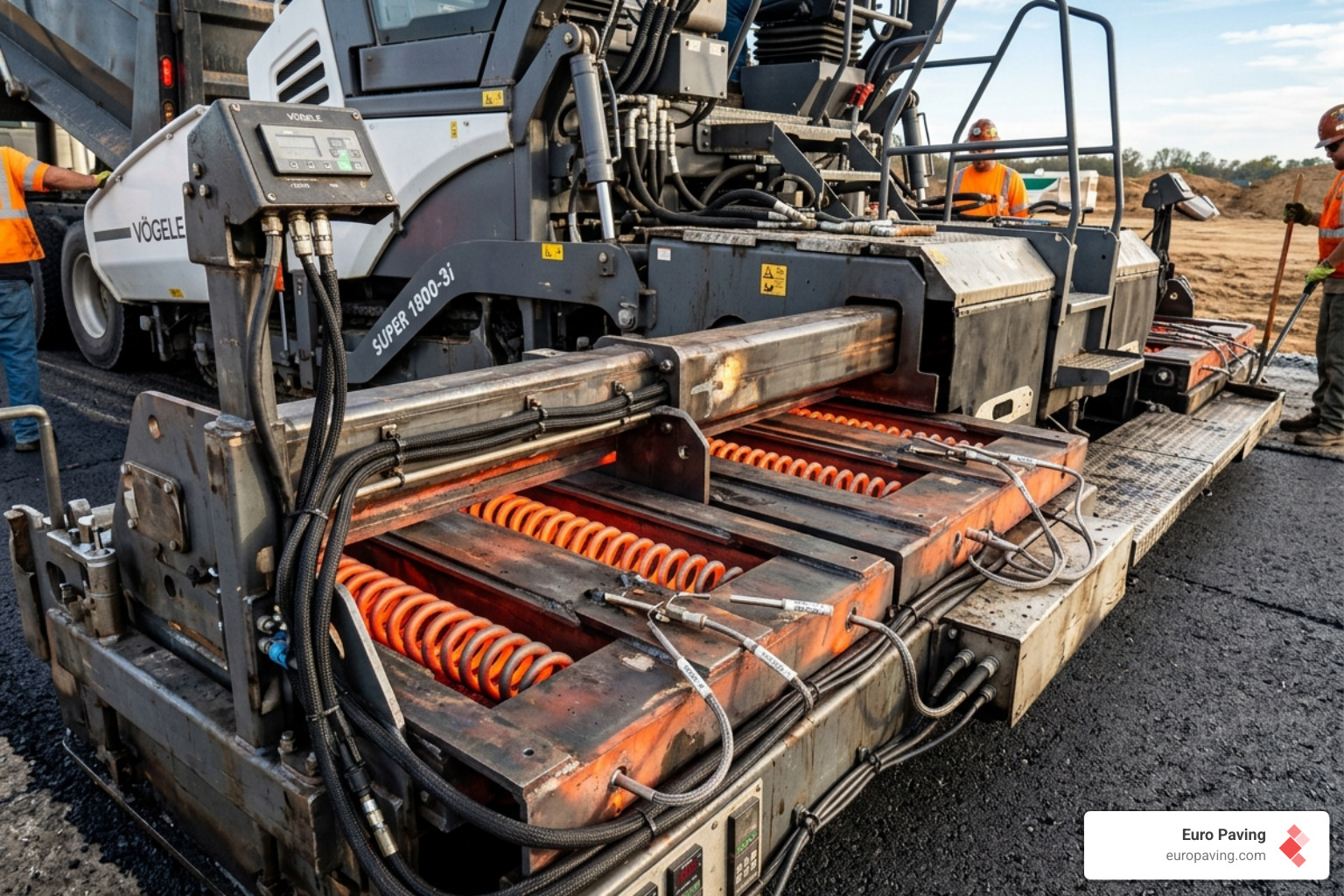
The real magic happens at the screed. This is a free-floating component that rests on the asphalt. It uses a tamper bar and vibratory plates to smooth the material and provide that critical initial compaction. Because the screed “floats,” it can level out irregularities in the base layer, ensuring the final road surface is flat and uniform. If you are interested in how this compares to other large-scale equipment, check out our guide on concrete paving machines that do the heavy lifting.
High-Production Asphalt Paver Machine Models
When the job calls for massive scale—think O’Hare airport runways or the I-90 expansion—standard machines won’t cut it. High-production models are built for speed, durability, and sheer volume.
- Caterpillar AP1055: This is a beast of a machine. With 249 hp and a maximum throughput capacity of 1,602 tons per hour, it can handle the largest infrastructure projects in the Chicago area. Its SE60-series screeds can extend up to 33 feet, allowing for fewer passes and seamless surfaces.
- BOMAG BF 800 C-3: A European powerhouse often seen on major highways, this model features a 23,500 kg operating weight and a capacity of 800 tons per hour. It’s known for its massive working widths of up to 9 meters (nearly 30 feet).
- LeeBoy 8680: For those needing American-made muscle with a Tier 4 Final 210 hp engine, the 8680 is a top contender. It weighs in at 33,600 lbs and offers variable paving widths up to 15’6″, making it a favorite for heavy commercial work.
Key Specifications for Selecting an Asphalt Paver Machine
Choosing the right asphalt paver machine requires more than just picking a brand name. You need to match the machine’s specs to your specific project requirements in Arlington Heights or Highland Park.
- Paving Width: This is the most critical spec. Compact pavers might only reach 8–15 feet, while highway-class machines can stretch over 30 feet.
- Horsepower and Throughput: If you are paving a small residential cul-de-sac, 125 hp is plenty. For a 24-hour highway shift, you’ll want the 200+ hp range to maintain a throughput of over 1,400 tons per hour.
- Truck Entry Height: This is often overlooked. If the hopper is too high, standard dump trucks can’t feed it efficiently. Models like the Cat AP500 have an optimized truck entry height of 21 inches to accommodate various fleet sizes.
- Operating Weight: Heavier machines generally provide better stability and screed pressure, leading to better pre-compaction.
| Model | Gross Power | Max Throughput | Operating Weight |
|---|---|---|---|
| Cat AP500 | 148 hp | 1,100 ton/h | 32,012 lb |
| Cat AP655 | 173 hp | 1,433 ton/h | 40,560 lb |
| Cat AP1055 | 249 hp | 1,602 ton/h | 36,800 lb* |
*Base weight; varies significantly by screed attachment.
Integrated Technology for Asphalt Paver Machine Efficiency
In 2026, paving is as much about software as it is about steel. Modern machines are packed with “smart” features that take the guesswork out of the job:
- Cat Grade Control: This system uses sensors to automatically adjust the screed, removing surface irregularities and ensuring the mat thickness is perfect every time.
- Pave Start Assistant: This allows operators to save setup profiles. If you have a specific configuration that worked perfectly for a parking lot in Downers Grove, you can recall those settings instantly for the next job.
- Thermal Mapping: Using infrared cameras, this technology monitors the temperature of the entire asphalt width in real-time. This prevents “cold spots” which are the leading cause of early pavement failure.
Track vs. Wheel Pavers: Traction and Mobility
One of the oldest debates in the industry is whether to go with tracks or wheels. Each has distinct advantages depending on the terrain of your Chicago area job site.
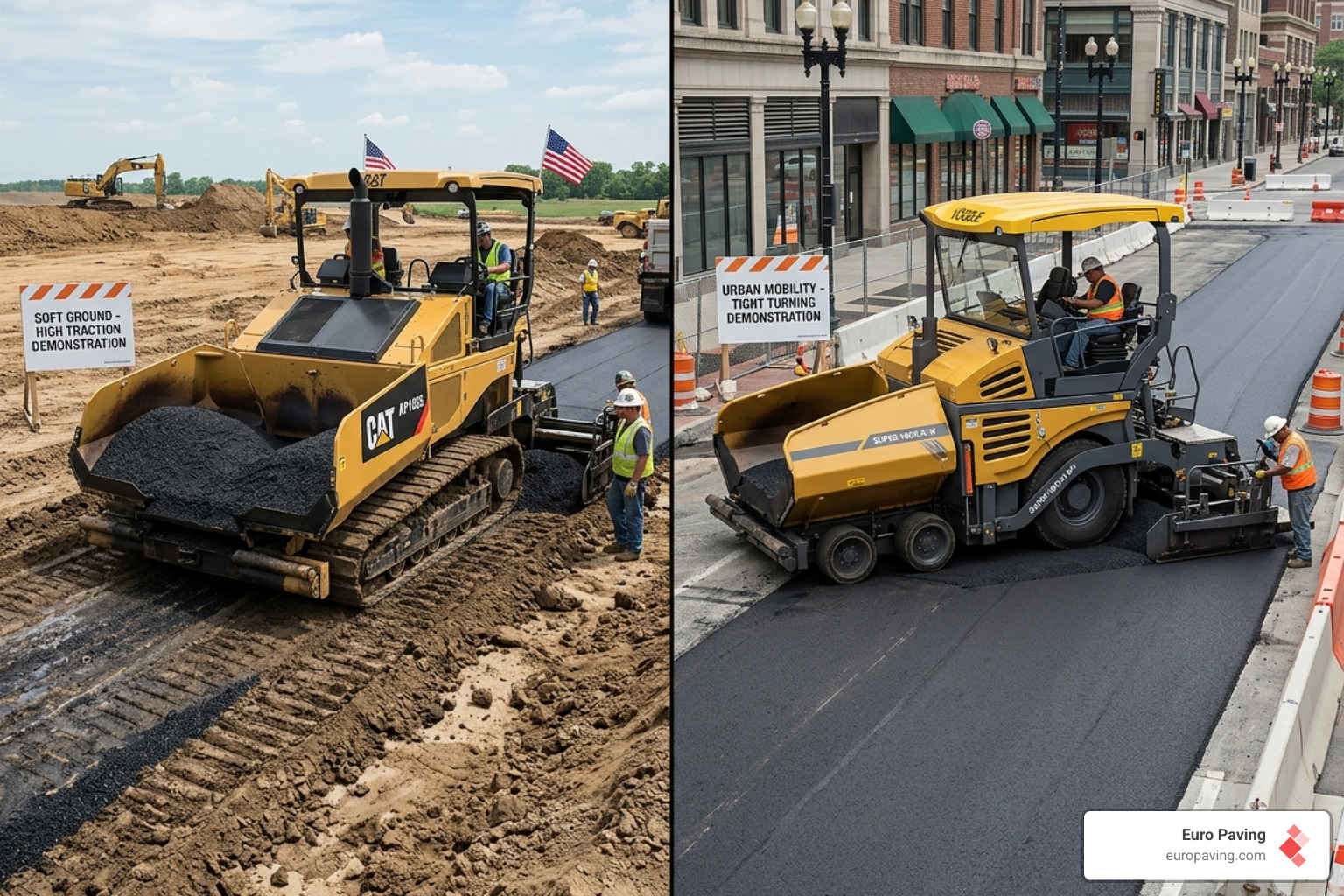
Track Pavers (like the Cat AP655) are the kings of traction. They use rubber tracks or “Mobil-trac” undercarriages to distribute weight over a larger surface area. This provides excellent flotation, meaning the machine won’t sink into soft sub-bases. If you’re working on a new road expansion where the ground is still unsettled, tracks are your best friend.
Wheel Pavers (like the Cat AP1000), on the other hand, offer unmatched mobility. They have a tighter turning radius and much faster travel speeds (up to 12 mph compared to 9 mph for tracks). This makes them ideal for urban paving in Chicago or Norridge, where the machine might need to move between different sections of a large parking lot quickly.
For more on how automation is changing the way we lay materials, see our comparison of brick laying machines vs human brick pavers.
Advanced Innovations and Integrated Technology
As we move further into 2026, the focus has shifted toward sustainability and extreme efficiency.
Electric Paving is no longer a pipe dream. Manufacturers like LeeBoy now offer models like the 8520C Electric, powered by General Motors 48kW battery systems. These are perfect for indoor paving (like underground parking structures in the Loop) where exhaust fumes are a major safety concern.
Screed Heating has also seen a revolution. Traditional systems took forever to warm up, but new integrated 70 kW generators (originally developed for electric-drive dozers) can now heat a screed to operating temperature in as little as 15 minutes. This adds nearly an hour of productive paving time to every workday.
ECOMODE and Fuel Savings: Most modern machines, including the Cat AP600, feature an “Eco-mode.” This adjusts engine speed automatically, reducing fuel consumption by up to 15% and significantly lowering noise levels—a feature your neighbors in Winnetka or Lake Forest will certainly appreciate during early morning starts.
Maintenance, Service, and Rental Options
An asphalt paver machine is a high-wear piece of equipment. The asphalt mix is abrasive and hot, meaning the components that touch it need constant care.
- Screed Plate Care: The bottom plates of the screed are typically made of 15mm thick high-grade steel (often with a Brinell hardness of 450). Even so, they eventually wear down. Regularly checking these plates ensures your mat stays smooth.
- Service Kits: Companies like BOMAG and Caterpillar offer pre-packaged service kits. These include all the filters, seals, and wear parts needed for scheduled maintenance, which is vital for preventing downtime during the busy Chicago paving season.
- Chicago Equipment Rentals: If you aren’t ready to drop $200k+ on a new machine, local dealers like Casey Equipment offer excellent rental and used options. You can find listings for asphalt pavers for sale in Illinois that range from compact units to highway-class machines.
For those looking at the financial side, many dealers offer “Cat Card” financing or zero-down programs for well-qualified contractors. If you’re curious about how these machines look in action within the local area, you can view this gallery of paving equipment.
Frequently Asked Questions about Asphalt Paver Machines
What is the primary function of an asphalt paver?
Its primary job is to lay asphalt mix at a consistent thickness and width while providing initial compaction. It creates the smooth, driveable surface that road rollers then finish to final density.
How does a free-floating screed ensure a smooth surface?
The screed is not rigidly attached to the paver’s frame. Instead, it “tows” behind it. This allows the screed to seek its own level based on the “angle of attack.” If the paver hits a small bump, the screed barely moves, effectively “averaging out” the bumps in the road base to create a much smoother top layer.
What are the advantages of using a material transfer unit (MTU)?
An MTU (or feeder) sits between the dump truck and the paver. It prevents the truck from ever touching the paver, which eliminates “truck bumps” that cause ripples in the asphalt. It also remixes the asphalt to ensure a uniform temperature and aggregate distribution, leading to a much higher-quality road.
Conclusion
Whether you are managing a massive commercial parking lot in Roselle or looking to upgrade the infrastructure for a suburban development in Mount Prospect, the asphalt paver machine is the cornerstone of a job well done. From the high-tech Cat AP1055 to the nimble wheel-driven models, the right equipment ensures longevity and a professional finish.
At Euro Paving, we understand that the quality of your pavement reflects the quality of your business or home. While we specialize in transforming backyards into relaxing spaces with custom brickwork and fire pits, we know that a solid asphalt foundation—whether it’s for a driveway or a commercial lot—is where great property design begins.
If you’re ready to start your next project in the Chicago area, from Elmhurst to Arlington Heights, don’t settle for subpar results. Contact Euro Paving for professional sidewalk paving services and let our experts help you build a surface that lasts a lifetime.