



The Best Concrete Paving Machines for Heavy-Duty Projects
Concrete paving machines are the backbone of modern road, highway, and infrastructure construction. Whether you’re sourcing equipment for a highway job, airport runway, or municipal street project, here’s a quick-reference guide to the main types available:
Top concrete paving machine types at a glance:
| Machine Type | Best For | Example Models |
|---|---|---|
| Slipform Paver | Highways, airports, wide slabs | GOMACO Commander III, Power Paver SF-3404 |
| Curb & Gutter Machine | Urban streets, roadside profiles | GOMACO 3300, GT-3600 |
| Placer/Spreader | Pre-spreading concrete ahead of paver | GOMACO GP460 |
| Texture/Cure Machine | Surface finishing, evaporation protection | GOMACO 9500 |
| Bridge Deck Finisher | Bridge and elevated slab work | Bid-Well 4800 |
These machines range from compact curb pavers weighing around 28,000 lbs to massive full-width slipform rigs topping 108,000 lbs. Paving widths span from 10 feet all the way to 50 feet, powered by engines producing 225 kW to over 300 kW.
The right machine depends on your project scope, required paving width, and site conditions. This guide breaks down every major category, highlights top models, and covers what to look for when buying new or used.
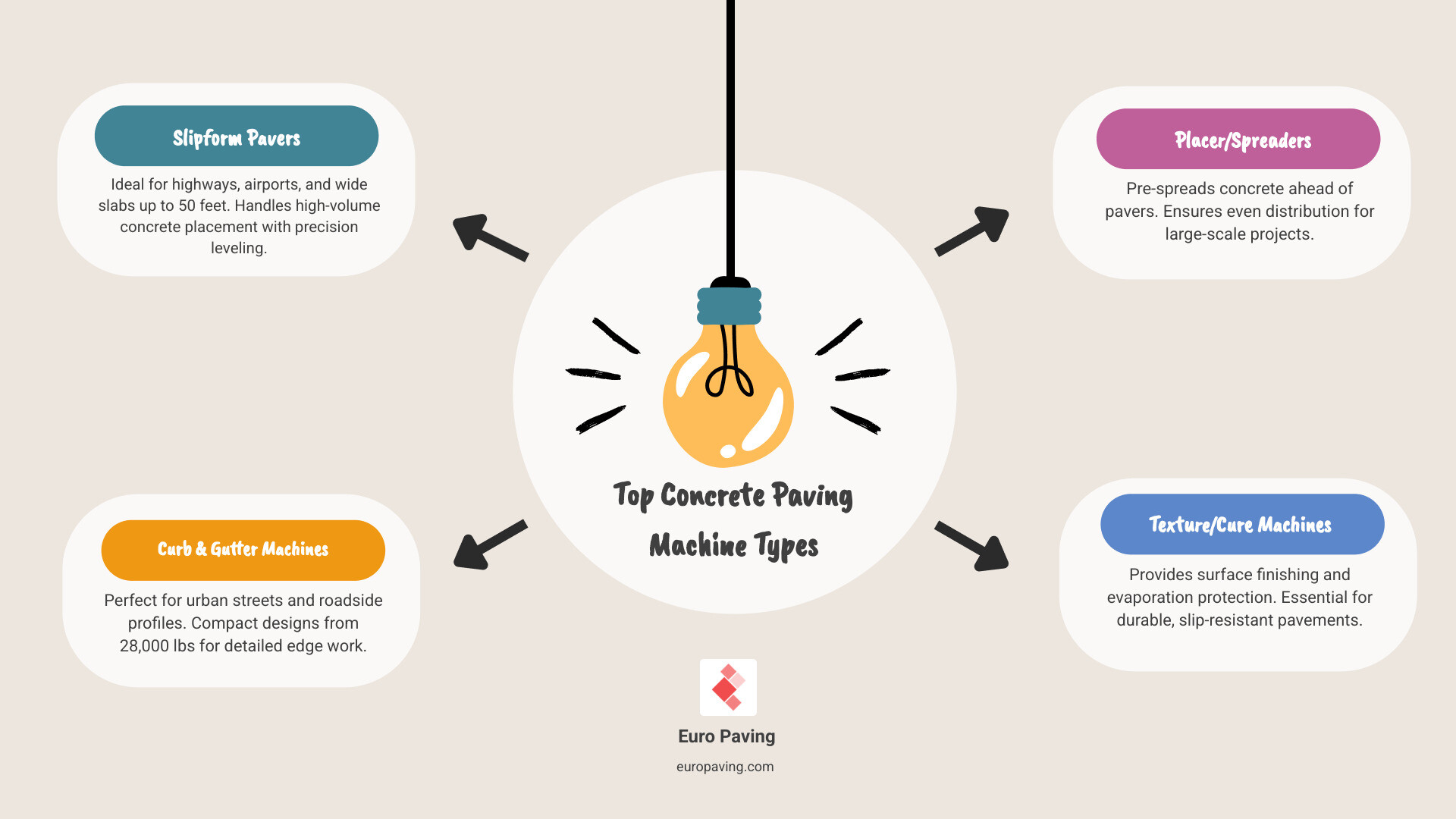
Primary Types of Concrete Paving Equipment
When we talk about a concrete paving machine, we aren’t just talking about one piece of gear. It is an entire ecosystem of heavy-duty machinery designed to turn wet concrete into perfectly leveled, durable surfaces. In the high-stakes world of Chicago infrastructure—from the busy streets of Arlington Heights to the commercial hubs of Downers Grove—using the right tool is the difference between a project that lasts decades and one that fails in five years.
The main categories include:
- Slipform Pavers: The heavy hitters. These machines use “slipforming” technology to mold concrete into a finished slab without the need for fixed forms.
- Curb and Gutter Machines: Specialized for the edges. They create the monolithic concrete profiles seen alongside municipal roads.
- Texture/Cure Machines: These follow the paver to provide the final surface structure (like tining for traction) and apply curing compounds to prevent premature drying.
- Placer/Spreaders: These work ahead of the paver, receiving concrete from trucks and spreading it to a uniform depth so the paver can focus on the final finish.
- Bridge Deck Finishers: Lightweight but precise machines designed to pave elevated surfaces like bridges and overpasses.
If you are looking to expand your fleet, you can often find reliable used GOMACO GT3600 models at regional auctions, which are excellent for curb and gutter work throughout the Chicago area.
High-Capacity Slipform concrete paving machine Models
High-capacity paving generally falls into two methods: inset and offset.
- Inset Paving: The concrete is deposited directly in front of the machine or fed from the side. The machine then “straddles” the concrete, spreading it with an auger or plow and compacting it with internal vibrators. This is the gold standard for highways and airport runways.
- Offset Paving: The mold is mounted to the side of the machine. This allows the concrete paving machine to pour barriers, curbs, or sidewalks while the machine itself stays on the subgrade or an adjacent lane.
Key models that dominate the industry include the GOMACO Commander III, famous for its “Xtreme” radius capabilities, and the Power Paver SF-3404, which can handle widths up to 40 feet. For those massive airport runway jobs, the CMI SF-6 remains a legendary benchmark for high-capacity output.
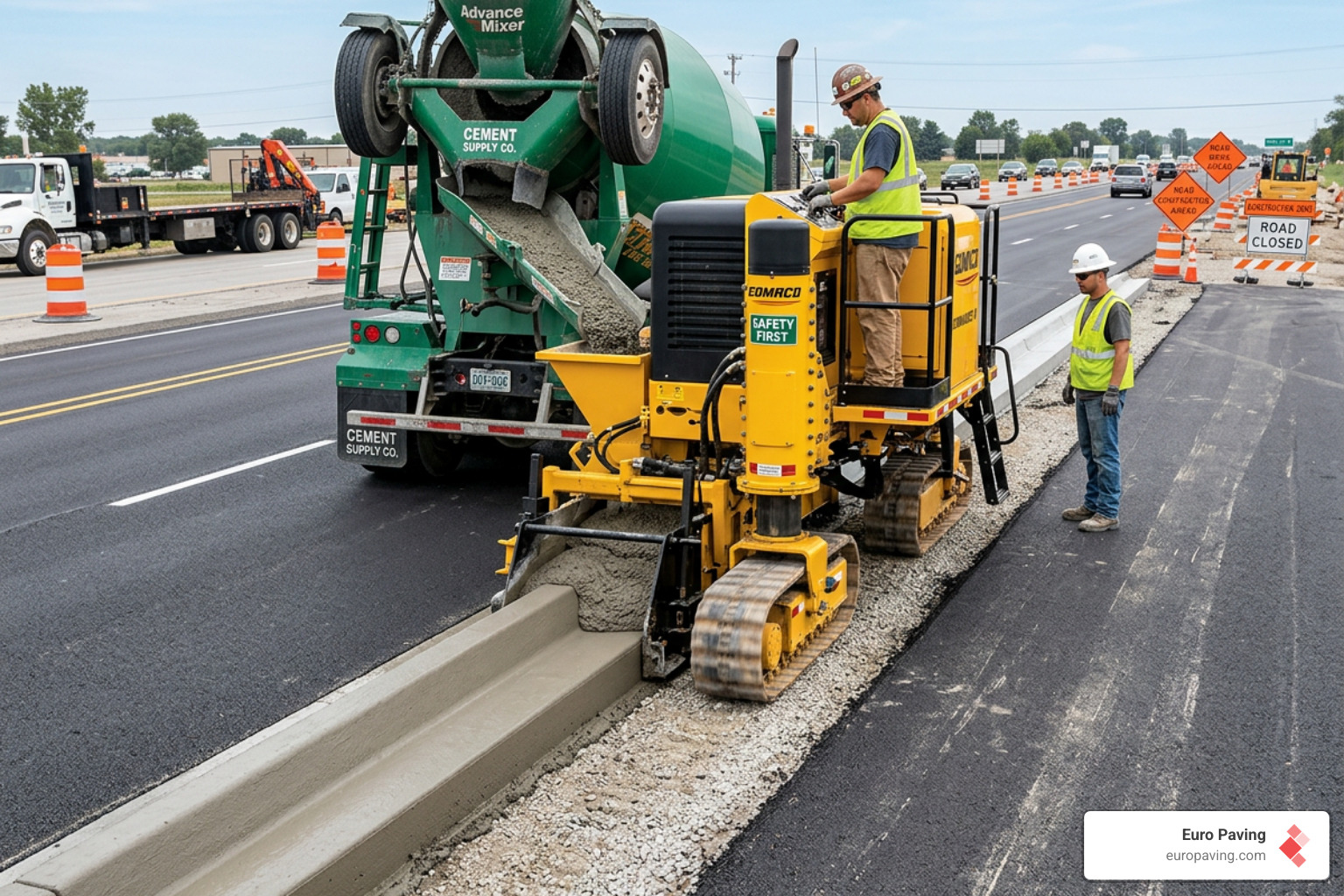
Specialized Finishing and Support Machinery
A road isn’t finished just because the concrete is flat. Texture curing machines are vital for safety; they create the grooves (texturing) that prevent hydroplaning and spray a protective membrane (curing) to keep moisture in the slab.
Before the concrete even arrives, subgrade trimmers like the GOMACO 9500 ensure the ground is perfectly level. This prevents “concrete over-run,” where you end up using more material than planned because the ground was too low. For those interested in how these massive machines compare to smaller-scale automated solutions, you can find more info about brick laying machine technology which we use for high-end residential projects in Lake Forest and Hinsdale.
Advanced Control Systems and Paving Accuracy
Modern paving has moved far beyond stringlines and manual levels. Today’s concrete paving machine is a computer on tracks. Systems like GOMACO’s G+ control and Power Paver’s SlipSmart solutions allow for 3D guidance. This means the machine “knows” exactly where it is in 3D space via GPS or total stations, eliminating the need for physical stringlines that can be tripped over or knocked out of alignment.
Comparison: Inset vs. Offset Paving
| Feature | Inset Paving | Offset Paving |
|---|---|---|
| Machine Position | Directly over the slab | To the side of the slab |
| Primary Use | Highways, Runways, Large Slabs | Curbs, Gutters, Barriers, Sidewalks |
| Concrete Delivery | Front or Side | Side (Conveyor/Auger) |
| Compaction | Internal Vibrators | Mold-integrated Vibrators |
Precision Engineering in the concrete paving machine
Accuracy is maintained through a suite of sensors. Sonic sensors monitor the “head” of concrete in front of the machine to ensure the vibrators have enough material to work with. TeleMold systems allow operators to change paving widths on the fly without stopping the machine—a huge advantage for tapering lanes in Northbrook or Glenview.
Furthermore, technologies like AccuSteer and SmartLeg allow the tracks to swing and rotate independently. This allows a massive machine to navigate tight cul-de-sacs or roundabouts with surgical precision.
Industrial Applications for Heavy-Duty Paving
While we at Europa Paving love a beautiful backyard transformation in Highland Park, these industrial machines are built for the “heavy lifting” of the Midwest’s infrastructure.
- Highway Construction: Using inset pavers to create miles of continuous, steel-reinforced road.
- Airport Runways: Where precision and thickness (sometimes over 20 inches) are non-negotiable.
- Canal Lining: Specialized pavers designed to pave on slopes.
- Municipal Streets: High-production machines that can handle the tight clearances of Chicago’s suburban streets.
If you are working on bridge infrastructure, you might want to view bridge deck finishers for sale to ensure your elevated slabs meet strict DOT smoothness requirements.
Roller Compacted Concrete (RCC) and the concrete paving machine
Roller Compacted Concrete (RCC) is a unique beast. It’s a “zero-slump” mix—meaning it’s almost dry—that is placed using high-density asphalt-style pavers and then finished with vibratory rollers.
RCC is incredibly popular for industrial pavements like warehouse yards in Hillside or Lombard because it can accept local traffic in as little as 4 hours and heavy traffic within 24-48 hours. It provides the strength of concrete with the speed of asphalt.
Key Considerations for Selecting a concrete paving machine
Buying a concrete paving machine is a multi-million dollar decision. Here is what we recommend evaluating:
- Paving Width: Does the frame telescope? The G&Z S850SL, for example, can telescope from 12 feet to 26 feet without adding bolt-on extensions.
- Engine Power: Look for Tier 4 Final engines like the Caterpillar C7.1 (302 hp) or Cummins B6.7 (310 hp) to ensure compliance with Illinois environmental standards.
- Track Systems: Are the tracks “smart”? Can they swing to avoid obstacles?
- Transport Dimensions: Can the machine be moved on a single trailer, or does it require a fleet of trucks? The GOMACO 3300 is a favorite because of its relatively light 28,000 lb transport weight.
Evaluating Used Paving Equipment
If you aren’t ready for a brand-new rig, the used market in the Chicago area is robust. When inspecting a used machine, check the meter hours. A machine with 200 hours is practically new, while one with 5,000+ hours will need a thorough inspection of the hydraulic pumps and vibrator circuits.
Always look for “IronClad Assurance” or similar warranties when buying at auction. For those looking for smaller, automated solutions for residential roads, you can check out more info about automated brick road machines which show how automation is changing even the brick-laying industry.
Frequently Asked Questions about Concrete Paving
What is the difference between inset and offset paving?
Inset paving happens directly underneath the machine’s frame, used for wide slabs like highways. Offset paving happens to the side of the machine, used for curbs, gutters, and barriers.
How does 3D stringless guidance improve efficiency?
It removes the hours of labor required to set up physical stringlines. It also allows for better job site access, as trucks don’t have to navigate around wires and stakes.
Why is Roller Compacted Concrete (RCC) used for industrial sites?
RCC is faster to install, cheaper than traditional reinforced concrete, and can handle massive loads. It’s perfect for the high-volume intersections and industrial yards found throughout Cook and DuPage Counties.
Conclusion
At Europa Paving, we understand that whether you are building a massive highway or a custom brick patio in Mount Prospect, the quality of the finish depends on the quality of the machinery. While we specialize in transforming backyards into relaxing spaces with fire pits and family-friendly designs, we respect the engineering marvels that keep our Chicago area infrastructure moving.
From the precision of a concrete paving machine on the I-294 to the hand-laid craftsmanship of our brick walkways, paving is about durability and design. If you’re ready to upgrade your property or need expert advice on more info about sidewalk paving services, we are here to help. Whether you are in Skokie, Downers Grove, or right here in Chicago, let us bring our 25+ years of expertise to your next project.