



Essential Concrete Driveway Maintenance Practices for Long-Term Durability
Concrete driveway maintenance comes down to a few consistent habits: keep the surface clean, reseal it on schedule, keep control joints sealed, and avoid chemical deicers. These practices limit moisture absorption, prevent surface scaling, and preserve the slab’s structural integrity through Chicago’s seasonal temperature swings.
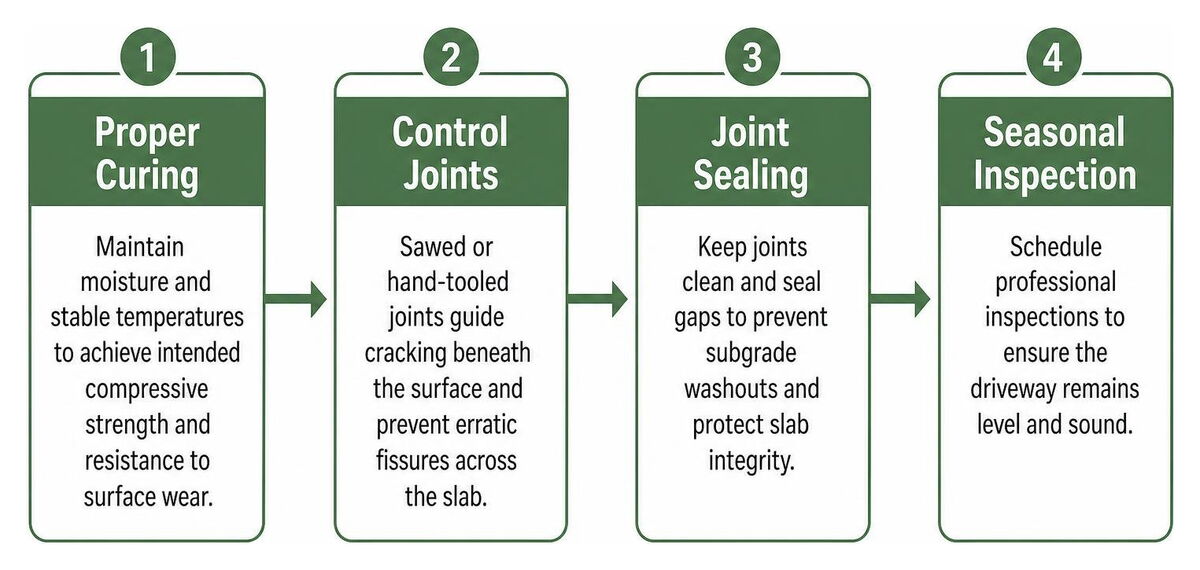
A solid slab also begins with proper installation standards. Hydration is the chemical process that gives concrete its structural integrity, requiring controlled moisture and stable temperatures immediately after placement. According to the Michigan Concrete Association guidelines on exterior flatwork, adequate curing must be maintained during initial placement to ensure the surface achieves its intended compressive strength and resistance to surface wear.
In regions that experience harsh temperature swings, exterior flatwork requires air-entrained concrete mixes. Air entrainment introduces billions of microscopic air voids into the paste, giving internal moisture room to expand without fracturing the cement matrix.
Control joints are another vital component of slab design. Because concrete shrinks slightly as it cures, sawed or hand-tooled control joints create intentional planes of weakness. These joints guide cracking beneath the surface rather than allowing erratic fissures across the visible slab.
Routine preventative upkeep protects these elements over time. Keeping control joints clean, sealing joint gaps against subgrade washouts, and planning professional inspections ensure your pavement remains level and sound. When underlying soil moves or initial joints fail, scheduling professional concrete driveway installation and repair prevents minor slab movement from becoming an unmanageable structural failure.
Protecting Concrete Slabs from Chicago Freeze-Thaw Cycles
Winter weather presents significant challenges for concrete pavements in Cook and DuPage counties. When liquid water penetrates porous concrete, subgrade soil, or open joints, it expands as it freezes. This expansion exerts intense hydraulic pressure inside the slab pores, leading to surface scaling, spalling, and subgrade settlement.
The Tennessee Concrete Association mix standards and freeze-thaw exposure classes outline how high compressive strength combined with controlled water-to-cement ratios directly influences cold-weather durability. When water sits on an unsealed slab, saturated subgrade soils heave upward during hard freezes and drop unevenly during winter thaws. Managing drainage is essential. Downspouts and surrounding landscape grades must channel runoff away from the driveway perimeter to stop water from pooling along slab edges.
Seasonal Concrete Driveway Maintenance and Deicing Protocols
Chemical deicers cause severe surface flaking on residential flatwork. Compounds containing ammonium nitrate, ammonium sulfate, or magnesium chloride chemically degrade the paste. Standard rock salt (sodium chloride) also accelerates damage by artificially increasing the frequency of freeze-thaw cycles the slab experiences during winter cold spells.
For winter traction, clean masonry sand or non-chemical traction grit provides slip resistance without attacking the surface paste. If you maintain other hardscape features on your property, coordinating your routine with proper winter paver and hardscape care ensures your walkways, patios, and parking areas survive the cold months intact.
Surface Protection Against Heavy Vehicles and Snow Removal Equipment
Residential concrete slabs are engineered for standard passenger cars, SUVs, and light pickup trucks. Heavy commercial delivery vans, construction roll-off dumpsters, and concrete transit trucks can exceed the load capacity of a standard residential slab, causing perimeter cracking and edge deflection.
Snow removal requires careful tool selection:
- Use plastic or composite shovel blades rather than metal-edged shovels that can chip concrete joints.
- Ensure professional snowplow services install polyurethane or rubber edge guards on plow blades.
- Direct plows to lift blades slightly over control joints and expansion strips to avoid gouging surface edges.
- Avoid parking heavy vehicles on unsupported slab perimeters where edge crumbling is most likely to occur.
Routine Cleaning, Stain Removal, and Surface Sealing Schedules
Porous concrete absorbs dirt, atmospheric pollutants, and organic material over time. An annual deep cleaning lifts embedded grime before it alters the slab surface.
When power washing, keep water pressure moderate and use a wide fan nozzle. Holding the wand at a steady distance from the concrete protects the top cement paste from etching.
To determine whether your driveway requires a fresh coat of sealer, perform a simple water beading test. Splash a cup of clean water onto dry concrete. If the liquid beads into tight droplets, the sealer is active. If the water absorbs immediately and turns the concrete dark, moisture can enter, indicating it is time to reseal.
| Sealer Property | Penetrating Silane-Siloxane Sealers | Topical Acrylic Sealers |
|---|---|---|
| Primary Mechanism | Reacts chemically inside pores beneath the surface | Forms a protective continuous film over the top paste |
| Surface Appearance | Natural, matte finish with no gloss | Satin or high-gloss sheen; enhances colors |
| Slip Resistance | Maintains original slab texture | May require traction additives on smooth finishes |
| Reapplication Cycle | Reapply periodically as wear occurs | Reapply more frequently as top film wears |
| Best Application | Standard broom-finish driveways and freeze-thaw zones | Stamped, colored, or decorative architectural concrete |
Managing Oil Spills, Organic Debris, and Surface Discoloration
Hydrocarbon fluids such as motor oil, transmission fluid, and power steering fluid penetrate deep into unsealed concrete pores. Treat fresh oil spots immediately using absorbent clay or commercial degreasers. For set-in stains, a poultice treatment—mixing an absorbent medium with a solvent-based cleaner—draws embedded oils out through capillary action.
Organic debris, including wet fall leaves, produces dark tannin stains when left to decompose on damp concrete. Raking leaves promptly prevents these surface discolorations. For stubborn leaf rings or irrigation rust marks, commercial cleaners formulated specifically for concrete lift discoloration without etching the surface paste.
Sealing Intervals and Application Best Practices
Applying sealer shields the slab from water infiltration, chloride penetration, and surface dusting. Penetrating silane-siloxane formulas work well on standard residential slabs because they leave pores breathable while repelling liquid water.
Sealers should be applied during stable weather conditions, ideally in early fall during moderate daytime temperatures. The concrete must dry thoroughly after pressure washing before sealer application. Applying sealers over damp concrete traps moisture, creating cloudy white blemishes and poor adhesion.
Assessing Slab Damage: Professional Repair Versus Driveway Replacement
Driveways naturally show signs of wear over time. Knowing when to patch surface defects and when to plan for structural replacement keeps repair budgets balanced. Our concrete driveway resurfacing versus replacement guide outlines how subgrade stability and the depth of cracking determine whether a slab can be restored or must be poured anew.
Addressing Structural Cracks and Concrete Driveway Maintenance Needs
Hairline fissures are common shrinkage cracks that do not indicate structural failure. However, they must be sealed to keep out water and winter deicers.
For active cracks and separating control joints, flexible polyurethane joint sealants provide a weather-resistant barrier that expands and contracts with seasonal temperature shifts. Inserting closed-cell foam backer rods into deep voids before applying sealant ensures proper depth control and adhesion. When fissures widen or break apart, following best practices for fixing large cracks in a concrete driveway prevents water from eroding the underlying base material.
Options for Sunken Slabs, Scaling, and Widespread Deterioration
When an entire slab section drops or pitches toward the foundation, water runoff can pool against the house. Sinking often occurs when base gravel was poorly compacted or when downspouts wash away subgrade soil.
Professional concrete lifting options include high-density polyurethane foam injection, which raises sunken concrete by expanding beneath the slab without the heavy disruption of full demolition. Reviewing methods for raising a sinking slab with polyurethane injection can help you decide if lifting is a practical option for your property.
If concrete exhibits deep alligator cracking across large portions of the surface, or if vertical displacement between sections creates substantial trip hazards, complete removal and replacement provides the only lasting solution. If you are considering alternative materials during a major renovation, brick paver projects start at about $28 per square foot; every quote is individual and depends on the size of the project, the materials and the site.
Frequently Asked Questions About Concrete Driveway Care
How often should an exterior concrete driveway be sealed?
Standard broom-finish concrete driveways protected with penetrating sealers generally require periodic resealing as the protective barrier wears down over time. Stamped, colored, or decorative acrylic-coated slabs typically need more frequent applications to maintain their protective top film. Testing the surface with a splash of water will show whether moisture still beads or if the pores are absorbing liquid.
What deicing methods are safe for residential concrete surfaces?
Clean silica sand or non-chemical traction grit are the safest options for winter traction on residential concrete slabs. Avoid chemical deicers containing ammonium nitrate, ammonium sulfate, or magnesium chloride, as these attack the cement paste. Freshly poured concrete should never be exposed to chemical salts, as newly cured paste is particularly vulnerable to surface scaling.
When should a damaged concrete slab be repaired instead of replaced?
A concrete driveway can be repaired if cracks remain minor, slabs stay level, and surface scaling is isolated. If you observe widespread structural fissures, significant vertical shifting between adjoining sections, or systemic subgrade erosion, full replacement is necessary to ensure long-term load-bearing capacity.
Conclusion
Proactive slab care preserves the structural strength, safety, and curb appeal of your property throughout the year. Simple habits—such as sweeping debris, clearing winter slush, avoiding aggressive deicing chemicals, and keeping control joints sealed—protect your pavement against seasonal moisture damage.
When your driveway shows deep cracks, uneven settlement, or extensive surface wear, an expert assessment will help you choose the right path forward. Our team provides comprehensive hardscape solutions across the Chicago area, from professional evaluations to complete installations. Contact Euro Paving today to request your free estimate and custom 3D design at https://europaving.com/contact-us/ or call (773) 988-2353.