



Is Covering Your Concrete Walkway with Pavers Worth It?
Yes — installing pavers over a concrete walkway is a smart, cost-effective upgrade for most homeowners. Here’s the quick answer:
- Works when: the existing concrete is structurally sound, relatively flat, and drains properly
- Saves: 30–50% compared to full demolition and replacement
- Adds: only 2–3 inches of height to the existing surface
- Lasts: 20–30 years with proper installation and minimal maintenance
- Best for: walkways, front entries, patios, and driveways in good structural condition
You look down at your concrete walkway and see cracks, stains, and a surface that’s seen better days. The thought of jackhammering it out — the cost, the mess, the weeks of construction — is enough to make anyone pause.
Here’s the good news: you probably don’t have to.
Overlaying your existing concrete with brick or concrete pavers is one of the most practical hardscape upgrades available to Chicago-area homeowners. It transforms a tired, plain surface into something that genuinely adds curb appeal and value — without the full demolition bill.
At Euro Paving, we work with homeowners across Elmhurst, Hinsdale, Mount Prospect, and the greater Chicago suburbs to evaluate existing concrete and install professional paver overlays that are built to handle Midwest freeze-thaw cycles for decades.
This guide covers everything you need to know — from assessing your current concrete, to choosing the right installation method, to understanding what a professionally finished overlay actually looks like.
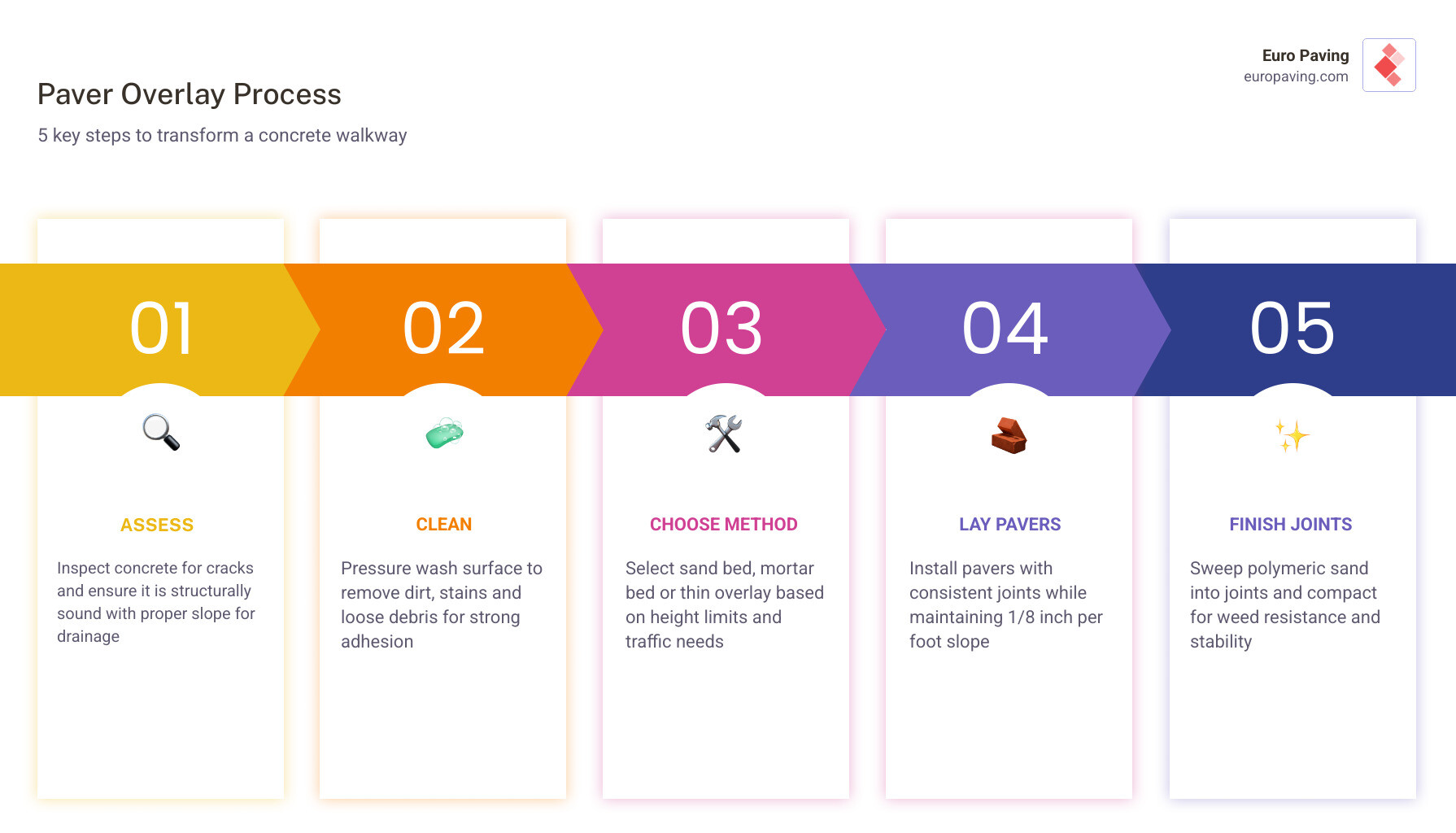
Quick pavers over concrete walkway definitions:
Why Choose Pavers Over Concrete Walkway Overlays?
When homeowners in Chicago and suburbs like Norridge, Skokie, or Barrington consider updating their front entryways, they often face a choice: pour a brand-new concrete slab, tear everything out, or overlay the existing base with premium pavers.
Choosing a paver overlay instead of full demolition offers several major advantages, starting with your budget. By using your existing concrete as a stable foundation, you completely eliminate the labor and disposal costs associated with jackhammering and hauling away heavy concrete. This typically reduces total project costs by 30% to 50% while slashing installation times in half.
Beyond cost, the long-term durability of individual paving stones far exceeds that of a monolithic poured concrete slab. Poured concrete is highly rigid. As the ground shifts during our harsh Northern Illinois winters, that rigid slab inevitably cracks. Pavers, on the other hand, are individual units that can flex slightly with ground movement without cracking or shifting out of place.
If a single paver is ever stained or damaged, it can be easily popped out and replaced. If a poured concrete walkway cracks, your only options are unsightly patches or another round of expensive demolition.
To understand how these options stack up, consider the key differences below:
| Feature | Poured Concrete Walkway | Paver Overlay (Over Sound Concrete) |
|---|---|---|
| Upfront Cost | Moderate | Highly Cost-Effective (saves demolition costs) |
| Lifespan | 10–15 years (before cracking occurs) | 20–30+ years with minimal maintenance |
| Crack Resistance | Low (prone to cracking from freeze-thaw) | Extremely High (individual units flex naturally) |
| Repair Process | Difficult, requires patchy joint repairs | Simple, individual units can be replaced |
| Aesthetics & Variety | Limited, prone to fading and staining | Endless patterns, textures, and premium colors |
Choosing to overlay your walkway also opens up incredible design possibilities. You can easily coordinate your front entrance with a matching backyard design. For inspiration on how a new walkway can completely elevate your home’s exterior, read about the 11 Benefits of Adding a Brick Sidewalk to Your Home and see how we integrate these elements seamlessly.
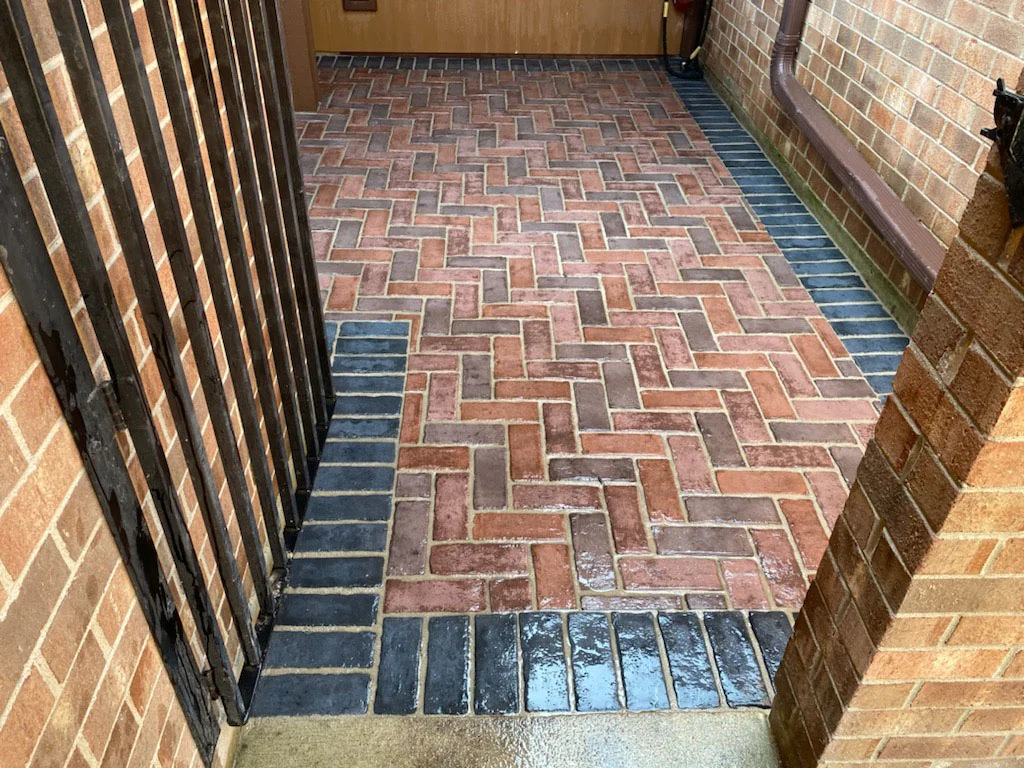
By working with an experienced team, you can review professional design options—such as premium Unilock pavers—to ensure your new walkway matches your home’s architectural style. For more information on why this approach is highly recommended, check out the expert insights from Can You Install Pavers Over a Concrete Walkway? – Atlantic Hardscape and Concrete.
Structural Requirements and Surface Preparation
An overlay is only as good as the foundation beneath it. While installing a pavers over concrete walkway system is an excellent way to revitalize your landscape, we must first verify that your existing concrete is up to the task.
Before any pavers are laid, a professional hardscape team must thoroughly assess the structural integrity of your concrete slab. The ideal concrete base must be:
- Structurally Stable: It should not be sinking, tilting, or actively crumbling.
- Even and Flat: While minor surface wear is perfectly fine, there should be no significant vertical offsets (where one section of the walkway has buckled higher than the other).
- Free of Major Fissures: Hairline cracks are common and completely acceptable, but large, wide chasms indicate deep structural failure or soil erosion underneath.
If we install pavers over a base that is actively shifting or settling, those movements will eventually transfer directly to the surface, causing your beautiful new pavers to warp, wobble, or pop out of place within a few seasons.
Once the concrete is deemed structurally sound, the surface must be meticulously prepared. This is a critical step that we never skip. Any dirt, moss, weeds, or oil deposits will prevent bonding agents, mortar, or sand beds from settling correctly.
Our team uses commercial-grade pressure washers operating between 1,500 and 3,000 PSI to deep-clean the concrete, stripping away decades of built-up grime and organic material. We then allow the slab to dry completely for at least 24 hours. If there are minor hairline cracks, we seal them with specialized concrete fillers to prevent water from seeping underneath and causing issues down the line. To learn more about how we prepare properties for a flawless installation, take a look at our guide on What to Know Before Your Paving Stone Installation.
Assessing Your Base for Pavers Over Concrete Walkway Projects
In regions like Downers Grove, Lake Forest, and Northbrook, proper water management is the single most important factor in hardscape longevity. Because water expands when it freezes, any moisture trapped beneath your pavers during a Chicago winter will create immense pressure, leading to “frost heave” and uneven surfaces.
This is why we closely evaluate the slope of your existing concrete walkway. For safe and efficient water runoff, the concrete base must have a minimum slope of 1/8 inch per foot (and ideally 1/4 inch per foot) sloping away from your home’s foundation.
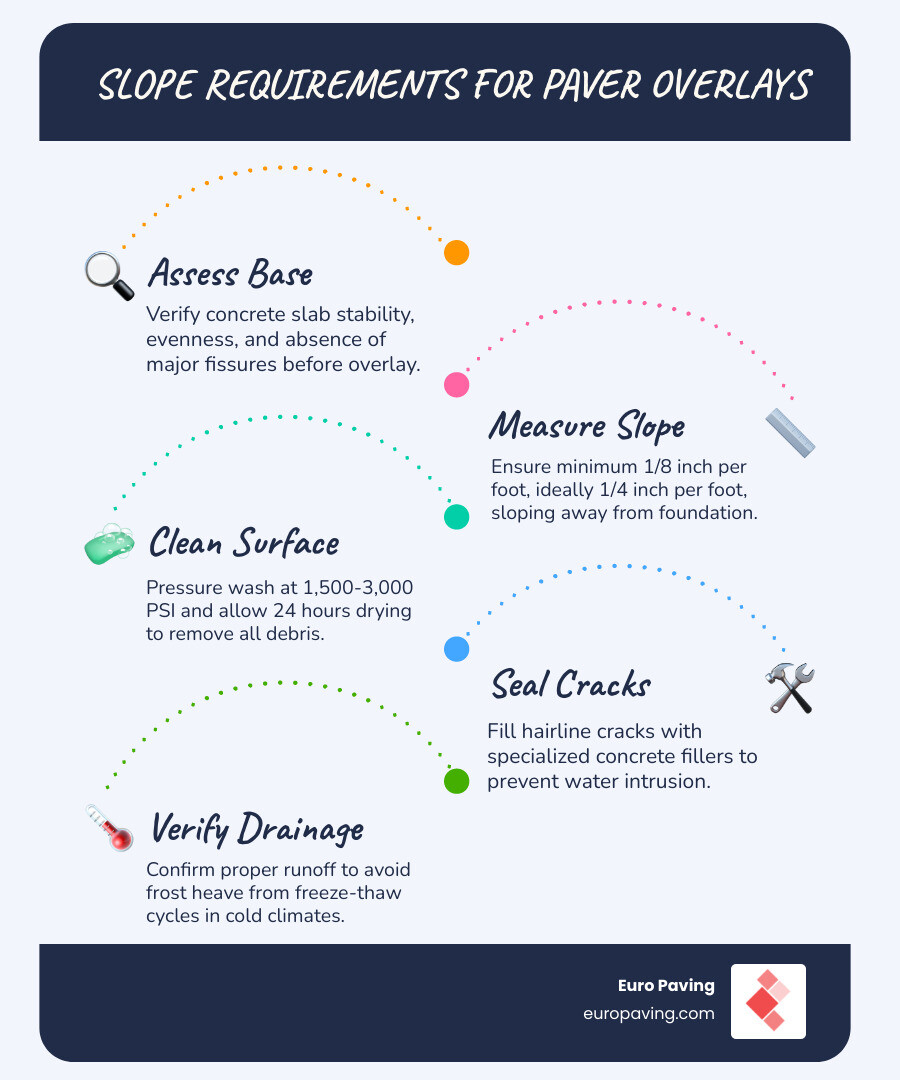
If your existing walkway does not have a proper slope, water will pool in the joints between the pavers. During winter, this standing water will freeze, forcing the pavers upward and ruining the flat surface. When we assess a property, we measure the slope using precise leveling tools. If the slope is slightly off, we can often correct it during the prep phase using specialized leveling compounds or mudset layers. For a deeper look at evaluating a slab for structural readiness, you can read How to Put Pavers Over Concrete: Complete Homeowner’s Guide.
Professional Overlay Installation Methods
Once the base is clean, stable, and properly sloped, we select the best installation method for your specific walkway. There is no “one-size-fits-all” approach; the right method depends on your home’s architecture, expected foot traffic, and height limitations.
Here are the three most common professional methods used today:
1. The Sand Bed Method
This traditional method involves laying a thin, uniform layer of fine, washed concrete sand (usually 1 to 1.5 inches thick) directly over the concrete slab. The pavers are then bedded into the sand and locked together with joint sand.
- Pros: Excellent flexibility, allows for natural expansion and contraction, and makes individual paver replacement incredibly simple.
- Cons: Adds about 3 to 4 inches of total height to your walkway, which may cause clearance issues near doors or steps. It also requires highly secure edge restraints to prevent the sand from washing out over time.
2. The Mortar Bed Method
For high-traffic entryways or areas where absolute rigidity is desired, the mortar bed method is a premier option. A half-inch layer of high-strength mortar is applied to the concrete, and the pavers are set directly into it.
- Pros: Incredibly stable and durable. It locks every stone permanently in place, making it virtually impossible for weeds to grow or water to penetrate the joints.
- Cons: Rigid systems do not flex as easily as sand-set systems, meaning they rely entirely on the concrete base remaining 100% stable. It is also more labor-intensive and costly to repair if a stone is damaged.
3. Thin Overlay Pavers
If you have tight clearance issues near front doors or low porch steps, thin overlay pavers are the perfect solution. These pavers are engineered to be slimmer (typically 1 inch thick) while maintaining the structural strength of traditional 2.5-inch pavers. They are usually secured using high-strength, exterior-grade polyurethane concrete adhesives.
- Pros: Minimizes height increases (adding only about 1.5 inches total), making transitions to lawns or existing steps much easier to manage.
- Cons: Not suitable for heavy vehicular traffic (like driveways), though they perform beautifully on residential walkways and patios.
To explore how different paver styles and layouts can transform your home’s entrance, check out our dedicated resource on Brick Paving Sidewalks.
Professional Methods for Laying Pavers Over Concrete Walkway Systems
For homeowners who want the absolute best in modern hardscaping technology, we often utilize advanced materials like dry mudset or premium polymer-modified adhesives.
Dry mudset is a product that installs with the ease of sand but cures like concrete once activated with water. This provides an exceptionally stable, level bed that won’t wash away, while still allowing the system to handle heavy foot traffic.
Additionally, we use high-performance polymeric sand to fill the joints between the pavers. Once swept into the joints and misted with water, polymeric sand hardens to create a flexible, water-resistant seal. This prevents rain from washing out the joint material, blocks weed growth, and stops ants from tunneling beneath your beautiful new path.
For commercial-grade insights and technical specifications on these advanced overlay systems, you can refer to the Belgard Commercial Overlay Guide.
Key Engineering Challenges: Elevation, Transitions, and Drainage
While overlaying concrete is highly efficient, it does present unique engineering challenges that require professional expertise to solve. The most significant of these is elevation change.
Because you are adding a layer of sand or adhesive plus the thickness of the pavers, your new walkway will sit 2 to 3 inches higher than the original concrete. This height increase can create several critical transition issues:
- Door Thresholds: If your walkway leads directly to a front door or porch, the new pavers must not sit higher than the doorsill, which could trap water or prevent the door from opening.
- Step Alignment: In places like Highland Park or Winnetka, building codes strictly regulate step heights. If we overlay a step without careful planning, we could create an uneven step height, which is a major tripping hazard.
- Lawn Transitions: The edge of your new walkway will now sit higher than the surrounding grass.
To solve these challenges, we design custom transitions. We can install gradual beveled borders, create beautiful retaining soldier courses, or gently regrade the surrounding lawn to meet the new height of the pavers.
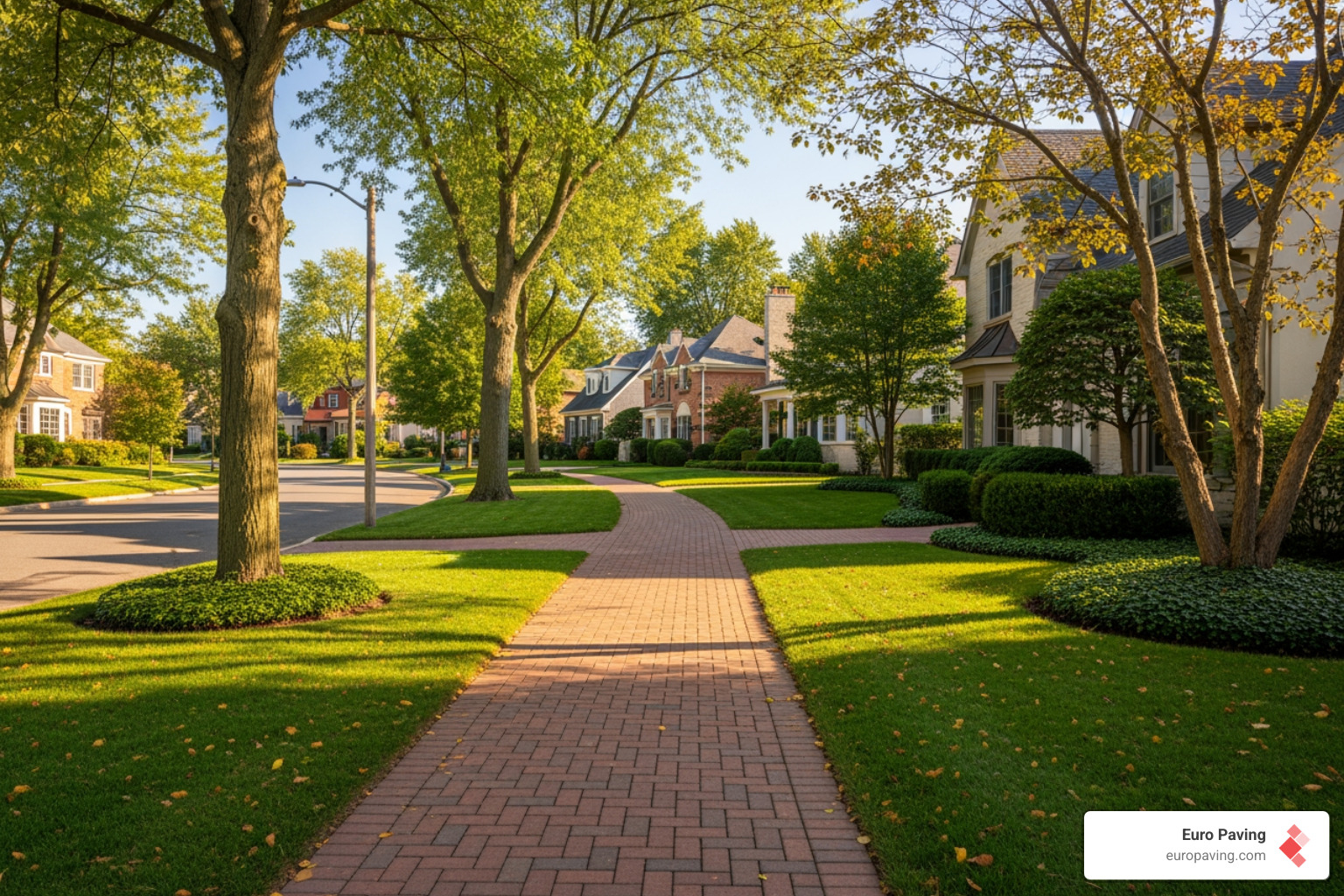
In areas where water runoff is a concern, we may also integrate subtle drainage solutions, such as micro-channel drains or French drains along the edge of the walkway, ensuring water is routed safely away from your home’s foundation. To learn more about selecting materials that can handle these transitions while maintaining their beauty, read our guide on The Best Paving Stones for a Sidewalk That Lasts.
Frequently Asked Questions
Can you install thin pavers over a cracked concrete walkway?
Yes, but only if the cracks are stable hairline cracks. If the concrete has major structural cracks, vertical shifting, or is actively crumbling, those issues must be professionally repaired first. Laying pavers over unstable, shifting concrete will cause the pavers to shift and sink within a few seasons.
How do you prevent weeds and shifting in a paver overlay?
We prevent shifting by installing heavy-duty commercial edge restraints around the perimeter of the walkway. To eliminate weeds, we use premium polymeric sand in the joints. This sand hardens when activated with water, creating an impenetrable barrier that prevents weed seeds from taking root.
How long does a professionally installed paver overlay last?
When installed by a professional team using proper drainage techniques and high-quality materials, a paver overlay can easily last 20 to 30 years. Regular maintenance, such as sweeping and occasional sealing, will keep the colors vibrant and protect the stones from harsh Chicago winters.
Conclusion
Covering an old, tired concrete sidewalk with premium brick or concrete pavers is one of the most rewarding home improvement projects you can undertake. It completely revitalizes your home’s curb appeal, increases property value, and saves you thousands of dollars in demolition costs.
However, achieving a flawless, long-lasting finish requires precise engineering, proper water management, and the right installation methods. At Euro Paving, we are proud to be a premier Unilock authorized contractor serving Chicago and the surrounding suburbs, including Elmhurst, Hinsdale, Mount Prospect, Roselle, and Glenview.
Our team specializes in creating custom, family-friendly outdoor spaces designed to withstand our challenging Midwest climate. We handle every step of the process—from professional 3D design planning and concrete structural assessments to the final sweep of polymeric sand.
Ready to transform your cracked concrete walkway into a beautiful, welcoming entrance? Contact Euro Paving today to schedule a consultation with our hardscape experts. Let us help you design a walkway that you’ll love coming home to every single day. For more information on our services, visit our Sidewalk Paving Services page.