



Is Your Sinking Asphalt Driveway a Sign of Something Serious?
A sinking asphalt driveway is more than a cosmetic problem — it’s a warning sign that something is failing beneath the surface. Here’s a quick overview of what causes it and how to fix it:
Quick answer: How to level a sinking asphalt driveway
- Identify the cause — poor soil compaction, drainage issues, tree roots, or broken utilities
- Assess the severity — minor dips vs. widespread subsidence
- Choose the right repair — patching for small areas, mudjacking for moderate sinking, full reconstruction for base failure
- Improve drainage — redirect water away from the driveway to prevent recurrence
- Maintain regularly — sealcoat every 2-3 years and seal cracks early
Walk across almost any older driveway in the Chicago suburbs and you’ll likely spot at least one low spot, dip, or uneven section. It’s easy to dismiss it as normal wear. But that gradual sinking is usually a symptom of something happening underground — eroding soil, a failing sub-base, or water quietly washing away the foundation beneath your feet.
Left alone, a small depression becomes a pothole. A pothole becomes a structural failure. And a structural failure means a full replacement — not a simple patch.
The good news? Most sinking driveways are fixable — especially when caught early. With proper installation and maintenance, an asphalt driveway can last 15 to 30 years. The key is understanding what’s causing the problem before throwing a fix at the surface.
This guide walks you through exactly how to do that — from diagnosing the root cause to choosing the right professional repair for your situation.
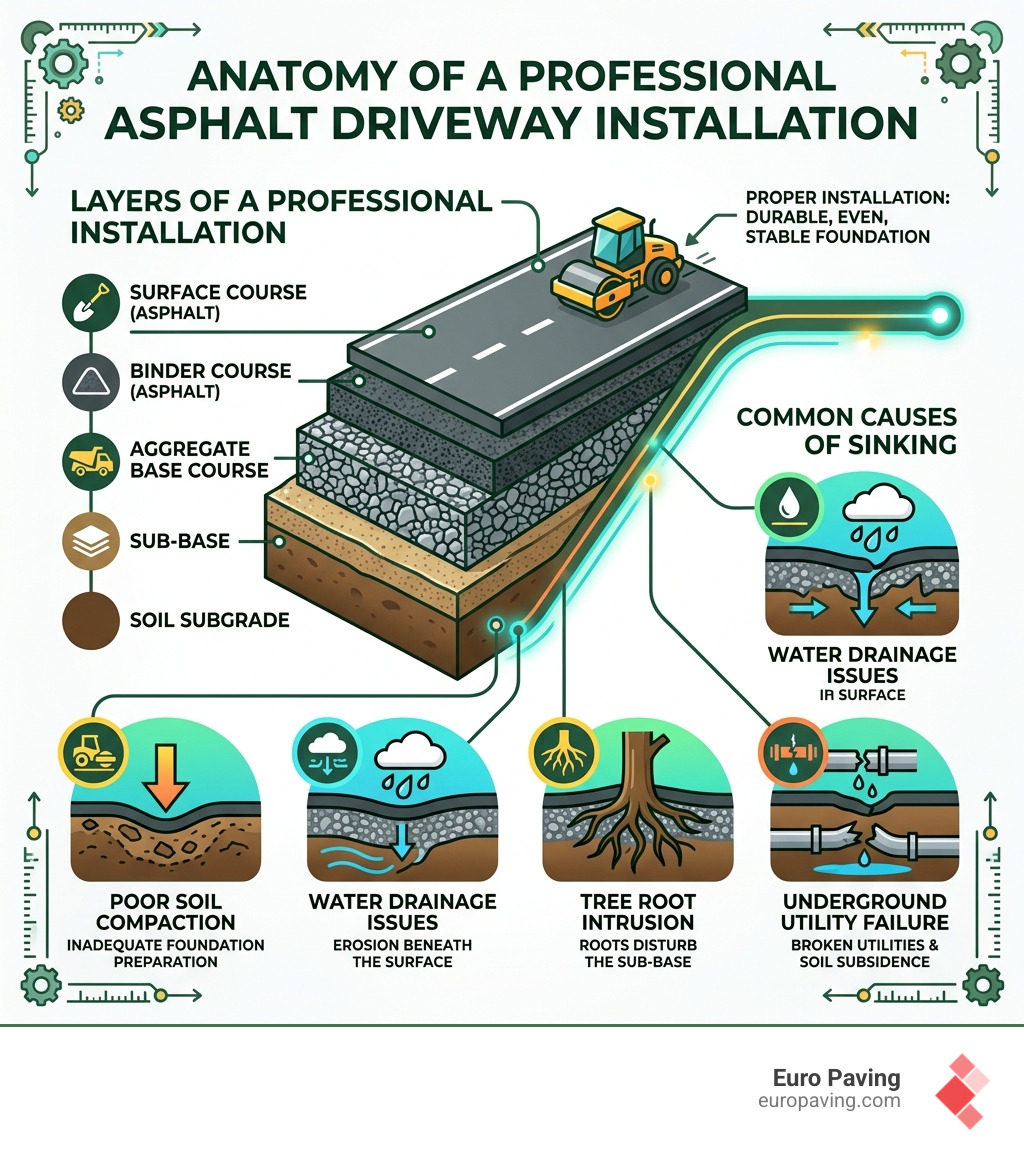
Simple guide to sinking asphalt driveway:
Identifying the Root Causes of a Sinking Asphalt Driveway
When we visit homes in Arlington Heights or Northbrook, the first thing we do is look past the surface. A sinking asphalt driveway (or “pavement subsidence” as we pros call it) doesn’t just happen by accident. It is almost always a result of the foundation losing its ability to support the weight above it.
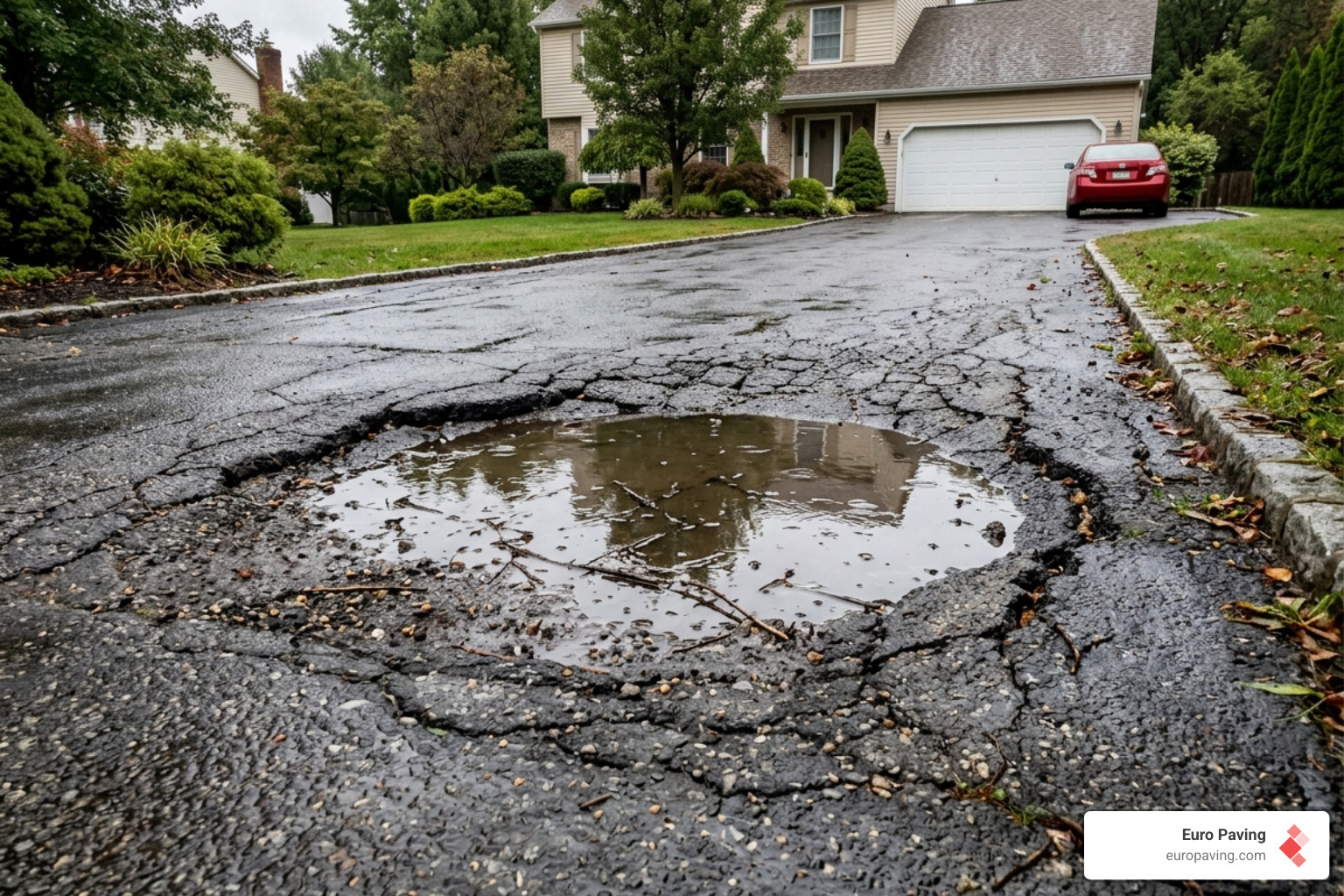
One of the most common culprits is poor soil compaction. If the original installer didn’t use a vibratory roller or plate compactor effectively, the soil remains full of air pockets. Over time, gravity and the weight of your SUV do the work the contractor should have done, pressing the soil down and leaving a dip in your driveway. In many Chicago-area homes built during the construction booms of the 1980s through 2008, excavators often backfilled foundations with “native soil” (the dirt they dug up) rather than stable granular materials. When that native soil is loosely packed or contains frozen chunks, it eventually settles, causing the first few feet of the driveway to sink.
Water is the other great enemy. According to Sinking Asphalt Explained: What Causes It and How to Fix It, water erosion creates literal voids beneath the asphalt. If your gutters dump water right next to the pavement, that water seeps under the edges and washes away the sand and gravel base. Without that support, the asphalt has nowhere to go but down.
Heavy vehicle loads also play a role. If you regularly park a heavy RV or a commercial truck in the same spot, the constant pressure can compress even a decent base, leading to those familiar “tire tracks” or depressions. For more complex issues involving structural failure, you can find more info about professional asphalt contractor services to see how deep the fix needs to go.
Warning Signs of a Sinking Asphalt Driveway
You don’t need a degree in civil engineering to spot a driveway in trouble. Most of the time, your driveway is screaming for help through several visible signals.
- Alligator Cracking: These are small, interconnected cracks that look like the skin of a reptile. This is a major red flag. It usually means the sub-base has failed, and the asphalt is flexing too much under weight.
- Standing Water: If you notice puddles that linger long after a Chicago rainstorm has passed, you have a low spot. Water sitting on asphalt is a recipe for disaster, as it seeps into the pores and weakens the binder.
- Crumbling Edges: When the soil beneath the edge of your driveway washes away, the asphalt loses its lateral support. You’ll see the edges start to break off in chunks.
- Garage Apron Gaps: This is a classic Chicago suburb issue. You might notice a 2-to-5-inch “step down” from your garage floor to the driveway. This happens when the backfill around the house foundation settles.
If you see any of these, it’s a good idea to check out these 5 Signs You Need to Call a Paving Expert to prevent a small dip from becoming a total driveway collapse.
The Role of Subterranean Erosion and Utilities
Sometimes, the problem is buried even deeper. Broken or leaking utility lines are a frequent but overlooked cause of a sinking asphalt driveway. Large pipes for water or sewage can leak slowly for years, creating subterranean caverns. As the soil is sucked into these leaks or washed away, the ground above it settles.
According to the experts at Summit Asphalt in their guide How Can Broken or Leaking Utility Lines Cause Asphalt Pavements to Sink?, utility trenches that were poorly backfilled are a primary cause of linear sinking—where a narrow strip of the driveway drops lower than the rest.
Vegetation can also be a hidden saboteur. If a driveway was built over an old tree stump or decaying organic debris, that material will eventually rot away. As it decomposes, it leaves a void, and the soil above it collapses to fill the space. Conversely, living tree roots can grow under the base, lifting some sections while causing others to “sink” by comparison as the base is disrupted.
Professional Solutions for Leveling and Restoration
Once we’ve identified why the driveway is sinking, we have to decide how to fix it. There is no “one-size-fits-all” solution. A small birdbath-sized dip requires a different approach than a driveway that looks like a topographical map of the Rolling Hills.
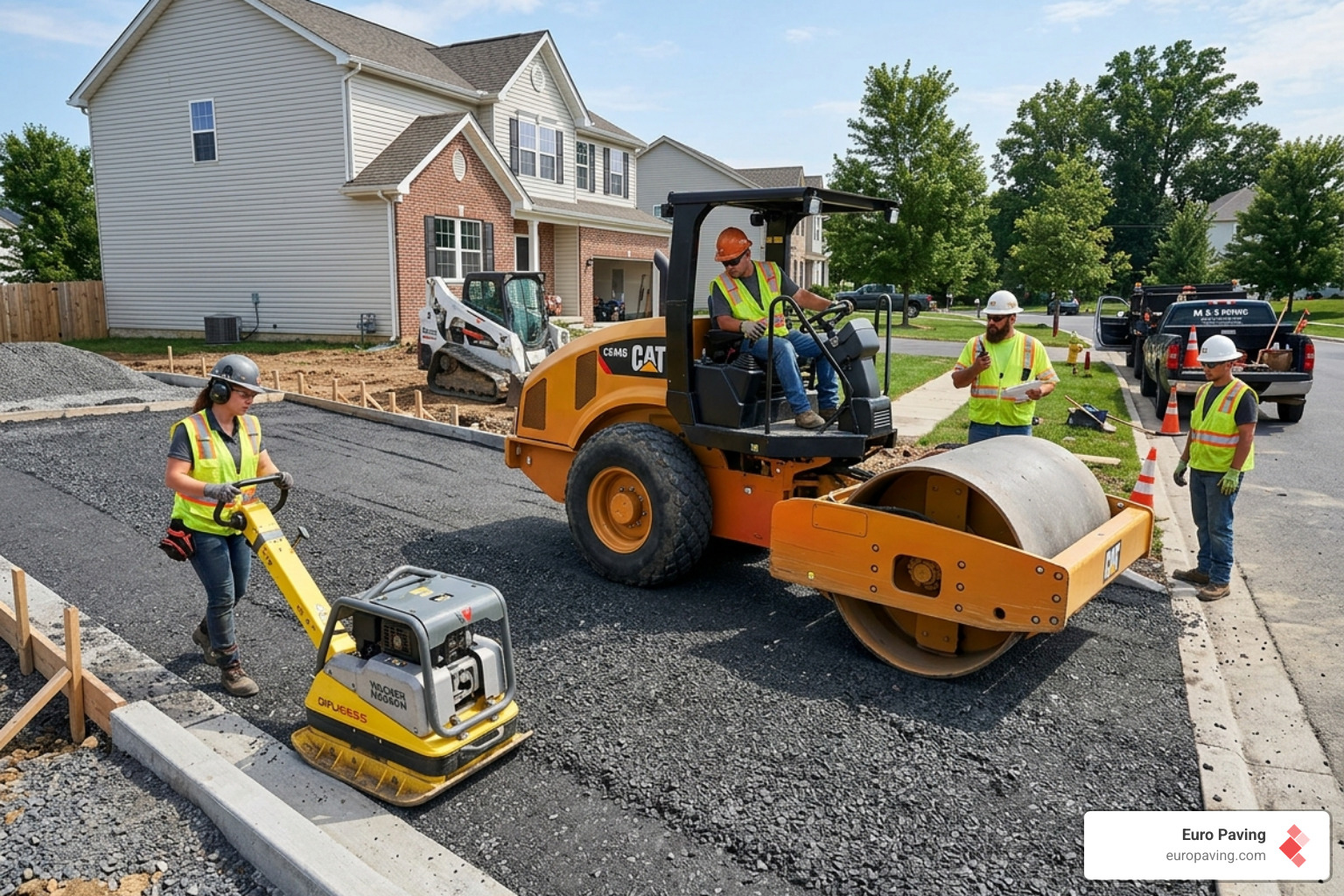
For minor depressions where the base is still relatively stable, we often use asphalt patching. This involves cleaning the area, applying a bonding agent (emulsion), and filling the hole with fresh hot-mix asphalt. For a deeper look at this, see The Ultimate Asphalt Patching Guide for Homeowners.
However, if the sinking is more significant, we might suggest infrared repair. This is a cool technology where we heat the existing asphalt until it’s workable, add a bit of new material, and compact it all together. It creates a seamless patch that prevents water from getting back into the joint.
| Method | Best For | Pros | Cons |
|---|---|---|---|
| Patching | Small potholes/dips | Cheap, fast | Visible seams, temporary |
| Infrared Repair | Moderate sinking | Seamless, long-lasting | Requires specialized gear |
| Mudjacking | Large, sunken slabs | No excavation needed | Harder to do on asphalt than concrete |
| Reconstruction | Total base failure | Permanent fix, 20+ year life | Most expensive option |
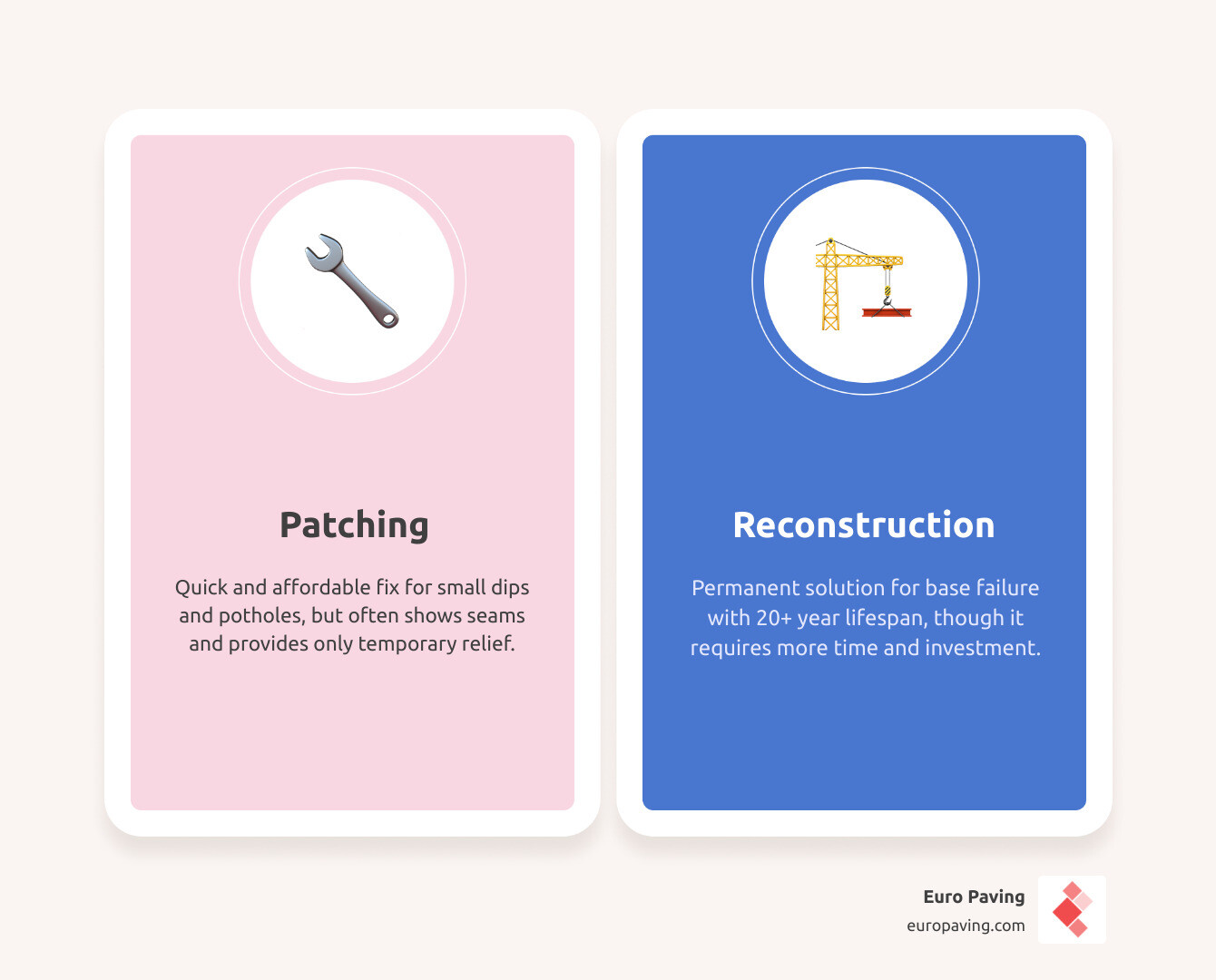
Professional Repair for a Sinking Asphalt Driveway
When the sinking is caused by deep soil issues—like that native soil backfill we mentioned earlier—a surface patch is just a Band-Aid. A professional repair usually involves excavating the affected area down to the sub-grade.
We remove the soft, wet, or uncompacted soil and replace it with granular backfill (usually a mix of crushed stone and fines). This material is then compacted in layers. As noted in How to Fix a Sinking Asphalt Driveway, proper compaction is the secret sauce. We use heavy vibratory rollers to ensure there are no air pockets left to settle later. Only once the foundation is rock-solid do we lay the new asphalt.
When to Choose Full Reconstruction Over Patching
We often get asked, “Can’t you just put a new layer over the old one?” This is called an overlay, and in April 2026, we generally advise against it if the driveway is already sinking. If the “bones” of the driveway are bad, the new layer will just sink along with the old one.
You should consider full reconstruction if:
- More than 25-30% of the driveway shows alligator cracking.
- The driveway is over 20 years old.
- There are significant drainage issues that require re-grading the entire lot.
A full reconstruction allows us to fix the drainage from the ground up, ensuring a much higher long-term ROI. For more on making this decision, check out Driveway Renovation – Avoiding Common Problems.
The Impact of Chicago’s Climate on Driveway Stability
Living in the Chicago area—from Downers Grove to Lake Forest—means our driveways face some of the harshest conditions in the country. It’s not just the cold; it’s the constant switching back and forth.
In a typical season, our temperatures can fluctuate above and below freezing 30 to 50 times! This is the “freeze-thaw cycle.” When water gets into a crack in your asphalt and freezes, it expands by roughly 9%. That expansion exerts massive pressure, pushing the asphalt apart. When it thaws, it leaves a larger gap, which then fills with more water.
Furthermore, much of the soil in Cook and DuPage Counties has high clay content. Clay is like a sponge; it holds onto water and expands significantly when frozen (this is called “frost heave”). This movement can tilt, buckle, or sink sections of your driveway overnight. To keep your pavement from falling victim to these elements, follow these Don’t Let Your Driveway Crumble with These Maintenance Tips.
Drainage Management in Northern Illinois
If you want to stop a sinking asphalt driveway, you have to control the water. In the flat terrain of the Chicago suburbs, water doesn’t always have an easy place to go.
We often recommend:
- French Drains: These are gravel-filled trenches with perforated pipes that redirect groundwater away from the driveway base.
- Catch Basins: For driveways with a natural “bowl” shape, a catch basin can collect surface water and sent it to the storm sewer.
- Slope Correction: Sometimes we just need to re-grade the area so the water flows toward the street or a lower part of the yard.
Properly managing water is the only way to fix your crumbling driveway edges before they disappear.
Why Asphalt Flexibility Matters in April 2026
One reason asphalt remains a popular choice in Illinois is its flexibility. Unlike concrete, which is rigid and prone to snapping under the pressure of frost heave, asphalt can “give” a little. This resilience allows it to survive the thermal expansion of a hot July day and the brutal contraction of a January freeze.
However, that flexibility only lasts as long as the asphalt stays “oily” and hydrated. As it ages and turns gray, it becomes brittle. Regular inspections and knowing how to repair driveway cracks early can keep that surface resilient for decades.
Long-Term Prevention and Maintenance Strategies
Prevention is always cheaper than a cure. If you want to avoid a sinking asphalt driveway, you need a maintenance schedule.
The most important step is sealcoating. You should sealcoat a new driveway about 6 to 12 months after installation, and then every 2 to 3 years after that. Sealcoating acts as a waterproof barrier, preventing rain and snow from soaking into the asphalt and reaching the sub-base. It also protects against UV rays that dry out the binder.
Crack sealing is equally vital. If you see a crack wider than a quarter-inch, seal it immediately. This stops the “9% expansion” cycle before it starts. For those with gravel driveways or mixed surfaces, remember to prevent your driveway from becoming a moon crater by maintaining the aggregate levels.
According to Sinking Asphalt Driveways: Repair Steps, Causes & Prevention, managing your vehicle loads—like not parking the heavy family camper in the same spot all summer—can also extend the life of your pavement significantly.
The Benefits of Upgrading to Brick Pavers
At Europa Paving, we love a good asphalt driveway, but if you’re tired of the “sink and patch” cycle, it might be time to consider brick pavers.
There are 8 benefits of having a brick driveway instead of asphalt, but the biggest one regarding sinking is repairability. If a section of a brick driveway settles because of a utility leak or soil compaction, we don’t have to cut and patch it. We simply lift the bricks, add more base material, compact it, and put the same bricks back. It’s a “reset” rather than a “repair,” and it leaves no visible scar.
Many homeowners ask, “Is a brick driveway cheaper than concrete?” While the upfront cost is higher than asphalt, the lifetime value is often superior because you aren’t paying for resurfacing or major repairs every 15 years. Plus, the aesthetic value and curb appeal in neighborhoods like Hinsdale or Barrington are unmatched.
Frequently Asked Questions about Sinking Asphalt Driveways
What is the average cost to fix a sinking driveway in Chicago?
In April 2026, costs vary based on the scale. A simple professional patch might cost a few hundred dollars. However, if you are looking at mudjacking or localized sub-base repair, you might spend between $1,000 and $3,000. Full reconstruction for a standard two-car driveway usually starts around $5,000 and goes up based on the thickness and drainage requirements.
How long should a professionally installed asphalt driveway last?
With proper maintenance (sealcoating and crack filling), you can expect 15 to 30 years. Without maintenance, or if installed on poor Chicago clay without a proper base, you might see sinking and cracking in as little as 5 to 7 years.
Can tree roots cause a sinking asphalt driveway?
Yes, but they usually cause “shifting.” Roots can grow under the base and displace the soil. When the root eventually dies or is removed, it leaves a void that causes the asphalt to sink. If you have large trees near your driveway, installing a root barrier during the paving process is a smart preventative move.
Conclusion
A sinking asphalt driveway doesn’t have to be the end of your home’s curb appeal. Whether it’s a minor dip caused by the heavy spring rains in Hillside or a major subsidence issue in Winnetka, the key is to act fast. By identifying the root cause—be it drainage, compaction, or aging utilities—you can choose a repair that actually lasts.
At Europa Paving, we specialize in more than just fixing surfaces; we transform your property. From custom brick patios and outdoor kitchens to durable, family-friendly driveway designs, we help homeowners in Elmhurst, Arlington Heights, and across the Chicago area create spaces that stand the test of time.
Don’t wait for that small puddle to become a major liability. Schedule a professional brick paving driveway consultation with us today and let’s get your driveway back on solid ground.