



What Makes a Brick Paver Driveway Last in Chicago?
Premium brick paver driveway installation starts below the surface. For a Chicago-area home, hire a contractor who plans for vehicle weight, drainage, and winter freeze-thaw cycles. Ask how they will prepare and compact the base, set a firm edge, and keep the pavers from shifting. Those details matter as much as the color and pattern you see from the street.
A well-planned driveway can add curb appeal while allowing individual pavers to be lifted and reset if a small area settles. This guide explains what to look for in the design, installation, and long-term care of a driveway built for Chicago conditions.
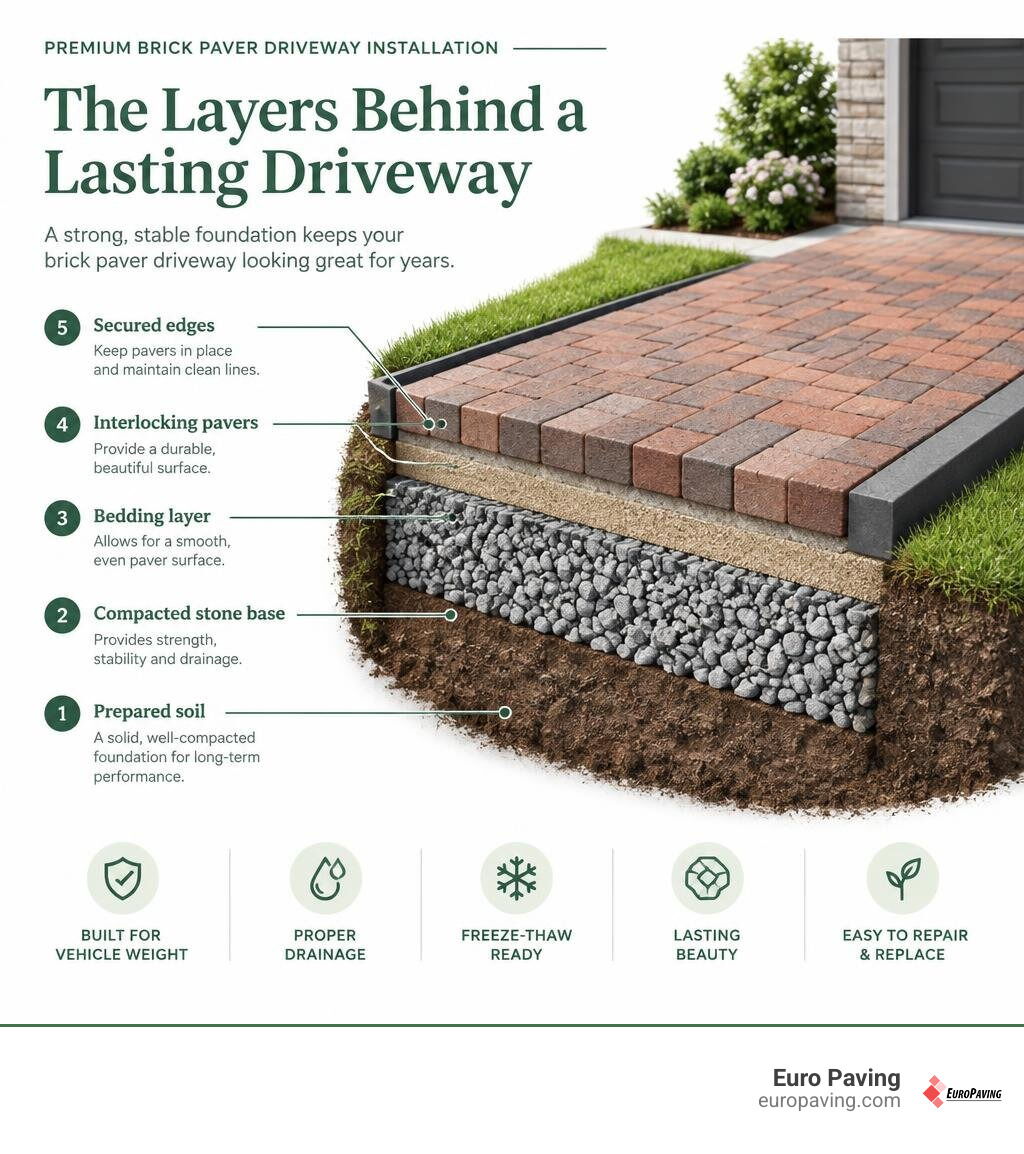
Handy premium brick paver driveway installation terms:
Why Choose a Premium Brick Paver Driveway Installation
A driveway is one of the most visible structural elements of your front landscape. When selecting materials, homeowners in Cook and DuPage counties often weigh the performance of modular pavers against monolithic poured concrete or asphalt. Standard concrete and asphalt slabs form rigid surfaces that inevitably crack when ground movement occurs during freezing winter conditions.
In contrast, modular paver systems distribute vehicular loads across an interlocking network of individual units. Because the joints between each paver contain specialized sand rather than rigid mortar, the entire surface can flex slightly under extreme load and temperature shifts without fracturing. Reviewing the benefits of a brick driveway for Chicago homes makes it clear that segmental pavement provides unmatched structural adaptability.
Another primary advantage is spot repairability. If underground utilities require excavation or an oil stain occurs, our crews can extract specific pavers, complete the utility work or stain treatment, and re-install the exact same units without leaving unsightly patches.
| Feature | Segmental Brick Pavers | Poured Concrete | Standard Asphalt |
|---|---|---|---|
| Material Flexibility | Flexible segmental joints | Rigid monolithic slab | Semi-flexible surface |
| Freeze-Thaw Response | Flexes without surface cracks | Prone to surface cracking | Prone to frost heaves |
| Spot Repairability | High (remove and reset units) | Low (requires patching/cutting) | Low (requires cutting/filling) |
| Surface Traction | High textured slip resistance | Variable smooth/broom finish | Smooth to textured |
Engineering Benefits of Premium Brick Paver Driveway Installation
The core mechanical strength of an interlocking concrete paver driveway comes from vertical, rotational, and horizontal interlock. Premium pavers are engineered to withstand severe weight loads and resist the abrasive action of winter road grit.
According to guidelines published by the Interlocking Concrete Pavement Institute (ICPI), concrete pavers manufactured for vehicular applications must exhibit high compressive strength and low moisture absorption rates. This low absorption prevents deep water penetration that would otherwise cause internal spalling and surface degradation during repetitive Midwest freeze-thaw cycles. When installed over a properly engineered foundation, the flexible system transfers vehicle point loads outward across a wide footprint of compacted base material.
Surface Drainage and Subsoil Movement in the Chicago Area
Native subsoils throughout the Chicago area frequently contain high concentrations of dense clay. Clay soils expand significantly when wet and retain water for extended periods, creating substantial frost heave risks during cold snaps. When setting up a driveway, establishing a positive drainage slope away from structures is critical.
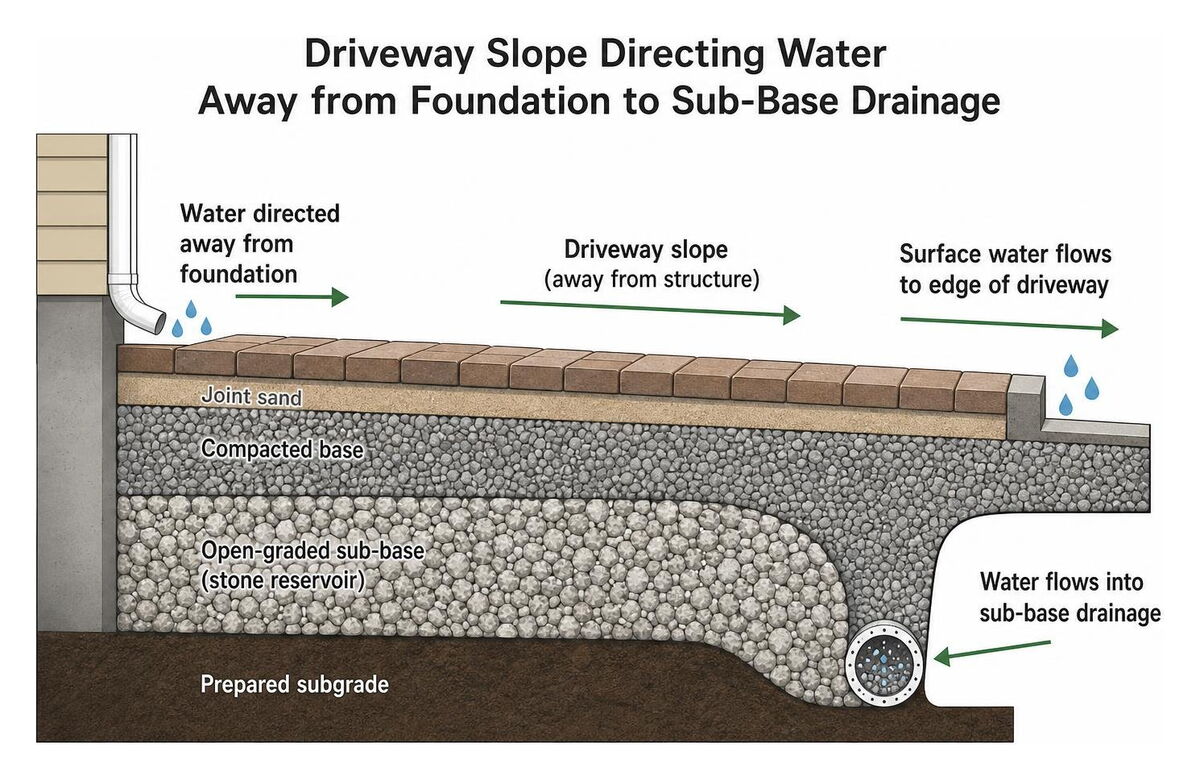
Permeable paver systems offer an effective alternative for properties dealing with poor natural drainage or local municipal restrictions on impervious surface coverage. Permeable installations use wider joint gaps filled with clean crushed aggregate. This allows stormwater to flow rapidly through the surface into an open-graded stone reservoir beneath, preventing standing puddles and reducing ice sheet formation during fluctuating winter temperatures.
Key Steps in Professional Driveway Base Preparation and Construction
A premium paver driveway is only as stable as the ground beneath it. According to the Interlocking Concrete Pavement Institute, most structural pavement failures result from improper excavation, inadequate aggregate depth, or poor compaction.
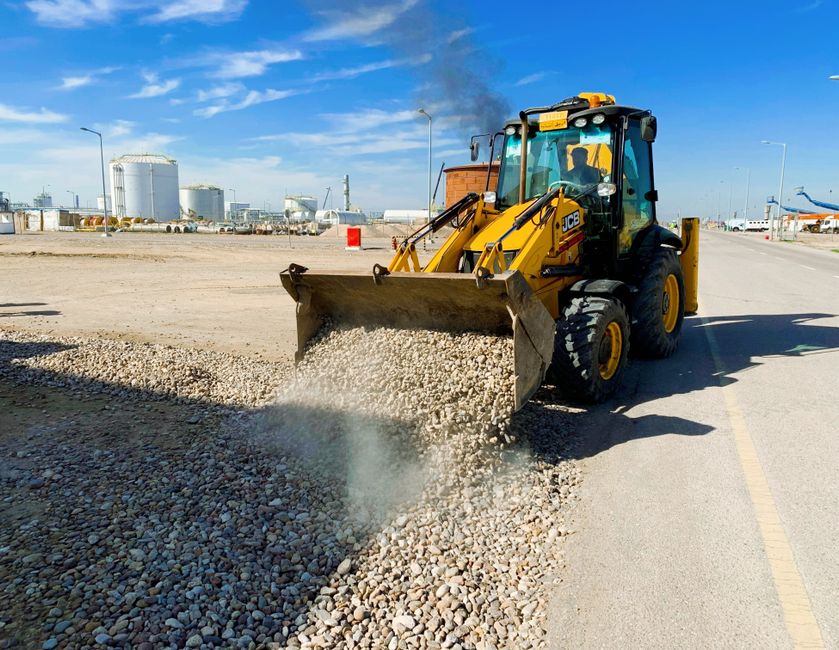
To understand how professional contractors approach these critical steps, you can review the professional guide to paving a brick driveway. Professional crews follow strict installation standards, such as those detailed in the Construction of Interlocking Concrete Pavements – CMHA documentation, to guarantee long-term stability.
Excavation, Sub-Base Compaction, and Edge Restraints
Professional base construction follows a defined structural progression:
- Subgrade Excavation: The native soil is excavated to a uniform depth, establishing a consistent slope for water drainage.
- Geotextile Separation: A heavy-duty woven geotextile fabric is laid over the clay subgrade to prevent the crushed aggregate base from migrating down into soft subsoil over time.
- Aggregate Base Installation: Dense-graded crushed stone aggregate is spread across the footprint.
- Mechanical Compaction in Lifts: Aggregate is placed and compacted in thin layers using heavy vibratory plate compactors to eliminate air pockets and achieve maximum density, following the lift thickness recommended by the Interlocking Concrete Pavement Institute.
- Rigid Edge Restraint Anchoring: Heavy-duty commercial edge restraints are secured into the compacted base using steel spikes along all open perimeter lines to eliminate lateral paver drift under turning tires.
Paver Placement and Polymeric Sand Joint Stabilization
Once the base is compacted and the bedding layer is precisely screeded, field pavers are set in position according to the architectural layout. Workers place each unit firmly against adjacent stones without dragging them across the bedding material.
After the field is laid and edge units are cut to fit, the entire surface is swept with high-performance polymeric sand. Mechanical plate compactors are run over the paved surface to seat the stones evenly into the bedding layer while vibrating the sand deep into the joint spaces. Once joints are filled to the base of the chamfer, a light water mist activates the binding polymers in the sand, creating an elastic joint that locks the stones, blocks weed growth, and prevents insect tunneling.
Design Options, Colors, and Laying Patterns
Modern hardscaping provides broad design versatility to complement brick, stone, and siding architectural styles common across the Chicago area. Homeowners can mix field colors with contrasting border bands to create defined entry aprons and wide motor courts.
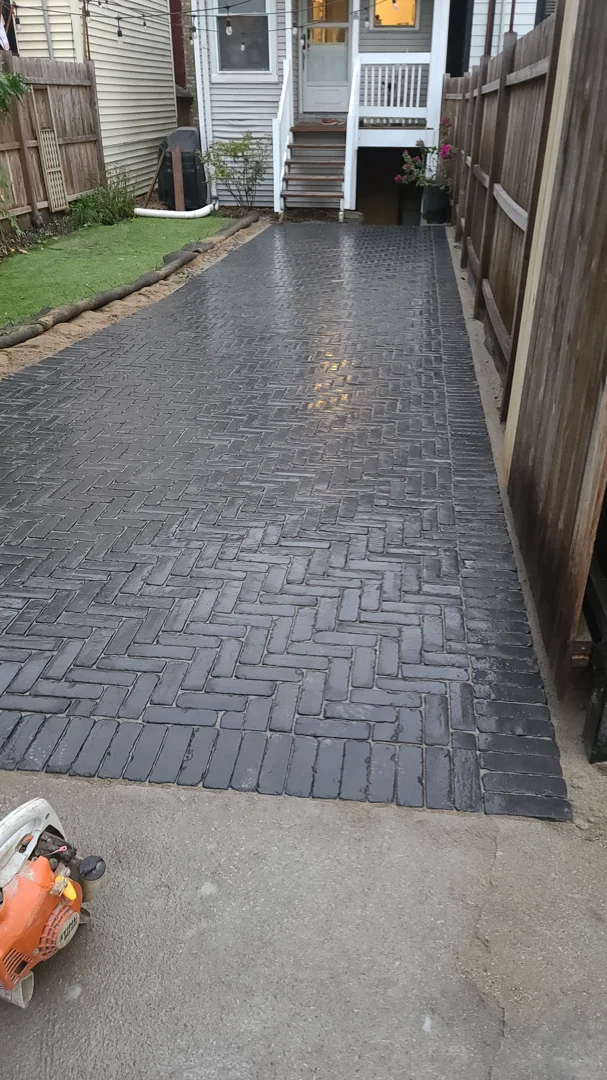
Before breaking ground, homeowners can explore spatial layouts and color palettes through professional 3D paving design services. This visualization confirms that paver tones align with siding, masonry, and surrounding walkways.
Critical Standards for Premium Brick Paver Driveway Installation Patterns
Not all laying patterns offer equal load resistance. Driveways experience strong rotational forces when vehicle wheels turn at low speeds.
- 45-Degree Herringbone: The most structurally sound pattern for residential driveways. Interlocking units distribute tire braking and turning loads evenly in multiple directions.
- 90-Degree Herringbone: Offers high mechanical interlock while aligning cleanly with straight garage thresholds and roadway entries. Explore our detailed overview of herringbone brick driveway layouts for layout mechanics.
- Soldier and Sailor Course Borders: Linear framing rows placed along the perimeter that secure the outer field cuts and deliver a clean visual finish.
Maintenance, Sealing, and Long-Term Care for Paver Surfaces
Maintaining an interlocking paver driveway in northern climates requires simple, proactive measures to preserve its structural strength and appearance:
- Winter Care and De-Icing: Avoid using harsh chemical de-icers or rock salt that can degrade joint sand. Calcium chloride or plain sand provides safe traction without damaging pavement materials.
- Surface Sealing: Applying breathable brick paving sealer and coating every 2 to 3 years guards against motor oil penetration, protects colors from UV fading, and locks joint sand in place.
- Targeted Repairs: If ground shifting occurs over time, professional paver repair and releveling services can lift isolated areas, rebuild the base, and reset existing units seamlessly.
Frequently Asked Questions About Brick Paver Driveways
How long does a professionally installed brick paver driveway last in Chicago?
When installed according to ICPI aggregate depth and compaction standards, an interlocking paver driveway can deliver a functional lifespan of 25 to 50 years. Because the system can flex with seasonal ground movement, it avoids the cracking common in rigid concrete slabs.
How does vehicular traffic affect paver stability over time?
Vehicular weight helps stabilize properly installed paver driveways. Routine driving transfers downward pressure through the interlocking joint sand, distributing loads across the compacted aggregate base without causing uneven settlement.
What is the estimated cost of installing brick pavers for a residential driveway?
Brick paver projects start at about $28 per square foot; every quote is individual and depends on the size of the project, the materials and the site. Native soil excavation requirements, access constraints, and drainage modifications also factor into project investment.
Conclusion
A well-engineered paver driveway provides dependable durability, simplified maintenance, and refined curb appeal for your property. Euro Paving was founded in 2006 by Wojciech Chrzanowski and provides licensed and insured hardscaping craftsmanship across Chicago and the surrounding suburbs. As a recognized Unilock Authorized Contractor with Unilock Awards of Excellence and a 4.9-star rating on Google, we build high-performance residential and commercial surfaces.
Unilock pavers and wall blocks carry a lifetime material guarantee from Unilock covering materials only, and flexible financing is available through the Unilock DO-IT-NOW program. To learn more about our options for professional brick paving driveways, contact our team today.
Ready to upgrade your home? Request a free estimate and 3D design at https://europaving.com/contact-us/ or call (773) 988-2353.