



Why Your Choice of Driveway Paver Options Matters More Than You Think
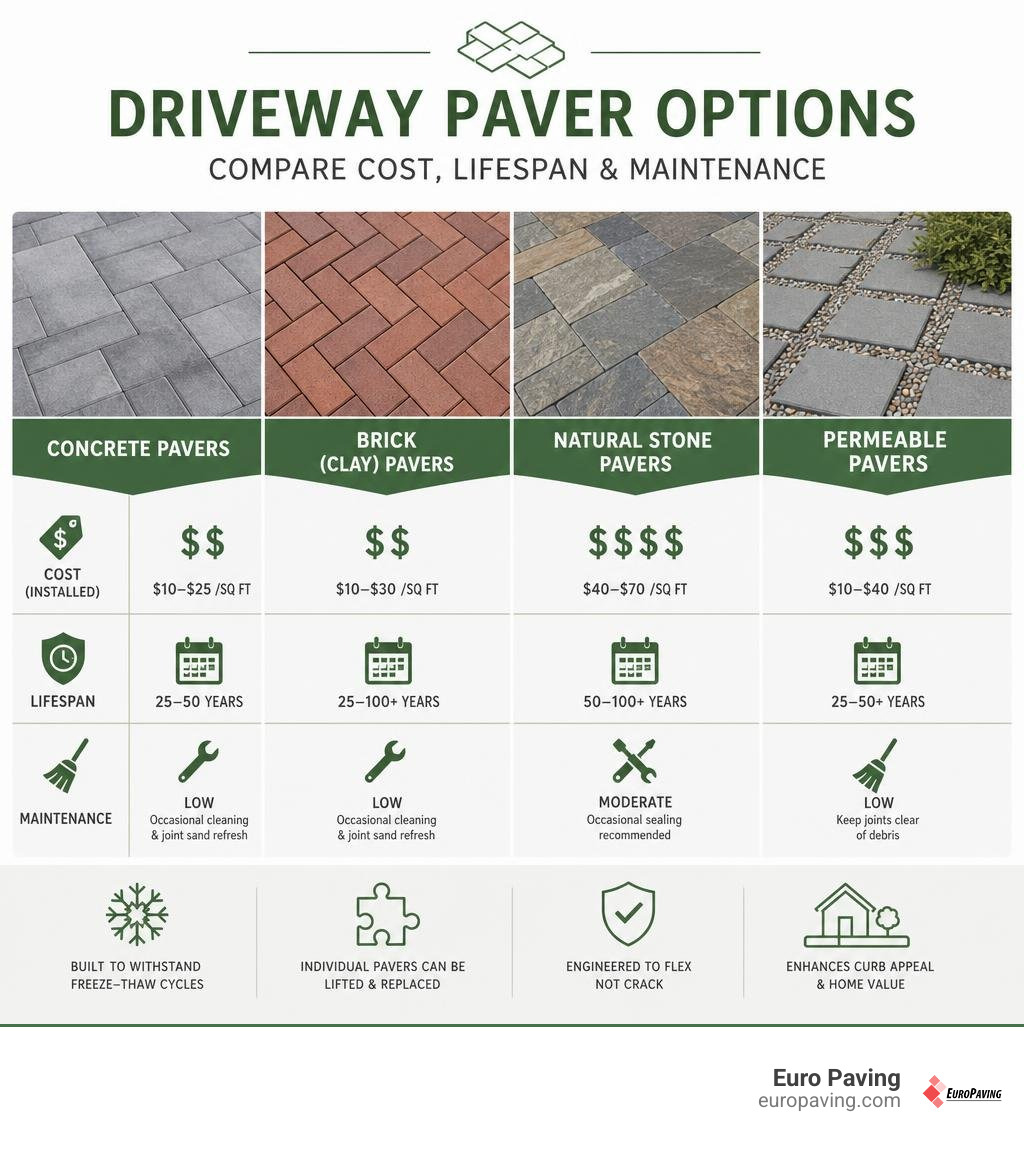
When it comes to driveway paver options, most Chicago-area homeowners are choosing between four main materials:
| Paver Type | Cost (Installed) | Lifespan | Best For |
|---|---|---|---|
| Concrete pavers | $10–$25/sq ft | 25–50 years | Versatility, modern looks |
| Brick (clay) pavers | $10–$30/sq ft | 25–100+ years | Classic style, freeze-thaw durability |
| Natural stone pavers | $40–$70/sq ft | 50–100+ years | Luxury, longevity |
| Permeable pavers | $10–$40/sq ft | 25–50+ years | Drainage, eco-friendliness |
Your driveway is one of the first things visitors — and potential buyers — notice about your home. A beautiful, well-installed driveway can increase your home’s value by 5 to 10 percent. But pick the wrong material and you could be dealing with cracked surfaces, costly repairs, or a look that simply doesn’t fit your home’s style.
The good news? Unlike poured concrete or asphalt, quality driveway pavers are engineered to flex with Chicago’s brutal freeze-thaw cycles instead of cracking under them. Individual damaged units can be lifted and replaced without patching or resurfacing the whole driveway. And they last — properly installed concrete and brick pavers regularly reach 25 to 50 years, while natural stone can last a century or more.
This guide walks you through every major material, what each one costs, how long it lasts, and what it takes to install it correctly in the Chicago suburbs.
Glossary for driveway paver options:
Comparing the Main Driveway Paver Options
To choose the perfect look for your home, you must weigh up how different materials perform under heavy vehicles and harsh Midwest winters. When we consult with homeowners in Hinsdale, Skokie, or Arlington Heights, we look at durability, upfront costs, and long-term maintenance requirements.
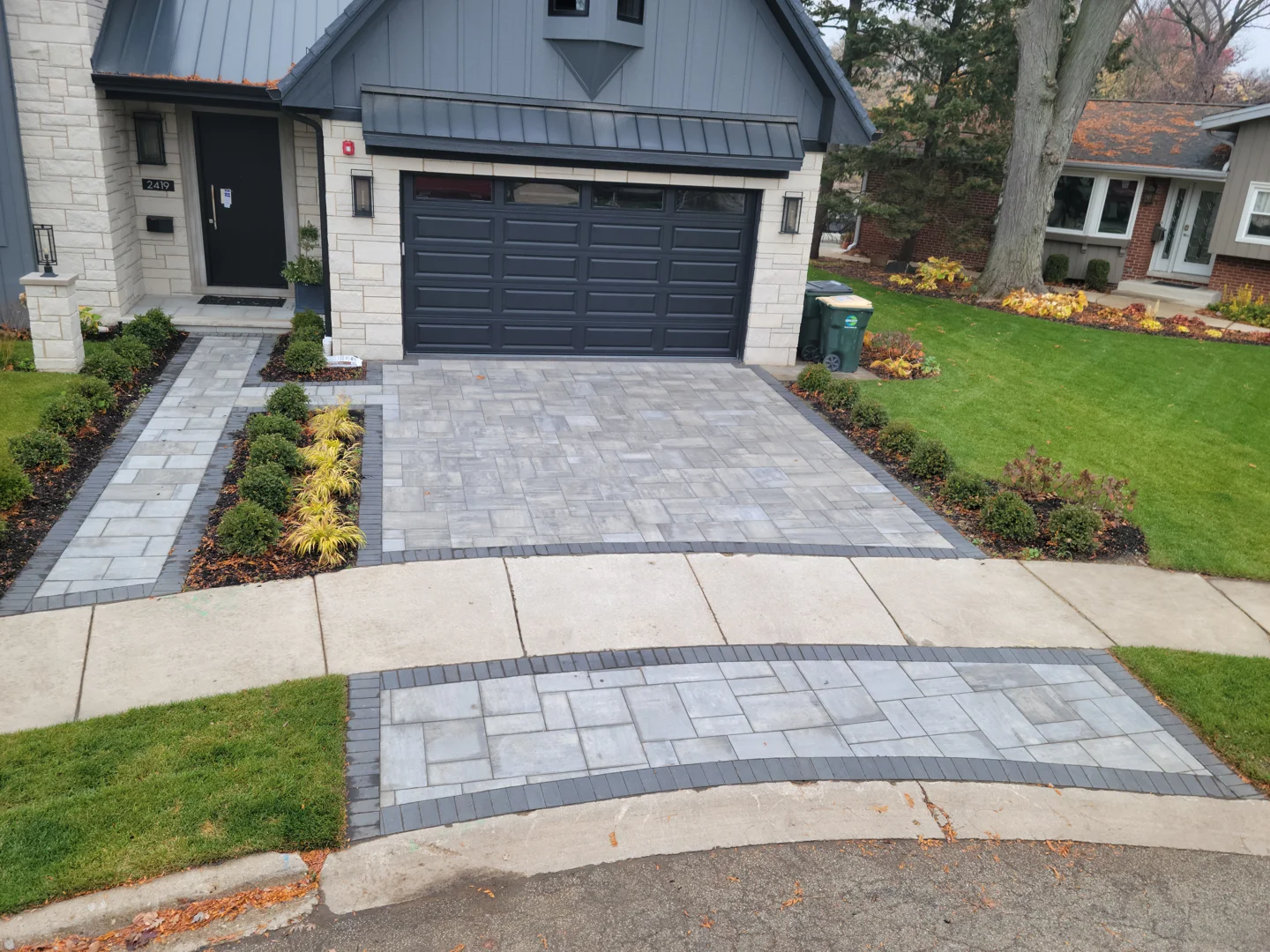
The four primary driveway paver options each bring distinct characteristics to your property:
- Concrete Pavers: These are highly customizable, cost-effective, and incredibly strong. They are manufactured under intense pressure, making them roughly three times stronger than standard poured concrete.
- Clay Brick Pavers: Fired in kilns at extremely high temperatures, true clay bricks boast a natural, warm look that never fades. They are historically durable and can handle massive loads.
- Natural Stone Pavers: Usually sourced as granite cobblestone or dense sandstone, natural stone offers unmatched prestige and can literally last for generations.
- Permeable Pavers: Engineered with wider joints filled with small aggregate, these pavers allow rainwater to seep directly into the ground, eliminating standing water and winter ice buildup.
To help you choose, let us look closely at how these options stack up across different performance metrics. For a detailed breakdown of how to choose between these systems, read our Choosing Between Different Types of Driveways 2026 Guide.
Concrete Driveway Paver Options
If you want design flexibility and maximum strength, concrete pavers are hard to beat. Standard concrete pavers have a compressive strength rating of approximately 8,000 PSI (pounds per square inch).
However, conventional concrete pavers can face a common enemy: UV-driven color fading. Over the years, sun exposure breaks down surface pigments. To solve this, we specialize in installing premium Unilock pavers. Unilock products feature advanced manufacturing processes like EnduraColor™ finish, which concentrates high-performance minerals and deep-bonded pigments on the surface layer. This ensures your driveway keeps its rich color for decades.
For ultimate performance, Unilock Elegance™ pavers offer up to four times the strength of traditional poured concrete or asphalt. This extreme durability prevents surface wear, chipping, and aggregate exposure, even under heavy SUVs and service trucks.
Clay Brick and Natural Stone Driveway Paver Options
For classic architectural styles, clay brick remains a top-tier choice. Made from natural clay and shale fired in a kiln, brick pavers carry a compressive strength of up to 12,000 PSI. Because their color runs completely through the body of the brick, they never fade or look worn. Instead, they develop a graceful, rustic patina over time.
Natural stone represents the peak of luxury hardscaping. Granite cobblestones and dense sandstones are highly resistant to freeze-thaw cycles and de-icing salts. For instance, the calibrated Promenade Sandstone Driveway Pavers – De Terra | Natural Paving USA provides a natural, slip-resistant texture with through-body colors that concrete cannot fully replicate. These sandstone pavers come in 1¼-inch thicknesses for standard residential driveways and 2-inch options for heavy-traffic areas, allowing them to install seamlessly alongside traditional concrete pavers.
Pavers vs. Traditional Asphalt and Poured Concrete
Many homeowners ask us: Why should I pay more for pavers when I can just pour concrete or lay asphalt? The answer comes down to structural engineering and lifecycle costs.
Traditional poured concrete is rigid. When the ground freezes and expands in January, concrete has no room to move, which leads to surface cracking. Asphalt is more flexible but softens in summer heat and requires seal coating every two to three years. Both asphalt and poured concrete driveways typically require complete resurfacing or replacement within 15 to 20 years, often leaving behind ugly patch marks from repairs.
Interlocking pavers solve this problem. The sand-filled joints between individual pavers allow the entire system to flex, distribute heavy vehicle loads evenly, and settle naturally without cracking. If a utility line needs repair or a single paver gets stained by motor oil, we can lift that specific section, complete the repair, and lay the exact same pavers back down. No scars, no mismatched patches. To learn more about these financial and structural benefits, explore our guide on the 8 Benefits of Having Brick Driveway Instead of Asphalt Driveway.
Technical Specifications and Base Preparation
No matter how beautiful or expensive your driveway pavers are, they will only perform as well as the base beneath them. Shifting, sinking, and rutting are almost always caused by poor base preparation, not the pavers themselves.
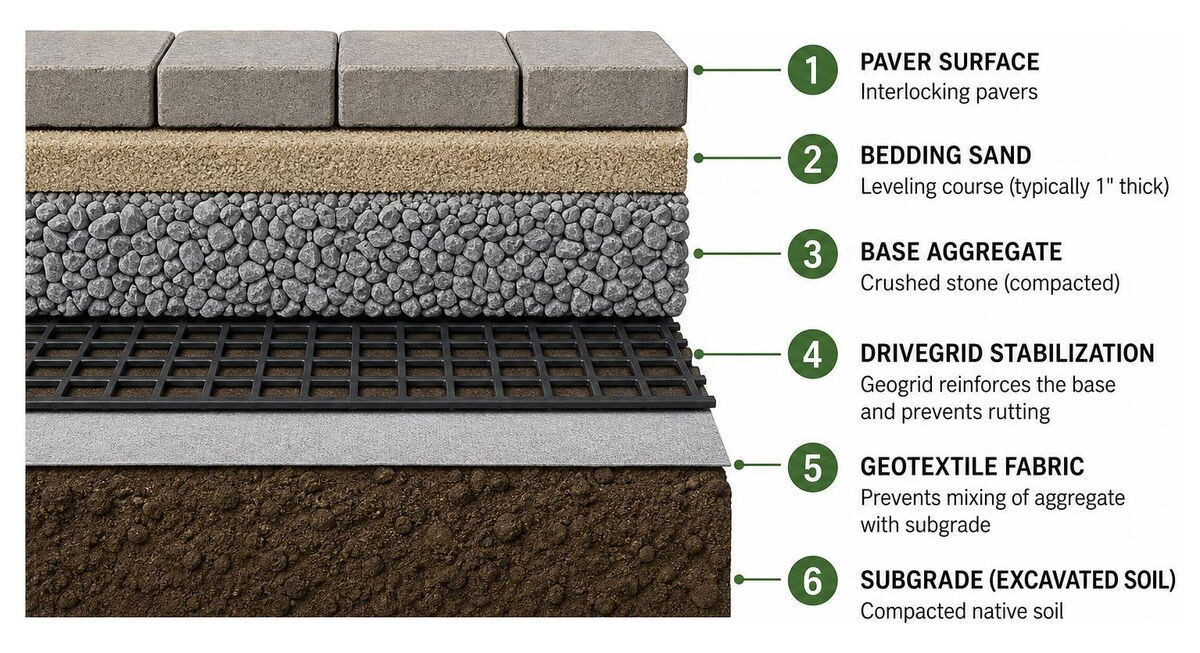
A professional driveway installation follows a strict sequence of engineering steps:
- Excavation: Digging out the native soil to a depth that accounts for Chicago’s heavy clay and frost lines.
- Geotextile Fabric: Lining the subgrade with a professional-grade geotextile fabric to prevent the clay subsoil from mixing with your clean aggregate base.
- DriveGrid Stabilization: Laying down a high-performance geogrid to reinforce the subgrade and prevent rutting under heavy vehicle wheels.
- Aggregate Base: Spreading clean, crushed stone in 3-to-4-inch layers (lifts), compacting each layer thoroughly.
- Compaction: Running a 10,000 lb. reversible plate compactor over the base at least three times to ensure zero settling.
For a comprehensive breakdown of these standards, see our Paving Contractor Expert Guide for Chicago Properties 2026 Guide.
Excavation, Base Depth, and Thickness Requirements
In the Chicago area, our heavy clay soils hold water, making them highly susceptible to shifting during frost cycles. Because of this, driveways require an aggregate base depth of 8 to 12 inches of thoroughly compacted crushed stone.
The thickness of the pavers themselves is also critical:
- 60mm (2⅜ inches): The minimum thickness required for standard residential driveways carrying normal passenger cars and SUVs.
- 80mm (3⅛ inches): Required for driveways that accommodate heavier vehicles, such as delivery trucks, motorhomes, or trailers, and areas with frequent tight wheel turning.
Can You Install Pavers Over Existing Concrete?
Yes, you can install pavers over an existing concrete driveway, but only under very specific conditions. The existing concrete slab must be structurally sound, free of major settling, and completely level.
To do this correctly, we must drill drainage holes through the concrete slab at its lowest points and fill them with pea gravel. This prevents water from getting trapped between the pavers and the concrete, which would freeze and pop the pavers loose in winter. We then lay a thin bedding sand layer, install the pavers, and secure the perimeter with robust edge restraints.
That adding a paver overlay will raise your driveway’s surface height by 3 inches. This can affect how the driveway meets your garage floor threshold, front walkways, and surrounding lawn, which is why a professional assessment is highly recommended.
Design Aesthetics and Curb Appeal
Your driveway is a canvas that can dramatically improve your home’s curb appeal. By choosing the right colors, textures, patterns, and borders, we can turn a basic driveway into a stunning architectural feature.
Choosing the Right Color and Style for Your Home
When looking at driveway paver options, your goal should be to complement your home’s exterior trim and roof colors rather than matching them exactly.
- Warm-Toned Homes: If your home features red brick, warm siding, or beige stone, look for earth-toned pavers (browns, buffs, tans, and terracottas).
- Modern or Cool-Toned Homes: For gray, white, or blue siding, look for cool grays, charcoal, or slate-colored pavers.
- Contrast Borders: Using a dark charcoal or deep red border stone creates a clean frame that defines the driveway’s edges.
- Masking Spills: We always recommend choosing multi-colored blends or darker paver tones for your main driveway area, as they are highly effective at masking occasional oil drips or tire marks.
Laying Patterns and Border Accents
The pattern in which your pavers are laid is not just about looks — it is also about structural strength.
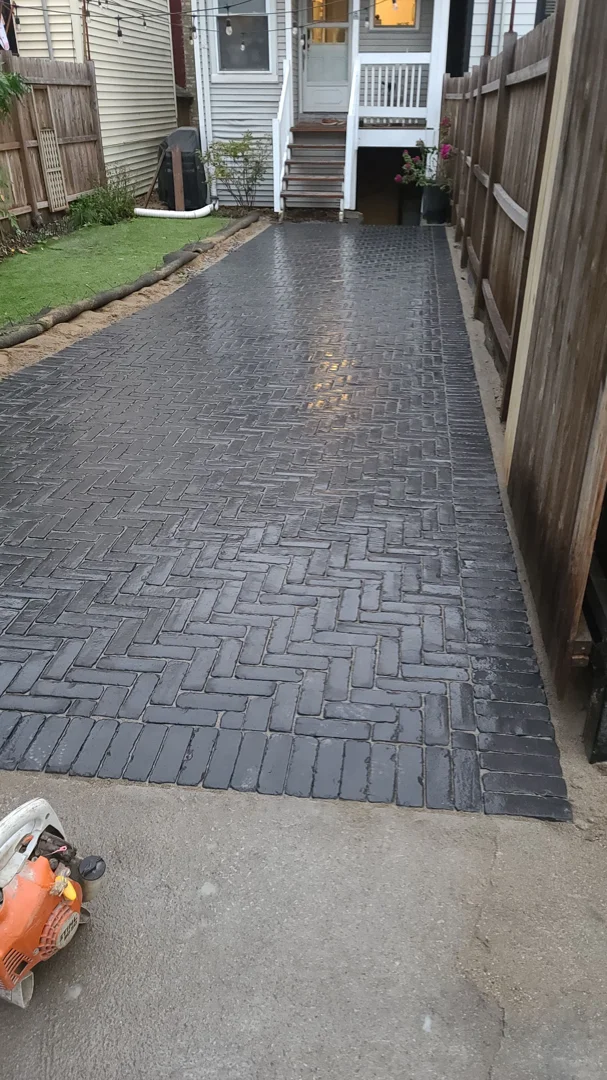
- Herringbone Pattern (45° or 90°): This is the gold standard for driveways. Because the pavers interlock at angles, herringbone patterns provide approximately 40% more lateral resistance than other patterns. This prevents the pavers from shifting or creeping when vehicles accelerate, brake, or turn their wheels. For a deeper look at this classic design, check out our Step-by-Step Guide to Herringbone Brick Driveway.
- Running Bond & Basketweave: These are excellent for pedestrian walkways or light-duty parking areas, but they require robust borders when used on driveways.
- Borders (Soldier & Sailor Courses): A “soldier course” (pavers laid side-by-side standing upright) or a “sailor course” (pavers laid end-to-end) acts as a strong frame that keeps the inner patterns securely locked in place. Read our guide on Driveway Edging Brick Ideas for a Polished Look to see how these borders elevate a design.
Frequently Asked Questions about Driveway Pavers
Do driveway pavers need to be sealed?
Sealing is not strictly required for structural integrity, but it is highly recommended for concrete pavers. Applying a high-quality, breathable sealer every 3 to 5 years protects the surface from UV fading, prevents oil and grease stains from soaking into the concrete, and highlights the natural colors of the stone.
Additionally, we use polymeric sand in the joints. This specialized sand contains chemical binders that activate when wet, hardening to lock the pavers in place, prevent joint erosion, and stop weeds and ants from taking over. If you want a low-maintenance option, we install Unilock pavers equipped with factory-sealed EasyClean™ stain resistance, which protects the stone right out of the mold.
Are permeable pavers a worthwhile investment for Chicago homes?
Absolutely. Chicago is prone to intense summer downpours and rapid winter snowmelts. Permeable pavers feature wider joint gaps filled with small aggregate, allowing water to drain directly into an open-graded stone base.
This brings several major benefits:
- No Standing Water: Water drains away instantly, eliminating large puddles on your driveway.
- Reduced Ice Accumulation: Because water drains through the surface rather than pooling on top, permeable driveways see significantly less winter ice buildup, making them much safer.
- Environmental Protection: Runoff is filtered naturally back into the soil, keeping oils and chemicals out of our municipal storm sewers.
How much do driveway pavers cost per square foot?
For a professional installation in the Chicago suburbs, concrete and brick pavers typically range from $10 to $30 per square foot for materials and labor. Natural stone and complex permeable systems can range from $10 to $70 per square foot.
While the upfront cost of a paver driveway is higher than poured concrete or asphalt, it offers incredible long-term value. With a lifespan of 30 to 50+ years, zero cracking issues, and easy individual repairs, you will spend far less on maintenance and replacement over the life of your home.
Conclusion
Upgrading your driveway is a major home improvement project that requires experienced design and precise engineering. As a premier Unilock Authorized Contractor with nearly 20 years of experience serving Chicago and surrounding suburbs like Hinsdale, Northbrook, and Arlington Heights, Euro Paving is here to help you bring your vision to life.
We don’t believe in guesswork. We use advanced 3D design planning to help you visualize your new driveway, walkways, and landscaping before we lay a single stone. Plus, our installations are backed by lifetime-guaranteed Unilock materials and flexible financing options to fit your budget.
Ready to transform your home’s curb appeal with a gorgeous, durable paver driveway? Explore our Brick Paving Driveways page or contact us today to schedule your custom design consultation!