



Why Brick Paver Patterns Transform Your Outdoor Space
Exploring brick paver pattern ideas is one of the most rewarding steps you can take when planning a patio, driveway, or walkway upgrade. The pattern you choose doesn’t just affect how your hardscape looks — it also determines how well it holds up under foot traffic, vehicle weight, and Chicago’s freeze-thaw cycles.
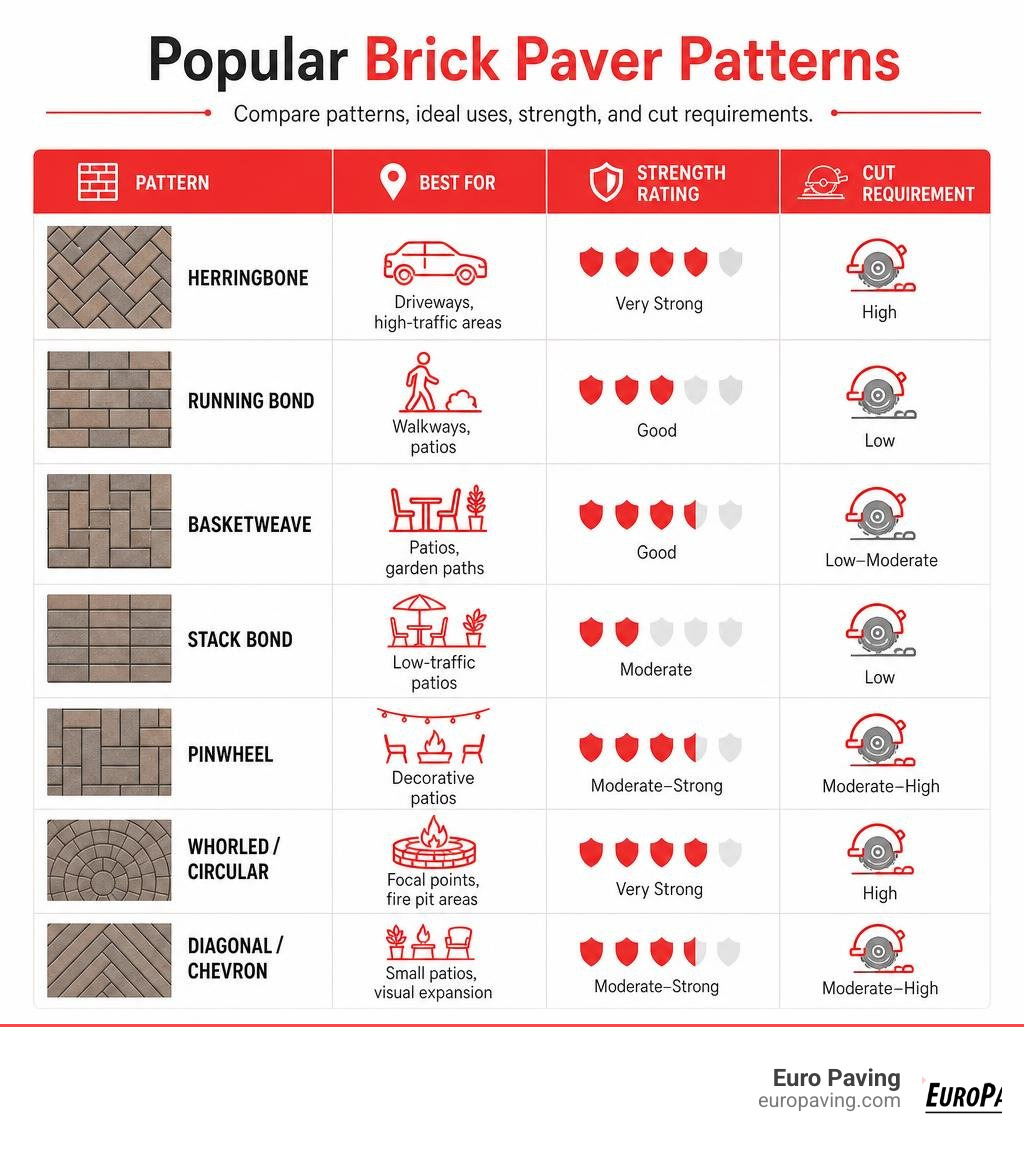
Here are the most popular brick paver patterns and what each one is best for:
| Pattern | Best For | DIY Difficulty |
|---|---|---|
| Herringbone | Driveways, high-traffic areas | Moderate |
| Running Bond | Walkways, patios | Easy |
| Basketweave | Patios, garden paths | Easy–Moderate |
| Stack Bond | Low-traffic patios | Easy |
| Pinwheel | Decorative patios | Moderate–Hard |
| Whorled/Circular | Focal points, fire pit areas | Hard |
| Diagonal/Chevron | Small patios, visual expansion | Moderate–Hard |
It’s no surprise that outdoor living is booming. According to industry data, 63.3% of new single-family homes started in 2022 included a patio — the seventh consecutive record year. Homeowners across the Chicago suburbs are investing in hardscapes that extend their living space beyond four walls.
But with so many layouts to choose from, picking the right pattern can feel overwhelming.
This guide cuts through the noise. Whether you want a timeless herringbone driveway, a clean running bond walkway, or a custom mixed-material patio, you’ll find exactly what you need to make a confident decision — and know when to call in a professional.
Brick paver pattern ideas terms to remember:
Popular and Visually Appealing Brick Paver Pattern Ideas
Selecting the perfect layout is about balancing design aesthetics with your home’s existing architectural style. The right pattern can draw the eye toward a focal point, mimic the organic curves of your landscape, or create a formal, structured transition from your back door to your lawn.
Different layout patterns have a profound impact on the visual depth of an outdoor space. For instance, a pattern with clean, continuous lines can make a narrow walkway feel longer, while a staggered layout can make a wide patio feel incredibly cozy. When exploring brick patterns for patios, we always recommend aligning the geometry of the pavers with the architectural lines of your home.
Classic Herringbone Brick Paver Pattern Ideas
The herringbone pattern is the undisputed gold standard for both traditional charm and unmatched structural performance. This layout is created by placing rectangular pavers at 45-degree or 90-degree angles to one another, forming a continuous interlocking “V” shape that resembles the skeleton of a herring fish.
- The 45-Degree Herringbone: This variation is highly dynamic. Because the pattern runs diagonally to the home or driveway edge, it creates a sense of movement and visual expansion. It is incredibly popular for large patios and grand entryways.
- The 90-Degree Herringbone: This layout runs parallel to the borders of the paved area. It offers a slightly more structured, grid-like feel while maintaining the strength of the interlocking design.
The primary benefit of the herringbone pattern is its exceptional weight distribution. Because the bricks interlock in multiple directions, they resist shifting when subjected to lateral forces—such as a vehicle turning its wheels. This makes it the premier choice for driveways. To see this pattern in action, explore our step-by-step guide to herringbone brick driveway installations.
Traditional Basketweave and Half-Basketweave Layouts
If you want to evoke a sense of vintage charm and old-world elegance, the basketweave pattern is an exceptional choice. Taking inspiration from historic textile arts, this layout is created by laying pairs of rectangular pavers perpendicular to one another (two vertical, followed by two horizontal). This repetition creates a beautiful woven texture and a checkerboard visual effect.
Variations of this classic pattern include:
- The Half-Basketweave: This layout pairs two vertical bricks next to a single horizontal brick. It reduces the symmetry slightly to create a more contemporary, staggered look.
- The Boxed Basketweave: This style frames the pairs of pavers with additional borders to emphasize the woven blocks.
Basketweave layouts are highly adaptable and require very little custom cutting along straight borders, making them incredibly cost-effective. For more inspiration on historic and decorative layouts, you can read about 13 Brick Patterns for Patios, Walkways, Walls & More or browse through curated collections like 17 Brick Paving ideas – Pinterest to see how these textures complement traditional brick homes.
Running Bond and Stack Bond Brick Paver Pattern Ideas
For modern and contemporary homes in the Chicago area, simplicity often reigns supreme. This is where linear patterns like running bond and stack bond excel.
- Running Bond (Stretcher Bond): In this layout, pavers are laid end-to-end in parallel rows, with the joints of each row offset by exactly half a brick length. This staggered alignment creates a clean, classic look that guides the eye along the direction of the rows. It is highly effective for making narrow garden paths look longer or balancing the proportions of a rectangular patio.
- Stack Bond (Jack-on-Jack): This is the simplest layout possible. Pavers are aligned perfectly side-by-side and end-to-end in a continuous grid. This creates strong, uninterrupted horizontal and vertical joint lines. It offers an ultra-modern, minimalist aesthetic, but because there is no interlocking offset, it has lower structural strength and is strictly reserved for pedestrian-only, low-traffic areas.
To learn more about the technical specifications and structural limits of these layouts, read our guide on brick paving standards and patterns.
Structural Integrity: Choosing the Strongest Patterns for High-Traffic Areas
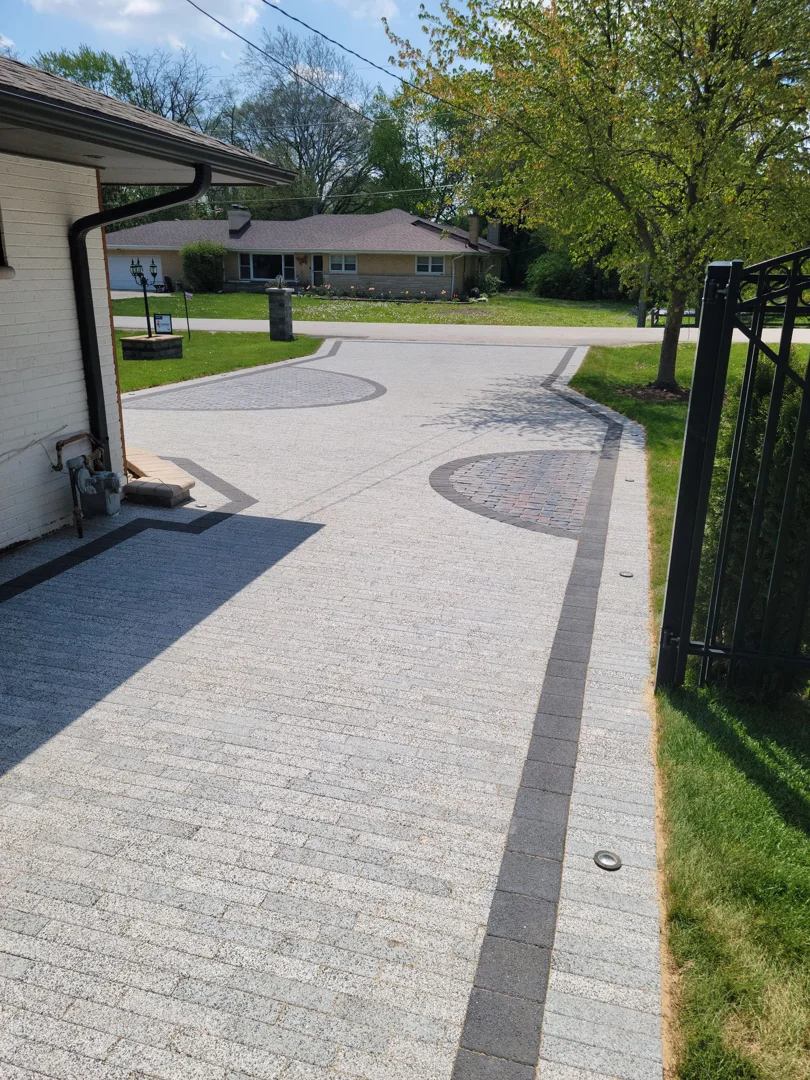
When designing a hardscape, beauty must be backed by structural integrity. This is especially true for high-traffic areas like driveways, where heavy vehicles place immense stress on the paver surface. Without the right pattern and material thickness, tires will eventually push the pavers apart, leading to rutting, sagging, and uneven joints. For professional planning tips, check out our tips for designing a driveway with brick pavers.
Why Herringbone Reigns Supreme for Driveways
The herringbone pattern is universally recognized by structural engineers as the strongest paver layout. Its strength lies in its tight, interlocking design. When a vehicle accelerates, brakes, or turns on a herringbone surface, the force is distributed evenly across the surrounding pavers in all four directions.
This multi-directional load distribution provides superior lateral resistance, preventing the individual bricks from sliding or creeping over time. To ensure maximum durability, driveways must be constructed using pavers that are at least 3 inches (80mm) thick, laid over a perfectly compacted gravel base.
Comparing Durability Across Standard Layouts
Not all brick paver pattern ideas are created equal when it comes to load-bearing capacity. The table below outlines how standard layouts compare in terms of strength and traffic suitability:
| Pattern | Interlocking Strength | Best Traffic Application | Shifting Resistance |
|---|---|---|---|
| Herringbone | Excellent | Heavy vehicular (Driveways) | Very High |
| Running Bond | Good | Moderate pedestrian (Walkways/Patios) | Moderate |
| Basketweave | Fair | Light pedestrian (Patios/Courtyards) | Low-Moderate |
| Stack Bond | Poor | Very light pedestrian (Decorative borders) | Low |
Because a stack bond pattern has aligned joints in both directions, it has no interlocking capacity. Heavy loads will easily push the columns of pavers out of alignment. Running bond offers decent resistance if the rows run perpendicular to the flow of traffic, but it still cannot match the multi-directional lock of a herringbone layout.
Design Efficiency: Minimal-Cut and No-Cut Patterns for Streamlined Installation
When investing in a new patio or walkway, design efficiency plays a massive role in both the project timeline and your overall budget. Intricate patterns that require extensive cutting along the borders increase labor costs and generate significant material waste. By selecting smart, dimensionally compatible layouts, you can achieve a flawless look with maximum efficiency. Discover more layout strategies in our guide to brick paving patterns to inspire your next project.
Basketweave and Stack Bond for Zero-Cut Perimeters
If you want to minimize material waste and speed up the installation process, basketweave and stack bond are the ultimate zero-cut patterns. Because these layouts rely on straight, repeating square grids, they can be perfectly planned to fit the exact dimensions of your patio without requiring a single cut along the outer edges.
To achieve a true no-cut installation, the project dimensions must be planned in multiples of the paver’s length. For example, if you are using standard pavers where the length is exactly twice the width (such as a 4″ x 8″ brick), a basketweave pattern will fit perfectly into any space that is a multiple of 8 inches. Using specialized pavers with built-in spacer nibs, such as English Edge pavers, further simplifies this process by ensuring perfectly consistent joint widths across the entire field.
Designing Walkways with Minimal Waste
Walkways are highly susceptible to high material waste if the pattern is not matched to the width of the path. A standard residential walkway is typically 36 inches wide to accommodate a single walker, while a more welcoming 48-inch width allows two people to walk side-by-side comfortably.

By choosing a running bond pattern that runs parallel to the path, we can lay full bricks across the width of the walkway with minimal to no cutting. For a unique twist on walkway design, some homeowners opt for a diamond pattern. You can explore how this looks in this DIY Paver Walkway: Diamond Pattern with Gravel | Crystel Montenegro Home project, which showcases how rotating square pavers to a 45-degree angle can create an intentional, custom look while using gravel to fill the triangular edge gaps.
Elevating Hardscapes with Borders, Color Variations, and Mixed Materials
A beautiful brick patio or driveway should never look flat or monotonous. To elevate your hardscape from standard to spectacular, we use design techniques like contrasting borders, mixed materials, and subtle color variations to add depth, define functional zones, and highlight your landscape’s best features. You can browse through dozens of completed projects in our brick paving gallery to see these design principles in action.
Framing the Field with Soldier and Sailor Courses
Just like a frame completes a beautiful painting, a professional border course completes a paver patio or driveway. Borders serve two critical purposes: they provide a strong physical restraint that prevents outer pavers from spreading, and they create a clean visual boundary.
- Soldier Course: In this layout, rectangular pavers are laid side-by-side, perpendicular to the edge of the patio. It creates a thick, dramatic border that clearly defines the shape of the paved space.
- Sailor Course: In this layout, pavers are laid end-to-end, parallel to the edge. This creates a thinner, more subtle border.
To maximize visual interest, we often use a contrasting color for the border—such as a deep charcoal border framing a warm red clay patio field. For a classic, historic aesthetic, utilizing reclaimed materials like those found in Old Chicago Brick Pavers – Pinterest or exploring ideas from the 68 Best Brick Pavers ideas board can help you design a space that feels rich with character.
Integrating Natural Stone, Retaining Walls, and Custom Inlays
For a truly custom backyard oasis, don’t limit yourself to a single material. Combining classic clay brick pavers with natural stone accents—such as bluestone stepping pads, slate borders, or flagstone fire pit surrounds—creates a rich, multi-textured environment.
To add vertical dimension to your flat patio, you can integrate matching vertical elements. Our gallery of beautiful brick paving retaining walls demonstrates how low seating walls can frame a patio, double as extra guest seating, and hold back planting beds. If you are designing a complete outdoor entertainment space in the Chicago suburbs, you can also see how these paved elements integrate with structures by viewing Downers Grove Pavilions | Downers Grove Pergolas installations.
The Professional Hardscaping Process: From 3D Design to Polymeric Sand
At Euro Paving, we believe that a paver patio is only as good as the foundation beneath it. While choosing your favorite brick paver pattern ideas is the fun part, executing the installation with precision is what ensures your investment lasts for decades without sagging or cracking. To help our clients visualize their completed space before we ever break ground, we utilize a beautiful brick paving 3D design model to map out patterns, colors, and borders.
Excavation and Base Stabilization Standards
The secret to a lifetime of durability lies entirely underground. In the Cook and DuPage County clay soils, proper excavation and base preparation are non-negotiable.
- Excavation: For a standard residential patio, we excavate to a depth of approximately 8 inches. For driveways, this depth increases to 10 to 12 inches to accommodate heavier loads.
- Slope for Drainage: We establish a precise slope of 1 to 2 inches for every 10 feet of length, directing water safely away from your home’s foundation.
- Gravel Base: We lay down a 4-inch layer of crushed gravel (CA-6 or road pool base) and compact it using a heavy-duty commercial plate compactor. This layer provides structural strength and allows water to drain freely.
- Leveling Sand: We apply a 1-inch layer of clean leveling sand over the compacted gravel, screeding it perfectly flat to create the bedding for the pavers.
Laying, Edging, and Joint Stabilization
Once the base is prepared, our skilled crew begins laying the pavers in your chosen pattern, working from the outer borders inward to maintain perfect joint lines.
To keep the pavers from shifting laterally over time, we install heavy-duty professional edge restraints along the entire perimeter, secured with steel stakes driven deep into the ground.
Finally, we sweep premium polymeric sand into the joint gaps. Polymeric sand contains special chemical binders that, when activated with a light mist of water, lock the sand particles together. This creates a flexible but incredibly strong bond that prevents weeds from growing between the joints, stops ants from nesting, and prevents water from eroding the bedding sand beneath. Whether you are searching for premium Arlington Heights Brick Paving solutions, planning a modern driveway in the Skokie Brick Paving area, or seeking timeless elegance with Lake Forest Brick Paving designs, our professional installation standards remain consistently elite.
Frequently Asked Questions about Brick Paver Patterns
What is the strongest brick paver pattern for a driveway?
The herringbone pattern (especially laid at a 45-degree angle) is the strongest layout for driveways. Because the pavers interlock in multiple directions, they distribute the heavy load of vehicles and resist the lateral forces of turning tires, preventing the bricks from shifting or rutting.
How do I choose a pattern that makes my small patio look larger?
To make a compact outdoor space feel larger, choose a diagonal layout (such as a 45-degree herringbone or diagonal running bond) or use large-format pavers. Diagonal lines guide the eye outward to the corners of the space, creating a visual illusion of width and depth.
Can I mix different paver colors and materials in one pattern?
Absolutely! Mixing colors and materials is a fantastic way to add custom style. We recommend using a neutral, solid color for the main field of the patio, and then framing it with a contrasting color or texture (like a dark charcoal soldier course or natural stone borders) to define the space.
Conclusion
Transforming your backyard into a beautiful, functional retreat starts with choosing the right brick paver pattern ideas and executing them with professional precision. From timeless herringbone driveways to modern running bond patios, the layout you select will define your outdoor living experience for years to come.
As a premier Unilock Authorized Contractor serving the Chicago suburbs—including Elmhurst, Hinsdale, Mount Prospect, Norridge, and Arlington Heights—Euro Paving is dedicated to delivering flawless craftsmanship, lifetime material guarantees, and beautiful custom designs.
Ready to bring your dream patio, driveway, or outdoor kitchen to life? Schedule a professional consultation with our hardscaping experts today!