



The Ultimate Guide to Professional Paver Fire Pits for Chicago Backyards
Paver fire pits are one of the most popular ways to transform a plain backyard into a true outdoor living space. But not all fire pits are created equal — and if you’re a homeowner in the Chicago suburbs ready to invest in something built to last, the differences matter.
Quick answer: What are paver fire pits?
| Feature | Details |
|---|---|
| What they are | Fire pits built from concrete, brick, or natural stone pavers — either from retail kits or custom-built by professionals |
| Best for | Permanent backyard installations, entertaining, and increasing property value |
| Wood vs. gas | Wood-burning is more affordable upfront; gas offers cleaner, controllable flames |
| Shapes available | Round, square, rectangular, linear fire tables, and sunken designs |
| Who installs them | DIY kits exist, but permanent custom builds require professional hardscape contractors |
| Chicago relevance | Must meet Cook County and DuPage County setback and permit requirements |
Think about it: a crackling fire on a cool fall evening, friends gathered around, conversation flowing naturally. That’s the promise of a well-designed fire pit. But where most homeowners go wrong is choosing a temporary big-box kit when what their yard — and their lifestyle — actually calls for is a permanent, professionally built hardscape feature.
In Chicago and the surrounding suburbs, where winters are brutal and summers are short, you want an investment that holds up year after year — not one that cracks, shifts, or looks dated by next season.
This guide walks you through everything you need to know to make the right call.
Related content about paver fire pits:
Why Choose Professional Paver Fire Pits for Your Backyard?
When we talk to homeowners in Arlington Heights or Hinsdale, the conversation usually starts with a desire for a “cozy spot.” But as professionals, we look at paver fire pits as a strategic addition to your home’s equity. A well-executed hardscape project in the Chicago area can significantly increase property value, often providing a high return on investment because it extends the usable square footage of your home into the outdoors.
Durability vs. Temporary Solutions
Unlike the metal bowls you find at hardware stores that rust through in two seasons, a professional paver installation is built for the long haul. We use high-grade, heat-resistant materials that can withstand the intense thermal expansion of a roaring fire. Furthermore, our designs are engineered for the Illinois climate. We deal with “freeze-thaw” cycles that can wreak havoc on poorly installed stone. By using professional-grade base preparation and polymeric sands, we ensure your fire pit stays level even after a -20°F Chicago winter.
Custom Aesthetics with 3D Design Planning
One of the biggest advantages of going professional is the ability to see your project before a single stone is laid. We utilize 3D design planning to show you how a new fire pit integrates with your existing brick paving. Whether you want to match your home’s Victorian architecture in Lake Forest or a sleek modern vibe in Northbrook, custom masonry allows for a level of detail kits simply can’t match. You can learn more about these design choices in A Complete Guide to Safe and Stylish Brick Fire Pits.
360-Degree Entertainment
A professional fire pit isn’t just a hole in the ground; it’s a focal point. We often design these features to offer 360-degree views, ensuring everyone has a “front-row seat” to the warmth. By integrating seating walls or “knee walls” made of matching pavers, we create a permanent “outdoor room” that is always ready for guests.

Popular Styles of Professional Paver Fire Pits
- Round Designs: The classic “campfire” feel. Round pits are excellent for social flow, as they have no sharp corners and encourage people to gather in a perfect circle.
- Modern Square Configurations: These offer a more architectural, structured look that pairs beautifully with contemporary homes and geometric patio layouts.
- Linear Rectangular Fire Tables: Often gas-powered, these serve as a hybrid between a coffee table and a fire feature, perfect for narrow patios or poolside lounging.
- Sunken Pits: For areas in the Chicago suburbs prone to wind, a sunken design provides natural protection for the flame and a unique, intimate “conversation pit” atmosphere. Check out options like the SUNSET FIRE PIT | Unilock Chicago for inspiration on high-quality pre-designed styles.
Comparing Professional Custom Designs vs. Retail Kits
It is tempting to see a pallet of stones at a big-box store and think, “I can do that this weekend.” While retail kits serve a purpose for budget-conscious DIYers, there is a massive gap in quality and longevity compared to a professional build.
The Limitations of Pre-Packaged Kits
Most retail kits are “one size fits all.” They use standard concrete blocks that may not be fire-rated, leading to cracking over time. They also lack the specialized venting required for safe gas operation or proper drainage. If you put a retail kit on top of an existing patio without reinforcement, you risk the weight of the stone cracking your patio pavers.
The Euro Paving Professional Difference
We don’t just “stack blocks.” We use premium materials like Unilock or natural stone slabs that come with lifetime guarantees. Our custom masonry techniques include specialized firebrick lining and heat-sensitive mortar that protects the decorative outer pavers from the core temperature of the fire.
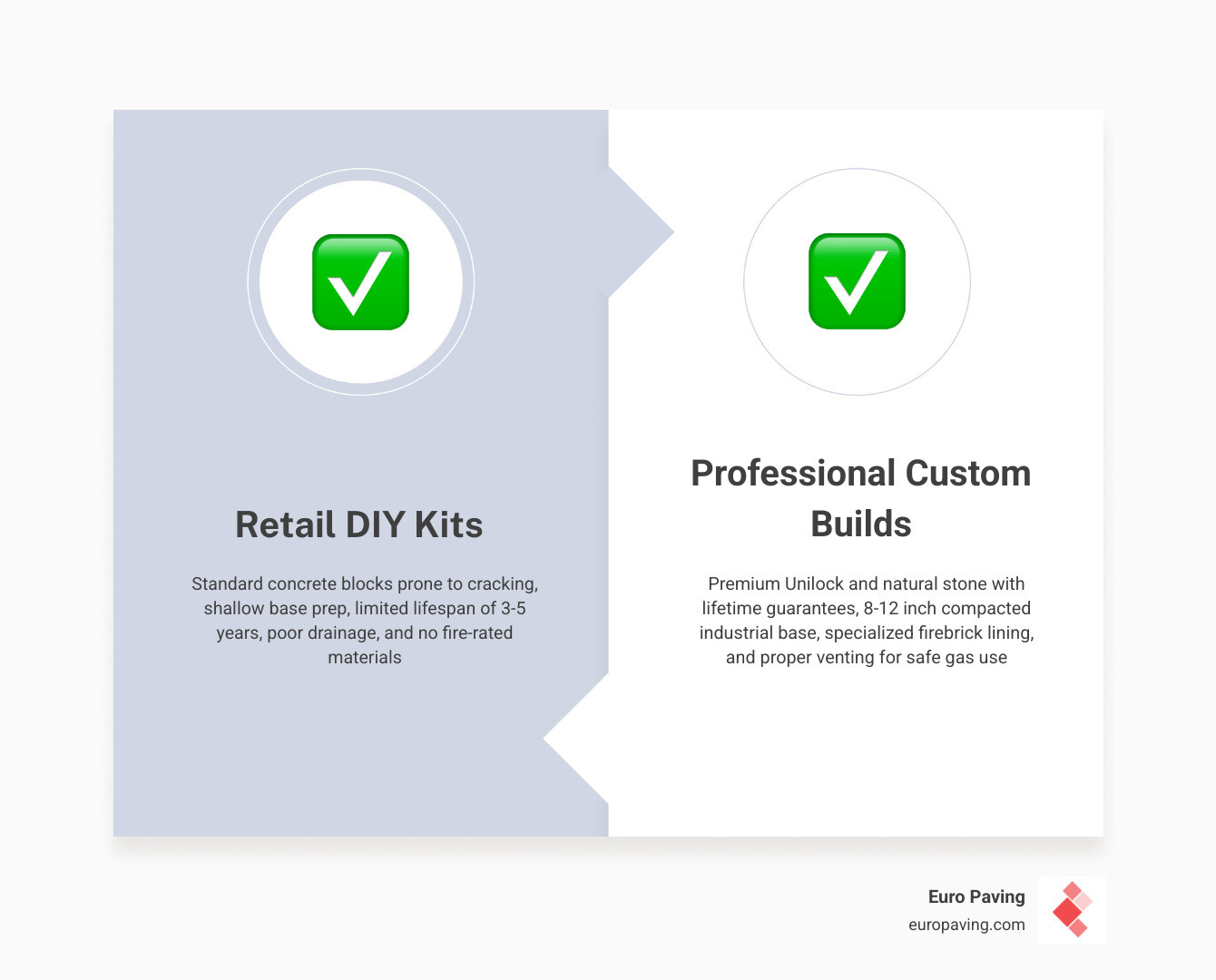
| Feature | Retail DIY Kit | Euro Paving Custom Build |
|---|---|---|
| Material Quality | Standard concrete | Premium Unilock / Natural Stone |
| Base Prep | Often skipped or shallow | Industrial-grade 8-12″ compacted base |
| Lifespan | 3–5 years | Lifetime |
| Safety Features | Minimal | Firebrick lined, vented, and code-compliant |
| Design | Fixed shapes/colors | Fully custom 3D designs |
For those looking for the ultimate backyard upgrade, we recommend exploring The Hottest Custom Fire Pits for Your Outdoor Space to see how custom work stands apart.
Essential Components for High-End Paver Fire Pits
To achieve a “pro” result, the internals matter as much as the external stones.
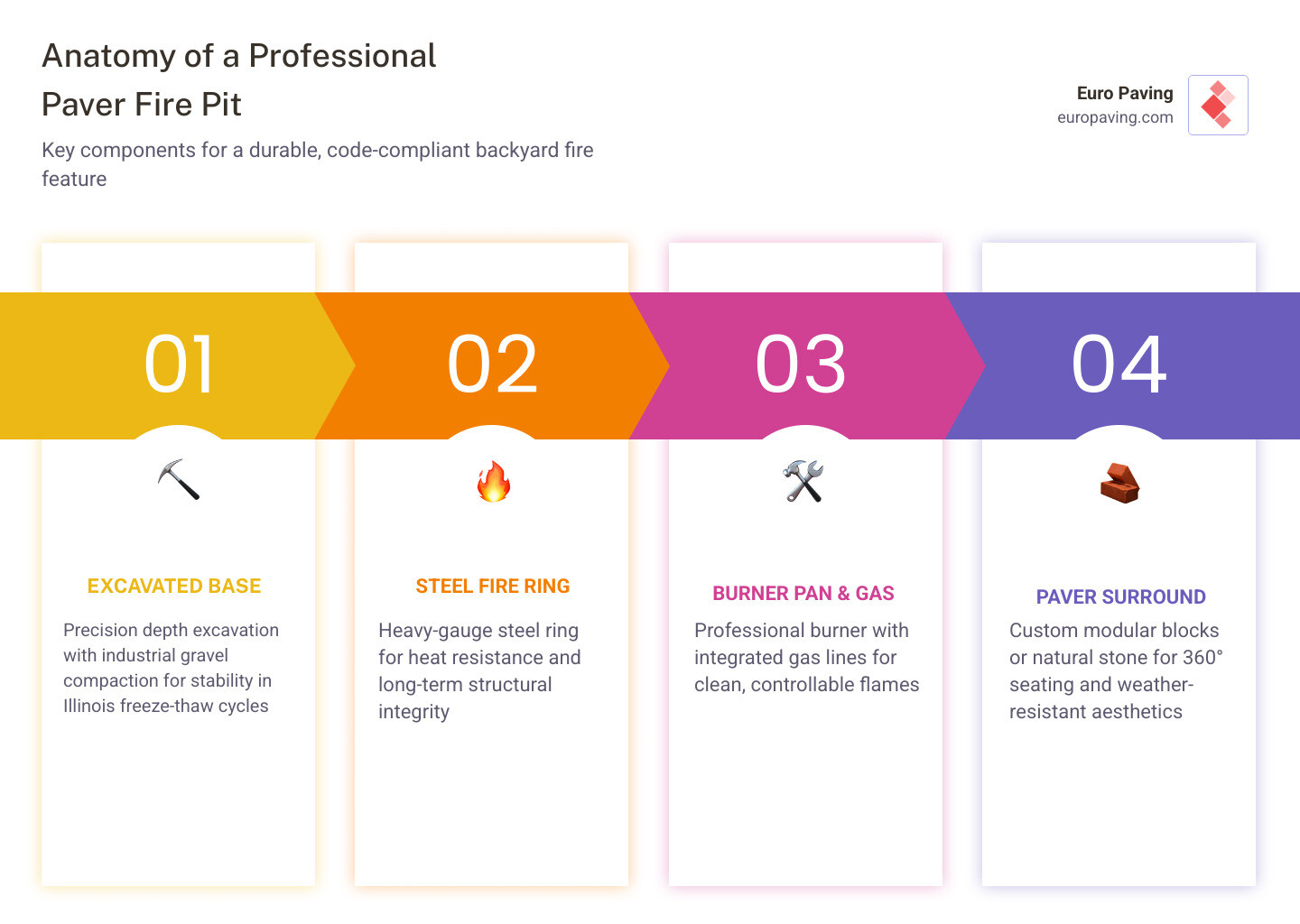
- Heavy-Gauge Steel Fire Rings: These protect your pavers from direct flame contact.
- Professional Burner Pans: For gas units, a stainless steel pan ensures proper drainage and keeps the burner level.
- Ignition Systems: We offer everything from simple match-lit starts to electronic “plug-and-play” systems that you can control with a remote or smartphone.
- Custom-Fit Covers: A heavy-duty galvanized steel or aluminum cover is essential to keep debris and Chicago snow out of your burner.
- Gas Line Integration: We coordinate the safe installation of natural gas lines, so you never have to worry about running out of propane in the middle of a party.

Professional Installation Standards and Chicago Area Building Codes
Building paver fire pits in the Chicago area requires more than just a shovel and a level. We have to navigate specific local regulations that vary by county and municipality.
Precision Excavation and Base Compaction
The secret to a fire pit that doesn’t sink is the base. We excavate to a depth of at least 8–12 inches, depending on the soil composition in areas like Downers Grove or Mount Prospect. We then fill this with industrial-grade crushed gravel, compacting it in 2-inch “lifts” using high-vibration power tampers. This creates a foundation as solid as a roadbed.
Laser-Leveling and Drainage
We use laser levels to ensure the first course of stone is perfectly flat. If the base is off by even a quarter-inch, the top of the fire pit will look crooked. Furthermore, we install drainage layers to ensure that heavy rainfall — a staple of Illinois springs — doesn’t pool inside your fire pit, which can cause damage to gas burners or make it impossible to light a wood fire.
Navigating Local Codes
- Elmhurst and Hinsdale: These areas often have strict “setback” requirements, meaning your fire pit must be a certain distance (usually 10-15 feet) from any combustible structure, including your house and deck.
- Cook County Regulations: Often require fire pits to be a specific distance from property lines and may require a permit for gas line extensions.
- DuPage County: May have specific rules regarding “open burning” versus gas-fueled decorative appliances.
As a local expert, we handle the technical details of these permits so you don’t have to. Whether we are working in Arlington Heights or Skokie, we ensure your project is 100% code-compliant.
Maintenance and Safety for Long-Term Outdoor Enjoyment
Once your fire pit is installed, a little bit of professional maintenance goes a long way in preserving your investment.
Professional Upkeep Tips
- Ash Removal: For wood-burning pits, never let ash build up to the level of the air vents. This chokes the fire and can lead to excessive smoke.
- Paver Sealing: We recommend high-performance sealing every 2–3 years. This protects the pavers from oil stains (from those dropped s’mores!) and prevents the Chicago salt and ice from eroding the stone.
- Polymeric Sand Replenishment: The “sand” between your pavers is actually a specialized binding agent. Over time, it can wear down. Replenishing it keeps the structure stable and prevents weeds from growing in the joints.
- Gas Line Inspections: For gas pits, an annual check of the burner jets and connections is a safety must.
Safety First
Always use a custom spark screen if you are burning wood, especially in densely populated suburbs like Norridge or Highland Park. This prevents embers from floating onto dry grass or neighboring properties. For more design-focused safety tips, read our article on Hot Stuff Brick Fire Pit Designs for Your Backyard.
Frequently Asked Questions about Professional Fire Features
What is the best base for a permanent paver fire pit?
The “gold standard” is a deeply compacted base of 3/4″ crushed limestone (CA-6) topped with a thin layer of leveling sand. For high-end custom builds, we sometimes use a reinforced concrete pad if the fire pit is exceptionally heavy or part of a larger outdoor kitchen structure.
How far should a fire pit be from a house in Illinois (Chicago/Suburbs)?
While specific municipal codes vary, the general rule of thumb is at least 15 feet from any structure, overhanging trees, or power lines. In some tightly packed Chicago neighborhoods, this can be reduced to 10 feet for gas-only features, but always check with us for your specific local code.
Why should you avoid putting a fire pit directly on an existing patio without reinforcement?
A standard patio is designed for foot traffic and patio furniture, not the concentrated weight of several hundred pounds of stone and firebrick. Without reinforcement or “cutting in” the fire pit to the base, the heat and weight can cause the surrounding pavers to shift, sink, or crack.
Conclusion
Investing in paver fire pits is about more than just adding a feature to your yard; it’s about creating a destination. At Euro Paving, we combine expert craftsmanship with 3D design technology to ensure your backyard transformation is exactly what you envisioned.
As a Unilock Authorized Contractor, we provide access to the best materials in the industry, backed by lifetime guarantees. We’ve spent years serving the Chicago area — from the historic homes of Lake Forest to the modern backyards of Barrington — transforming ordinary spaces into relaxing retreats.
Ready to stop dreaming and start building? Whether you’re looking for a built-in grill to go with your new fire feature or a complete backyard kitchen, we are here to help.
Contact Euro Paving for professional brick paving and fire pit installation in Chicago and Suburbs today to schedule your consultation. Let’s build something beautiful together.