



Your Front Porch Is the First Thing Everyone Sees — Make It Count
Porch brick design is one of the highest-impact upgrades a homeowner can make to their property. A well-designed brick porch signals quality, permanence, and craftsmanship before a guest even reaches the front door.
Here are the most popular porch brick design styles and what makes them work:
| Design Style | Best For | Key Feature |
|---|---|---|
| Herringbone pattern | Traditional & craftsman homes | Visual depth, elegant flow |
| Running bond | Modern & transitional homes | Clean lines, timeless look |
| Basketweave | Victorian & colonial homes | Classic symmetry |
| Soldier border | Any style | Defined edges, polished finish |
| Curved steps with wing walls | Grand entrances | Architectural drama |
Beyond looks, brick porches hold their value. With proper care, a professionally installed brick porch can last 15 to 20 years before needing even minor restoration — unlike poured concrete, which cracks, stains, and offers few repair options.
In April 2026, Chicago-area homeowners are investing more in premium hardscaping as outdoor living spaces become a top priority. A well-executed brick porch isn’t just curb appeal — it’s a functional, lasting asset that makes your home stand out on the block.
Whether you’re starting from scratch or replacing a tired concrete stoop, the right brick design can transform your entrance into something genuinely grand.
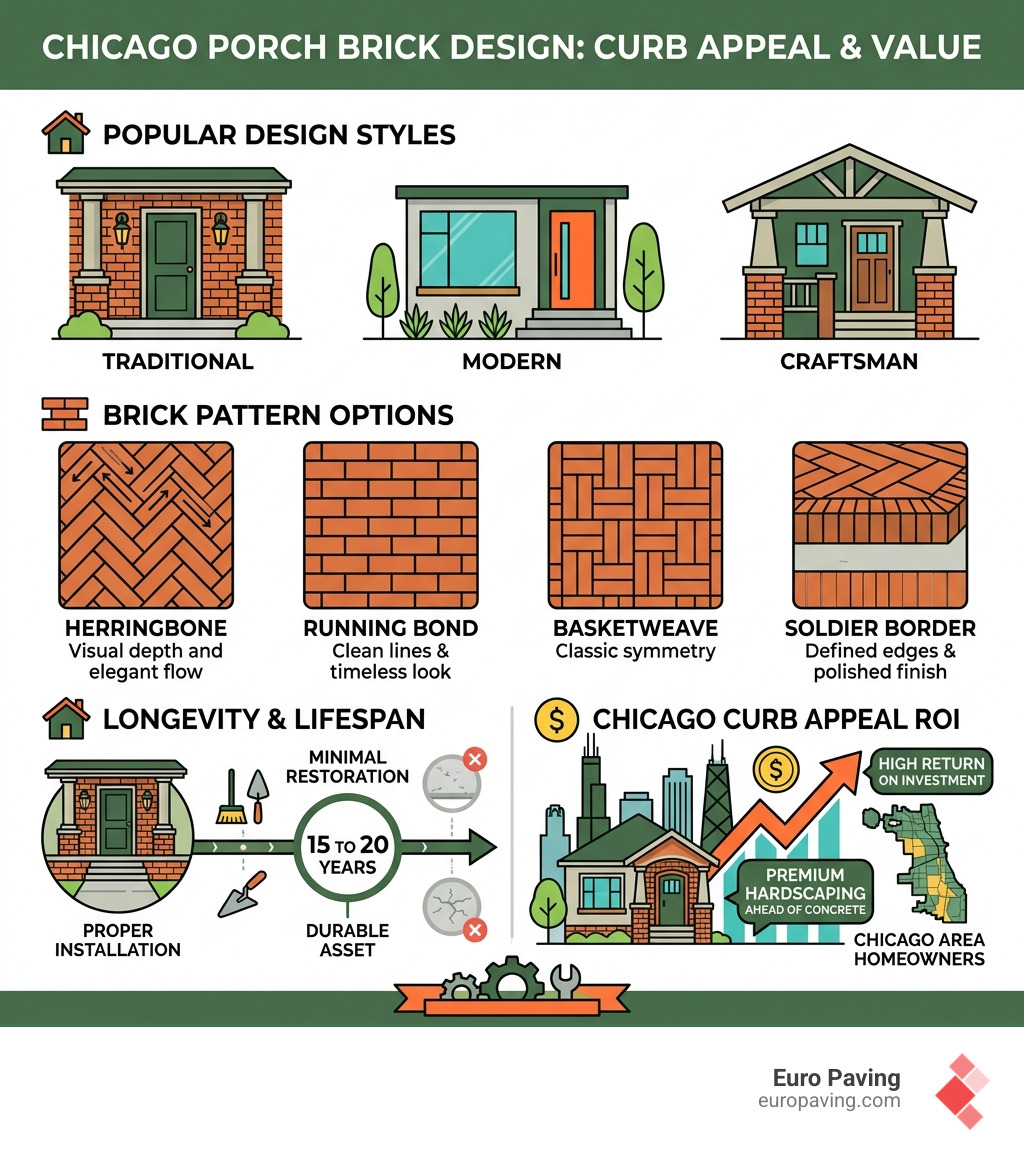
Porch brick design vocabulary:
Why Brick is the Superior Choice for Porch Brick Design
When we evaluate materials for a front entrance, we look for a balance of decorative beauty and structural resilience. Brick pavers offer a level of sophistication that mundane poured concrete simply cannot match. In the Chicagoland area, where our homes face extreme temperature swings, the material choice for your porch is the difference between a lifetime of beauty and a decade of frustration.
One of the primary benefits of adding a brick patio or porch is the inherent restoration capability. If a single brick is damaged or stained, it can be replaced individually. If the ground settles, we can lift the pavers, re-level the base, and relay the original materials. Concrete, by contrast, is a “one-and-done” material; once it cracks, your only options are unsightly patches or a full, expensive demolition.
| Feature | Brick Pavers | Poured Concrete |
|---|---|---|
| Aesthetic Appeal | High (Custom colors/patterns) | Low (Industrial/Mundane) |
| Durability | Flexible (Resists cracking) | Rigid (Prone to cracking) |
| Maintenance | Minor restoration at 15-20 years | Frequent sealing/patching |
| Repairability | Individual units replaceable | Full slab replacement required |
| Curb Appeal ROI | High | Moderate |
For homeowners in Arlington Heights or Hinsdale, the aesthetic completion of a home often hinges on these small details. A brick porch feels like a natural extension of the architecture, whereas concrete often feels like an afterthought.
Timeless Patterns and Architectural Styles
The beauty of porch brick design lies in its versatility. Whether you own a historic Victorian in Winnetka or a modern farmhouse in Northbrook, there is a brick configuration that will elevate your home’s facade. We often see that the most successful projects are those that respect the home’s original lines while adding a touch of contemporary flair.

In urban settings like Chicago, two and three-story porches often utilize brick for the foundation and first-floor entry to provide a sense of grounded luxury. By selecting the right brick patterns to inspire your next project, we can guide the eye toward your front door, creating an inviting “pathway” of texture and color.
Customizing Your Porch Brick Design with Premium Patterns
The pattern you choose dictates the “movement” of your porch. A herringbone pattern, for instance, is the gold standard for elegance. It’s visually complex and provides excellent structural interlocking, making it ideal for high-traffic entryways.
If you prefer a more traditional look, the running bond offers a classic, clean aesthetic that mimics the look of traditional brick masonry walls. To add a professional “frame” to your porch, we always recommend a soldier border—where bricks are laid standing up or perpendicular to the main pattern. This defines the space and prevents the design from looking unfinished at the edges.
Color selection is equally vital. In the Chicago area, the Bavarian Blend—a mix of earth tones, tans, and charcoals—is incredibly popular for its ability to hide dirt while complementing both light and dark siding. For a more sophisticated touch, Sandstone accents can be used in the borders or steps to create a high-contrast, high-end look.
Complementing Your Home’s Aesthetic
A porch shouldn’t just be an “add-on”; it should be a cohesive part of your landscape. This is why a brick paving patio is a better choice than a wood deck or a basic concrete stoop—it allows for a seamless transition from the driveway to the front door, and eventually to the backyard.
We consider the following when planning your design:
- Entry Steps: Should they be flared for a grand feel or rounded for a softer touch?
- Wing Walls: These low brick walls flanking the steps provide a sense of enclosure and can be topped with limestone or bluestone for extra elegance.
- Color Harmony: Matching the mortar color to your home’s trim or window frames can tie the entire exterior together.
Professional Execution and 3D Porch Brick Design
The difference between a “DIY” look and a professional installation is found in the preparation. At Euro Paving, we believe that what goes under the brick is just as important as the brick itself. Proper site preparation, including excavation, a compacted gravel base, and specialized drainage solutions, ensures that your porch remains level despite Chicago’s notorious freeze-thaw cycles.
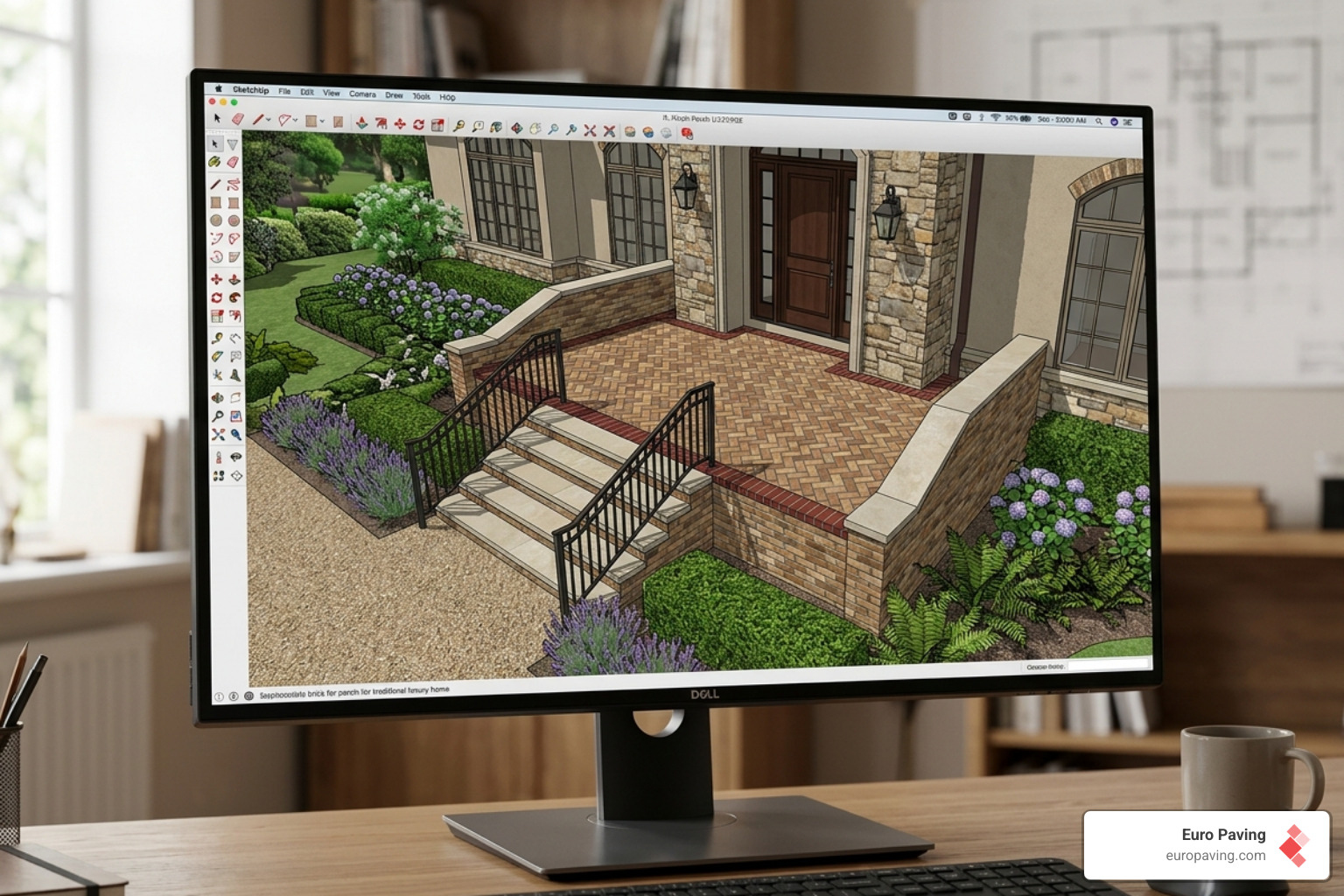
Professional 3D Porch Brick Design Planning
To take the guesswork out of the process, we utilize advanced 3D modeling. There are numerous benefits of 3D design for brick paving projects, but the most significant is the ability to see the finished product before a single brick is laid.
For our clients in Elmhurst, Hinsdale, and Mount Prospect, this means we can experiment with different layouts and color blends virtually. We can adjust the height of the steps or the width of the landing to ensure the scale is perfect for your specific entryway. This precision measurement phase prevents costly mid-project changes and ensures the structural integrity of the build.
Material Selection and Installation Standards
We only work with the highest quality materials to ensure longevity. While some homeowners consider thin brick (a veneer that can be applied over existing concrete), most “grand” entrances benefit from full-size pavers. We are Unilock certified, meaning we use pavers that are engineered to withstand the weight of heavy foot traffic and the corrosive effects of winter salt.
Our installation process involves:
- Industrial Adhesives: Used on vertical surfaces and step treads to ensure nothing shifts over time.
- High-Grade Grout or Polymeric Sand: This fills the joints, preventing weed growth and insect infestation while allowing for the natural expansion and contraction of the materials.
- Professional Sealing: We apply a siloxane-based sealer that protects the brick from UV rays and moisture without making the surface slippery.
While a DIY thin brick project might cost around $22 per square foot for materials alone, a professional installation provides the peace of mind that comes with a lifetime material guarantee and expert labor.
Maintenance and Long-Term Restoration
One of the most attractive aspects of a brick porch is its low-maintenance nature. Unlike wood, which requires annual staining, or concrete, which requires constant crack repair, brick only needs a bit of occasional attention to look new for decades.
Typically, a well-installed brick porch will serve you for 15 to 20 years before it requires even minor restoration. In areas like Skokie, Northbrook, and Norridge, we often perform “tune-ups” where we power wash the surface, replace the joint sand, and re-apply a high-quality sealer. This simple process can make a two-decade-old porch look like it was installed yesterday.
Frequently Asked Questions about Porch Brick
How much does a brick porch cost in 2026? The cost varies based on the complexity of the design and the materials chosen. A standard professional installation in the Chicago suburbs typically ranges from $15,000 to $25,000, depending on the square footage and whether you are including elements like wing walls, custom steps, or integrated lighting.
How does brick compare to concrete for maintenance? Brick is far superior for long-term maintenance. Concrete is prone to “spalling” (surface peeling) and cracking due to our local climate. Brick pavers are individual units that can move slightly with the ground, preventing the structural cracks that plague concrete slabs.
What is the best sealer for Chicago climates? We recommend a breathable, siloxane-based impregnating sealer. This type of sealer penetrates the brick to protect it from moisture and salt but allows water vapor to escape from the ground below. This prevents the “cloudy” look that cheap, film-forming sealers often develop in cold climates.
Conclusion
Your home’s entrance is more than just a doorway; it is an introduction to your family’s style and a reflection of your pride in your property. By choosing a sophisticated porch brick design, you are investing in a feature that offers timeless beauty, unmatched durability, and a welcoming atmosphere for every guest.
At Euro Paving, we specialize in creating these grand entrances throughout the Chicago area, from the historic streets of Hinsdale to the modern neighborhoods of Mount Prospect and Northbrook. Our team is dedicated to transforming your vision into a reality using 3D design and the highest industry standards.
Ready to elevate your home’s curb appeal? Contact Euro Paving for your next brick porch project and let us help you design a grand entrance that will stand the test of time.