



Why Large Paver Walkway Ideas Are Transforming Suburban Curb Appeal
Large paver walkway ideas are one of the fastest ways to boost your home’s curb appeal and create a polished, welcoming entrance.
Here are the most popular large paver walkway ideas to consider:
- Minimalist concrete slabs – Clean, wide 24×48 or 36×36 pavers for a modern look
- Natural stone stepping paths – Limestone or granite slabs with gravel or grass infill
- Checkerboard layout – Alternating light and dark large-format pavers for bold contrast
- Diamond pattern walkway – Large pavers rotated 45° for visual interest
- Curved biophilic path – Meandering large slabs flanked by garden beds
- Mixed material design – Large pavers combined with pea gravel, mulch, or turf borders
- Runway-style entry – Wide oversized pavers leading straight to your front door
Your front walkway sets the tone before a guest even knocks. Yet most homeowners overlook it entirely — settling for cracked concrete or a narrow, uninviting path that does nothing for curb appeal.
The good news? Going big literally pays off. Large-format pavers — think 36″ x 36″ or 24″ x 48″ slabs — cover more ground with fewer pieces, fewer joints, and a far more sophisticated look than small interlocking stones.
For busy suburban homeowners in the Chicago area, a professionally installed large paver walkway isn’t just beautiful. It’s durable, low-maintenance, and built to handle harsh Midwest freeze-thaw cycles year after year.
Below, we’ve rounded up the best design ideas, material options, and expert guidance to help you plan the perfect walkway for your home.
The Functional Advantages of Oversized Pavers
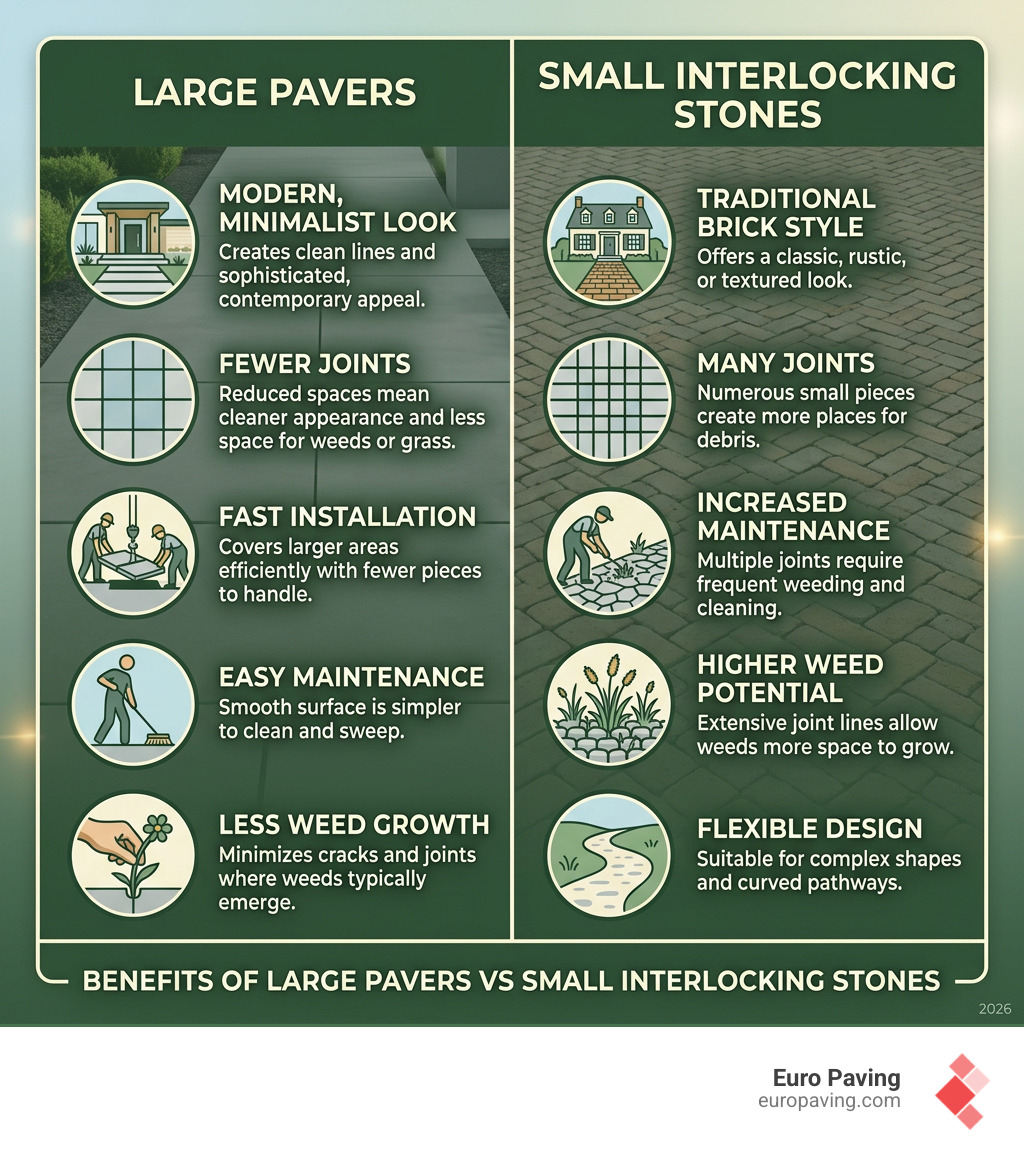
When we talk to homeowners in Arlington Heights or Northbrook, the first question is usually: “Why choose large pavers over standard bricks?” While we love a classic brick look, oversized pavers offer functional benefits that smaller units simply can’t match.
First and foremost, large paver walkway ideas prioritize a “less is more” philosophy regarding joints. Fewer joints mean fewer places for weeds to sprout and fewer opportunities for ants to build unsightly mounds. From a structural standpoint, larger slabs distribute weight more effectively across the base, which is vital in our local soil conditions.
Safety is another huge factor. Small, uneven pavers can become tripping hazards as they shift over time. Large-format slabs provide a much more stable, continuous surface. This is particularly important for accessibility. A standard 36-inch width is the baseline for walkways, but we often recommend a 48-inch width to allow two people to walk side-by-side comfortably. For those requiring wheelchair access, a 36-inch path with a 60-inch turnaround area is the gold standard we aim for.
Beyond safety, there is the sheer speed of transformation. Large-format pavers like 36″ x 36″ or 24″ x 48″ can cover 8-9 square feet in about 30 seconds during the laying phase. While the preparation takes time, the visual progress is incredibly satisfying. The benefits of a brick sidewalk and brick driveway extend beyond just aesthetics; they include long-term durability and ease of snow removal—a must-have for any Chicago winter.
Comparing Large Format Materials
Not all “large” pavers are created equal. Depending on your home’s architecture and your budget, you might lean toward concrete or natural stone. Here is how they stack up:
| Feature | Concrete XL Pavers | Natural Stone XL (Granite/Limestone) |
|---|---|---|
| Typical Thickness | 3.5 inches | 1.5 to 2 inches |
| Weight per Unit | ~450 lbs (for 36×36) | 140–200 lbs |
| PSI Strength | High | Superior |
| Color Longevity | Good (with sealing) | Excellent (natural pigments) |
| Texture | Molded/Smooth | Natural/Thermal |
Inspiring Large Paver Walkway Ideas for Modern Homes
Modern architecture in suburbs like Skokie and Glenview demands clean lines and intentional spacing. Large paver walkway ideas often lean into the “floating” look, where oversized slabs are set into a bed of contrasting material.
One of our favorite designs involves using 24×48 slabs surrounded by dark Mexican beach pebbles or light grey pea gravel. This creates a high-contrast, minimalist aesthetic that makes the walkway look like a piece of art rather than just a functional path. It’s also incredibly practical for drainage, as the stone borders allow rainwater to permeate directly into the ground.

We also see a rising trend in biophilic design. Instead of a rigid, straight line, we can design curved, meandering paths that mimic the flow of a natural stream. By using large pavers with slightly irregular edges or by staggering the joints, we can create a path that feels organic and integrated with your landscaping. More info about brick paving sidewalks can help you see how these designs fit into broader backyard transformations.
Geometric Patterns and Large Paver Walkway Ideas
The layout of your pavers can completely change the “vibe” of your home’s entrance. Even with large units, you aren’t stuck with a basic straight line.
- Checkerboard Layouts: By alternating two different colors of 24×24 or 36×36 pavers, you create a bold, contemporary statement. This works exceptionally well for large entryways or as a transition between a driveway and a front porch.
- Diamond Orientation: Rotating your large pavers to a 45-degree angle (the diamond pattern) draws the eye forward and can make a shorter walkway feel much longer and more expansive.
- Running Bond: This is the classic “staggered” look. It’s simple, timeless, and provides excellent structural interlock, ensuring the pavers stay exactly where we put them.
- Offset Joints: For a more custom, high-end feel, we often use an organic offset pattern. This avoids the rigid grid look and feels more like a custom stone installation found in luxury estates.
Natural Stone and Large Paver Walkway Ideas
While concrete is versatile, there is something undeniably prestigious about natural stone. In neighborhoods like Lake Forest and Winnetka, natural stone slabs are the preferred choice for their timeless elegance.
Limestone and granite are the heavy hitters here. A 24×48 limestone slab in a soft grey or buff tone provides a sophisticated, “old world meets new world” look. Granite, on the other hand, offers incredible durability and a “thermal” finish that provides excellent grip, even when wet or icy. These stones are naturally porous but extremely dense, meaning they breathe well while resisting the harsh salts and chemicals often used during Chicago winters.
Using these materials in a 36×36 format creates a massive, solid feel underfoot. Because natural stone is often thinner than its concrete counterparts (1.5″ vs 3.5″) but significantly stronger in PSI, it allows for a lower profile installation that still handles heavy foot traffic with ease.
Professional Engineering and Base Preparation
This is the part where we get serious. You can have the most beautiful large paver walkway ideas in the world, but if the foundation is weak, the project will fail within two seasons. In the Chicago area, we deal with a “freeze-thaw” cycle that is brutal on hardscapes. The ground expands when it freezes and contracts when it thaws; without a professional base, your large pavers will shift, tilt, or crack.
Our process for sidewalk-paving begins with deep excavation. For a standard walkway, we typically dig 4 to 6 inches deep, but for high-traffic areas or areas with poor soil drainage, we may go as deep as 8 inches.
We then install a multi-layered foundation:
- Geotextile Fabric: This is a crucial “separator” layer. It prevents the clean gravel base from sinking into the native clay soil over time.
- Crushed Stone Base: We use 3 to 4 inches of compacted crushed stone. We don’t just dump it in; we compact it in “lifts” (layers) using a heavy-duty plate compactor to ensure there are zero air pockets.
- Bedding Sand: A 1-inch layer of coarse sand is screeded to a perfect level. This acts as the “cushion” for your large pavers.
- Drainage Slope: We ensure the entire path has a slight slope (usually 1/8 to 1/4 inch per foot) away from your home’s foundation to prevent basement flooding and puddling.
By following these engineering standards, we ensure that your 48-inch wide walkway stays perfectly level for decades, regardless of how many blizzards hit Barrington or Downers Grove.
Long-Term Maintenance and Durability Standards
One of the best things about large pavers is that they are relatively low-maintenance, but “low” doesn’t mean “no.” To keep your investment looking brand new, we follow specific durability standards.
The “secret sauce” of a professional paver installation is polymeric sand. Unlike regular play sand, polymeric sand contains special additives that cause it to harden like concrete when misted with water. This “locks” the large pavers in place, prevents weeds from growing in the joints, and stops ants from making a home under your path.
We also highly recommend high-quality penetrating sealers. Because materials like limestone are naturally porous, a sealer acts as an invisible shield against oil, wine, bird droppings, and UV rays. It also enhances the natural color of the stone without making it slippery. We suggest re-sealing every 2 to 3 years to maintain that “just installed” glow.
11-benefits-of-adding-a-brick-sidewalk-to-your-home include things like increased property value and better drainage, but the most immediate benefit is the ease of cleaning. A simple power wash and a fresh sweep of sand are usually all it takes to keep your walkway in top shape.
Frequently Asked Questions about Large Paver Walkways
What is the ideal width for a large paver walkway?
For a front entrance, we recommend a minimum of 48 inches. This allows two people to walk comfortably side-by-side. For secondary paths (like a side yard), 36 inches is standard. If you are designing for accessibility, ensure you have a 36-inch clear path with 60-inch turnaround zones.
Which material is most durable for Chicago climates?
Both high-strength concrete and natural stones like granite or limestone are excellent. The key isn’t just the material, but the installation. In Chicago, the base must be deep and well-compacted to survive the winter. Natural stone often edges out concrete in terms of color retention over decades.
How do large pavers improve property drainage?
Large pavers reduce the number of joints, but when we install them with wider gaps filled with decorative stone or permeable sand, they actually allow for better water infiltration than a solid slab of poured concrete. This helps replenish groundwater and prevents heavy runoff into your lawn or street.
Conclusion
Transforming your home’s exterior starts from the ground up. Whether you are in Elmhurst, Highland Park, or Hinsdale, large paver walkway ideas offer a unique blend of modern style and rugged durability. At Euro Paving, we take pride in our ability to take these oversized elements and craft them into a seamless, welcoming journey to your front door.
We specialize in custom hardscaping that stands the test of time. From the initial 3D design to the final sweep of polymeric sand, our team ensures every inch of your new walkway is engineered for the Chicago climate and designed for your family’s lifestyle.
Ready to elevate your curb appeal? Don’t settle for a boring sidewalk. Schedule a consultation for your professional sidewalk paving project with Euro Paving today, and let’s build something beautiful together.