



Residential & Commercial Brick Projects in Chicago — Every Scale, Every Surface, Done Right
Brick paving is more than a design choice in Chicago. It’s the material that fits the city’s architecture, survives the climate, and holds its value across decades. A well-built brick driveway, patio, or commercial plaza looks better at year fifteen than a concrete equivalent does at year five — and when individual units shift or crack, they can be repaired without tearing out the entire surface.
Residential and commercial brick projects in Chicago cover an enormous range of work — from a single front entry walkway on a bungalow in Norwood Park to a full commercial plaza hardscaping job in the West Loop. Euro Paving has completed projects at every point on that spectrum since 2006. We’re a Unilock authorized contractor, licensed, insured, and 5-star rated. We offer 3D design planning, financing options, and free on-site estimates. Projects are scheduled spring through fall — and Chicago’s paving season fills up fast.
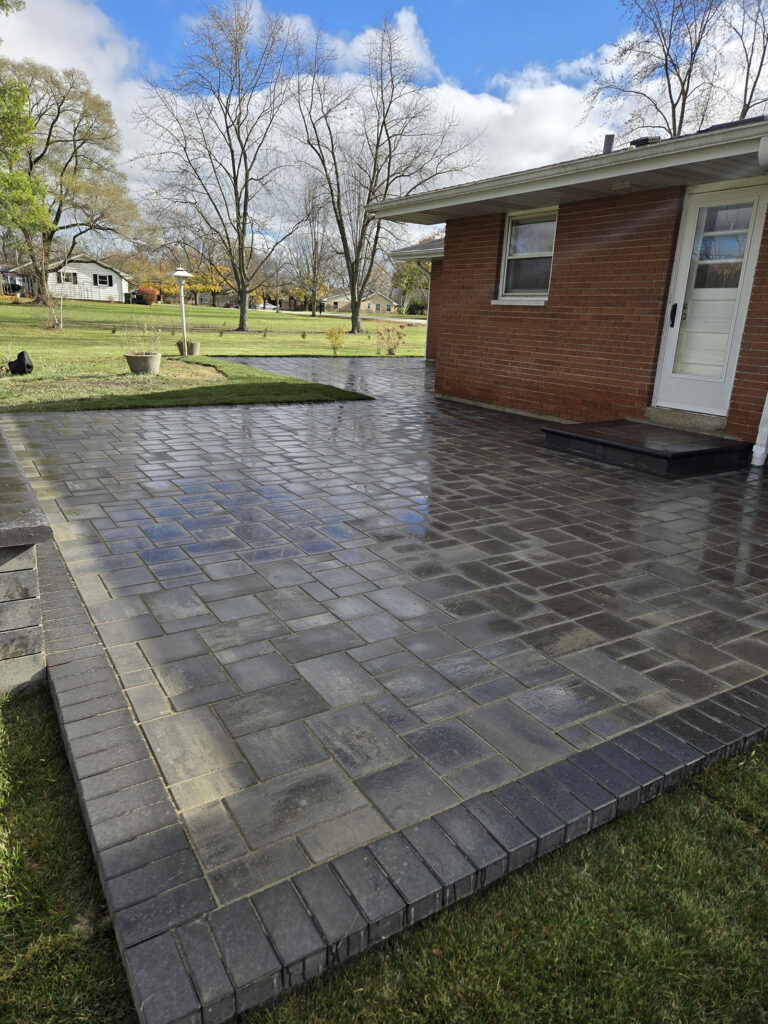
Euro Paving Handles Every Type of Residential and Commercial Brick Project in Chicago
Before calling a contractor, most homeowners and property managers want to know: does this company actually do the specific thing I need? The answer here is broad — and specific.
Residential brick projects:
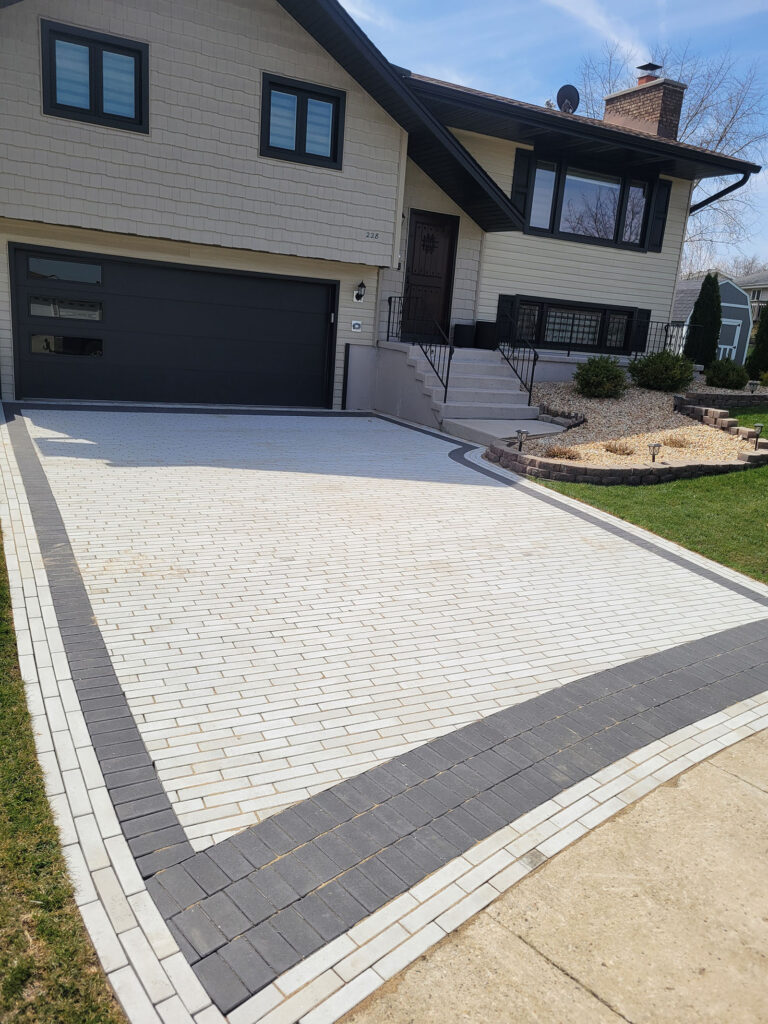
A brick driveway is the most visible upgrade a Chicago homeowner can make. It sets the tone for the entire property from the street. Euro Paving installs full brick driveways — new construction and full replacements — using Unilock and premium paver materials in patterns and colors selected to complement the home’s architecture.
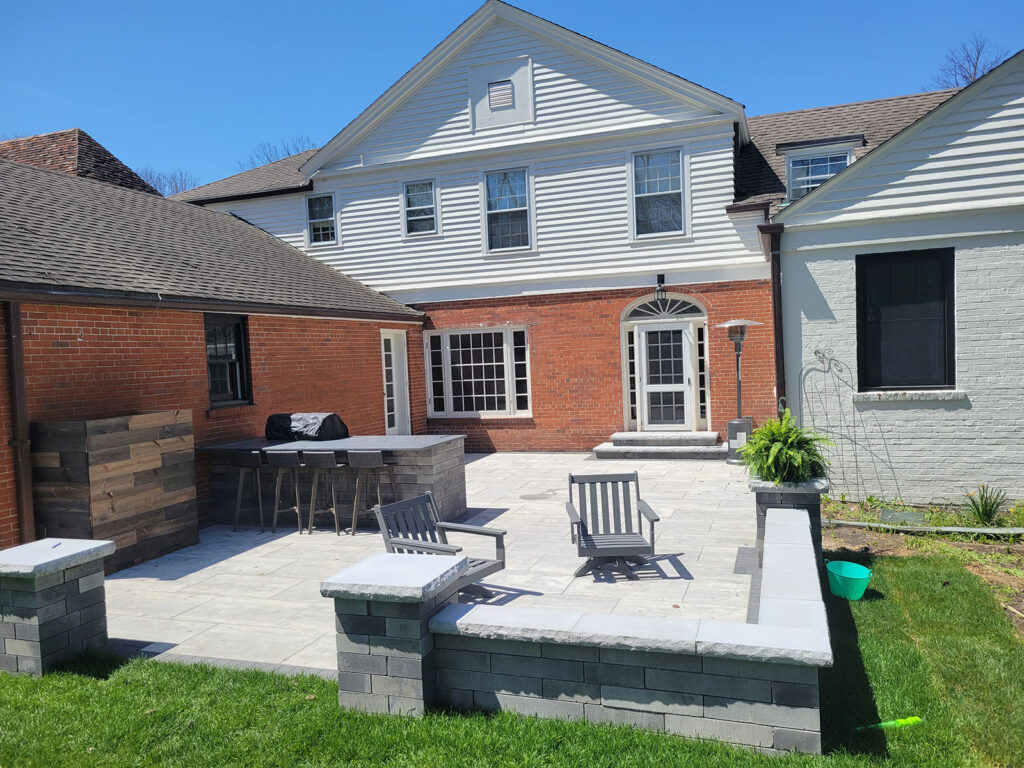
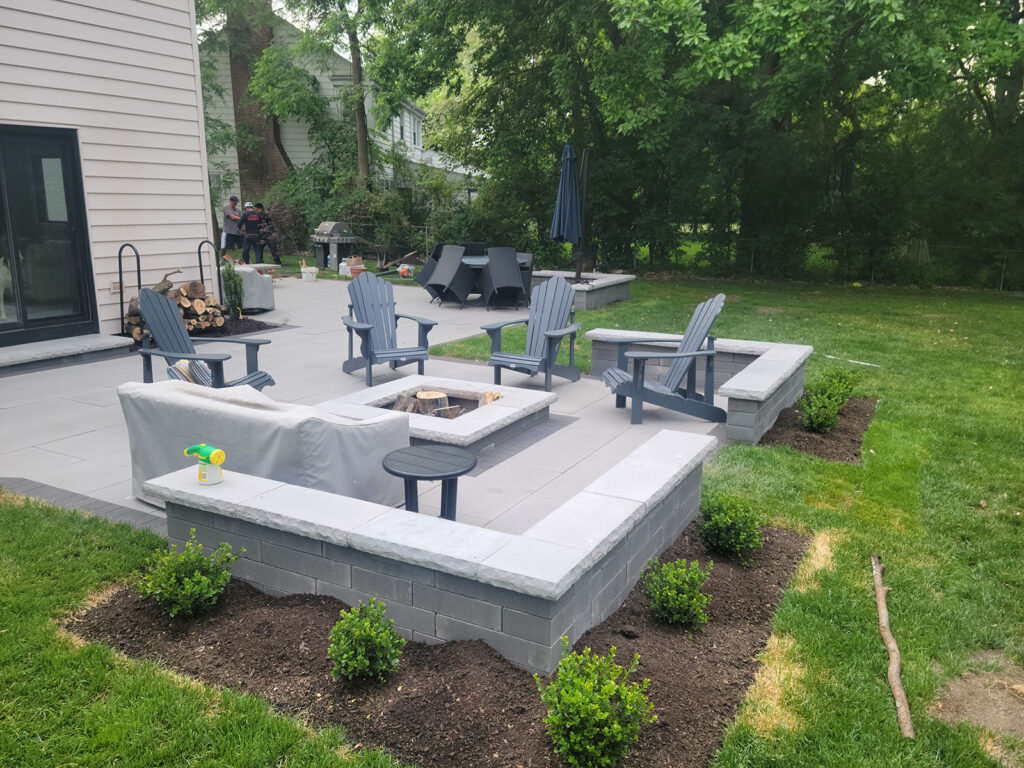
Patios are the most personal project. A rear yard brick patio built around how a family actually uses their outdoor space — with defined zones for dining, seating, and landscaping — becomes the most-used part of the property. We build custom brick patios from the ground up, with 3D design planning available so you can see the finished result before installation begins.
Front entry walkways, side paths, rear yard connecting walks, pool surrounds, and retaining walls round out the residential scope. Retaining walls in particular are a structural need in Chicago properties with grade changes — brick retaining walls manage elevation changes while adding significant visual character to a rear yard or terraced garden.
Repair and restoration work — re-setting heaved units, replacing cracked pavers, restoring deteriorated joint fill — is available for existing brick surfaces across all these applications.
Commercial brick projects:
Building entry plazas, storefront sidewalks, parking area paving, loading zone hardscaping, and courtyard installations for retail, office, and multi-unit residential properties. Commercial work involves different planning requirements — load tolerances, ADA compliance, permit coordination, and operational continuity during installation — but the output is the same: durable, professionally installed brick paving that performs and looks the part for decades.
Chicago’s architectural stock — greystones, vintage commercial buildings, brick-front apartment buildings — creates a consistent design challenge: new paving that looks like it belongs with the existing structure. Matching material tone, texture, and coursing pattern to an existing facade is something Euro Paving assesses at every estimate. The 3D design tool makes that matching process visible before a single paver is ordered.
Residential and Commercial Brick Projects Have Different Demands — Here's What Changes
A homeowner replacing a driveway and a property manager installing a commercial entry plaza both want quality brick paving. But the two projects are fundamentally different in how they’re planned, permitted, built, and managed. Understanding those differences helps buyers confirm they’re hiring a contractor with the right experience for their specific scope.
Design intent
Residential projects are primarily design-driven. The homeowner is making an aesthetic and functional decision about their property. Material selection, pattern choice, color matching to the home’s exterior, and how the finished surface integrates with landscaping are all central to the decision. Euro Paving’s 3D design planning process was built specifically for this — it answers the visualization question before installation begins.
Commercial projects are performance-driven first, design-driven second. The surface needs to handle foot traffic volumes, vehicle loads, weather exposure, and long-term maintenance cycles before aesthetics enter the conversation. A well-designed commercial brick entry is both durable and visually impressive — but the structural requirements come first.
Technical specifications
Residential driveways and patios are built to handle passenger vehicles and pedestrian foot traffic. Standard base depths and paver thickness specifications apply.
Commercial surfaces are built to handle higher loads — delivery vehicles, service trucks, high-density foot traffic — and require higher-PSI rated pavers, deeper compacted base prep, and engineered drainage systems. A paver that performs perfectly on a residential driveway may not be the correct specification for a commercial loading area.
Permitting
Residential projects sometimes require permits — particularly for public-facing sidewalk work or projects that involve significant grade changes. Most residential brick work on private property does not require a permit.
Commercial projects almost always involve permits. In Chicago, commercial paving that connects to or affects the public right-of-way requires CDOT coordination. Projects that involve accessible routes require ADA-compliant design documentation. In River North and the West Loop, where commercial properties sit on tight footprints adjacent to public infrastructure, permit coordination is a significant part of the project management scope.
Operational continuity
A homeowner can park on the street for two days. A retail business cannot close its entry and parking for a week without serious operational impact. Commercial projects require phased installation planning — completing one section before moving to the next — so that customer and employee access is maintained throughout the project. Euro Paving plans phasing at the estimate stage, not as an afterthought.
Ready to start your project? Contact us for a free estimate on any paving project in Chicago or the surrounding suburbs.
The Materials Euro Paving Uses Are Chosen for Chicago's Climate and Long-Term Performance
Chicago’s freeze-thaw cycle runs forty to sixty times per year. That number isn’t abstract — it means that any water that gets into a crack, a joint, or the pores of a paving material freezes and expands, over and over, all winter long. Materials that aren’t engineered for this fail visibly and fast. Spalling, cracking, and surface flaking are the results. They appear gradually, usually becoming obvious after the second or third winter on a material that wasn’t specified correctly.
This is why material selection for Chicago brick projects isn’t interchangeable with material selection in a milder climate. The spec that works in Atlanta or Phoenix does not automatically work here.
Unilock concrete pavers
The primary material for most Euro Paving residential and commercial projects. Unilock pavers are engineered specifically for freeze-thaw performance — low water absorption rates, tested to ASTM freeze-thaw cycling standards, and produced in consistent sizing that creates tight, stable joints resistant to frost movement. The design range is extensive: hundreds of profiles, colors, textures, and surface finishes that work from traditional Chicago bungalow driveways to contemporary commercial plazas. As a Unilock authorized contractor, Euro Paving has direct access to the full product line and the training to specify correctly for each application.
Natural stone — bluestone, limestone, granite
For projects where premium material character is the priority, natural stone delivers what engineered pavers can’t — the variation, depth, and authenticity of material that was formed over geological time. Bluestone is a particularly strong performer in Chicago winters: dense, low-absorption, and naturally textured for traction in wet and icy conditions. Granite is among the most durable paving materials available anywhere, with near-zero water absorption and a lifespan measured in generations. Limestone brings warmth and visual softness to garden pathways and entry walks.
Natural stone requires careful material selection — not all stone performs equally in freeze-thaw conditions. Dense, low-absorption varieties are correct for Chicago. Porous stone without proper sealing is not.
Freeze-thaw rated clay brick
The traditional Chicago look. Clay brick has paved Chicago’s alleys, courtyards, and residential driveways for over a century, and the aesthetic belongs here in a way that manufactured materials don’t always replicate. The critical specification detail: clay brick used in Chicago must carry an SX (Severe Weathering) freeze-thaw rating under ASTM standards. Standard clay brick without this rating is still widely sold and looks identical to rated brick. The performance difference becomes apparent after the first two winters — rated brick holds. Non-rated brick spalls.
Base and joint materials
The visible surface is only part of the system. Compacted aggregate base at the correct depth — matched to the load requirements and Chicago’s frost penetration depth — is what keeps the surface stable through ground movement. Polymeric joint sand, correctly installed and activated, locks paver joints against erosion, weed infiltration, and freeze-thaw displacement. These materials are specified to the same standard as the surface pavers.
Large-Scale Commercial Brick Paving in Chicago Requires a Crew With the Right Experience
Not every paving contractor in Chicago is set up for large commercial work. A crew that handles residential driveways and patios may not have the equipment, capacity, project management infrastructure, or permit experience to execute a 10,000 square foot commercial plaza installation on a construction schedule with other trades on site.
Euro Paving has completed large-scale commercial brick paving projects across Chicago and the suburbs since 2006. Here’s what that capability actually looks like:
Crew and equipment capacity
Large commercial projects require multiple crews working simultaneously to hit project milestones. We’re not a single-crew residential operation. Commercial-grade compaction equipment, concrete and asphalt saw-cutting capability, and bulk material handling are part of our standard kit — not rented for the occasion.
Project management
Commercial brick paving projects involve written contracts with clearly defined scope, material specifications, base depth requirements, phasing plans, and milestone timelines. Progress communication with the property manager or general contractor is structured, not informal. We coordinate with other trades on site — concrete, landscaping, electrical for lighting — as part of the project execution, not as an afterthought.
Permit coordination
In Chicago, large commercial paving projects almost always involve CDOT permits, Chicago Department of Buildings coordination, and in some cases suburban municipality permitting for projects outside city limits. We handle all of it in-house. The property owner or general contractor doesn’t manage the permit process independently.
Commercial project scope examples
In areas like Rosemont and Schaumburg — Chicago’s major commercial and hospitality corridors — Euro Paving has completed building entry plaza hardscaping, parking area brick paving, and retail courtyard installations that required engineered drainage design, ADA-compliant layout, and phased installation to maintain business operations throughout the project.
Phased installation for operational continuity
A hotel, office building, or retail center cannot shut down its parking and entries for two weeks. Phased paving — completing sections in sequence while maintaining access — is standard practice for commercial projects. The phasing plan is developed at the estimate stage and built into the project schedule. Customers and employees don’t experience more disruption than necessary.
Choosing the Right Brick Paving Contractor in Chicago Comes Down to Five Things
Chicago has no shortage of paving contractors. It also has no shortage of contractors who will give you a low number, start the job, and deliver something that looks fine for two winters before it starts failing. Protecting yourself from that outcome takes about fifteen minutes and five specific checks.
1. Licensed and insured in Illinois — verified, not assumed
Ask for the contractor’s Illinois license number and certificates of general liability insurance and workers’ compensation. Check the license number against the Illinois Department of Professional Regulation’s public database. Verify the insurance certificates show current coverage dates. This takes ten minutes and eliminates a significant category of risk. An unlicensed contractor has no accountability trail and no insurance means any jobsite injury or property damage becomes your liability.
2. Unilock authorized contractor status or equivalent premium material certification
Unilock authorized status isn’t a marketing badge — it means the contractor has been trained and approved to install Unilock products correctly and has direct access to the full product line. For other premium material brands, equivalent certification exists. Material certification confirms the contractor knows how to specify and install the products they’re selling, not just lay pavers on a surface.
3. Written contract with material specs, base depth, and timeline
Before any work begins, you should have a document that specifies: what material is being installed, what paver thickness and profile, what base depth, what drainage provisions, what the project timeline is, and what the payment schedule is. A contractor who resists putting specs in writing is a contractor whose specs aren’t worth writing down. Get it on paper.
4. Verifiable reviews from completed Chicago projects
Google reviews, Yelp reviews, and direct references from homeowners and property managers in Chicago and the suburbs. Not testimonials on the contractor’s own website — those are self-selected. Third-party review platforms show the full picture. Euro Paving maintains a 5-star Google rating across more than 30 reviews from Chicago-area customers.
5. 3D design planning available
This one separates professional operations from labor-for-hire crews. A contractor who offers 3D design planning before installation begins has a process — they’re thinking about the project as a design and construction challenge, not just a digging and laying job. It also means you see what you’re getting before you commit to it.
Euro Paving meets all five criteria. We provide documentation before any contract is signed and references from completed projects on request.
Financing Makes It Possible to Start Your Chicago Brick Project Now
The most common reason Chicago homeowners delay a brick paving project isn’t that they don’t want it done. It’s that the full project cost isn’t sitting available right now, and waiting feels like the responsible choice.
Here’s what waiting actually costs: a cracked or deteriorating driveway gets worse every winter. What would have been a resurfacing job becomes a full replacement. A patio that needed repair becomes a patio that needs rebuilding. The project you delay this year often costs more next year — and the year after that even more.
Chicago’s paving season compounds the problem. Work runs May through October. If you miss the current season, you’re waiting a full year — not a few months. By the time the ground thaws and contractors’ schedules open up again, you’ve had another winter’s worth of freeze-thaw cycles working on the surface.
The Unilock DO-IT-NOW Program
Euro Paving offers financing for qualifying residential projects through the Unilock DO-IT-NOW program. Flexible payment options mean the full project cost doesn’t need to be available upfront. You move forward on the complete project scope — the right materials, the correct base depth, the full design — rather than scaling back to fit a cash budget or splitting the work into multiple smaller phases that each require separate planning, scheduling, and mobilization.
Doing the project in one complete scope is almost always more efficient and more cost-effective than phasing it over two or three seasons. Financing makes that possible.
Ask about financing options when you request your free estimate. We’ll walk you through what’s available and what the project timeline looks like if you want to move forward this season.
Frequently Asked Questions
Residential: brick driveways, patios, front and rear walkways, entry paths, pool surrounds, retaining walls, and garden borders. Commercial: building entry plazas, parking area paving, storefront sidewalks, loading area hardscaping, and courtyard installations. Repair and restoration work — re-setting heaved units, replacing damaged sections, re-pointing joints — is available for both residential and commercial existing surfaces.
Small projects such as a walkway or border treatment complete in one day. A full driveway or mid-size patio typically runs two to three days. Larger or more complex residential projects — a full rear yard hardscaping design with patio, pathways, and retaining wall — may take up to a week. Commercial projects run one to two weeks depending on square footage and phasing requirements. We provide a specific timeline estimate at the on-site assessment.
Yes. We have multiple crews, commercial-grade equipment, and project management infrastructure for large commercial scopes. We handle CDOT and Chicago building department permitting in-house and offer phased installation to maintain business operations during the project. We’ve completed large commercial brick paving projects across Chicago and the suburbs since 2006 — references from completed commercial projects are available on request.
Yes. We offer the Unilock DO-IT-NOW financing program and flexible payment options for qualifying residential projects. Financing allows you to complete the full project scope now — in the current paving season — rather than delaying or scaling back. Ask about financing options when you call for your free estimate.
Call us at (773) 988-2353 or submit a request at europaving.com. We come out to your property, assess the project scope, discuss design options — including 3D design planning — and provide a written estimate. There’s no commitment required to get the estimate, and we typically schedule site visits within the week.
GET A FREE ESTIMATE
Euro Paving · 2210 W Chicago Ave, Chicago, IL 60622 · (773) 988-2353 · contact@europaving.com
Serving Chicago, Hinsdale, Burr Ridge, Park Ridge, Elmhurst, Norridge, Arlington Heights, and surrounding suburbs.