



Your Crumbling Driveway Edges Are Costing You More Than You Think
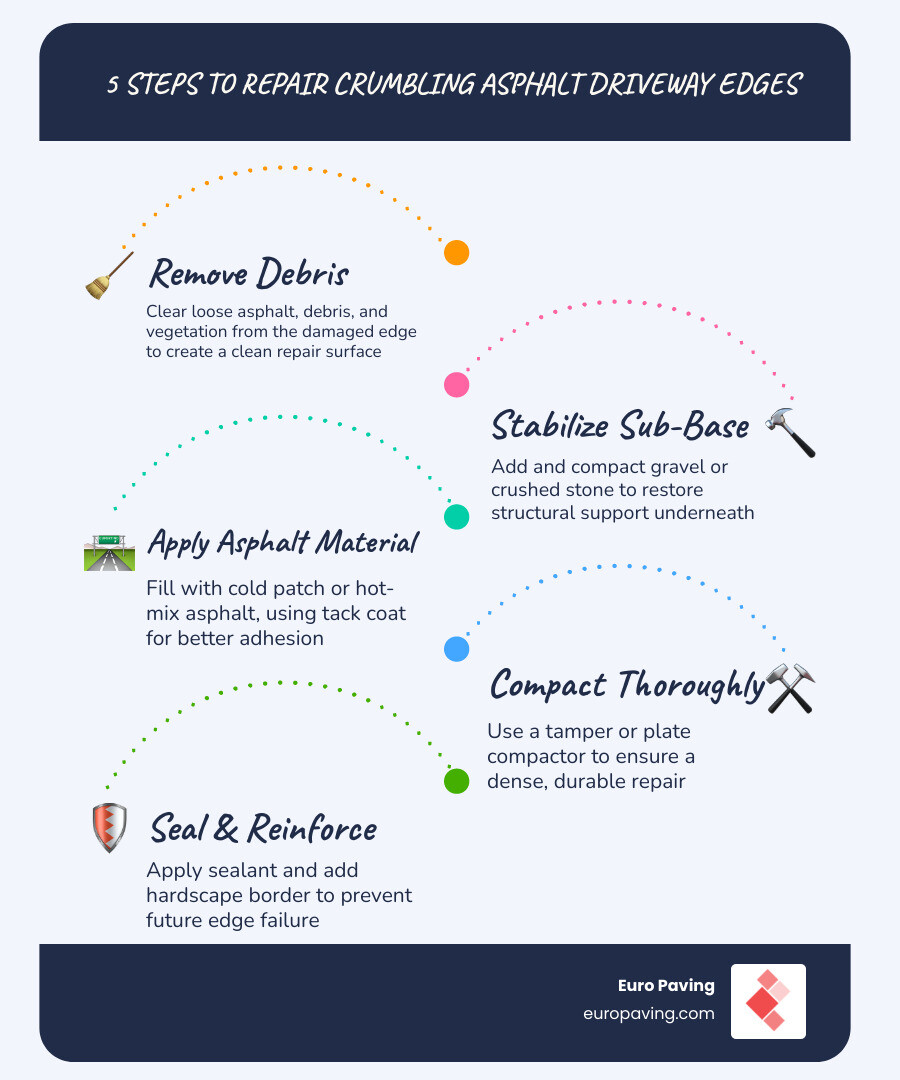
To repair crumbling edge asphalt driveway damage, follow these core steps:
- Remove all loose asphalt, debris, and vegetation from the damaged edge
- Stabilize the sub-base with compacted gravel or crushed stone
- Apply cold patch asphalt or professional hot-mix material to rebuild the edge
- Compact the repair thoroughly with a tamper or plate compactor
- Seal the repaired area with an acrylic-based or rubberized sealant
- Reinforce with a hardscape border (brick, cobblestone, or steel edging) to prevent repeat damage
The edges of your asphalt driveway are almost always the first thing to go.
They take the most abuse — tires rolling over them, water pooling beside them, grass and soil pushing underneath them. And once they start to crumble, the damage spreads fast.
Left untreated, what starts as a small crumbling edge can turn into a structural problem that demands full driveway replacement — a cost that averages around $7,500. Timely edge repairs, by contrast, can run as little as $450 to $600 for a medium-sized driveway when addressed early.
That’s a significant difference. And the gap only grows the longer you wait.
This guide walks you through everything a homeowner in the Chicago suburbs needs to know — from understanding why edges fail, to the professional repair process, to when it makes more sense to resurface or replace.
Understanding the Causes of Edge Deterioration
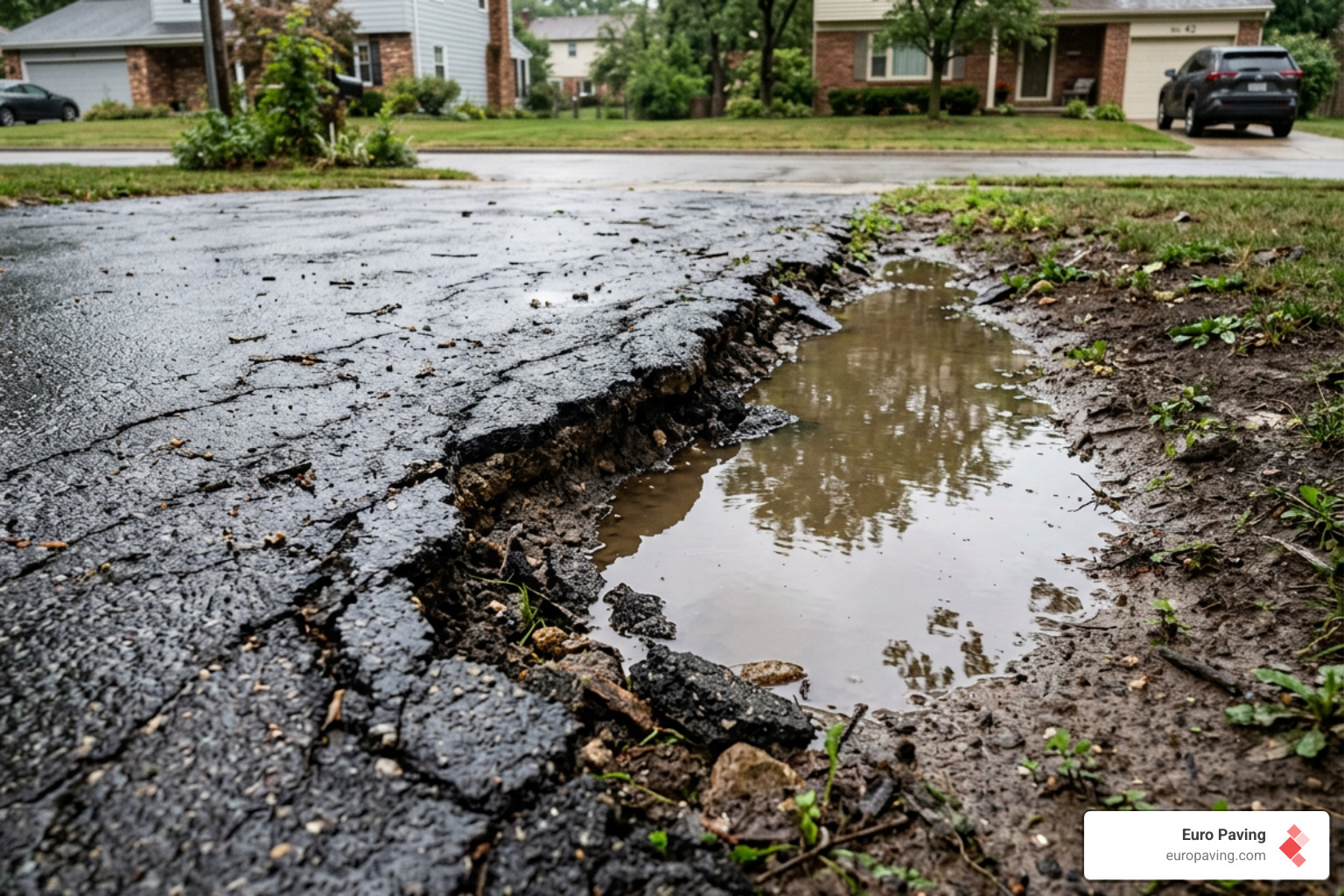
Before we dive into how to repair crumbling edge asphalt driveway sections, we need to talk about why they fall apart in the first place. If you don’t fix the root cause, your repair will likely fail within a single Chicago winter.
The Chicago Climate Factor: Freeze-Thaw Cycles
In areas like Arlington Heights, Downers Grove, and Skokie, our driveways face a brutal cycle. Water seeps into the tiny pores of the asphalt edge. When the temperature drops below freezing, that water expands. This creates internal pressure that literally “pops” the asphalt apart. Over several winters, this cycle turns a solid edge into a jagged, gravelly mess.
UV Rays and Oxidation
Think of asphalt like a sponge held together by glue (the bitumen binder). Over time, UV rays from the sun bake that “glue,” making it brittle. This process is called oxidation. As the binder fails, the stones (aggregate) begin to loosen and fall away. This is often called “raveling,” and it almost always starts at the edges where the asphalt is thinnest.
Poor Drainage and Sub-Base Erosion
If your driveway wasn’t graded correctly during installation, water will pool right at the edge. This water softens the soil or gravel underneath (the sub-base). Without a firm foundation, the weight of a car driving near the edge causes the asphalt to snap off because there is no support beneath it. According to the Asphalt edge crumbling guide, moisture infiltration is the leading cause of structural edge failure.
Lack of Lateral Support
Asphalt is a flexible pavement. It needs something to push against. If the soil on the side of your driveway has eroded or was never packed tightly, the asphalt has nothing to hold it in place. Every time you pull into your garage in Barrington or Lake Forest and catch the edge of the pavement, you’re applying lateral pressure that forces the edge outward and down.
Professional Steps to Repair Crumbling Edge Asphalt Driveway
When we tackle a project to repair crumbling edge asphalt driveway issues, we don’t just throw some “black stuff” in a hole and hope for the best. A professional-grade repair requires a systematic approach to ensure the new material bonds with the old.
At Europa Paving, we believe that the quality of the repair is only as good as the preparation. While DIY kits exist, they often lack the structural integrity provided by professional equipment and materials. If you are looking for a permanent solution, you can find more info about asphalt contractor services on our specialized service pages.
Preparing the Area to Repair Crumbling Edge Asphalt Driveway
The first mistake many homeowners make is trying to patch over loose debris. This is a recipe for a repair that peels up in six months.
- Vegetation Control: We start by removing all grass, weeds, and roots encroaching on the edge. If you leave roots under the repair, they will grow back and crack your new asphalt.
- Debris Removal: Using a stiff wire brush or a high-pressure air blower, we clear out every speck of dust and loose stone.
- Squaring the Edges: We don’t just fill the jagged gap. We use a masonry saw or a chisel to cut back the crumbling area until we reach solid, healthy asphalt. This creates a vertical “shoulder” for the new patch to lean against.
- Cleaning: For the best bond, the area must be dry and clean. For more info about driveway crack repair, even small hairline cracks near the edge should be cleaned and filled during this stage.
Base Stabilization and Material Application
Once the area is clean, we look at what’s underneath. If the gravel base has washed away, we can’t just fill it with asphalt.
- Gravel Sub-Base: We add a layer of crushed stone or “grade 8” gravel. This is compacted until it’s rock-hard. This prevents the repair from sinking later.
- Tack Coat: We apply a liquid asphalt binder (tack coat) to the vertical edges of the old asphalt. This acts like a glue to ensure the new material fuses with the old.
- Material Choice:
- Polymer-Modified Cold Patch: This is a high-grade version of the stuff you find at big-box stores. It stays flexible and handles the Chicago freeze-thaw cycle better than standard mixes.
- Hot-Mix Asphalt: For larger repairs, we use professional hot-mix. It’s applied at over 300°F and provides the most durable, long-lasting finish.
- Compaction Layers: We don’t just dump 4 inches of asphalt at once. We apply it in “lifts” of 2 inches, compacting each layer with a vibratory plate compactor or a heavy hand tamper. This removes air pockets that could trap water.
Reinforcing Edges with Hardscape Borders
One of the best ways to repair crumbling edge asphalt driveway sections permanently is to stop using asphalt for the edge entirely. By installing a hardscape border, you provide the lateral support that asphalt naturally lacks.
At Europa Paving, we specialize in this “hybrid” approach. By surrounding an asphalt driveway with a border of Unilock pavers or cobblestones, you create a rigid frame. This frame protects the asphalt from heavy vehicle loads and prevents soil erosion.
- Lateral Support: The brick or stone is set into a concrete “haunch” or a deep gravel bed, providing a solid wall that the asphalt can be pressed against.
- Aesthetics: A brick border instantly upgrades the curb appeal of a home in Hinsdale or Winnetka. It transforms a standard blacktop into a custom-designed feature.
- Soil Stabilization: The border keeps your lawn from creeping into your driveway and prevents water from washing away the sub-base.
If you’re interested in how this looks, you can find more info about driveway paving services on our website, where we showcase how we blend asphalt durability with brick elegance.
Resurfacing vs. Replacement: Making the Right Choice
Sometimes, a simple repair isn’t enough. If your driveway edges are crumbling in fifty different spots, you might be fighting a losing battle. Here is how we help our clients in the Chicago area decide between a patch, a resurface, or a full replacement.
Assessing Damage to Repair Crumbling Edge Asphalt Driveway
We use a few “rules of thumb” to determine the health of your pavement:
- The 1/4 Inch Rule: If your cracks are less than 1/4 inch wide and the edges are only crumbling in isolated spots, a repair is likely sufficient.
- Alligator Cracking: If the asphalt looks like the back of an alligator (interconnected scales), this indicates a base failure. No amount of edge repair will fix a foundation that has turned to mud.
- Age: Asphalt driveways in the Midwest typically last 15 to 20 years. If your driveway is 18 years old and the edges are disappearing, it’s probably time for a replacement.
- Drainage: If the entire driveway is sinking or holding water, resurfacing (adding a new layer on top) won’t fix the problem—it will just hide it for a year or two.
For those unsure about their next step, check out our guide on more info about avoiding common renovation problems to ensure you don’t spend money on a temporary fix when a permanent solution is needed.
Frequently Asked Questions about Driveway Edge Repair
What is the best time of year to repair asphalt edges in Chicago?
The ideal window is between late spring and early fall. For the asphalt to bond and cure properly, the ambient temperature should be at least 40°F and rising. In Chicago, we typically aim for May through October. Repairing in the dead of winter is possible with “cold patch,” but these are usually temporary “Band-Aids” to get you through until spring.
How long should I wait before driving on repaired edges?
If we use a professional hot-mix, you can usually drive on it within 24 to 72 hours, depending on the temperature. If you’re using a DIY cold patch, it can take weeks or even months to fully “cure” because it relies on the evaporation of oils. However, you can usually drive over a well-compacted cold patch immediately—just avoid turning your tires sharply on it!
Can I prevent future crumbling with sealcoating?
Yes! Sealcoating is like sunscreen for your driveway. It provides a thin, liquid-proof barrier that slows down oxidation and prevents water from entering the pores of the asphalt. We recommend sealcoating every 2 to 3 years in the Chicago suburbs to keep the binder flexible. However, remember: sealcoating is a preventative measure. It will not fix an edge that is already crumbling. You must repair crumbling edge asphalt driveway damage first, then seal over it.
Conclusion
Your driveway is one of the first things people see when they pull up to your home. Beyond curb appeal, a solid edge is vital for the structural integrity of the entire surface. Whether you’re in Norridge, Highland Park, or Glenview, taking care of those crumbling edges now will save you thousands of dollars in the long run.
At Europa Paving, we’ve been helping homeowners across the Chicago area—from Hillside to Mount Prospect—transform their outdoor spaces. We don’t just fix driveways; we build lasting foundations for family memories. Whether you need a professional asphalt repair or you’re ready to upgrade to a stunning brick-bordered entrance, we’re here to help.
Ready to stop the crumble? Schedule a consultation for your brick paving driveway project today, and let’s make sure your driveway stays exactly where it belongs.