



Sidewalk & Pathway Masonry in Chicago — Safe, Durable, and Built to Impress
A cracked or uneven sidewalk isn’t just an eyesore in Chicago — it’s a liability. City ordinances place the responsibility for sidewalk maintenance squarely on the property owner. A raised paver, a sunken section, a heaved brick walk — if someone trips, the claim comes to you. Beyond the legal exposure, a deteriorating sidewalk or pathway signals neglect in a way that affects how your entire property is perceived.
Sidewalk and pathway masonry in Chicago covers everything from new brick and stone pathway installation to repair and full replacement of existing surfaces — residential front walks, side entry paths, rear yard pathways, and commercial building entries. Euro Paving has been installing and repairing masonry sidewalks across Chicago since 2006. We’re licensed, insured, and a Unilock authorized contractor. Free on-site estimates, permit guidance included, and most residential projects complete in one to two days.
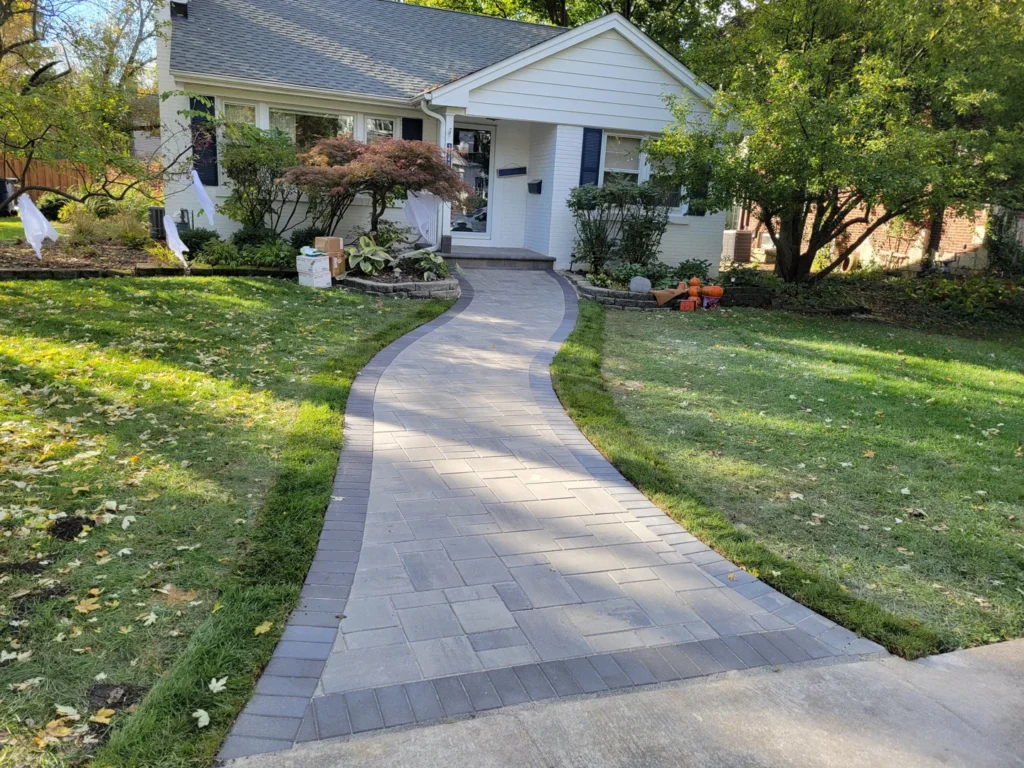
Masonry Sidewalks Cover More Than You Think — Here's What the Service Includes
When most people think of sidewalk work, they picture a concrete crew and a poured slab. Masonry sidewalk work is a different discipline — more materials, more design options, more repair flexibility, and a significantly higher visual result. Here’s what the full service scope covers:
New installation — brick or stone sidewalks and pathways built from the ground up. Front entry walks from the public sidewalk to your door, side entry paths along the gangway, rear yard pathways between structures, garden paths, and connecting walks between a driveway and a back door or detached garage.
Repair — re-leveling sunken or heaved units, replacing cracked or spalled individual bricks or pavers, re-setting sections that have shifted due to tree root pressure or frost heave, and re-pointing deteriorated mortar or sand joints to restore the surface’s structural integrity and appearance.
Full replacement — complete tearout of a failed masonry sidewalk, base rebuild, and new installation when repair is no longer a viable option. This is the right call when base failure is widespread or when more than half the surface is damaged beyond re-setting.
Commercial sidewalk installation — storefront walks, building entry paths, and ADA-compliant access routes for retail, office, and multi-unit residential properties across Chicago.
Chicago’s dense residential neighborhoods — bungalows, two-flats, greystones, coach houses — have multiple distinct walkway surfaces, each with different conditions and requirements. A front public-facing sidewalk, a gangway path, a rear yard walk to the garage, a side garden path — they’re all part of the same property and benefit from consistent, quality masonry treatment. We assess all of it when we come out for the estimate.
Masonry Outlasts Concrete Sidewalks in Chicago — Here's Why
When a homeowner is replacing a sidewalk or installing a new pathway in Chicago, the first choice is usually material: brick and stone masonry or poured concrete. Concrete is cheaper upfront. Masonry is better in almost every other way — and specifically better suited to Chicago’s conditions.
The freeze-thaw problem with concrete
Poured concrete is a monolithic slab. It expands and contracts as a single unit with temperature swings. In Chicago’s climate, with dozens of freeze-thaw cycles every winter, that movement creates stress across the slab. Without perfectly placed control joints — and sometimes even with them — concrete cracks. When it cracks, repair means saw-cutting out the damaged section and pouring a new one. The patch color never quite matches. The joint between old and new is a permanent feature of the repair.
Why masonry handles the same conditions better
Masonry sidewalks are made of individual units — brick, stone, or pavers — set on a compacted base with sand or mortar joints between them. Each unit can move slightly and independently. When freeze-thaw cycles cause ground movement, individual pavers lift. They don’t crack — they shift. And a shifted paver can be re-set. A cracked concrete slab section cannot.
The tree root factor
This is the Chicago-specific advantage that matters most in older neighborhoods. Chicago’s urban canopy is one of the city’s greatest assets — and one of the most consistent causes of sidewalk damage. Tree roots grow under walkways and push individual units upward. In a masonry sidewalk, this is a repair: lift the affected units, address the root as needed, re-grade the base, and reset the bricks. In a concrete sidewalk, the same root pressure cracks the slab and requires section removal and repour.
In neighborhoods like Lincoln Square and Beverly, where historic character and mature tree canopy define the streetscape, brick and stone masonry sidewalks aren’t just a better-performing choice — they’re the appropriate one. Poured concrete reads as a cheap substitute in these contexts.
The repair economy of masonry
Over a 30-year period, a masonry sidewalk installed correctly typically requires less total repair cost than a concrete sidewalk in Chicago. Individual unit replacement is straightforward and inexpensive. Full-section concrete repair is neither.
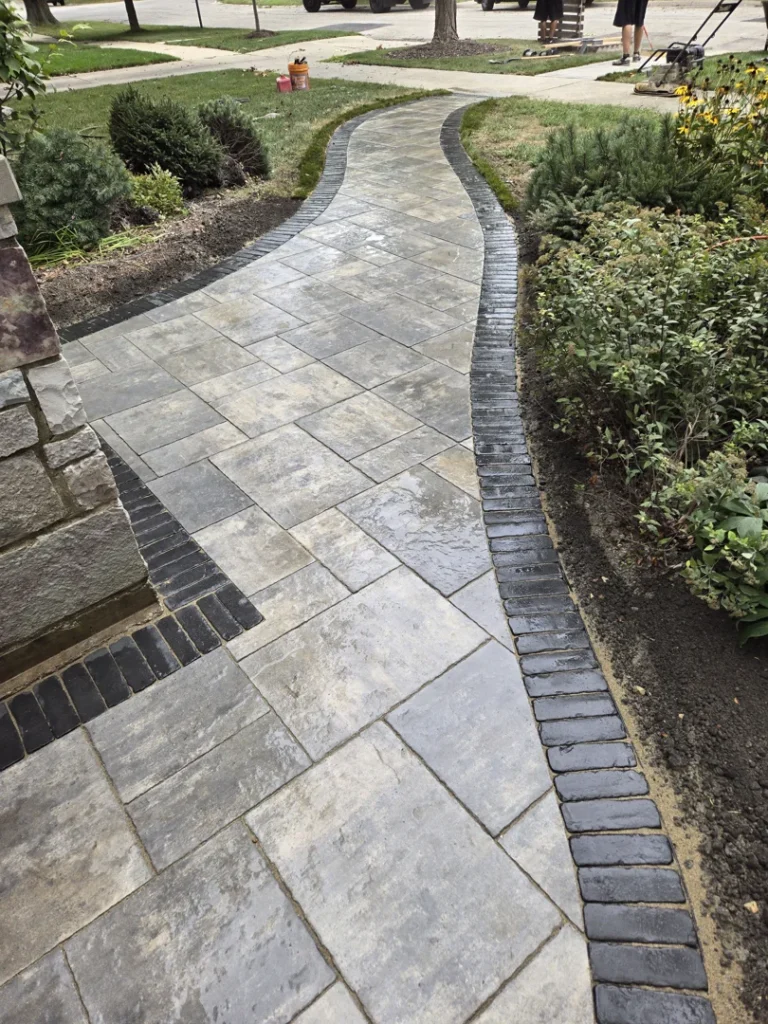
Ready to start your project? Contact us for a free estimate on any paving project in Chicago or the surrounding suburbs.
Chicago Sidewalk Permits — What Property Owners Need to Know Before Work Starts
Permit requirements for sidewalk work in Chicago stop more projects than they should — not because the process is insurmountable, but because property owners don’t know what’s required until they’re ready to start, and then the uncertainty causes delay. Here’s the straightforward breakdown:
Public-facing sidewalk — the parkway strip
The sidewalk panel that runs between your property line and the curb sits in the public right-of-way. Any new installation or full replacement here falls under the jurisdiction of CDOT — the Chicago Department of Transportation. A permit is typically required. CDOT sets the standards for panel dimensions, slope, material, and finish, and work that connects to the public right-of-way must meet those standards.
Private pathways on personal property
A pathway that runs entirely on your private property — a backyard garden path, a side yard walk, a path from the back door to the garage — generally does not require a permit. The work is on your land and doesn’t interact with the public right-of-way.
Repair work on existing sidewalk panels
Repair requirements vary by scope and location. Minor repairs to individual panels are sometimes handled without a permit; full section replacement that involves the public-facing walk should be confirmed with your local alderman’s office or with CDOT directly. Requirements have some variation by ward, and the answer you get from a neighbor’s experience may not match what applies to your specific project.
ADA-compliant curb cuts and ramps
If your project involves curb cuts or accessible ramps at the property edge, separate standards apply. ADA compliance requirements govern slope, surface texture, width, and detectable warning surface specifications. These are non-negotiable for commercial properties and increasingly expected on residential properties adjacent to commercial corridors.
What Euro Paving does
We handle permit applications and CDOT coordination as part of the project scope. You don’t navigate this independently — we pull the permits, manage the submittal, and schedule the work around any required inspections. When you call for an estimate, permit requirements are part of what we assess and communicate upfront.
Chicago also runs a sidewalk replacement program through CDOT that subsidizes replacement costs for qualifying properties with deteriorated public-facing sidewalks. We’ll let you know during the estimate if your property may qualify.
These Are the Best Materials for Masonry Pathways in Chicago's Climate
Material selection for a Chicago masonry sidewalk or pathway is a decision that plays out over decades. The right choice is still performing at year twenty-five. The wrong choice starts failing at year three. The difference is freeze-thaw performance — specifically, how much water the material absorbs and what happens to it when that water freezes.
Water expands by roughly 9% when it freezes. A material with high water absorption takes on moisture during Chicago’s wet fall and early spring. When temperatures drop below freezing — which happens dozens of times every winter — that moisture freezes inside the material and expands. The expansion force is enough to crack, flake, and spall a material that isn’t engineered for it. This is called freeze-thaw spalling, and it’s the most common material failure we see in Chicago masonry work.
Concrete pavers — Unilock and premium brands
The most reliable all-around choice for Chicago freeze-thaw conditions. Engineered with low water absorption rates and tested specifically to freeze-thaw cycling standards. Consistent sizing produces tight, stable joints that resist frost movement. Available in a wide range of colors, textures, surface finishes, and profiles — from clean and contemporary to traditional tumbled looks. Unilock pavers carry a lifetime material guarantee and are what we specify most often for Chicago residential and commercial pathway work.
Bluestone
A dense, low-absorption natural stone that performs exceptionally well in cold climates. Its natural surface texture provides better traction in wet and icy conditions than a smooth finish — an important safety consideration for Chicago winters. Bluestone reads as refined and substantial and works beautifully as an entry pathway material alongside both brick architecture and contemporary home exteriors. In Hinsdale and Western Springs, bluestone entry walks are a consistent choice for high-end residential properties.
Tumbled granite
Among the most durable natural stone options available. Extremely dense, near-zero water absorption, and the tumbled finish provides excellent traction. Granite doesn’t fade, doesn’t spall, and maintains its appearance for decades with minimal maintenance. Higher installation cost than concrete pavers, but the lifespan justifies it on a well-trafficked residential or commercial path.
Freeze-thaw rated clay brick
The classic Chicago look — and a correct choice when specified properly. Clay brick must carry an explicit freeze-thaw rating, designated SX (Severe Weathering) in ASTM standards. Standard red clay brick without this rating is still widely available at home improvement stores and looks identical on the shelf. It does not perform identically in a Chicago winter. Freeze-thaw spalling on non-rated clay brick is gradual, typically becoming apparent after the second or third winter — by which point the installation has already failed.
What lifespan looks like with the right material:
- Premium natural stone (bluestone, granite): 25–50 years
- Quality concrete pavers (Unilock and equivalent): 20–30 years
- Freeze-thaw rated clay brick, correctly installed: 20–30 years
Base preparation determines where in those ranges your pathway lands. Compacted aggregate base at the correct depth, proper drainage slope, and correctly filled joints are what keep individual units stable through Chicago winters. Material and base work together — one without the other doesn’t deliver the full lifespan.
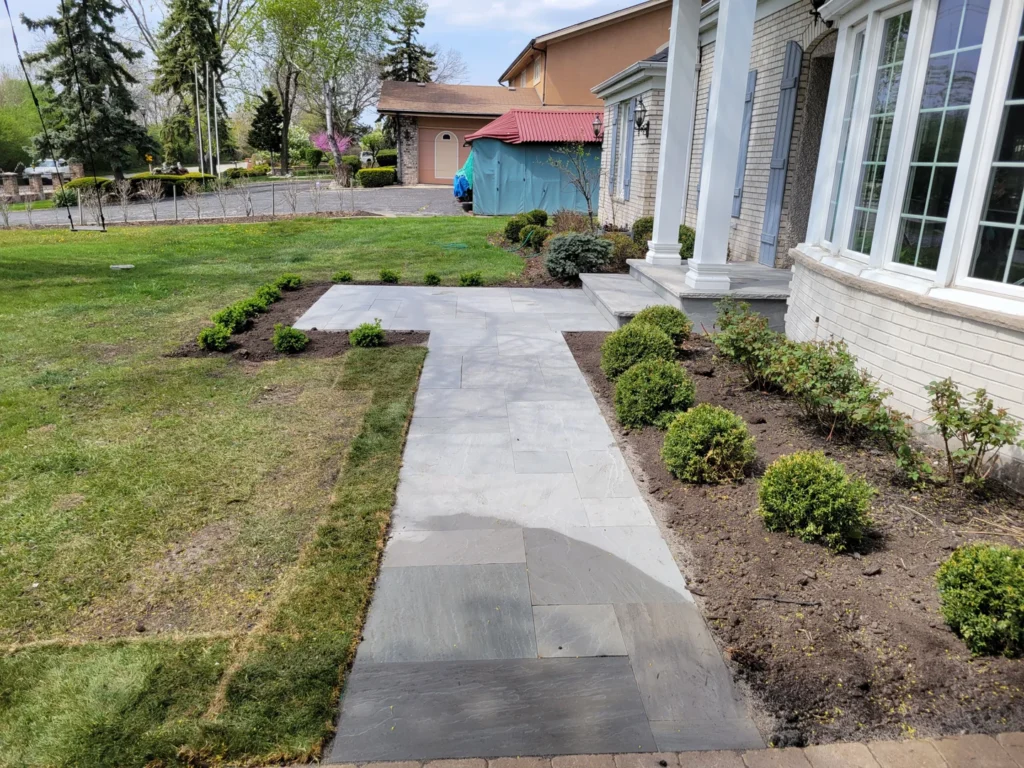
Cracked and Uneven Masonry Sidewalks Can Be Repaired — Not Always Replaced
The assumption most homeowners make when they see a heaved, cracked, or uneven masonry sidewalk is that the whole thing needs to come out. In many cases, it doesn’t. Masonry’s defining advantage over poured concrete is repairability — individual units can be addressed without touching the rest of the surface.
Re-leveling heaved units
This is the most common repair we perform on Chicago masonry sidewalks. Individual bricks or pavers have lifted due to frost heave or tree root pressure. The affected units are carefully removed, the base beneath them is re-graded and re-compacted, the root or drainage issue causing the heave is addressed, and the units are reset level with the surrounding surface. Done correctly, the repair is nearly invisible and the surrounding sidewalk is completely undisturbed.
Chicago’s mature tree canopy is the leading cause of this type of damage — particularly in older neighborhoods like Norwood Park and the areas surrounding Jefferson Park, where large-caliper trees line residential parkways and their root systems extend well under adjacent sidewalks. In these neighborhoods, masonry repair is an ongoing maintenance reality, not a one-time event. The advantage is that each repair is targeted and manageable rather than requiring a full surface replacement.
Replacing cracked or spalled individual units
When individual bricks or pavers have cracked, spalled, or deteriorated beyond re-setting, they’re removed and replaced with matching material. The surrounding surface stays in place. This is where material selection at the original installation matters — matching a replacement unit to an existing surface requires that the original material is still available or that a close equivalent exists. We assess this during the estimate and source matching material before work begins.
Re-pointing deteriorated joints
Mortar and sand joints between masonry units deteriorate over time — mortar shrinks and cracks, polymeric sand washes out, joint filler loosens. Open joints let water in, which accelerates freeze-thaw damage from below. Re-pointing — cleaning out the deteriorated joint material and filling with fresh mortar or polymeric sand — restores the surface’s structural integrity and appearance without any unit replacement.
When repair isn’t the right answer
Repair makes sense when damage is isolated — a section of heaved units, a few cracked bricks, deteriorated joints across the surface. Full replacement becomes the right call when base failure is widespread, when more than roughly 40–50% of units are damaged, or when drainage problems have compromised the entire installation. We assess this honestly during the free estimate — there’s no default push toward full replacement if repair is the viable option.
Euro Paving Handles Commercial Sidewalk and Pathway Masonry Across Chicago
Commercial sidewalk and pathway masonry in Chicago involves requirements that residential work doesn’t. ADA compliance standards, higher pedestrian load tolerances, CDOT permitting for public-facing work, and the operational reality that a business can’t always shut down completely during installation — all of these factor into how a commercial project is planned and executed.
Euro Paving has completed commercial masonry projects across Chicago and the suburbs since 2006. Here’s what commercial sidewalk and pathway work includes:
Storefront and building entry sidewalks
The sidewalk in front of a retail space or commercial building is the first surface a customer touches. Deteriorated, uneven, or stained concrete in front of a business signals neglect before a customer has stepped inside. Masonry replacement — brick, stone, or quality concrete pavers — delivers a professional appearance that plain concrete cannot match and that holds up through Chicago’s heavy pedestrian traffic and winter conditions.
Along commercial corridors in neighborhoods like Wicker Park and Logan Square, storefront sidewalk quality directly affects foot traffic and customer perception. Businesses that invest in quality masonry entries consistently present better than their neighbors on plain concrete.
ADA-compliant pathway design
Commercial properties are required to provide accessible routes that meet ADA standards — correct slope (maximum 1:20 cross-slope, 1:12 on ramps), appropriate surface texture for traction, minimum pathway width, and detectable warning surfaces at curb transitions. We design and install to these standards and coordinate with the Chicago building department to ensure compliance.
Large-scale pathway networks
Multi-unit residential developments, mixed-use properties, and commercial campuses often need connected pathway systems — entry walks, connecting paths between buildings, accessible routes through outdoor areas. We plan and install these as unified projects with consistent materials and design language across the full property.
Phased installation
Most commercial properties can’t close entirely during sidewalk work. We sequence installations in phases — completing one section before moving to the next — so that pedestrian and vehicle access is maintained throughout the project. Phasing is planned at the estimate stage so disruption is minimized from the start.
Permit coordination
Commercial sidewalk work involving the public right-of-way in Chicago requires CDOT permits and, in some cases, coordination with the Chicago Department of Buildings. We manage the permit process as part of the project scope.
Frequently Asked Questions
It depends on where the sidewalk is located. Public-facing sidewalk replacement in the parkway strip — between your property line and the curb — typically requires a CDOT permit. A private pathway that sits entirely on your personal property generally does not. Euro Paving handles permit applications and CDOT coordination as part of the project. We’ll tell you exactly what’s required when we come out for the estimate.
In many cases, yes. Individual unit re-setting, crack and spall replacement, and joint re-pointing are all available without full surface replacement. Full replacement is recommended only when base failure is widespread or when more than roughly half the units are damaged. We assess repair vs. replace honestly during the free estimate — repair is recommended whenever it’s the viable option.
Masonry sidewalks use individual brick or stone units set on a compacted base — each unit can move slightly and be repaired independently. Concrete sidewalks are poured slabs — any repair requires cutting out and repourin a full section. In Chicago, masonry handles freeze-thaw movement better and is far easier to repair when tree root pressure lifts sections, which is a regular occurrence in older neighborhoods.
Premium natural stone such as bluestone or granite lasts 25–50 years. Quality concrete pavers such as Unilock last 20–30 years. Freeze-thaw rated clay brick installed correctly performs similarly. These lifespans assume proper base preparation and routine maintenance — specifically, re-pointing joints as needed and addressing heaved units promptly rather than leaving them through additional winters.
Yes. We design and install ADA-compliant pathways — correct slope, surface texture, width, and detectable warning surfaces at curb transitions — for retail, office, and multi-unit residential properties across Chicago. Permit coordination with CDOT and the Chicago Department of Buildings is included as part of the commercial project scope.
GET A FREE ESTIMATE
Euro Paving · 2210 W Chicago Ave, Chicago, IL 60622 · (773) 988-2353 · contact@europaving.com
Serving Chicago, Hinsdale, Burr Ridge, Park Ridge, Elmhurst, Norridge, Arlington Heights, and surrounding suburbs.