



Your Driveway Is the First Thing People See — Make It Count
A brick paver driveway is one of the most durable, attractive, and value-adding upgrades you can make to your home. Whether you’re replacing cracked concrete or building a new home from the ground up, brick pavers offer a combination of strength, style, and longevity that few other materials can match.
Here’s what you need to know at a glance:
| Feature | Brick Paver Driveway |
|---|---|
| Cost | $10–$20 per square foot installed |
| Lifespan | Up to 50 years with proper care |
| Strength | 8,000–12,000 PSI (vs. ~3,000 PSI for standard concrete) |
| Maintenance | Reseal every 3–5 years; occasional power washing |
| ROI | Estimated 2x return on investment at resale |
| Climate performance | Excellent — flexible joints resist freeze-thaw damage |
| Design options | 50+ colors, shapes, and patterns |
| Warranty | Lifetime product guarantee; up to 10-year labor warranty |
Think about the moment you pull into your driveway after a long day. That first impression — of your home, your property, your space — starts right there. A well-installed brick paver driveway doesn’t just look beautiful. It signals quality, craftsmanship, and care.
For homeowners in Chicago and the surrounding suburbs, where winters are harsh and curb appeal matters, brick pavers are a smart long-term investment. Euro Paving installs professional-grade brick paver driveways across Cook and DuPage Counties, using premium Unilock materials and proven installation methods built to last.
This guide covers everything — materials, costs, design, installation, maintenance, and how to choose the right contractor.
Understanding the Brick Paver Driveway: Materials and Comparisons
When we talk about a brick paver driveway, we aren’t just talking about the red clay bricks you see on old chimneys. Modern driveway paving has evolved into a sophisticated science of “interlocking segmental pavement.” This means the units are designed to fit together like a puzzle, distributing the weight of your vehicles across the entire surface rather than concentrating it in one spot.
Clay Bricks vs. Concrete Pavers
In hardscaping, you generally have two high-quality choices: clay brick and concrete pavers.
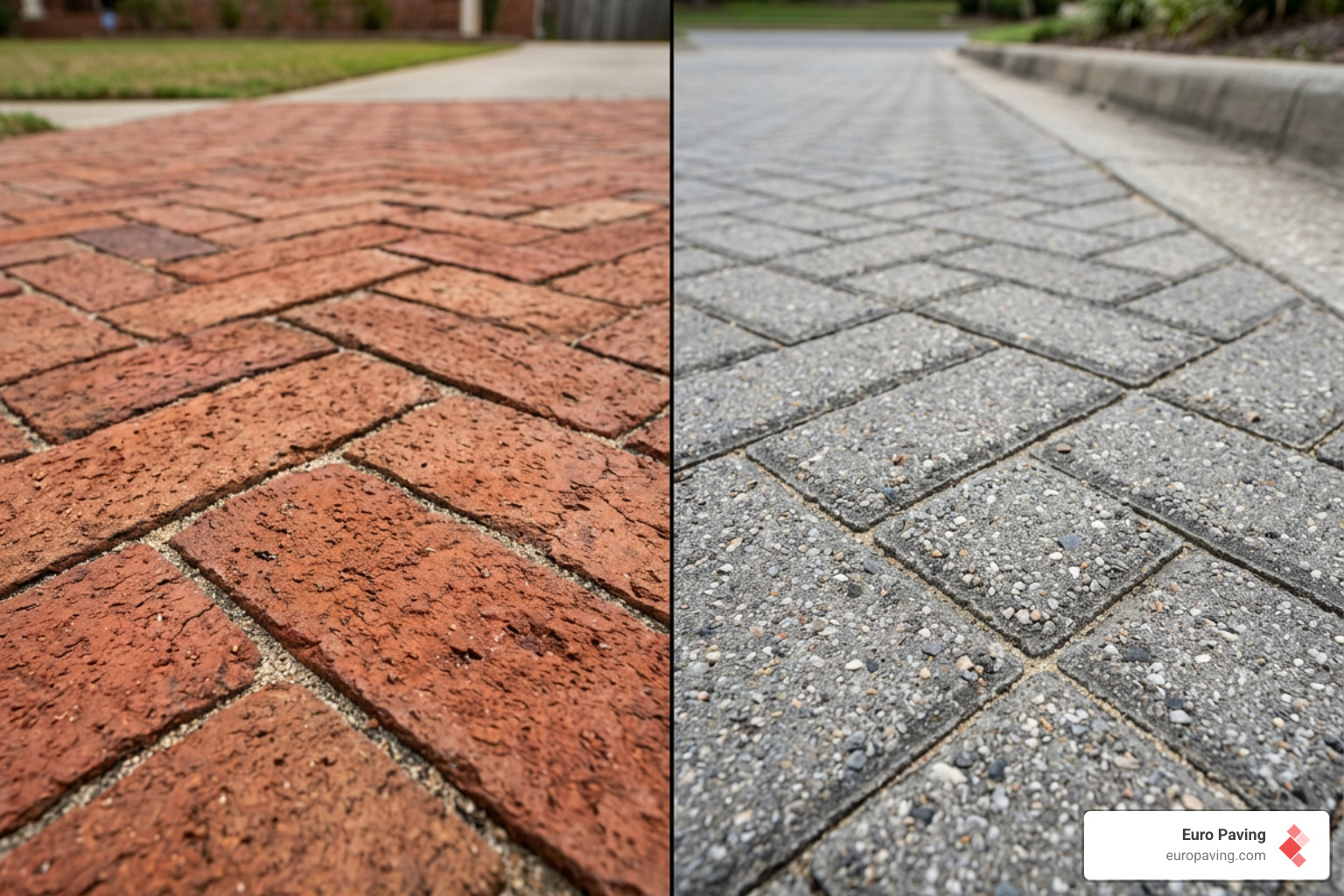
- Clay Bricks: These are made from natural clay fired in a kiln at extremely high temperatures. They are famous for their “forever” color—since the color is natural to the clay, it will never fade, even after 50 years of Chicago sun and snow. They offer a classic, regal aesthetic that is hard to beat.
- Concrete Pavers: These are manufactured using a precise mix of cement and various aggregates. Because they are molded, they come in a much wider variety of shapes, sizes, and textures. Brands like Fendt have set high manufacturing standards, ensuring these pavers are tested for extreme durability.
Both materials are excellent for driveways, but they differ significantly from traditional poured concrete or asphalt. Unlike a solid slab of concrete that is prone to cracking as the ground shifts, a paver system is flexible. If the ground moves, the pavers move with it. For more details on why this flexibility is a game-changer, check out our guide on Driveway Types: 4 Reasons to Choose Brick Pavers.
Material Durability and PSI Ratings
One of the most impressive stats about a brick paver driveway is its compressive strength. Standard poured concrete usually handles about 3,000 to 4,000 PSI (pounds per square inch). In contrast, interlocking brick pavers are manufactured to withstand at least 8,000 PSI, and many high-end concrete pavers reach up to 12,000 PSI.
This means your driveway is nearly four times stronger than a standard concrete slab. It can handle heavy SUVs, delivery trucks, and the constant “wear and tear” of daily life without crumbling. When homeowners ask, Is a Brick Driveway Cheaper Than Concrete?, we often explain that while the initial investment is higher, the lack of expensive crack repairs and the 50-year lifespan make it the more cost-effective choice over time.
Sourcing High-Quality Pavers
We believe in using only the best materials because our reputation is built on the longevity of our work. We specialize in Unilock materials, which are renowned for their stability and aesthetic versatility. As authorized contractors, we provide access to “EnduraColor” technology and “Ultima” concrete, which makes pavers up to four times stronger than poured concrete.
When you source through a professional like Euro Paving, you aren’t just getting bricks from a big-box store. You are getting high-density units that come with lifetime product guarantees against cracking, chipping, and breaking.
Benefits of Installing a Brick Paver Driveway
Why choose pavers over the standard asphalt we see in so many Chicago neighborhoods? It comes down to performance and “razzle dazzle.”
50-Year Lifespan and Resilience
A well-maintained brick paver driveway can last up to 50 years. Asphalt, by comparison, often needs to be replaced every 12 to 20 years and requires messy sealcoating every other year just to stay functional. Pavers are resistant to salt erosion—a major plus for those of us in Arlington Heights or Hinsdale who deal with heavy road salt in the winter.
For a deeper dive into the comparison, see our article on 8 Benefits of Having Brick Driveway Instead of Asphalt Driveway.
Enhancing Curb Appeal and Home Value
Hardscaping is one of the few home improvements that consistently offers a massive return on investment (ROI). Real estate experts suggest that high-quality landscaping and driveways can lead to a 200% to 300% return. If you invest $10,000 in a premium paver project, it’s estimated to yield roughly a $20,000 increase in your home’s value upon sale.
Beyond the numbers, there is the “architectural harmony.” Whether your home is a modern build in Northbrook or a classic Victorian in Lake Forest, we can find a paver style that complements the architecture. Our Tips for Designing a Driveway with Brick Pavers can help you choose the right aesthetic.
Performance in Cold Climates
Chicago winters are the ultimate test for any driveway. Between freeze-thaw cycles and heavy snow removal, standard surfaces often fail.
- Freeze-Thaw Resilience: Because pavers have sand-filled joints, they can expand and contract as the ground freezes and thaws. This prevents the “heaving” and cracking that ruins concrete slabs.
- Snow Removal: Modern pavers are manufactured with smooth, chamfered edges, making them perfectly safe for snowplows and shovels. Darker colored pavers even help melt snow faster by absorbing more heat from the sun.
- Non-Skid Surface: Even when wet or icy, the texture of brick pavers provides better traction for tires and feet than smooth concrete.
Design Patterns and Permeable Solutions
Design is where we really get to have fun. With over 50 different colors, shapes, and patterns available, your driveway can be a unique work of art.
Choosing the Right Pattern
The pattern isn’t just about looks; it’s about structural integrity.
- Herringbone: This is the gold standard for driveways. Because the bricks are set at 45 or 90-degree angles to each other, they lock together most effectively, preventing the pavers from shifting under the pressure of turning tires.
- Basketweave: A classic look that evokes a traditional, “Old World” feel.
- Running Bond: Simple and modern, often used for borders or to make a driveway appear longer or wider.
You can explore more about these styles on our Driveway Paving service page.
The Role of Permeable Brick Paver Driveway Systems
In many Chicago suburbs, managing stormwater is a legal requirement. Permeable pavers are an eco-friendly solution designed with slightly larger joints filled with small stones. This allows rainwater to seep directly into the ground rather than running off into the street or overloading your home’s drainage system.
We often utilize Belgard Commercial drainage solutions for larger projects. These systems act as a natural filter, replenishing groundwater and reducing the risk of standing water on your property.
Custom Features and 3D Modeling
We don’t just “guess” what your driveway will look like. We use 3D design planning to help you visualize the final result. This allows us to integrate custom features like:
- Pillars and Borders: Adding a double-course border in a contrasting color can make the driveway “pop.”
- Lighting Integration: Low-voltage LED lighting built directly into the pavers or borders adds safety and nighttime elegance.
- Natural Stone Accents: Combining Unilock pavers with natural stone steps or walkways creates a high-end, custom look.
Professional Installation and Maintenance Standards
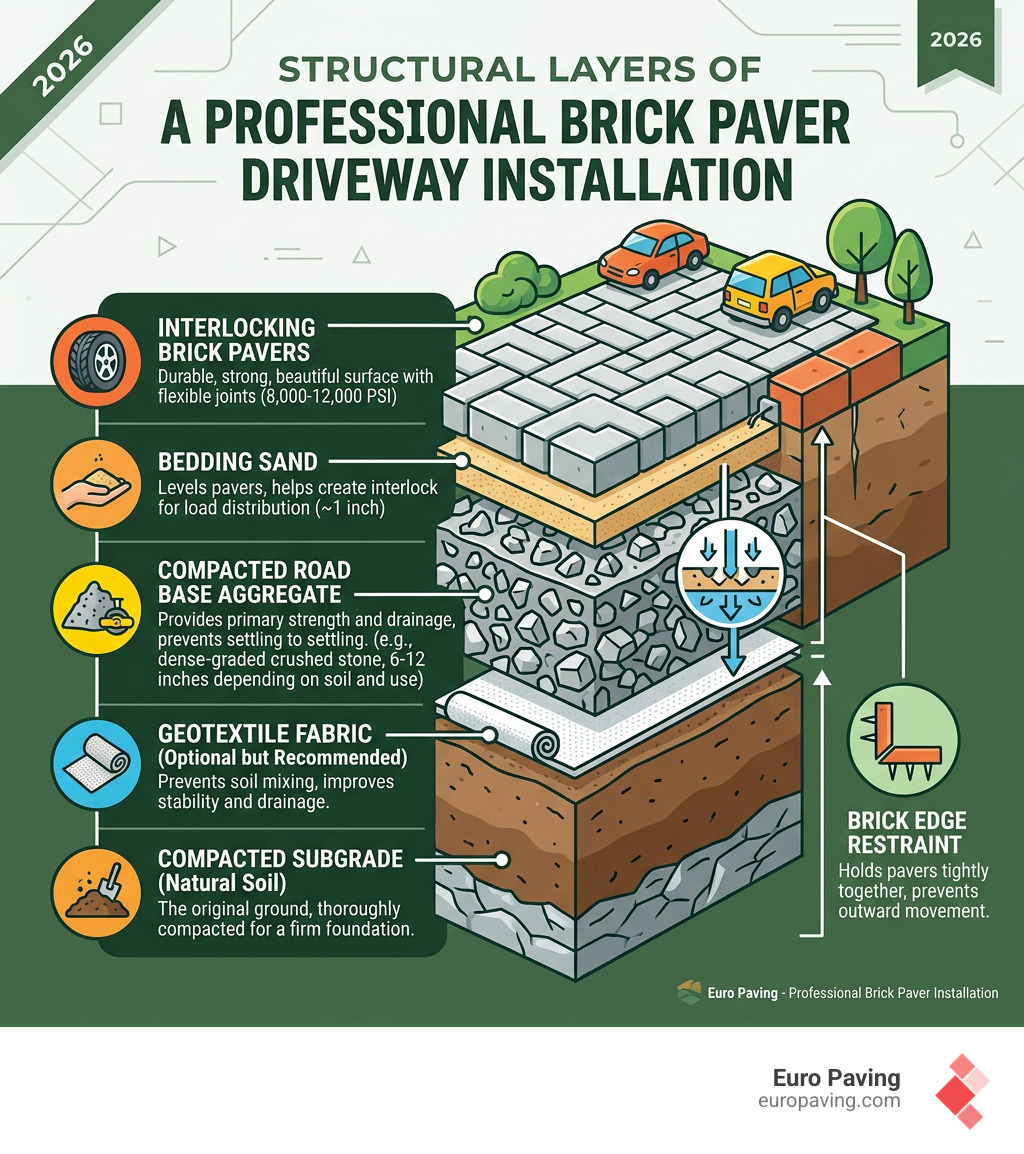
A brick paver driveway is only as good as the “invisible” work underneath it. At Euro Paving, we follow a rigorous five-step process to ensure your driveway never sags or shifts.
The Installation Process
- Excavation and Subgrade: We typically excavate to a depth of 12 inches. The “subgrade” (the natural soil) must be compacted perfectly.
- Geotextile Fabric: We lay down a professional-grade fabric that prevents the soil from mixing with our gravel base while still allowing water to pass through.
- Gravel Base: We add 8 to 10 inches of crushed gravel in layers, compacting each layer with heavy machinery. This is the “skeleton” of your driveway.
- Sand Bedding: A 1-inch layer of concrete sand is screeded perfectly flat to provide a seat for the pavers.
- Edge Restraints: We install heavy-duty restraints along the perimeter to keep the pavers from “creeping” outward over time.
For a more detailed breakdown, read our guide on How to Lay a Brick Driveway.
Long-Term Care for a Brick Paver Driveway
One of the biggest myths is that pavers are “high maintenance.” In reality, they are very easy to care for.
- Sealing: We recommend resealing your pavers every 3 to 5 years. This protects the color from UV rays and prevents oil stains from soaking into the material. There are 7 Benefits of Sealcoating Your Brick Driveway, including easier snow removal and weed prevention.
- Polymeric Sand: This is a special sand that hardens when wet. It stays in the joints, preventing weeds from growing and ants from tunneling.
- Power Washing: An occasional wash will keep the colors looking as vibrant as the day they were installed.
Frequently Asked Questions
How much does a brick paver driveway cost? Typically, you can expect to pay between $10 and $20 per square foot for professional installation. While this is more than asphalt, the 50-year lifespan and the 2x ROI make it a superior financial choice.
What if a paver gets stained or cracked? This is the “secret weapon” of pavers. If a single brick is damaged by a major oil spill or a heavy impact, we can simply pop that one brick out and replace it with a new one. You can’t do that with concrete or asphalt without leaving an ugly patch.
How do you handle cracks? Because the system is flexible, pavers themselves rarely crack. If you notice a “gap,” it’s usually just the joint sand settling. Learn How to Repair Driveway Cracks and joint issues in our maintenance section.
Are they slippery in the winter? No. In fact, pavers often provide better grip than poured concrete because of the texture and the frequency of the joints.
Conclusion: Trust the Experts at Euro Paving
A brick paver driveway is an investment in your home’s future. It’s a statement of quality that pays for itself in durability, beauty, and resale value. From the initial 3D design to the final sweep of polymeric sand, our team at Euro Paving is dedicated to craftsmanship that stands the test of time.
We serve homeowners throughout the Chicago area, including:
- Arlington Heights
- Hinsdale
- Mount Prospect
- Norridge
- Northbrook
- Skokie
- And many more Cook and DuPage County communities.
We are ICPI certified and offer a 10-year labor and workmanship warranty, alongside the lifetime material guarantees provided by our suppliers. We don’t just build driveways; we build lasting entrances to your home.
Ready to transform your curb appeal? Explore our Brick Paving Driveways services or contact us today to schedule a consultation. Let’s build something beautiful together.