



Popular Brick Paver Walkway Designs and Patterns
Brick paver walkway designs can completely transform the front of your home — turning a plain path into a stunning first impression that guests remember.
Here are the most popular brick paver walkway designs to consider:
| Design Pattern | Best For | Difficulty |
|---|---|---|
| Herringbone | Curved or high-traffic paths | Intermediate |
| Running Bond | Straight paths, first-time projects | Easy |
| Basketweave | Cottage or vintage style | Easy–Intermediate |
| Pinwheel | Decorative focal points | Intermediate |
| Concentric Square | Large, open entry areas | Advanced |
Whether you want a charming cottage path lined with hydrangeas or a sleek modern entrance for a contemporary home, there’s a brick paver pattern to match your vision — and your home’s architecture.
But great design is only half the story. How the walkway is built determines whether it lasts 5 years or 50. A poorly installed path shifts, cracks, and sprouts weeds. A professionally installed one stays flat, drains properly, and adds real value to your property.
At Euro Paving, we help Chicago-area homeowners — from Arlington Heights to Elmhurst — design and install brick paver walkways that look beautiful and stand up to Midwest winters.
Below, we’ll walk you through the best designs, patterns, and features to consider for your project.
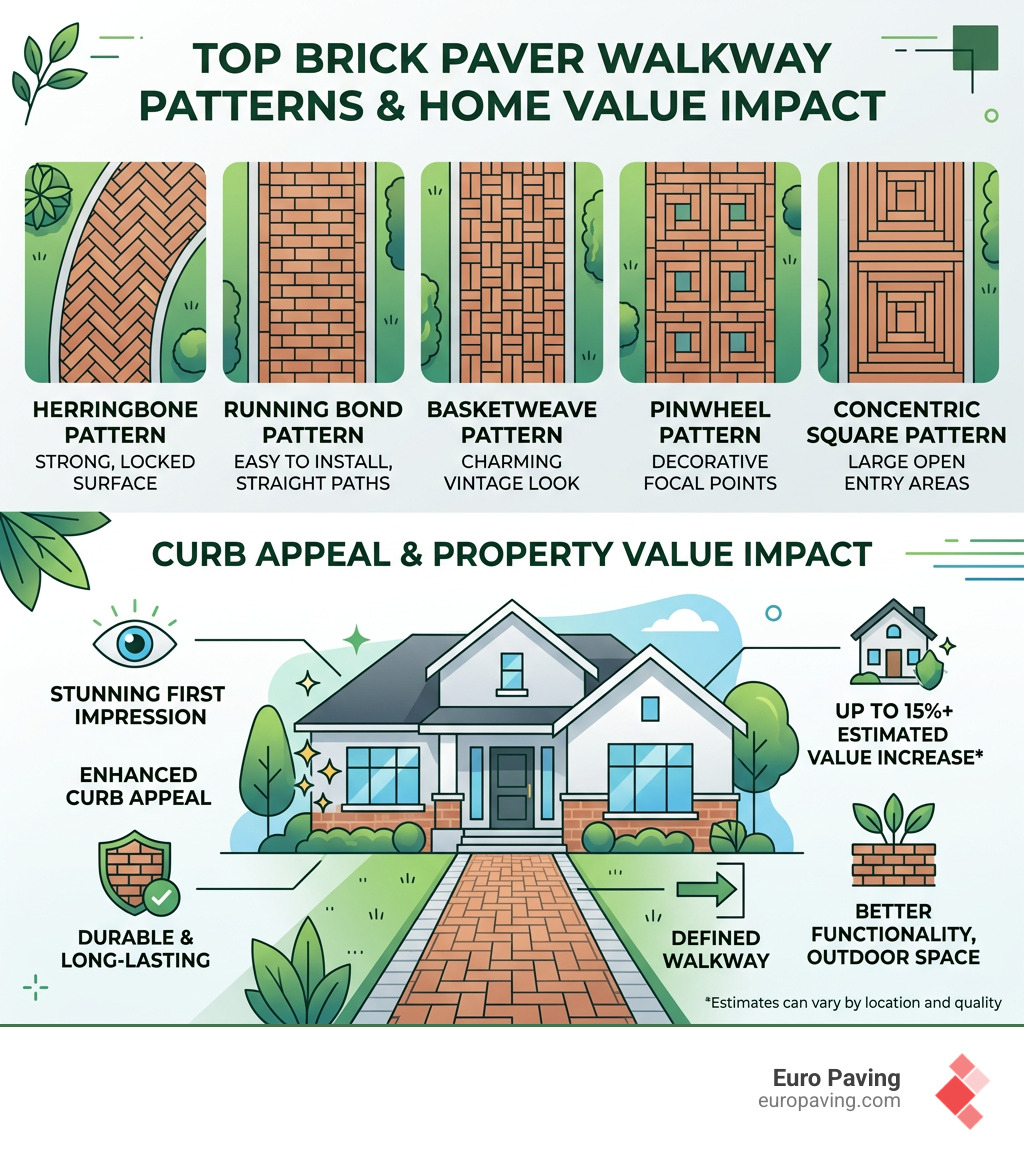
When we sit down with homeowners in Skokie or Barrington to plan a new entrance, the first thing we discuss is the pattern. The layout of your pavers isn’t just about looks; it’s about structural integrity and how the path directs the eye.
The herringbone pattern is perhaps the most iconic of all brick paver walkway designs. By laying bricks at 45-degree or 90-degree angles to each other, we create a “locking” effect. This makes it incredibly durable for high-traffic areas because the bricks are less likely to shift under foot traffic. It’s a centuries-old design that looks just as good in a Northbrook garden as it does in a historic European city.
For those who prefer a cleaner, more traditional look, the running bond is a go-to. It consists of parallel rows where the joints are offset by half a brick. It’s excellent for making a narrow path appear longer. If you’re looking for something with a bit of “old-world” charm, the basketweave pattern uses pairs of bricks laid at right angles to create a woven appearance.
We also specialize in more intricate layouts like the pinwheel—where a small central square is surrounded by four larger bricks—and concentric squares, which are perfect for creating a focal point at the start of a walkway or where two paths meet. You can explore more visual inspiration in our gallery of Beautiful Brick Sidewalks.
Timeless Patterns for Brick Paver Walkway Designs
There is something inherently comforting about a traditional brick path. For homes with classic architecture in areas like Hinsdale or Lake Forest, we often recommend clay pavers. Unlike concrete, clay pavers are through-body colored, meaning the rich red or earthy orange tones won’t fade over decades of sun exposure.
Weathered textures and tumbled edges provide a rustic charm that feels like the path has been there for a century. These “heirloom” designs work beautifully when paired with natural stone accents or fieldstone borders. If you are looking to replace a crumbling concrete sidewalk with something that has more character, you can find more info about sidewalk paving services on our dedicated service page.
Modern and Custom Brick Paver Walkway Designs
If your home leans toward modern minimalism, your brick paver walkway designs should reflect that. We often use large-format pavers with clean, sharp lines and minimal chamfers to create a sleek, “runway” effect. Instead of traditional reds, we might suggest cool grays, deep charcoals, or even “wood-look” pavers that provide the warmth of timber with the durability of stone.
Geometric precision is key here. We use minimalist borders in contrasting colors to frame the walkway, giving it a high-end, architectural feel. For homeowners who love to entertain, we can even integrate your walkway directly into a backyard oasis featuring Zentro Fire Pit Inserts, creating a seamless transition from your front door to your evening relaxation spot.
Matching Walkway Styles to Your Home’s Architecture
A common mistake we see is choosing a paver style that clashes with the home. A ultra-modern porcelain paver might look out of place next to a 1920s Tudor in Winnetka. Our goal is to create architectural harmony.
- Cottage and Farmhouse: For these styles, we love using “meandering” paths with soft curves. A basketweave or a simple running bond in varied “autumn” tones works perfectly.
- Southern Colonial: This style demands symmetry. A wide, straight herringbone path in a classic red brick creates the formal, grand entrance this architecture deserves.
- Modern Minimalism: Stick to monochromatic palettes—shades of white, gray, or black. Large, square pavers with tight joints create the “less is more” vibe.
- Mediterranean: Terracotta-style pavers or warm tan tones evoke a coastal feel that pairs beautifully with stucco or stone exteriors.
Investing in the right design doesn’t just make your house look better; it’s a smart financial move. There are at least 11 Benefits of Adding a Brick Sidewalk to Your Home, ranging from improved safety to significantly higher resale value.
Designing for Accessibility and Comfort
A walkway that is too narrow feels cramped and unwelcoming. We follow industry standards to ensure your path is as functional as it is beautiful:
- 36-inch standard: This is the minimum width for a single person to walk comfortably.
- 48-inch comfort: This allows two people to walk side-by-side. We almost always recommend this for front entrances in the Chicago area.
- 60-inch turnaround: If you or your guests use mobility devices like wheelchairs, we design “landing zones” or wider sections to allow for easy turning.
We also focus on smooth transitions. We ensure the pavers are flush with your driveway and porch to eliminate trip hazards, which is a vital part of a family-friendly design.
Integrated Lighting and Safety Features
Safety doesn’t have to be boring. We incorporate non-slip textures into all our brick paver walkway designs, ensuring that even during a rainy Chicago spring or a snowy winter, your path remains grippy.
To bring your walkway to life after the sun sets, we recommend integrated low-voltage LED lighting. This can include:
- In-paver lighting: Small lights embedded directly into the brickwork to outline the path.
- Mushroom lights: Classic fixtures that cast a gentle glow downward onto the pavers.
- Path lighting: Strategically placed fixtures in nearby flower beds to highlight both the path and your landscaping.
You can browse various outdoor lights and lighting accessories to see how different fixtures can enhance your home’s nighttime curb appeal.
Why Professional Installation Beats Poured Concrete
Many homeowners ask us why they should choose pavers over a simple poured concrete slab. While concrete might seem cheaper initially, it often fails in our Illinois climate.
| Feature | Brick Pavers | Poured Concrete |
|---|---|---|
| Durability | High (Flexible) | Moderate (Prone to cracking) |
| Maintenance | Easy (Replace individual bricks) | Hard (Requires patching or full repour) |
| Appearance | Custom, high-end | Plain, industrial |
| Drainage | Permeable options available | Non-permeable (Puddling) |
| Lifespan | 25–50+ years | 10–20 years |
In the Chicago area, our soil goes through intense “freeze-thaw” cycles. Concrete is rigid, so when the ground shifts, the concrete cracks. Brick pavers are a flexible pavement system. They move slightly with the ground and then settle back into place. Plus, we use high-quality Unilock materials that come with lifetime guarantees, ensuring your investment is protected. For a deeper dive into the long-term value, read about The Benefits of a Brick Sidewalk and Brick Driveway.
Professional Grade Base and Foundation
The secret to a walkway that never sags is the “invisible” work beneath the surface. At Euro Paving, we don’t cut corners on the foundation.
- Excavation: We dig 8 to 9 inches deep to make room for a proper base.
- Stabilization Fabric: We lay permeable landscape fabric to keep the stone base from mixing with the dirt below.
- 6-inch Gravel Base: We use crushed road stone, compacted in layers, to create a rock-solid foundation that allows for drainage.
- Sand Bed: A 1-inch layer of screeded sand provides the final leveling surface for the bricks.
- Polymeric Sand: Once the bricks are laid, we sweep in polymeric sand, which hardens when misted with water. This locks the bricks in place and acts as a powerful weed barrier.
For extra-wide joints or specific drainage needs, we may use advanced products like GFTK Xtreme Joint Compound, which is water-permeable and incredibly durable.
Enhancing Relaxing Spaces with Custom Hardscaping
A walkway shouldn’t just be a way to get from point A to point B; it should be an invitation to enjoy your outdoor space. We specialize in Sidewalks and Walkways Design and Build a Beautiful Outdoor Living Space that connects your entire property.
Imagine a curved brick path that starts at your driveway, winds past a lush garden bed, and opens up into a custom patio with a built-in fire pit. We use 3D design planning to show you exactly how these elements will look before we even break ground. This allows us to create family-friendly layouts where the kids have room to play while the adults relax by the outdoor kitchen.
Frequently Asked Questions about Brick Paver Walkway Designs
What is the most durable pattern for high-traffic walkways?
The herringbone pattern is widely considered the most durable. Because the bricks are set at angles, they distribute weight more evenly and resist shifting from the “shoving” force of foot traffic or heavy garden carts better than linear patterns like running bond.
How do professional installers prevent weeds and shifting?
We prevent shifting by using a 6-inch compacted gravel base and heavy-duty edge restraints (spiked every 12 inches). To stop weeds, we use a combination of landscape fabric beneath the base and polymeric sand in the joints. This sand hardens to create a seal that wind-blown seeds cannot penetrate.
How wide should a front entrance walkway be for two people?
For two people to walk comfortably side-by-side, the walkway should be 48 inches (4 feet) wide. This width feels generous and welcoming, whereas a standard 36-inch path can feel a bit tight for guests arriving in pairs.
Conclusion
Your home’s exterior is the first thing people see, and a well-designed walkway is the “red carpet” that welcomes them. Whether you are in Arlington Heights, Northbrook, Glenview, or Hinsdale, Euro Paving has the local expertise to bring your brick paver walkway designs to life.
We don’t just lay bricks; we build lasting outdoor environments. From the initial 3D design to the final sweep of jointing sand, our team is dedicated to craftsmanship and customer satisfaction. Ready to elevate your curb appeal and create a space your family will love for years to come?
Schedule a consultation for your brick paver walkway project with Euro Paving today, and let’s start building something beautiful together.