



Why Paving a Sidewalk the Right Way Matters More Than You Think
Paving a sidewalk is one of the most impactful upgrades you can make to your home or commercial property — and it’s also one of the easiest to get wrong.
If you’re ready to hire a professional, here’s what to know upfront:
- Choose your material — Brick pavers, concrete, or natural stone each offer different durability, aesthetics, and maintenance needs.
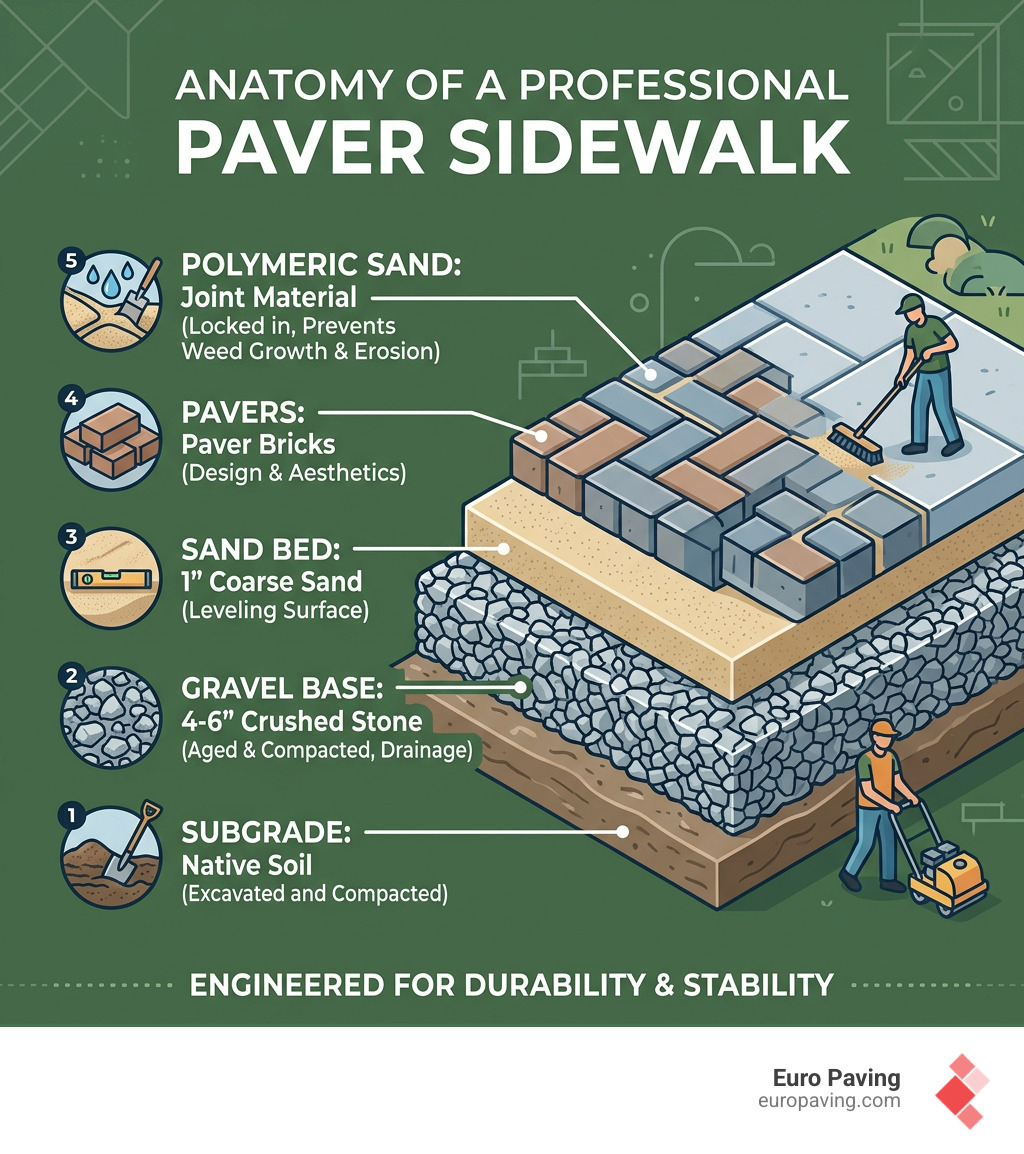
- Ensure proper base preparation — A compacted gravel base (4 inches minimum) plus a sand or limestone bedding layer is non-negotiable for long-term stability.
- Plan for drainage — The walkway must slope away from your home at 1/8 to 1/4 inch per foot.
- Check local codes — In the Chicago suburbs, permits, HOA rules, and utility checks (call 811) may be required before work begins.
- Hire a certified contractor — Proper compaction, material selection, and finishing require professional equipment and expertise.
A poorly installed sidewalk doesn’t just look bad. It creates tripping hazards, floods toward your foundation, and starts cracking or sinking within a few seasons — especially in the Chicago area, where freeze-thaw cycles are brutal on improperly built surfaces.
The difference between a sidewalk that lasts two years and one that lasts twenty or more comes down almost entirely to the quality of installation.
That’s exactly what Euro Paving specializes in — residential and commercial sidewalk paving built to survive Chicago’s climate, meet local codes, and look sharp for decades.
The Engineering Behind Paving a Sidewalk for Durability
When we talk about paving a sidewalk, many people focus on the surface — the beautiful brick patterns or the smooth finish of the concrete. But as experts in the landscaping and hardscaping industry, we know that the real magic happens underground. The longevity of your walkway is determined by the engineering of the base layers.
In the Chicago area, from Arlington Heights to Downers Grove, our soil deals with significant moisture and extreme temperature swings. If the ground isn’t prepared correctly, the first deep freeze will cause the soil to heave, pushing your pavers or concrete upward and creating dangerous uneven edges.
Subgrade Preparation and Soil Compaction
The first step in our professional process is excavating the site to a depth of 8 to 10 inches. We don’t just dig a hole; we prepare a foundation. We remove all organic matter, such as sod and tree roots, which can decompose over time and cause the sidewalk to sink.
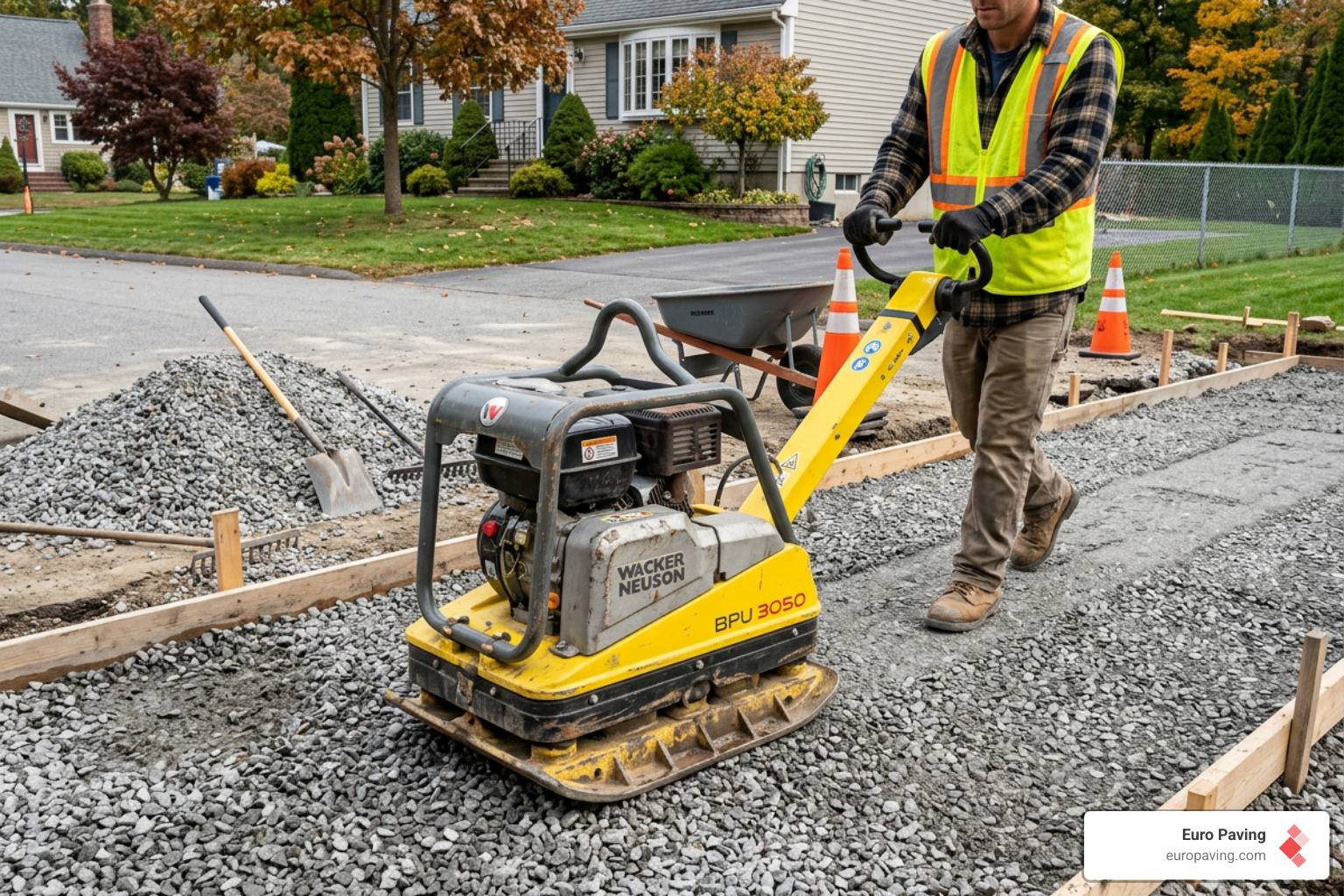
Once the area is cleared, we use a commercial-grade plate compactor. This isn’t a hand tool you’d find in a basic DIY kit; it’s a heavy-duty machine that ensures the subgrade is perfectly dense. Uniform compaction is vital because it prevents “differential settlement” — that’s the industry term for when one part of your sidewalk sinks faster than the rest, leading to those annoying cracks and puddles.
Navigating the Chicago Freeze-Thaw Cycle
Our local climate is one of the toughest in the country for hardscaping. To combat this, we follow the Best Practices for Concrete Sidewalk Construction (PDF) and apply those same high standards to our paver installations.
A critical component of this is the granular subbase. We typically install a 4-to-6-inch layer of crushed limestone or gravel. This layer provides a “bridge” over minor soil defects and allows water to drain away from the surface rather than sitting underneath and freezing.
Drainage and Slope: The 1/4 Inch Rule
Water is the enemy of any paved surface. If water pools on your sidewalk, it will eventually find its way into the base or, worse, toward your home’s foundation. We calculate the slope for every project with precision. The standard industry recommendation is a slope of 1/8 to 1/4 inch per foot away from any structures.
For many residential projects in Winnetka or Hinsdale, we might also recommend a “crowned” surface, where the center of the sidewalk is slightly higher than the edges, ensuring that heavy rain sheds off both sides immediately.
Structural Integrity: Limestone Screening vs. Sand
While some installers use plain sand for the bedding layer, we often prefer limestone screening. Why? Because it compacts better and offers superior structural integrity. This layer, usually about 1 to 1.5 inches thick, provides the final level surface upon which the pavers are set.
Comparing Professional Sidewalk Solutions
| Feature | Professional Concrete Pouring | Professional Brick Paver Installation |
|---|---|---|
| Average Lifespan | 20–40 Years | 25–50+ Years (with maintenance) |
| Repairability | Difficult (requires patching or replacement) | Easy (individual pavers can be replaced) |
| Aesthetics | Clean, modern, or stamped | High-end, classic, customizable |
| Climate Resilience | Prone to cracking if not jointed correctly | Flexible; moves with freeze-thaw cycles |
| Installation Time | Fast pour, but requires curing time | Labor-intensive but ready for use immediately |
Material Selection for Paving a Sidewalk
Choosing the right material is about more than just color; it’s about how the material performs under pressure. At Euro Paving, we specialize in high-performance materials that stand the test of time.
- Unilock Pavers: As authorized contractors, we highly recommend Unilock for Brick Paving Sidewalks. These pavers are manufactured to be up to four times stronger than poured concrete. They come in a staggering variety of textures and colors, allowing us to match the architectural style of any home in Skokie or Northbrook.
- Natural Stone: For a truly high-end look, natural stone slabs offer a timeless appeal. While they require expert cutting and placement, the result is a one-of-a-kind walkway that increases property value significantly.
- High-Strength Concrete: When a client prefers the clean look of concrete, we use fiber-reinforced mixes. This technology incorporates small fibers throughout the concrete to reduce shrinkage cracking and improve impact resistance.
- Permeable Options: In areas of the Chicago suburbs where stormwater runoff is a concern, we offer permeable paving solutions. These systems allow water to flow through the joints and back into the ground, reducing the load on municipal sewer systems and preventing ice buildup on the surface.
Long-Term Maintenance After Paving a Sidewalk
One of the reasons we are so passionate about paving a sidewalk with pavers is the ease of long-term care. Unlike a single slab of concrete that can crack and require an entire section to be jackhammered out, a paver system is modular.
Polymeric Sand and Joint Stabilization The secret to a “locked-in” paver sidewalk is polymeric sand. This isn’t your standard playground sand; it contains special additives that harden when activated by water. This creates a powerful bond that prevents the pavers from shifting, stops weeds from growing in the joints, and discourages ants from making a home under your walkway.
Sealing and Power Washing To keep your sidewalk looking as fresh as the day it was installed, we recommend a professional cleaning and sealing every two to three years. Sealing protects the pavers from UV fading, oil stains, and the harsh salt used during Chicago winters. There are 11 Benefits of Adding a Brick Sidewalk to Your Home, and high on that list is the fact that a well-maintained brick path can last a lifetime.
Root Management We’ve all seen sidewalks that have been uprooted by nearby trees. During our installation process, we assess the proximity of trees. We recommend maintaining a distance of at least two sidewalk widths from large trees or installing root barriers to ensure your beautiful new path isn’t ruined by nature’s slow-motion strength.
Design Aesthetics and Curb Appeal
Your sidewalk is the “red carpet” to your front door. It’s the first thing guests experience when they arrive at your home. We take pride in paving a sidewalk that doesn’t just function well but also serves as a piece of art.
3D Design Planning
We don’t believe in guesswork. For our clients in Lake Forest and Highland Park, we offer 3D design planning. This allows you to see exactly how your new walkway will integrate with your existing landscaping, porch, and driveway before a single shovel hits the dirt.
Patterns and Shapes
The pattern you choose can change the entire “vibe” of your property:
- Running Bond: A classic, staggered look that is clean and modern.
- Herringbone: Highly durable because the interlocking pattern distributes weight evenly. It offers a sophisticated, traditional feel.
- S-Shaped Paths: Who says a sidewalk has to be straight? Curved paths add visual interest and can help navigate around mature trees or garden features.
When we Design and Build a Beautiful Outdoor Living Space, we often integrate border stones in a contrasting color to “frame” the walkway, giving it a polished, professional finish.
Landscape Integration and Lighting
A sidewalk shouldn’t exist in a vacuum. We often work to raise adjacent garden beds or transplant shrubs to ensure the new path feels like it has always been there. Adding low-voltage LED lighting along the path not only enhances safety for nighttime arrivals but also highlights the texture of the pavers, creating a stunning evening ambiance.
Commercial vs. Residential Standards
While the basic principles of paving a sidewalk remain the same, commercial projects have much stricter requirements. Whether we are working on a storefront in Chicago or a large office park in Mount Prospect, we adhere to the highest standards of safety and durability.
Load-Bearing Capacity
Commercial sidewalks often have to deal with more than just foot traffic. Delivery carts, maintenance vehicles, and heavy snow removal equipment mean the base must be even thicker — often up to 8 or 12 inches of compacted stone — to prevent failure.
ADA Compliance and Accessibility
Accessibility is not optional. We ensure all our commercial sidewalks meet ADA (Americans with Disabilities Act) standards:
- Minimum Width: A standard residential walk might be 36 inches, but we recommend 48 to 60 inches for commercial areas to allow two people to walk side-by-side comfortably.
- Turnaround Space: We incorporate 60-inch turnaround areas for wheelchairs where required by code.
- Safety Textures: We use pavers with slip-resistant textures to ensure safety during our wet and icy Chicago winters.
Municipal and County Regulations
From Cook County to DuPage County, every municipality has its own set of rules regarding sidewalk thickness, reinforcement, and property line setbacks. We handle the technical details and ensure that your project is fully compliant with local codes, preventing future fines or legal headaches.
Frequently Asked Questions about Sidewalk Paving
Do I need a permit for sidewalk installation in Chicago suburbs?
In most cases, yes. Municipalities like Downers Grove, Barrington, and Roselle usually require a permit for any new permanent structure, including sidewalks. This ensures the project doesn’t interfere with drainage or public utilities. We also always call 811 before we dig to locate underground gas, water, and power lines — a step that is absolutely vital for safety.
How long does a professional paver sidewalk last?
With proper installation and minimal maintenance, a high-quality paver sidewalk can easily last 25 to 50 years. The modular nature of pavers means that if a single stone is damaged (perhaps by a dropped heavy object), it can be popped out and replaced without leaving a visible “patch” like you would see in concrete.
What is the best material for preventing sidewalk cracks?
For the Chicago climate, interlocking pavers are often the best choice. Because they are individual units set on a flexible base, they can move slightly as the ground freezes and thaws. Poured concrete, on the other hand, is a rigid slab. While we use control joints and expansion joints to “tell” the concrete where to crack, pavers offer a more naturally resilient solution to our local weather.
Conclusion: Partnering with Euro Paving
Paving a sidewalk is an investment in your property’s safety, value, and beauty. Whether you are looking to replace a crumbling concrete path in Elmhurst, add a sophisticated brick walkway to your home in Hinsdale, or install a high-traffic commercial sidewalk in Lombard, Euro Paving is here to help.
We specialize in transforming outdoor spaces with fire pits, family-friendly designs, and hardscaping that stands the test of time. Our status as Unilock authorized contractors means we provide not only expert craftsmanship but also lifetime material guarantees on our paver products.
Don’t settle for a sidewalk that will sink or crack in a few years. Choose the professionals who understand the unique challenges of the Chicago landscape.
Ready to upgrade your curb appeal? Contact Euro Paving today for a consultation and let us help you design a sidewalk that is as durable as it is beautiful. We serve the entire Chicago area, including Glenview, Hillside, and beyond. Let’s build something that lasts.