



Your Driveway Is the First Thing People See — Make It Count
Brick pavement for driveway projects is one of the smartest hardscape investments a homeowner can make in 2026. It combines lasting durability, timeless curb appeal, and real property value — all in one surface.
Here’s a quick look at your top options before we dive deeper:
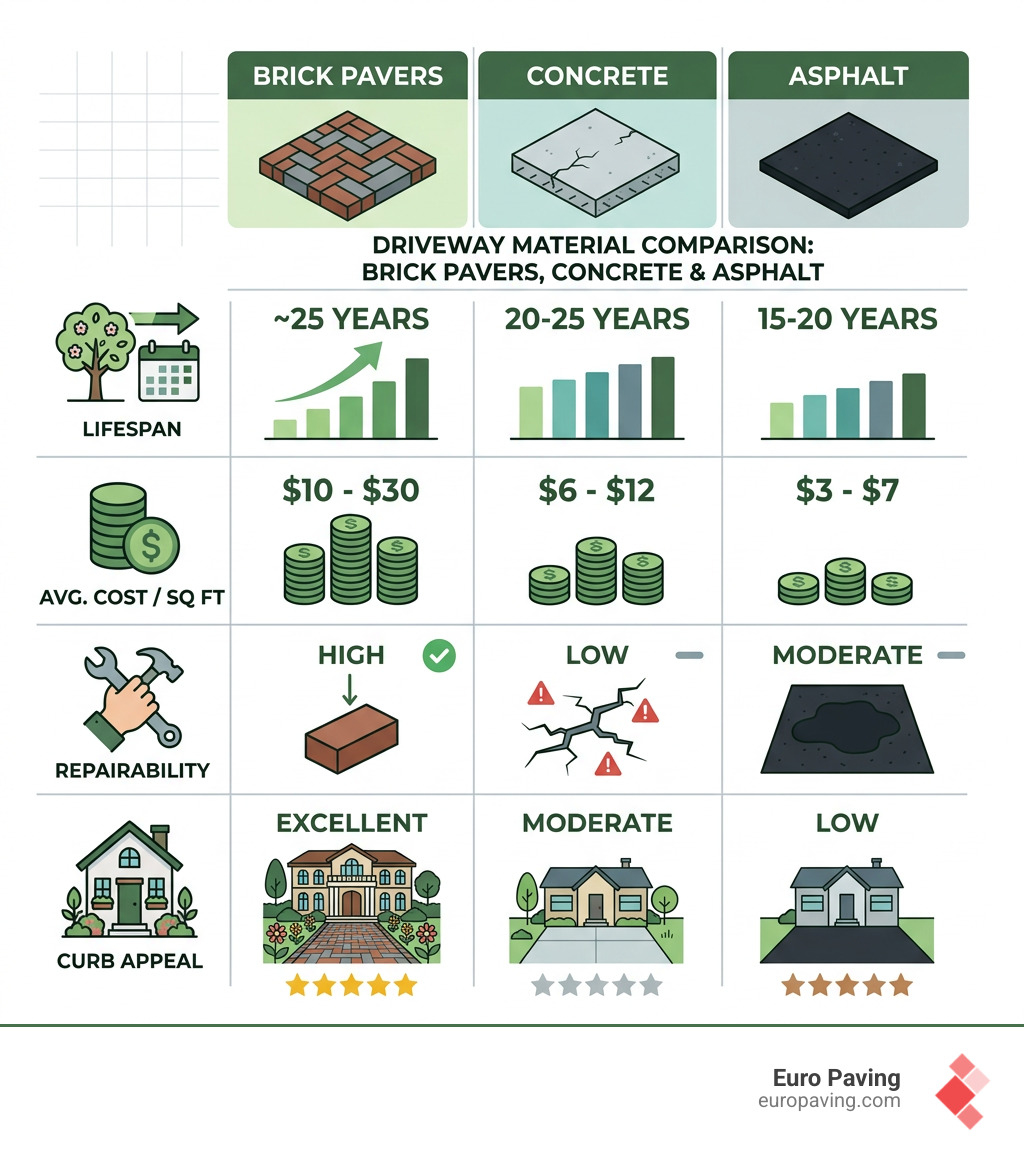
| Material | Lifespan | Avg. Cost/sq ft | Repairability | Curb Appeal |
|---|---|---|---|---|
| Brick Pavers | ~25 years | $10 – $30 | High (replace individual bricks) | Excellent |
| Concrete | 20-25 years | $6 – $12 | Low (cracks are hard to fix) | Moderate |
| Asphalt | 15-20 years | $3 – $7 | Moderate | Low |
The short answer: Brick pavers offer the best balance of aesthetics, longevity, and repair flexibility. Concrete costs less upfront but cracks under stress. Asphalt is the cheapest option but fades fast and needs frequent resealing.
Choosing the right brick paver material isn’t just about looks. It’s about how your driveway holds up under Chicago winters, heavy SUVs, and years of daily use.
In this guide, Euro Paving — a Unilock Authorized Contractor serving Elmhurst, Hinsdale, Arlington Heights, and surrounding suburbs — breaks down everything you need to know before buying brick driveway paving materials.
Comparing Brick Pavement for Driveway vs. Concrete and Asphalt
When we talk to homeowners in places like Skokie or Downers Grove, the debate usually boils down to three materials: brick, concrete, and asphalt. While concrete and asphalt are common, they often lack the “soul” and structural resilience of a well-engineered brick pavement for driveway.
Durability isn’t just about how hard a material is; it’s about how it handles movement. In the Chicago area, our soil shifts constantly due to moisture and temperature changes. Standard poured concrete is a rigid slab. When the ground moves, the concrete has two choices: bend (which it can’t) or crack (which it does). Asphalt is more flexible but suffers from UV degradation and requires high maintenance to prevent it from becoming brittle.
Brick pavers, however, are a segmental paving system. Because they are individual units sand-jointed together, they allow for minor expansion and contraction without cracking. This “interlocking” nature provides superior weight distribution, making it ideal for the heavy loads of modern SUVs and delivery trucks.
| Feature | Brick Pavers | Poured Concrete | Asphalt |
|---|---|---|---|
| Lifespan | 25+ Years | 20 Years | 15-20 Years |
| Maintenance | Low (Occasional Sealing) | Moderate (Crack Repair) | High (Sealcoating every 2-3 years) |
| ROI | High | Moderate | Low |
| Primary Benefit | Flexibility & Beauty | Lower Initial Cost | Lowest Initial Cost |
Aesthetic Superiority and Home Value
There is a reason why luxury homes in Lake Forest and Hinsdale almost exclusively feature brick or stone driveways. Fired-clay bricks offer a richness and vibrancy that dyed concrete simply cannot match. Because the color is baked into the clay at incredibly high temperatures, it doesn’t fade under the sun.
Whether you are aiming for the look of a Tuscan villa, a Craftsman cottage, or a sleek modern estate, the architectural variety of brick is unmatched. Choosing the right style can significantly boost your home value in 2026, making the driveway a centerpiece rather than just a functional path. You can learn more about why brick is a top choice for driveway types to see how it complements different Chicago architectures.
Maintenance and Repair Flexibility
One of the most frustrating things about a concrete driveway is that if a tree root pushes up one section or a utility line needs to be repaired underneath, you have to jackhammer the slab and patch it. The patch never matches the original color.
With a brick pavement for driveway, we can simply unzip the area, remove the individual bricks, fix the underlying issue, and relay the same bricks. It’s seamless. Even issues like spalling (where the surface of a brick flakes off) are easy to manage. Instead of resurfacing the whole driveway, you replace the $2 brick. This flexibility is a major reason why avoiding common driveway renovation problems starts with choosing a segmental system.
Structural Integrity: Installation and Subgrade Requirements
A beautiful driveway is only as good as what’s underneath it. At Euro Paving, we spend more time on the “invisible” parts of the project than the bricks themselves. If you skip on site preparation, your expensive pavers will be wavy and uneven within two seasons.
The process begins with excavation. For a standard residential driveway in the Chicago area, we typically excavate deep enough to accommodate a 12-inch base of compacted gravel, a 1-inch sand bedding layer, and the thickness of the brick itself.

The Importance of a Solid Foundation
Subgrade soil quality plays a massive role in performance. In many of our service areas like Arlington Heights and Northbrook, we deal with heavy clay soils. These soils hold water and expand when frozen. To combat this, we use a subbase of crushed limestone (typically 3/4 inch or less).
This base must be compacted to at least 95% maximum density. We often install the gravel in layers (lifts), tamping each one to ensure there are no air pockets. Proper drainage management is also built into this stage, ensuring water moves away from your home’s foundation. For those interested in the technical side, the Heavy-Duty Vehicular Paving Guide provides deep insights into how these systems are engineered for maximum load.
Engineering Brick Pavement for Driveway Traffic
To handle vehicular traffic, the pavers must achieve “interlock.” Interlock is the phenomenon where pavers transfer loads to their neighbors through friction. This is achieved through:
- Vertical Interlock: From the sand in the joints.
- Rotational Interlock: From the pavers being tightly packed.
- Horizontal Interlock: From the laying pattern (like herringbone).
Edge restraints are also non-negotiable. Without a solid border—either concrete or heavy-duty plastic edging—the pavers will migrate outward over time, opening up the joints and causing the system to fail. If you’re curious about the specifics, check our guide on how to lay a brick driveway to see the step-by-step professional approach.
Popular Patterns and Design Considerations
The pattern you choose for your brick pavement for driveway isn’t just an aesthetic choice; it’s a structural one. While a “running bond” (bricks in straight rows) looks great on a walkway, it’s often not the best choice for a driveway where tires are constantly turning and braking.
Choosing the Right Pattern for Heavy Loads
For driveways, we almost always recommend the Herringbone pattern (set at either 45 or 90 degrees). Because the bricks are nested at angles, they provide the best resistance to the horizontal forces caused by heavy vehicles. When you hit the brakes on a herringbone driveway, the force is distributed across dozens of bricks rather than pushing a single row out of place.
Other popular options include:
- Basketweave: Great for a vintage, “old-world” feel.
- Running Bond: Best used for borders or accents.
- Circular Kits: Perfect for large turnarounds or as a focal point in the center of a drive.
Understanding brick paving standards and patterns is essential for ensuring your driveway stays flat and functional for decades.
Color and Texture Selection for Chicago Homes
In the Chicago suburbs, we see a wide range of home styles.
- Tuscan and Mediterranean: Look great with “tumbled” pavers in tan, red, and charcoal blends.
- Modern and Minimalist: Benefit from large-format, smooth-surface pavers in solid greys or blacks.
- Craftsman: Often pair well with traditional deep red clay bricks.
We frequently use Unilock materials because they offer specialized textures and “EnduraColor” technology, which keeps the surface looking new even after years of Chicago’s brutal freeze-thaw cycles.
Sustainability and Permeable Brick Pavement for Driveway
As our suburbs become more developed, managing stormwater has become a major concern for local municipalities. Traditional driveways act as a slide for rainwater, sending oils and debris directly into the sewer system.
Environmental Benefits of Permeable Systems
Permeable brick pavement for driveway systems are designed with larger joints filled with small aggregate rather than sand. This allows rainwater to seep through the driveway and back into the ground.
Benefits include:
- Reduced Runoff: Helps prevent local flooding and takes the burden off city sewers.
- Groundwater Recharge: Naturally filters water as it returns to the earth.
- Heat Island Reduction: Light-colored pavers reflect more sunlight than black asphalt, keeping your property cooler.
Many homeowners find 8 benefits of having a brick driveway instead of asphalt align perfectly with these eco-friendly goals.
Long-term Performance in Freeze-Thaw Climates
One of the biggest myths is that brick driveways can’t handle Chicago winters. In reality, they often perform better than concrete. Because they are flexible, they don’t heave and crack when the frost line moves.
However, salt resistance is important. While high-quality fired clay is naturally resistant, we recommend sealcoating your brick driveway to protect the joints and prevent stains from de-icing chemicals. Regular maintenance ensures the benefits of sealcoating—like color preservation and weed prevention—last for the life of the driveway.
Investment and Maintenance Costs
Let’s talk numbers. A brick pavement for driveway is an investment. While the upfront cost is higher than asphalt, the long-term ROI and lack of replacement costs make it a savvy financial move.
Understanding the $10 to $30 Per Square Foot Range
The cost of a professional installation typically falls between $10 and $30 per square foot. Why such a wide range? It comes down to three factors:
- Material Quality: Standard concrete pavers are on the lower end, while premium fired-clay bricks or specialty Unilock stones are on the higher end.
- Design Complexity: A simple rectangular driveway is much cheaper to install than one with curves, circles, and multi-colored borders.
- Site Prep: If we have to remove 10 inches of old concrete and fix a “spongy” clay subgrade, the labor costs will increase.
Despite the initial price tag, is a brick driveway cheaper than concrete? Over a 25-year period, the answer is often yes, because you avoid the cost of full replacements and expensive crack repairs. For a more detailed breakdown, you can explore how much brick paving costs in the current market.
Frequently Asked Questions about Brick Driveways
How long does a brick driveway typically last?
With professional installation and basic maintenance (like cleaning and occasional joint sand top-offs), a brick driveway can easily last 25 to 30 years. In historical districts, you can still find clay brick streets that are over 100 years old!
Is brick pavement suitable for heavy SUVs and RVs?
Absolutely. The key is the base. For standard cars, a 6-8 inch base is fine. For heavy SUVs, delivery trucks, or RVs, we increase the base to 12 inches of compacted stone. Combined with a herringbone pattern, this creates a surface that can handle thousands of pounds without shifting.
Does a brick driveway require frequent sealing?
“Frequent” is a strong word. We generally recommend sealing your driveway every 3 to 5 years. This isn’t just for looks; it stabilizes the joint sand (preventing washouts) and creates a barrier against oil spills and tire marks.
Conclusion
Choosing the right brick pavement for driveway doesn’t have to be a wall you can’t climb. By focusing on a high-quality material like Unilock, ensuring a bulletproof foundation, and picking a structurally sound pattern like herringbone, you’re setting your home up for decades of beauty and function.
At Euro Paving, we take pride in being more than just installers; we are craftsmen who understand the unique challenges of the Chicago climate. Whether you’re in Hinsdale, Arlington Heights, or downtown Chicago, we’re here to help you transform your entranceway into a statement piece.
Ready to elevate your curb appeal? Transform your home with expert brick paving driveways and see why we are the preferred choice for homeowners who refuse to settle for “good enough.” Contact us today for a consultation and let’s start designing a driveway that welcomes you home every single day.